The Travelling Salesman Problem (Edexcel International AS Maths: Decision 1): Exam Questions

Exam code: XMA01

2 hours10 questions
1a
2 marks

The table shows the least distances, in km, between six towns, A, B, C, D, E and F.

A

B

C

D

E

F

A

-

122

217

137

109

82

B

122

-

110

130

128

204

C

217

110

-

204

238

135

D

137

130

204

-

98

211

E

109

128

238

98

-

113

F

82

204

135

211

113

-

Liz must visit each town at least once. She will start and finish at A and wishes to minimise the total distance she will travel.

Starting with the minimum spanning tree given in your answer book, use the shortcut method to find an upper bound below 810 km for Liz’s route. You must state the shortcut(s) you use and the length of your upper bound.
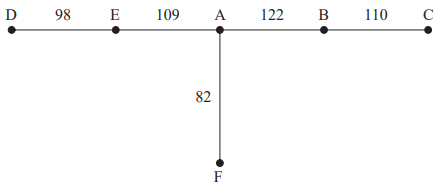
Diagram of points D, E, A, B, C on a line. Distances: DE 98, EA 109, AB 122, BC 110. Line AF is vertical from A, length 82.
1b
2 marks

Use the nearest neighbour algorithm, starting at A, to find another upper bound for the length of Liz’s route.

1c
3 marks

Starting by deleting F, and all of its arcs, find a lower bound for the length of Liz’s route.

1d
1 mark

Use your results to write down the smallest interval which you are confident contains the optimal length of the route.

2a
3 marks

A

B

C

D

E

F

G

A

-

43

52

47

59

53

55

B

43

-

59

45

46

52

47

C

52

59

-

51

50

55

51

D

47

45

51

-

52

49

55

E

59

46

50

52

-

57

48

F

53

52

55

49

57

-

55

G

55

47

51

55

48

55

-

The table above shows the least distances, in metres, between seven classrooms, A, B, C, D, E, F and G. A teacher needs to visit each classroom, starting and finishing at A, and wishes to minimise the total distance travelled.

Show that there are two nearest neighbour routes that start from A. State these routes and their corresponding lengths.

2b
3 marks

Starting by deleting A, and all of its arcs, find a lower bound for the length of the teacher’s route.

2c
1 mark

Use your results to write down the smallest interval which you can be confident contains the optimal length of the teacher’s route.

3a
3 marks
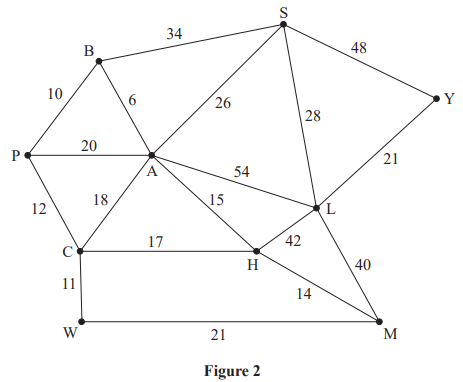
Diagram of interconnected points labelled B, S, Y, M, C, P, W, A, H, L with lines and numbers indicating distances between them; titled Figure 2.

The network in Figure 2 shows the distances, in miles, between ten towns, A, B, C, H, L, M, P, S, W and Y.

Use Kruskal’s algorithm to find a minimum spanning tree for the network. You should list the arcs in the order in which you consider them. In each case, state whether you are adding the arc to your minimum spanning tree.

3b
3 marks

A

B

C

H

L

M

P

S

W

Y

A

-

6

18

15

54

29

16

26

29

74

B

6

-

22

21

60

35

10

32

33

80

C

18

22

-

17

59

31

12

44

11

80

H

15

21

17

-

42

14

29

41

28

63

L

54

60

59

42

-

40

70

28

61

21

M

29

35

31

14

40

-

43

55

21

61

P

16

10

12

29

70

43

-

42

23

90

S

26

32

44

41

28

55

42

-

55

48

W

29

33

11

28

61

21

23

55

-

82

Y

74

80

80

63

21

61

90

48

82

-

Use Prim’s algorithm on the table, starting at A, to find the minimum spanning tree for this network. You must clearly state the order in which you select the arcs of your tree.

3c
1 mark

State the weight of the minimum spanning tree found in (b).

3d
1 mark

Sharon needs to visit all of the towns, starting and finishing in the same town, and wishes to minimise the total distance she travels.

Use your answer to (c) to calculate an initial upper bound for the length of Sharon’s route.

3e
2 marks

Use the nearest neighbour algorithm on the table, starting at W, to find an upper bound for the length of Sharon’s route. Write down the route which gives this upper bound.

3f
1 mark

Using the nearest neighbour algorithm, starting at Y, an upper bound of length 212 miles was found.

State the best upper bound that can be obtained by using this information and your answers from (d) and (e). Give the reason for your answer.

3g
2 marks

By deleting W and all of its arcs, find a lower bound for the length of Sharon’s route.

3h
1 mark

Sharon decides to take the route found in (e).

Interpret this route in terms of the actual towns visited.

4a
6 marks
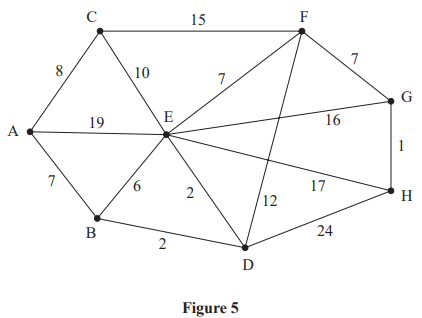
Graph showing nodes A to H connected by lines with weights: includes edges AE, EF, FG, GH, HD, DE, EB, and others, forming a network of paths.

Figure 5 models a network of roads. The number on each edge gives the length, in km, of the corresponding road. The vertices, A, B, C, D, E, F, G and H, represent eight towns. Bronwen needs to visit each town. She will start and finish at A and wishes to minimise the total distance travelled.

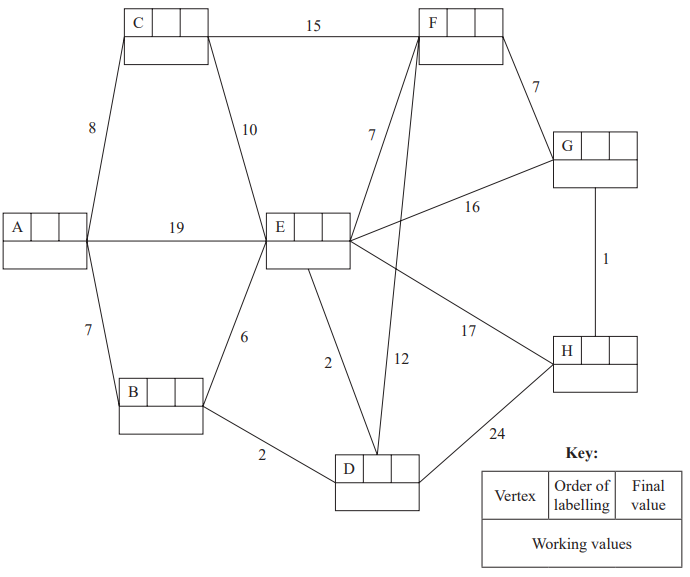
By applying Dijkstra’s algorithm, starting at A, complete the table of least distances.

Graph diagram with vertices A to H connected by weighted edges. Each vertex has a grid for labelling order and values. Key explains grid usage.

A

B

C

D

E

F

G

H

A

-

B

-

14

2

4

11

18

19

C

14

-

12

10

15

22

23

D

2

12

-

2

9

16

17

E

4

10

2

-

7

14

15

F

11

15

9

7

-

7

8

G

18

22

16

14

7

-

1

H

19

23

17

15

8

1

-

4b
2 marks

Starting at A, use the nearest neighbour algorithm to find an upper bound for the length of Bronwen’s route. Write down the route that gives this upper bound.

4c
4 marks

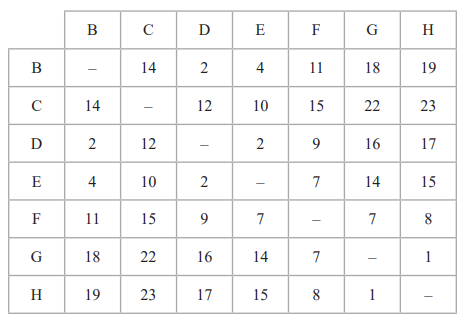
A reduced network is formed by deleting A and all arcs that are directly joined to A.

(i) Use Prim’s algorithm, starting at C, to construct a minimum spanning tree for the reduced network. You must clearly state the order in which you select the arcs of your tree.

(ii) Hence, calculate a lower bound for the length of Bronwen’s route.

Table showing distances with rows and columns labelled B to H. The diagonal shows dashes. Each cell contains a number representing a distance.
4d
2 marks

Using only the results from (b) and (c), write down the smallest interval that you can be confident contains the length of Bronwen’s optimal route.

5a
3 marks

The table below represents a complete network that shows the least costs of travelling between eight cities, A, B, C, D, E, F, G and H.

A

B

C

D

E

F

G

H

A

-

36

38

40

23

39

38

35

B

36

-

35

36

35

34

41

38

C

38

35

-

39

25

32

40

40

D

40

36

39

-

37

37

26

33

E

23

35

25

37

-

42

24

43

F

39

34

32

37

42

-

45

38

G

38

41

40

26

24

45

-

40

H

35

38

40

33

43

38

40

-

Srinjoy must visit each city at least once. He will start and finish at A and wishes to minimise his total cost.

Use Prim’s algorithm, starting at A, to find a minimum spanning tree for this network. You must list the arcs that form the tree in the order in which you select them.

5b
1 mark

State the weight of the minimum spanning tree.

5c
1 mark

Use your answer to (b) to help you calculate an initial upper bound for the total cost of Srinjoy’s route.

5d
4 marks

Show that there are two nearest neighbour routes that start from A. You must make the routes and their corresponding costs clear.

5e
1 mark

State the best upper bound that can be obtained by using your answers to (c) and (d).

5f
3 marks

Starting by deleting A and all of its arcs, find a lower bound for the total cost of Srinjoy’s route. You must make your method and working clear.

5g
2 marks

Use your results to write down the smallest interval that must contain the optimal cost of Srinjoy’s route.

6a
2 marks
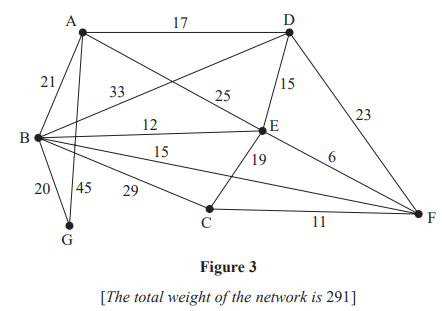
Diagram of a network graph with seven nodes, labelled A to G. Edges connect nodes with weights, totalling 291. Nodes are linked with various lines and numbers.

Figure 3 models a network of roads. The number on each edge gives the length, in km, of the corresponding road. The vertices, A, B, C, D, E, F and G, represent seven towns. Derek needs to visit each town. He will start and finish at A and wishes to minimise the total distance travelled.

By inspection, complete the two copies of the table of least distances.

A

B

C

D

E

F

G

A

-

21

17

25

31

41

B

21

-

26

27

12

15

20

C

26

-

17

11

46

D

17

27

-

15

47

E

25

12

17

15

-

6

32

F

31

15

11

6

-

35

G

41

20

46

47

32

35

-

6b
2 marks

Starting at A, use the nearest neighbour algorithm to find an upper bound for the length of Derek’s route. Write down the route that gives this upper bound.

6c
1 mark

Interpret the route found in (b) in terms of the towns actually visited.

6d
3 marks

Starting by deleting A and all of its arcs, find a lower bound for the route length.

6e
5 marks

Clive needs to travel along the roads to check that they are in good repair. He wishes to minimise the total distance travelled and must start at A and finish at G.

By considering the pairings of all relevant nodes, find the length of Clive’s route. State the edges that need to be traversed twice. You must make your method and working clear.

7a
2 marks

Explain the difference between the classical and the practical travelling salesperson problems.

7b
2 marks

The table below shows the distances, in km, between seven museums, A, B, C, D, E, F and G.

A

B

C

D

E

F

G

A

-

25

31

28

35

30

32

B

25

-

34

24

27

32

39

C

31

34

-

40

35

27

29

D

28

24

40

-

37

35

36

E

35

27

35

37

-

28

31

F

30

32

27

35

28

-

33

G

32

39

29

36

31

33

-

Fran must visit each museum. She will start and finish at A and wishes to minimise the total distance travelled.

Starting at A, use the nearest neighbour algorithm to obtain an upper bound for the length of Fran’s route. Make your method clear.

7c
1 mark

Starting at D, a second upper bound of 203 km was found.

State whether this is a better upper bound than the answer to (b), giving a reason for your answer.

7d
4 marks

A reduced network is formed by deleting G and all the arcs that are directly joined to G.

(i) Use Prim’s algorithm, starting at A, to construct a minimum spanning tree for the reduced network. You must clearly state the order in which you select the arcs of your tree.

(ii) Hence calculate a lower bound for the length of Fran’s route.

7e
1 mark

By deleting A, a second lower bound was found to be 188 km.

State whether this is a better lower bound than the answer to (d)(ii), giving a reason for your answer.

7f
2 marks

Using only the results from (c) and (e), write down the smallest interval that you can be confident contains the length of Fran’s optimal route.

8a
2 marks

The table below shows the least distances, in km, between six towns, A, B, C, D, E and F.

A

B

C

D

E

F

A

-

57

76

59

72

65

B

57

-

67

80

66

76

C

76

67

-

71

83

80

D

59

80

71

-

77

78

E

72

66

83

77

-

69

F

65

76

80

78

69

-

Mei must visit each town at least once. She will start and finish at A and wishes her route to minimise the total distance she will travel.

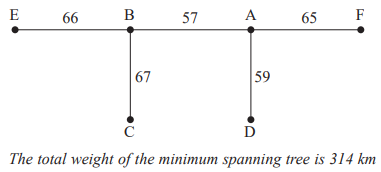
Starting with the minimum spanning tree below, use the shortcut method to find an upper bound below 520 km for Mei’s route. You must state the shortcut(s) you use and the length of your upper bound.

Graph showing a minimum spanning tree with vertices E, B, A, F horizontally and C, D vertically; edge weights are given in kilometres. Total weight is 314 km.
8b
2 marks

Use the nearest neighbour algorithm, starting at A, to find another upper bound for the length of Mei’s route.

8c
3 marks

Starting by deleting E, and all of its arcs, find a lower bound for the length of Mei’s route. Make your method clear.

9a
2 marks

The table below shows the distances, in km, between six data collection points, A, B, C, D, E and F.

A

B

C

D

E

F

A

-

35

42

55

48

50

B

35

-

40

49

52

31

C

42

40

-

47

53

49

D

55

49

47

-

39

44

E

48

52

53

39

-

52

F

50

31

49

44

52

-

Ferhana must visit each data collection point. She will start and finish at A and wishes to minimise the total distance she travels.

Starting at A, use the nearest neighbour algorithm to obtain an upper bound for the distance Ferhana must travel. Make your method clear.

9b
3 marks

Starting by deleting B, and all of its arcs, find a lower bound for the distance Ferhana must travel. Make your calculation clear.

10a
3 marks

A

B

C

D

E

F

A

-

73

56

27

38

48

B

73

-

58

59

43

34

C

56

58

-

46

38

42

D

27

59

46

-

25

32

E

38

43

38

25

-

21

F

48

34

42

32

21

-

The table above shows the least distances, in km, between six cities, A, B, C, D, E and F. Mohsen needs to visit each city, starting and finishing at A, and wishes to minimise the total distance he will travel.

Starting at A, use the nearest neighbour algorithm to obtain an upper bound for the length of Mohsen’s route. You must state your route and its length.

10b
3 marks

Starting by deleting A and all of its arcs, find a lower bound for the length of Mohsen’s route.

10c
2 marks

Use your answers from (a) and (b) to write down the smallest interval that you can be confident contains the optimal length of the route.