Precedence Tables (SQA National 5 Applications of Mathematics): Revision Note
Exam code: X844 75

Precedence tables
What is a precedence table?
A precedence table shows a list of the activities for a project
e.g. the activities needed to make a cup of tea
Each row corresponds to one activity
A precedence table usually has four columns:
Activity
Each activity is labelled by a different letter
Description
This is a short description of the activity
Preceding activities
These are the activities that need to happen before the current activity can happen
Activities might have no preceding activities
Time
The time that the activity takes
This could be in seconds, minutes, hours, days, etc
Example of a precedence table
Here is a precedence table for organising a charity bake sale
Activity | Description | Preceding activity | Time (minutes) |
|---|---|---|---|
A | Ice and decorate the cupcakes | C, I | 5 |
B | Mix the cake batter | G | 3 |
C | Leave the cupcakes to cool | D | 15 |
D | Bake the cupcakes | B | 20 |
E | Print and put up the posters | H | 5 |
F | Set up the stall and start the bake sale | A, E | 8 |
G | Plan the bake sale and buy ingredients | none | 20 |
H | Design the bake sale posters on the computer | G | 5 |
I | Make the icing for the cupcakes | G | 7 |
How do I fill in a diagram from a precedence table?
You will be given a mostly blank diagram and need to fill in the remaining activities
You will normally be given either the starting activity or the final activity
Identify the starting activity or activities
These are on the left on the diagram
These do not have any preceding tasks
e.g. activity G has no preceding activities
Identify the final activity or activities
These are on the right on the diagram
These do not appear as preceding activities for any activity
e.g. activity F does not precede any activity
Identify the different routes from the starting activity to the final activity
Start with the starting activity
Then find an activity which has the starting activity as a preceding activity
Continue this until you reach the final activity
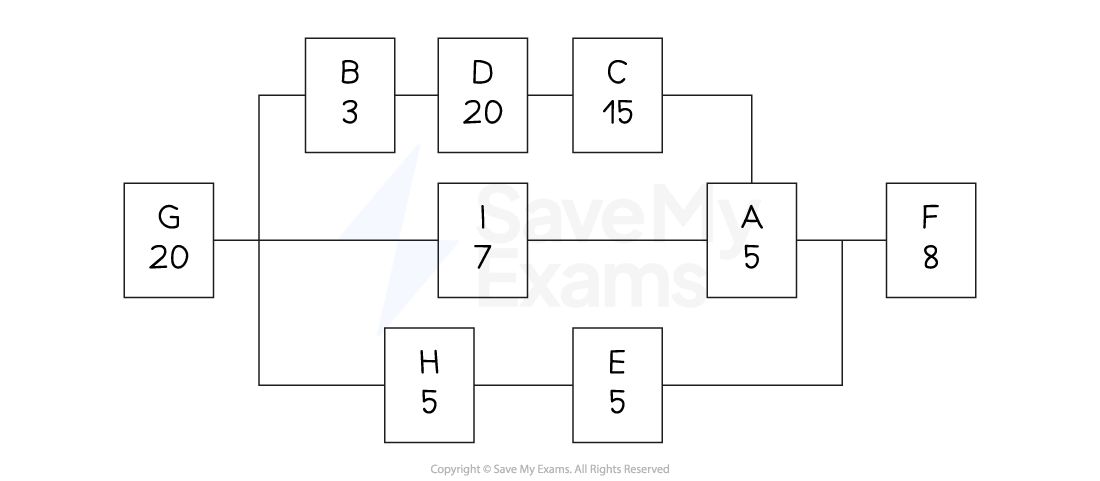
e.g. G - B - D - C - A - F
e.g. G - H - E - F
e.g. G - I - A - F
Use the lengths of the routes to place some activities
G - H - E - F and G - I - A - F both contain 4 activities
G - B - D - C - A - F contains 6 activities
This can be placed in the diagram straightaway
Identify activities which appear in more than one route (other than the start and final activities)
G - B - D - C - A - F and G - I - A - F both contain activity A
These routes must merge at A
G - H - E - F does not share any activities with the other routes
This route can be by itself
If you include the times as well as the letters in the boxes, it will make answering later parts of the question easier
Examiner Tips and Tricks
It is possible that there is more than one correct way to fill in a diagram. You can tell by the shape of the diagram. The example below shows two equivalent diagrams.
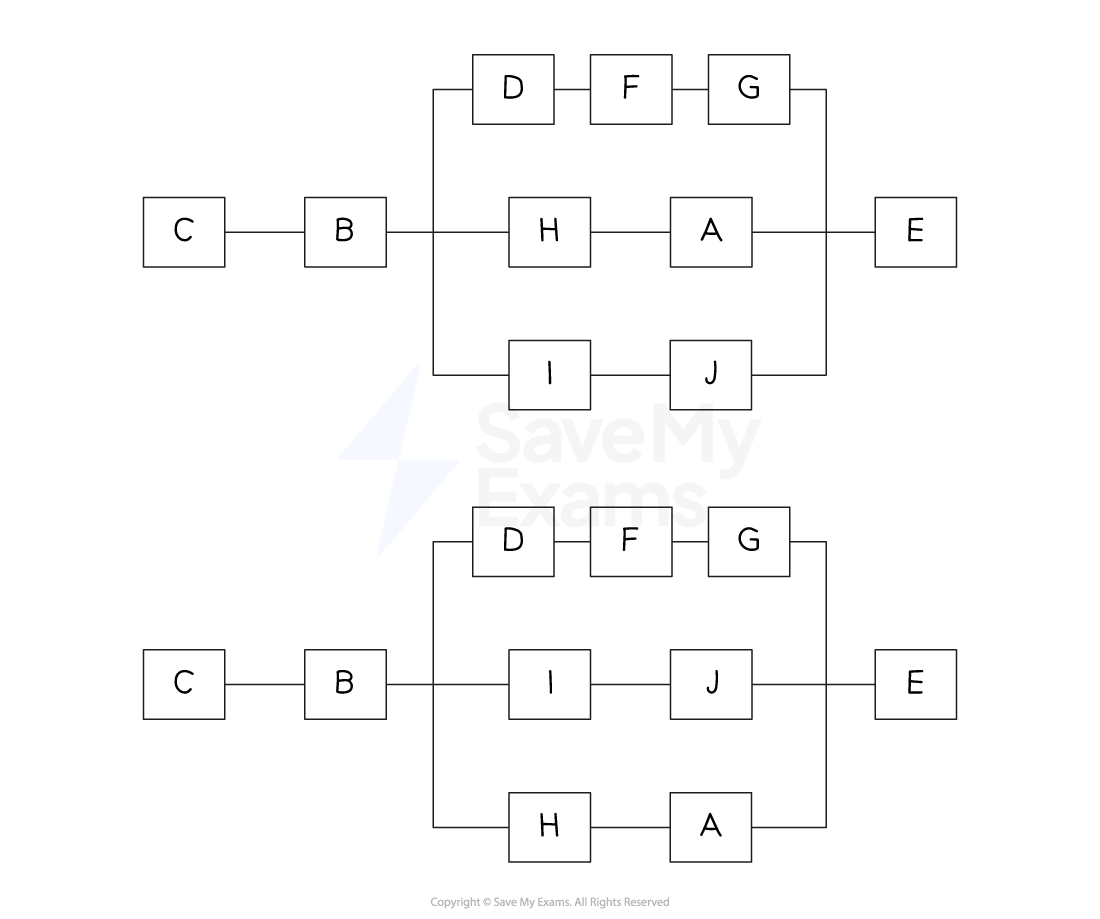
Here, there are two separate routes containing 5 activities. Therefore, activities H and A can be swapped with I and J.
How do I find the minimum time to complete a project from a precedence table?
You need to find the time taken to complete each of the possible routes
G - B - D - C - A - F takes 20+3+20+15+5+8=71 minutes
G - H - E - F takes 20+7+5+8=40 minutes
G - I - A - F takes 20+5+5+8=38 minutes
You need to select the biggest time
This is to ensure there has been enough to complete all the other routes
e.g. the minimum time for the project above is 71 minutes
Examiner Tips and Tricks
In exam questions, there is normally an activity that takes a lot longer than the rest. You can just find the length of this route to find the minimum time. Just take care if there are multiple activities which take longer than the others.

Unlock more, it's free!
Join the 100,000+ Students that ❤️ Save My Exams
the (exam) results speak for themselves:

Was this revision note helpful?