Programming Concepts (Cambridge (CIE) O Level Computer Science): Exam Questions

Exam code: 2210

54 mins20 questions
1
4 marks

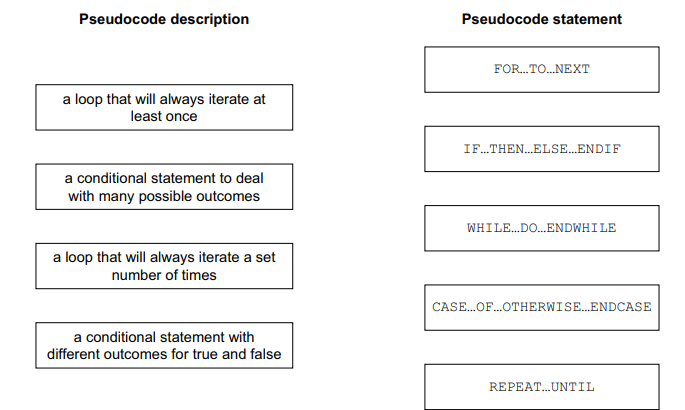
Four pseudocode descriptions and five pseudocode statements are shown.

Draw a line to link each pseudocode description to the most appropriate pseudocode statement.

Some pseudocode statements will not be used

Matching exercise: Left column lists pseudocode descriptions, right column lists corresponding pseudocode statements. Descriptions and statements are aligned side by side, indicating relationships.
2
1 mark

Tick (✓) one box to show the named section of a program that performs a specific task.

  • file

  • function

  • parameter

  • process

3
1 mark

A function is declared using pseudocode.

FUNCTION ConvertToCm(Inches: REAL)
RETURNS REAL RETURN Inches * 2.4
ENDFUNCTION

Tick (✓) one box which accurately describes the use of the variable Inches

  • answer

  • call

  • parameter

  • response

4
2 marks

A database table, 2018MOV, is used to keep a record of movie details

A table lists movies by catalog number, title, two genres, and availability in Blu-ray, DVD, and streaming formats. The columns are CatNo, Title, Genre1, Genre2, Blu-ray, DVD, Streaming.

Complete the table to identify the most appropriate data type for each field based on the data shown in the database table, 2018MOV.

Field

Data type

CatNo

Title

Genre1

Streaming

5
3 marks

The variables X, Y and Z are used to store data in a program:

  • X stores a string

  • Y stores a position in the string (e.g. 2)

  • Z stores the number of characters in the string.

Write pseudocode statements to declare the variables X, Y and Z.

6
3 marks

Four programming concepts and four descriptions are shown.

Draw one line to connect each programming concept to the most appropriate description

Table detailing programming concepts and descriptions. Library routine: may not return a value. Structure diagram: standard available subroutine. Procedure: used in assignments. Function: program overview.
7
1 mark

Tick (✓) one box in each row to identify the most appropriate data type for each description. Only one tick (✓) per column.

Description

Data type

Boolean

Char

Integer

Real

String

a single character from the keyboard

multiplecharacters from the keyboard

only one of two possible values

only whole numbers

any number

8
3 marks

An algorithm has been written in pseudocode to calculate a check digit for a four-digit number. The algorithm then outputs the five-digit number including the check digit. The algorithm stops when –1 is input as the fourth digit.

01 Flag FALSE
02 REPEAT
03 Total 0
04 FOR Counter 1 TO 4
05 OUTPUT "Enter a digit ", Counter
06 INPUT Number[Counter]
07 Total Total + Number * Counter
08 IF Number[Counter] = 0
09 THEN
10 Flag TRUE
11 ENDIF
12 NEXT Counter
13 IF NOT Flag
14 THEN
15 Number[5] MOD(Total, 10)
16 FOR Counter 0 TO 5
17 OUTPUT Number[Counter]
18 NEXT
19 ENDIF
20 UNTIL Flag

Give the line number(s) for the statements showing:

Totalling ...........................................................................

Count-controlled loop .......................................................

Post-condition loop ............................................................
9
2 marks

The variables P and Q are used to store data in a program. P stores a string. Q stores a character.

Write pseudocode statements to declare the variables P and Q, store "The world" in P and store 'W' in Q

10
2 marks

Describe the difference between a local variable and a global variable.

1
2 marks

A function LENGTH(X) finds the length of a string X and a function SUBSTRING(X,Y,Z) finds a substring of X starting at position Y and Z characters long. The first character in the string is position 1.

Write a pseudocode statement to extract the word Computer from P and store it in the variable F.

2
3 marks

Explain the difference between a WHILE … DO … ENDWHILE and a REPEAT … UNTIL loop

B ← FALSE
INPUT Num
FOR Counter ← 1 TO 12
IF A[Counter] = Num
THEN
B ← TRUE
ENDIF
NEXT Counter

3
4 marks

Explain the purpose of the library routines DIV and ROUND.

4
4 marks

State two features that should be included to create a maintainable program.

Give a reason why each feature should be used.

5
2 marks

The function LENGTH(Phrase) calculates the length of a string Phrase

The string "The beginning is the most important part" is stored in Phrase

State the output of the pseudocode statements:

  • OUTPUT LENGTH(Phrase)

  • OUTPUT UCASE(Phrase)

6
4 marks

The variables P and Q are used to store data in a program. P stores a string. Q stores a character.

Write a pseudocode algorithm to:

  • convert P to upper case

  • find the position of Q in the string P (the first character in this string is in position 1)

  • store the position of Q in the variable Position

1
3 marks

Using a single loop, write an algorithm in pseudocode to output 50 names that have been stored in the array, Name[]

2
3 marks

The function LENGTH(Phrase) calculates the length of a string Phrase

Write the pseudocode statements to:

  • store the string "The beginning is the most important part" in Phrase.

  • calculate and output the length of the string

  • output the string in upper case.

3
3 marks

A program needs to make sure the value input for a measurement meets the following rules:

  • the value is a positive number

  • a value is always input

  • the value is less than 1000.

The program needs editing to include a double entry check for the value input.

The input value needs to be stored in the variable Measurement Write pseudocode to perform the double entry check until a successful input is made.

4
4 marks

An algorithm has been written in pseudocode to calculate a check digit for a four-digit number. The algorithm then outputs the five-digit number including the check digit. The algorithm stops when –1 is input as the fourth digit.

01 Flag FALSE
02 REPEAT
03 Total 0
04 FOR Counter 1 TO 4
05 OUTPUT "Enter a digit ", Counter
06 INPUT Number[Counter]
07 Total Total + Number * Counter
08 IF Number[Counter] = 0
09 THEN
10 Flag leftwards arrow TRUE
11 ENDIF
12 NEXT Counter
13 IF NOT Flag
14 THEN
15 Number[5] MOD(Total, 10)
16 FOR Counter 0 TO 5
17 OUTPUT Number[Counter]
18 NEXT
19 ENDIF
20 UNTIL Flag

The algorithm does not check that each input is a single digit.
Identify the place in the algorithm where this check should occur.

Write pseudocode for this check. Your pseudocode must make sure that the input is a single digit and checks for –1