Properties of Photons (College Board AP® Chemistry): Study Guide

Photons
One of the main characteristics of light is its wave-particle duality
This means that light can behave as a wave, but also as a particle
A light wave has a frequency, a wavelength and an energy
However, the discovery of the photoelectric effect suggested that light can also behave as a particle
In the photoelectric effect, some metals emit electrons when light of high enough frequency shines on them
This result suggested that light comes in particles (packets of energy)
A light particle is called a photon
Examiner Tips and Tricks
Wave-particle duality and the photoelectric effect are included as context: they explain how we know that light can behave as particles. They are not part of the AP Chemistry course, so you will not be asked about them in the exam.
What you do need is the idea of a photon as a particle of light, and that its energy depends on its frequency (E = hν).
Absorption and emission of photons
Electrons move around the nucleus of the atoms in energy levels
Atoms and molecules can absorb photons, and the electrons will jump to higher energy levels
When this occurs, the energy of the atom or molecule increases by an amount equal to the energy of the photon
The excited atom or molecule can then emit a photon as the electron falls back to a lower energy level, often all the way to the lowest one, the ground state
When this occurs, the energy of the atom or molecule will decrease by an amount equal to the energy of the photon
Absorption and emission diagram
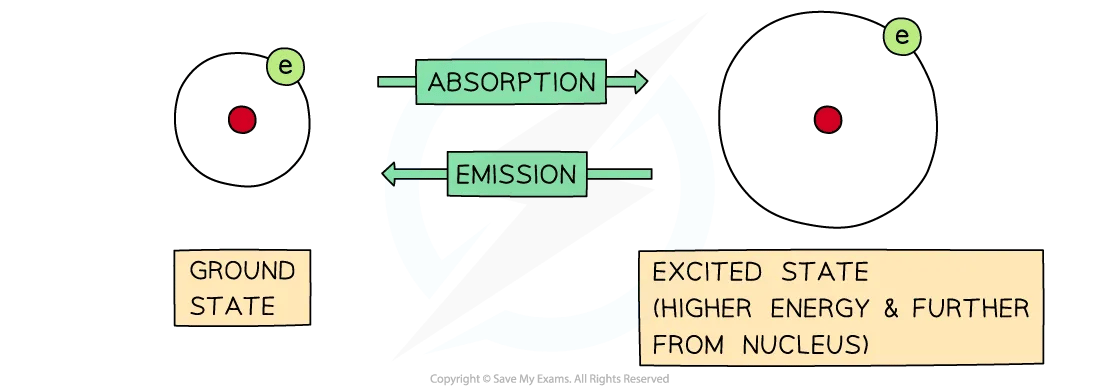
The difference between absorption and emission depends on whether electrons are jumping from lower to higher energy levels or the other way around
The hydrogen emission spectrum
The hydrogen emission spectrum is a set of separate lines; Niels Bohr’s model explained each line as a photon released when an electron falls from a higher energy level to a lower one
Bohr suggested that electrons can only exist in fixed energy levels
This means that electronic transitions can only occur when photons with a specific amount of energy are absorbed or released
Each electronic transition has to do with photons from specific regions of the electromagnetic spectrum
Electron transitions in the hydrogen atom
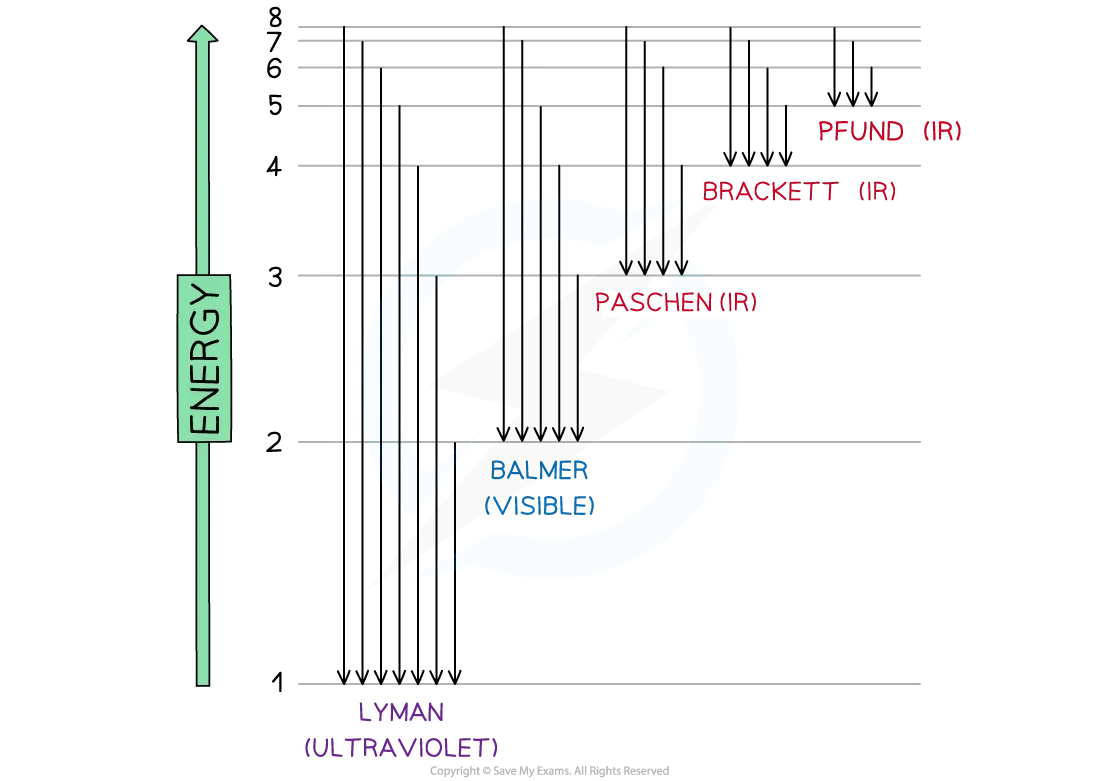
Electron jumps in the hydrogen spectrum
The table summarizes these jumps:
Electron transitions summary
Jumps | Region | Energy |
|---|---|---|
From n = 4, 5, 6 … to n = 3 | Infrared | Lowest |
From n = 3, 4, 5 … to n = 2 | Visible | Medium |
From n = 2, 3, 4 … to n = 1 | Ultraviolet | Highest |
Energy of photons
Frequency, wavelength and energy
As the electromagnetic spectrum shows, the lower the frequency of an electromagnetic wave, the longer its wavelength
Frequency (ν) and wavelength (λ) are inversely proportional
The equation that links them is:
c = λν
In this equation, c is the speed of light, 2.998 × 10⁸ m s-1
The lower the frequency, the lower the energy of each photon
Frequency (ν) and energy (E) are directly proportional
The equation that links the energy emitted or absorbed by a photon and its frequency is:
E = hν
In this equation, h is Planck’s constant, 6.626 × 10⁻³⁴ J s
These two equations can be used to calculate frequency, wavelength or energy when one of them is given
Examiner Tips and Tricks
E = hν and c = λν, Planck’s constant and the speed of light are all in the equations and constants reference available in the exam
E = hν needs the frequency: if you are given a wavelength, convert it to frequency with c = λν first, and convert nm to m (1 nm = 1 × 10⁻⁹ m)
Check the size of your answer: a visible or ultraviolet photon carries about 10-19 to 10-18 J, so an answer like 10-40 J means the wavelength was used in place of the frequency
Worked Example
Calculate the wavelength of the photon emitted when an electron transition releases 1.632 × 10⁻¹⁸ J
Answer:
Step 1: Calculate the frequency of the photon by using the Planck’s equation
E = hν
ν = 2.463 × 10¹⁵ s-1
Step 2: Use the frequency calculated in Step 1 to calculate the wavelength of the photon
c = λν
λ = 1.217 × 10⁻⁷ m = 121.7 nm (1 nm = 1 × 10⁻⁹ m)
This is in the ultraviolet region, specifically the hydrogen n = 2 → n = 1 line

Unlock more, it's free!
Join the 100,000+ Students that ❤️ Save My Exams
the (exam) results speak for themselves:

Was this revision note helpful?
Build on this topic
