Physical & Chemical Processes (College Board AP® Chemistry): Study Guide

Macroscopic characteristics & bond interactions
Physical processes and intermolecular interactions
Processes that involve only changes in intermolecular interactions, such as phase changes, are typically classified as physical processes
However, there is a change in the appearance of the substance
This change in appearance involves changes in the intermolecular forces between the molecules or ions that are part of the compound
E.g. when liquid water boils, the hydrogen bonds between water molecules (an intermolecular interaction) are overcome
The polar covalent bonds between oxygen and hydrogen atoms remain the same because the internal composition of water does not change when going from liquid to gas
In molecular substances, changes of state overcome intermolecular forces (London dispersion forces, dipole–dipole forces and hydrogen bonding), not the covalent bonds inside the molecules
In ionic and metallic solids, melting overcomes the attractions between the particles themselves (ionic or metallic bonding), so a physical process can involve breaking chemical bonds
Hydrogen bonding interaction and polar covalent bonds in water
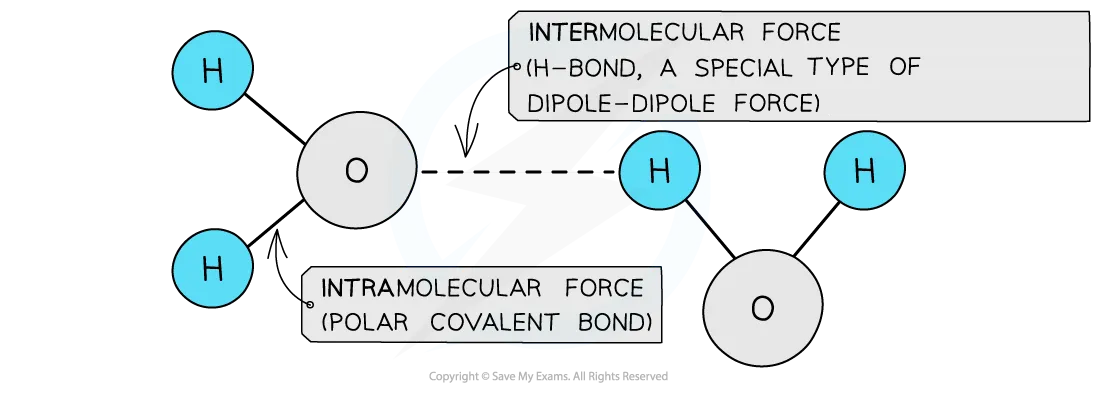
Intermolecular interactions are broken when going from liquid to gas. Intramolecular interactions remain the same
Chemical processes, bond breaking and bond formation
Processes that involve the breaking and/or formation of chemical bonds are typically classified as chemical processes
Reactants transform into products whose internal structure is totally different because the bonds between atoms rearrange
Chemical processes involve breaking and forming chemical bonds
Bond breaking is a process that requires energy
Bond formation is a process that releases energy
All the chemical reactions are chemical processes because the chemical identity of the products is different than the identity of the reactants
E.g. When hydrogen gas is burned in the presence of oxygen gas, water is produced
The reactants contain two H–H bonds and one O=O bond, while the products contain four O–H bonds
There is a rearrangement of the covalent bonds by comparing the left side with the right side
Burning hydrogen gas with oxygen gas to produce water

Chemical reaction between hydrogen and oxygen to produce water by showing the covalent bonds that were broken and formed during the process
Bond breaking in physical processes
Sometimes physical processes involve the breaking of chemical bonds, so a process can be argued to be either physical or chemical
Dissolving a salt in water is the standard example
The salt + water solution dilemma
Salt (NaCl) is an ionic compound that exists as an ordered lattice structure of Na+ and Cl−
Water (H2O) is a polar solvent: each molecule has a partial negative charge (δ−) on the O atom and partial positive charges (δ+) on the H atoms
When salt and water are mixed together, the result is a homogeneous solution
Preparing a solution is a physical process because the components of the mixture can be easily separated by a simple distillation
However, when these substances are mixed the lattice structure of salt breaks down
The ionic bonds (Coulombic attractions) between the Na+ and Cl− ions in the lattice are broken
Ion–dipole interactions then form:
Na+ ions attract the partially negative O ends of water molecules
Cl− ions attract the partially positive H ends of water molecules
Ionic bonds are broken and ion-dipole interactions are formed during this process, therefore this can be considered a chemical process
A lattice structure of NaCl is broken down when mixing it with water

Preparing a solution of an ionic compound can be considered either a physical (preparing a mixture) or chemical change (breaking the ionic bonds and forming ion-dipole interactions)
Examiner Tips and Tricks
When you explain a change of state of a molecular substance, name the intermolecular forces that are overcome. Never say the covalent bonds inside the molecules break
If you are asked to classify dissolving a salt, either answer can earn credit, but you must justify it:
Physical (no new substance and the salt is recovered when the water evaporates)
Chemical (ionic bonds broken, ion–dipole attractions formed)

Unlock more, it's free!
Join the 100,000+ Students that ❤️ Save My Exams
the (exam) results speak for themselves:

Was this revision note helpful?
Build on this topic