Application of Knowledge (AQA A Level Biology): Revision Note
Exam code: 7402

The importance of context
Questions with novel contexts allow students to move beyond basic description and make links between biological knowledge and the specific scenario or data presented
This is required in order to meet all of the assessment objectives (AO1, AO2 and AO3) in biology exams
The challenges of dealing with novel contexts include:
processing new information
linking biological knowledge to context in answers
Processing information about novel contexts
Exam questions will often present unfamiliar contexts, e.g.:
an unknown species and its evolutionary history
a new disease and its rates of infection
a new molecule with a similar structure to a known biological molecule
It is important that students know to expect questions like this, and how to deal with them effectively; consider the following tips:
look for the familiar biology within the unfamiliar context
Ask yourself which biology topic is relevant to the scenario presented
Underline any key words that link the scenario back to familiar ground
This will help you to switch from “panic, this is new!” to “okay, this is actually a question about gas exchange”
treat the new information like a textbook or a set of notes
You are not expected to know it already
The information included in the question stem will be useful to you, so don't ignore it
Underline important new ideas and definitions so that you can use them in your answer
Worked Example
Below is a question stem that could be part of an A Level exam question:
Myoglobin is a protein found in muscle tissue that binds and stores oxygen. Researchers investigated the oxygen-binding capacity of myoglobin in three mammals: the bottlenose dolphin, the elephant seal and the domestic dog. The scientists hypothesised that the dolphin and elephant seal would have adaptations allowing them to store more oxygen in their muscles, helping them remain underwater for extended periods. They extracted and analysed muscle tissue samples from 20 dolphins, 20 elephant seals and 20 dogs. |
Process this information as you might do in an exam.
Answer
(i) Which A Level topic, or topics does it link to?
Haemoglobin and oxygen transport
Aerobic respiration in muscle cells
Muscle structure and contraction
Adaptations of organisms
(ii) What new ideas have we learned that could be relevant to the answer?
Myoglobin is a protein found in muscle tissue
Myoglobin can bind to oxygen
Myoglobin has a role in oxygen storage
Dolphins and elephant seals can remain underwater for extended periods
Scientists hypothesise that adaptations for muscle oxygen storage will be associated with extended diving ability
Link to the novel context in your answer
Students often lose marks in application questions due to simply restating rote-learned ideas without making direct links to the context provided
Consider the following to help you keep your answer closely linked to context in application questions:
Use phrases that connect your knowledge directly to the new context
For example: “in this organism…”, “in this experiment…”, "this receptor is complementary to…”
Build a clear chain of reasoning that starts with what you know and links to the new scenario
Begin with one secure fact from the stem or your notes, then add one clear “so…” or "therefore" link at a time
Answer the exact question, don't just write everything you know about a topic
Underline the command word, e.g. “explain the effect of…”, “suggest why…”
Always refer to information in the question stem when directed, e.g. "use the information provided to..."
Check each sentence in your answer against the question: does every sentence directly link to both the question and the context?
Worked Example
The whitefly Bemisia tabaci is an invasive agricultural pest that has spread successfully into many different regions of the world. One factor in its success appears to be its ability to tolerate heat. This tolerance is thought to involve the activity of heat shock proteins (HSPs). These proteins help protect other cellular proteins from heat stress.
Suggest how HSPs might aid heat tolerance in whiteflies.
[2]
Mark scheme
Any two of the following:
Prevent breaking OR ensure proper formation of hydrogen / ionic / disulfide bonds [1 mark]
Assist during protein folding / ensure that proteins fold correctly [1 mark]
Stabilise/maintain 3D structure SO preventing denaturation [1 mark]
Prevent agglutination / clumping together [1 mark]
Student answer
0/2 marks | 2/2 marks |
|---|---|
Heat can damage proteins, breaking the bonds between amino acids and causing them to denature and lose their tertiary structure. Mark: 0/2 Reason for mark: this answer, while it contains correct information about the effect of heat on protein structure, does not link at all to the context provided, and does not address the question that has been asked. | The HSPs could prevent the breaking of bonds, such as disulfide bonds [1], within the protein structure. This would allow the HSPs to provide protection against denaturation, so maintaining the protein's specific tertiary structure [1]. Mark: 2/2 Reason for mark: this answer contains the same biological ideas as the previous answer, but all of the biology knowledge has been clearly linked to the context, e.g. using phrases such as "The HSPs could..." and "This would allow the HSPs to..." |
Novel experiments & data
Many questions will present you with information about a new (to you) scientific investigation, and ask questions such as:
"suggest why the scientists designed the study in this way"
"suggest how the validity of the results could be improved"
"state what can be concluded from the results shown"
You will need to:
process and understand the biology behind the new scenario (as described above)
apply your knowledge of the scientific method
carry out data analysis
Consider the following tips when dealing with novel experiments and data:
read the whole context carefully; pay attention to:
details of the investigation design
any statistical testing that has been carried out, or that is shown in the data
the relevant biology behind the study
use the context when evaluating or discussing
Don't use rote-learned phrases, or focus too heavily on a single familiar biological idea, but tailor your response to the scenario presented
Avoid generic evaluative statements, e.g. "correlation doesn't equal causation", but apply ideas specifically to the context
respond to the question being asked
Read the command word carefully, so that you know whether to, e.g.: describe, explain or evaluate
Don't just describe data, but link any descriptions to the aim of the question
Worked Example
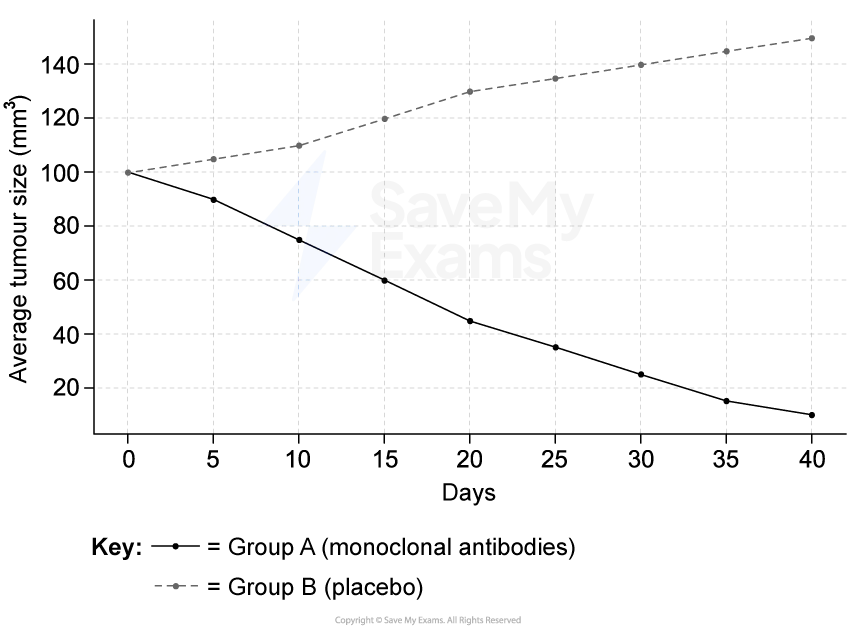
A group of scientists developed a monoclonal antibody treatment for cancer. The monoclonal antibodies were designed to bind to a protein found only on the surface of cancer cells. The scientists hypothesised that once bound, these antibodies would trigger the destruction of the cancer cells by the immune system.
To test the effectiveness of the treatment, they injected cancer cells into two groups of mice to induce tumour growth. After 10 days, all mice had developed tumours of similar size. Each group consisted of 20 mice.
Group A received monoclonal antibodies
Group B received a placebo (injection containing no active ingredients)
The scientists measured the average tumour size in each group every 5 days over 40 days.
Figure 1 below shows the average tumour size in two groups of mice over 40 days.
Figure 1
A student concluded that:
“Monoclonal antibodies inhibit tumour growth by preventing cell division."
Evaluate the student's conclusion.
[3]
Mark scheme
In support of the conclusion:
Mice treated with monoclonal antibodies/group A had a reduction in average tumour size over time, whereas tumour size increased in the placebo group/group B [1 mark]
The design includes a placebo control group SO differences are more likely due to the active treatment (and not any other factor) [1 mark]
Against the conclusion:
A maximum of two from:
The graph does not show the rate of mitosis/mitotic index / does not show the mechanism by which tumour size is affected [1 mark]
Antibodies may reduce tumour size by stimulating the immune system to destroy tumour cells / inducing apoptosis
Only the average is shown / no statistical test has been included SO we cannot judge how significant the difference is between groups
Evidence is from a mouse experiment SO cannot be directly applied to other species / more research in other species is needed [1 mark]
Student answers
0/3 marks | 3/3 marks |
|---|---|
Mice in group A showed a reduction in tumour size while mice in group B showed an increase in tumour size. There is a correlation but this does not mean that one variable has caused the change in the other. There is no statistical test carried out. Mark: 0/3 Reason for mark: this answer falls into several of the major pitfalls for evaluation questions that deal with novel data. It describes the data correctly, but it doesn't use this description to either back up or refute the conclusion in the question. It makes generic statements about correlation vs causation, and statistical testing, but it does not link these ideas to the context. It also fails to make reference to any details of the experimental design. | Mice in group A show a decrease in average tumour size, whereas in group B the average tumour size increases. This difference suggests that monoclonal antibodies are involved in reducing tumour growth, so the first part of the conclusion is supported by the data [1]. The presence of a control group in the study makes it more likely that the monoclonal antibody treatment has caused the difference in tumour size [1], rather than some other factor, so we can argue causation, not just correlation. However, the data do not show the mechanism by which the antibodies affect tumour size [1]. We don't know whether cell division is being prevented, whether more cells are being killed, or both. Therefore the second part of the student’s conclusion – that the antibodies work by preventing cell division – is not supported by the evidence given. There are also no error bars, so we cannot say that there is a significant difference between the results in groups A and B, and the work is only in one species of mouse, so more evidence would be needed before applying the conclusion more widely. Mark: 3/3 Reason for mark: this answer also describes the data, but it goes on to clearly link this description to both positive and negative arguments. It applies ideas about correlation vs causation, and statistical testing, to the context provided, and it considers how the design of the specific investigation affects the validity of the results. |

Unlock more, it's free!
Join the 100,000+ Students that ❤️ Save My Exams
the (exam) results speak for themselves:

Was this revision note helpful?