Questions with Specific Instructions (AQA A Level Biology): Revision Note
Exam code: 7402

The list rule
Understanding how the examiner will mark your answers is important to ensure that you don't lose unnecessary marks
The list rule applies to any question requiring a set number of responses, e.g. "give three reasons why..."
The list rule is applied as follows:
If a student provides more answers than the question requires, each error or contradiction provided in the additional responses cancels out a correct response
The general principle is that right + wrong = wrong
This rule prevents students from just guessing as many ideas as they can in the hope that some of them will be correct
Note that:
this rule only applies to additional answers beyond the number of answers specified in a question
neutral responses (i.e. those listed as "ignore" in a mark scheme) do not count as errors
the number of marks awarded for a question will never drop below zero
Worked Example
Give three differences between DNA molecules and tRNA molecules.
Mark scheme
Any three from:
DNA = deoxyribose and tRNA = ribose [1 mark]
DNA = double-stranded / double helix and tRNA = single-stranded [1 mark]
DNA = many nucleotides / longer and tRNA = few nucleotides / shorter [1 mark]
DNA = thymine and tRNA = uracil [1 mark]
DNA = linear / straight and tRNA = clover leaf [1 mark]
DNA = does not bind to amino acid and tRNA = does bind/attach to amino acid / has an amino acid binding site [1 mark]
DNA = no exposed bases and tRNA = anticodons [1 mark]
Apply list rule
Ignore T and U
Accept a description of clover leaf structure
Answer
DNA is double-stranded and tRNA is single stranded. DNA is straight and tRNA curves into a three-lobed shape. DNA has deoxyribose and tRNA has ribose. DNA has hydrogen bonds and tRNA doesn't.
Mark: 2/3
Reason for mark: this answer contains three correct differences between DNA and tRNA (MP1 [+1], MP2 [+1] and MP5 [+1]). However, it also contains four answers, and one says incorrectly that "DNA has hydrogen bonds and tRNA doesn't". Both DNA and tRNA contain H bonds, so this additional incorrect statement cancels out one of the marks gained from the earlier correct points [-1].
Examiner Tips and Tricks
The best practice here is to:
determine the number of answers needed
choose your best answers that add up to the number needed
write just these answers
Resist the temptation to add more answers "just in case", as you will risk being penalised by the list rule.
Showing working
Calculation questions are often worth multiple marks
Reaching the correct final answer will result in full marks being awarded
Failing to reach the correct final answer will lose you marks, but showing correct calculations can allow you to retain some of the marks
In calculation questions you should:
always write down numbers taken from graphs or tables
show how you put numbers into formulae
include simple steps like unit conversions
take note of any specific instructions for how the answer should be presented, such as rounding to 3.s.f.
include necessary units with your answer
Showing clear working can turn a wrong answer into some marks instead of none
Worked Example
Scientists investigated the effect of axon diameter and myelination on conduction speed in neurones. They measured the mean conduction speed of action potentials in axons of different diameters, with and without myelin sheaths. The results are shown in Figure 1 below.
Figure 1
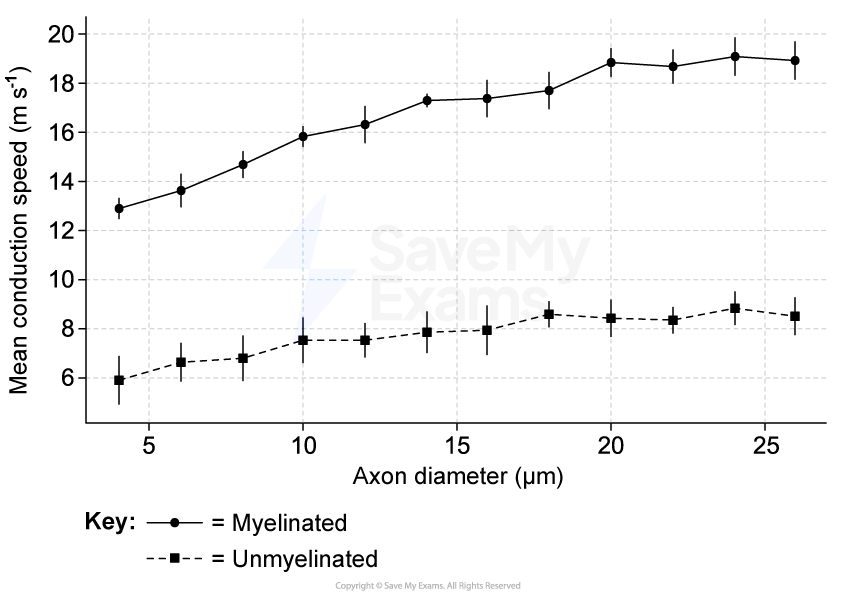
Calculate the percentage increase in the speed of conduction in the myelinated axon compared to the unmyelinated axon at 20 μm.
Mark scheme
(10.5 ÷ 8.5) x 100 [1 mark]
123.5 (%) OR 124 (%) [1 mark]
Award ECF marks for answers that come from slightly different readings of the graph
Award full marks for the correct answer in the absence of calculations.
Student answers
1/2 marks | 2/2 marks |
|---|---|
Myelinated axon conduction = 19 m s⁻¹ Unmyelinated axon conduction = 9 m s⁻¹ 19 - 9 = 10 m s-1 Percentage increase = (change ÷ starting point) x 100 = (10 ÷ 9) x 100 [1] = 111.1 Mark: 1/2 Reason for mark: although this answer is incorrect due to incorrect values being read from the graph, the student has been awarded a mark for the correct calculation process under the error carried forward guidelines. | Myelinated axon conduction = 19 m s⁻¹ Unmyelinated axon conduction = 8.5 m s⁻¹ 19 - 8.5 = 10.5 m s-1 Percentage increase = (change ÷ starting point) x 100 = (10.5 ÷ 8.5) x 100 [1] = 123.5 [1] Mark: 2/2 |
Reading all instructions
Sometimes students may lose marks for failing to follow the exact instructions included in a question
Examples to look out for include:
the question saying not to include something, e.g. evaluation questions that tell students not to include statistical tests or data analysis
the question may have limited scope, e.g. you may only be required to:
describe data that falls within a particular time frame
describe part of a process
Writing extra or irrelevant information will not gain marks, and can result in:
wasted exam time
students thinking that they have written a complete answer when they have not
Worked Example
Describe the role of a ribosome in the production of a polypeptide. Do not include transcription in your answer.
Mark scheme
Any three from:
mRNA binds to the ribosome [1 mark]
The ribosome has two codons / binding sites [1 mark]
tRNA with anticodons bind / associate (with the ribosome) [1 mark]
The ribosome catalyses formation of peptide bond between amino acids (held by tRNA molecules) [1 mark]
The ribosome moves along the mRNA / to the next codon [1 mark]
Student answers
2/3 marks | 3/3 marks |
|---|---|
First, DNA helicase unzips the DNA in the nucleus so free RNA nucleotides can form temporary hydrogen bonds to bases on the template strand. This forms a complementary mRNA strand. The mRNA then detaches from the DNA and leaves the nucleus before it binds to a ribosome [1]. tRNA with anticodons bind to the mRNA, and the ribosome catalyses a peptide bond [1] between amino acids. Mark: 2/3 Reason for mark: while 2/3 is still a good answer, the student has wasted valuable time describing transcription, which the question has explicitly said not to do. The answer is long, so the student would have thought this was enough for full marks, even though most of the content was not creditworthy. | To produce a polypeptide, the mRNA binds to the ribosome [1]. The ribosome is large enough to hold two codons at its binding sites. This allows tRNA molecules with complementary anticodons to associate with the mRNA codons [1]. The ribosome then catalyses the formation of a peptide bond between the amino acids [1] held by the tRNA molecules. Finally, the ribosome moves along the mRNA to the next codon to continue the chain. Mark: 3/3 Reason for mark: this answer focuses entirely on the role of a ribosome in translation, and therefore contains more than enough creditworthy content for three marks. |

Unlock more, it's free!
Join the 100,000+ Students that ❤️ Save My Exams
the (exam) results speak for themselves:

Was this revision note helpful?