Determination of Wage Differentials (Cambridge (CIE) A Level Economics): Revision Note
Exam code: 9708

Determination of wage differentials by labour market forces
Wage differentials are differences in pay between workers across occupations, industries and firms
In competitive labour markets, these are determined primarily by the interaction of labour demand and labour supply
The equilibrium wage in any labour market is set where demand for labour equals supply of labour
Workers in markets with high demand and restricted supply earn more than those in markets with low demand and abundant supply
The starting point for explaining any wage differential is marginal revenue product (MRP) theory: a firm's demand for labour is derived from the value that an additional worker adds to output
A worker's MRP = marginal product × price of the good or service produced
Firms hire up to the point where MRP = wage rate
workers whose MRP is higher will command higher wages
1. Differences in the demand for labour
Higher demand for labour raises the equilibrium wage, shifting the demand curve for labour to the right and increasing the wage rate at any given level of supply
Demand for labour is a derived demand — it depends on the demand for the final good or service the worker helps produce
A Premier League footballer generates enormous revenues for their club — their MRP is very high, so clubs are willing to pay exceptionally high wages
A supermarket cashier contributes to the sale of low-margin goods — their MRP is modest, and wage rates reflect this
Changes in the demand for skills can widen or narrow differentials over time
Rising demand for data scientists and software engineers — driven by rapid growth in the technology sector — has shifted their labour demand curve significantly to the right, raising wages substantially relative to other graduate occupations
2. Differences in the supply of labour
Restricted supply of labour pushes wages up
Where few workers can do a job, employers must offer higher wages to attract and retain staff
Supply of labour to an occupation depends on:
Length and cost of training
Becoming a surgeon requires over a decade of training; the supply of surgeons is highly inelastic, sustaining high wages even when demand is relatively stable
Non-monetary characteristics of the job
Dangerous, unpleasant, or antisocial-hours work requires a compensating wage differential to attract workers
Barriers to entry
Professional licensing, qualifications, and union membership restrictions all limit the supply of labour, keeping wages above the level that would prevail in a fully competitive market
The role of elasticity of supply
Supply condition | Effect on wages | Example |
|---|---|---|
|
|
|
|
|
|
Where supply is wage-inelastic, even a small rightward shift in demand produces a large increase in the wage rate
This explains extreme differentials at the top of the earnings distribution
3. Compensating wage differentials
Some wage differentials arise not from skill differences but from the characteristics of the job itself
Workers must be compensated for jobs that are:
physically dangerous (e.g. deep-sea fishing, construction)
unpleasant or socially stigmatised
requiring unsociable hours or significant geographical mobility
These compensating differentials are a labour market force
Without them, supply to these occupations would fall, creating labour shortages
Examiner Tips and Tricks
Always anchor your explanation of wage differentials in MRP theory - the demand for labour is derived from the value a worker adds, so differences in productivity and the price of the final product explain much of why wages differ. A surgeon and a retail assistant both work hard, but their MRPs - and therefore their wages - differ enormously.
The elasticity of labour supply is the key supply-side concept: inelastic supply (due to long training or scarce talent) keeps wages high; elastic supply keeps wages down by ensuring employers always have alternative workers available.
Avoid treating discrimination, government policy or bargaining power as labour market forces - these are institutional factors. Keep analysis rooted in demand, supply, MRP, and elasticity.
Case Study
Wage differentials in the UK - nurses vs. software engineers
The context
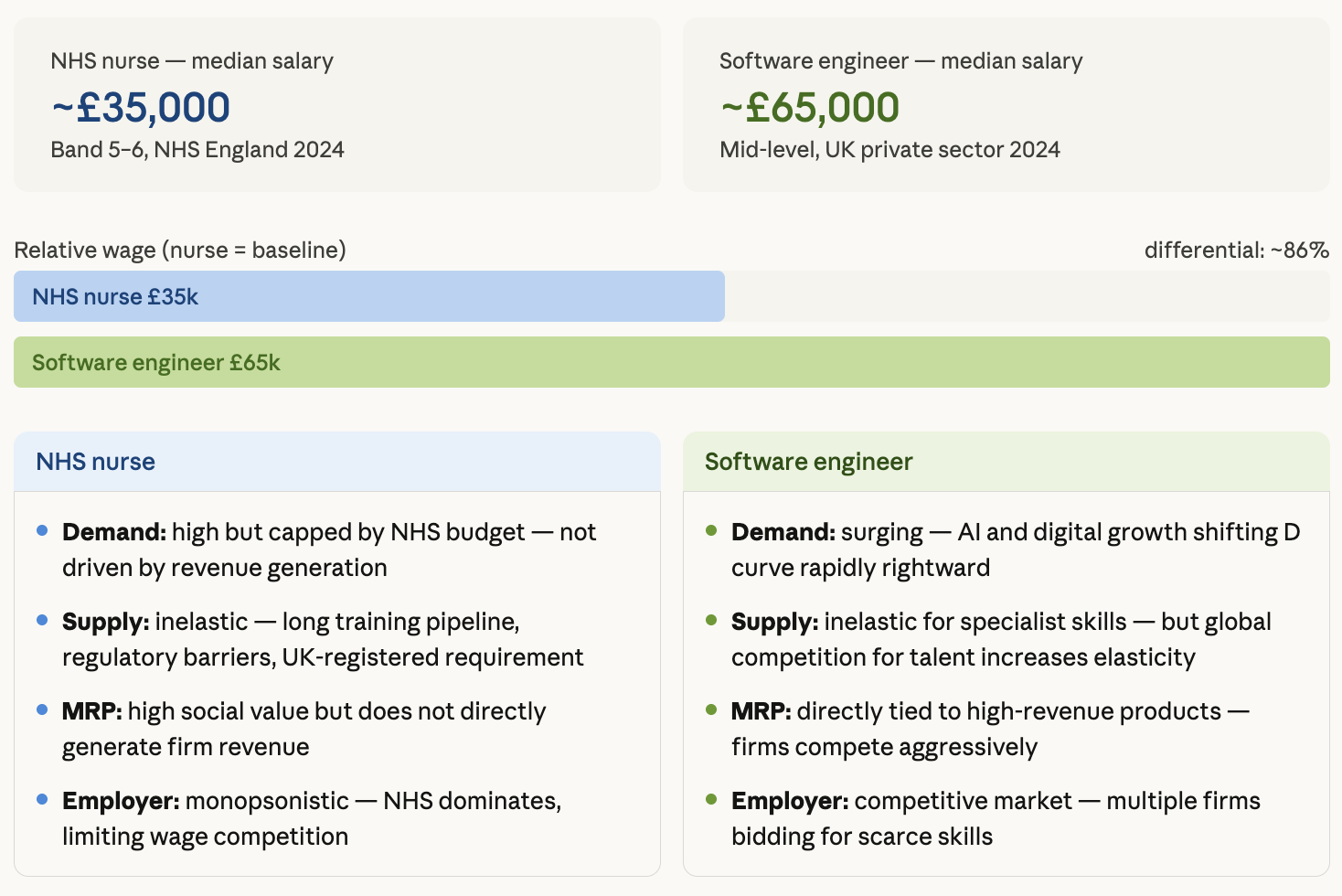
Both nursing and software engineering require significant post-secondary training and carry professional responsibilities. Yet median annual earnings for software engineers in the UK are roughly double those of NHS nurses — a persistent differential that illustrates how labour market forces operate in practice.
The labour market verdict
Both occupations require significant training and carry high responsibility — but the software engineer's MRP is tied directly to private sector revenue, supply conditions are shaped by global tech demand, and multiple employers compete for talent
The nurse faces a monopsonistic employer whose wage bill is politically constrained. The differential reflects market forces, not social worth.

Unlock more, it's free!
Join the 100,000+ Students that ❤️ Save My Exams
the (exam) results speak for themselves:

Was this revision note helpful?