Wage Determination in Imperfect Markets (Cambridge (CIE) A Level Economics): Revision Note
Exam code: 9708

Wage determination in imperfect labour markets
A perfectly competitive labour market is a theoretical construct
All labour markets face some level of imperfection
Reasons for imperfections in the labour market

In reality, labour market wages are not always determined according to the Marginal Revenue Product (MRP) theory
Firms and workers have some degree of influence over wage setting
The less competition in the labour market, the more power employers have in setting wages
Trade unions
A trade union is an organisation that represents workers in a particular occupation or industry, protecting their rights through collective bargaining
Unions negotiate wages and conditions on behalf of all members - giving workers significantly more bargaining power than they would have individually
Trade union activity causes wages to be set above the competitive equilibrium rate, affecting both wage levels and employment
Factors affecting trade union bargaining power
Factor | Effect on bargaining power |
|---|---|
Union membership size |
|
Unemployment level |
|
Firm's profitability |
|
Wage as proportion of total costs |
|
Ability to substitute capital for labour |
|
Productivity of labour |
|
State of the economy |
|
Impact of trade unions on labour markets
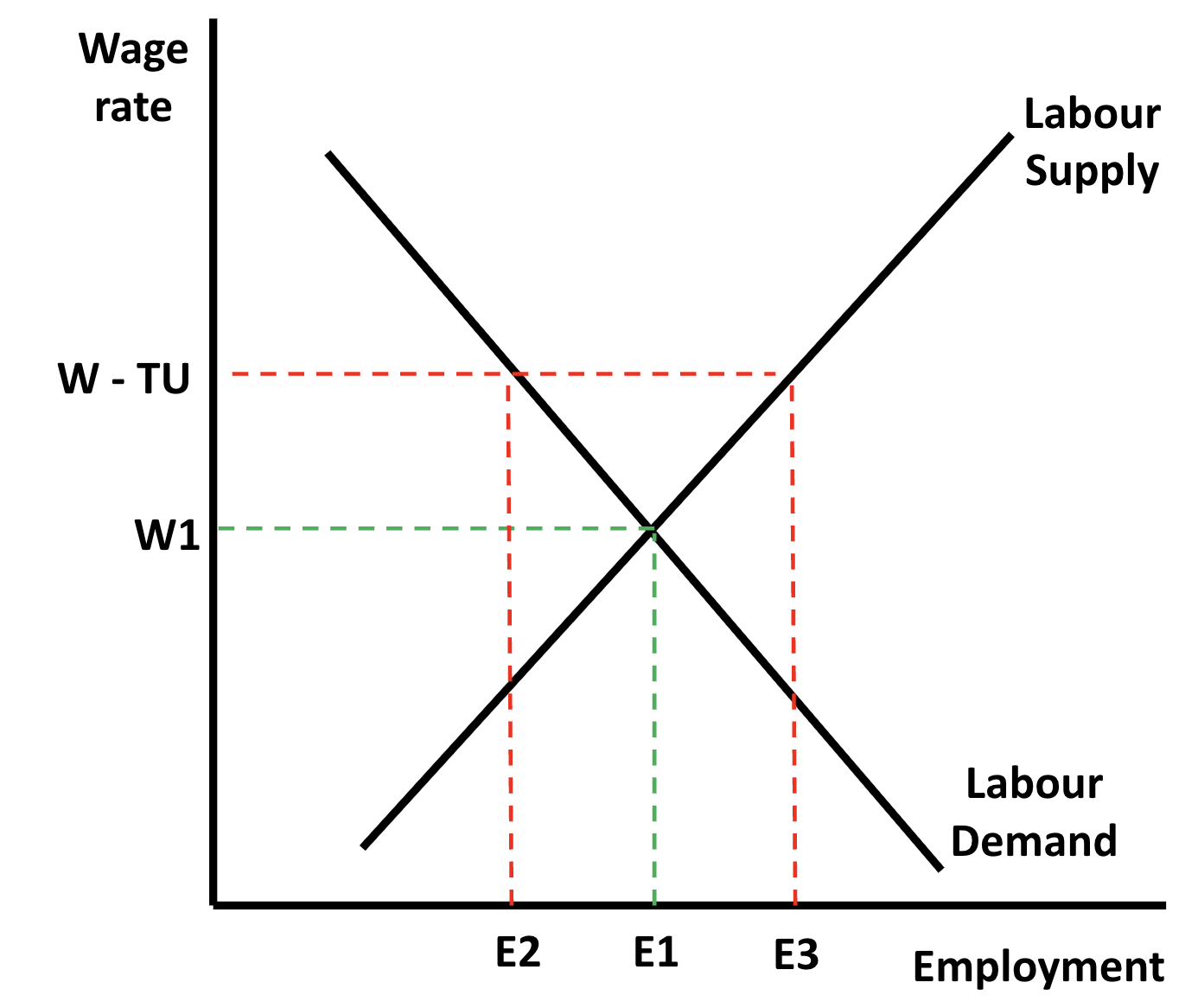
Diagram analysis
Competitive equilibrium at W₁, E₁ — where DL = SL
Union raises wage to WTU through collective bargaining
Firms reduce employment from E₁ → E₂ — movement along DL
More workers wish to work at the higher wage - quantity supplied rises to E₃
Excess supply (unemployment) of E₂E₃ results
Workers in employment gain; workers priced out of employment lose
Evaluating trade union influence
Advantages | Disadvantages |
|---|---|
|
|
|
|
|
|
|
|
Examiner Tips and Tricks
Always define collective bargaining precisely - unions negotiate on behalf of all members, giving workers greater power than individual negotiation.
The key trade-off is wages vs employment - higher union wages benefit members in work but create unemployment of Q₂Q₃. Always identify both sides explicitly.
Connect bargaining power to context - a union in a booming economy with low unemployment has far more power than one operating during a recession.
The employment cost depends on PED for labour - inelastic demand means small employment falls; elastic demand means significant unemployment.
Impact of a national minimum wage
A national minimum wage (NMW) is a legally imposed price floor in the labour market - employers cannot legally pay workers below this rate
It is set above the market equilibrium wage to be effective - a minimum wage set below the equilibrium has no impact
Governments use the NMW to:
Improve equity - raising incomes of the lowest-paid workers
Reduce exploitation - particularly in markets where employers have monopsony power
Reduce in-work poverty - ensuring full-time workers earn enough to meet basic needs
The rate often varies by age - lower rates for younger workers are common in many countries
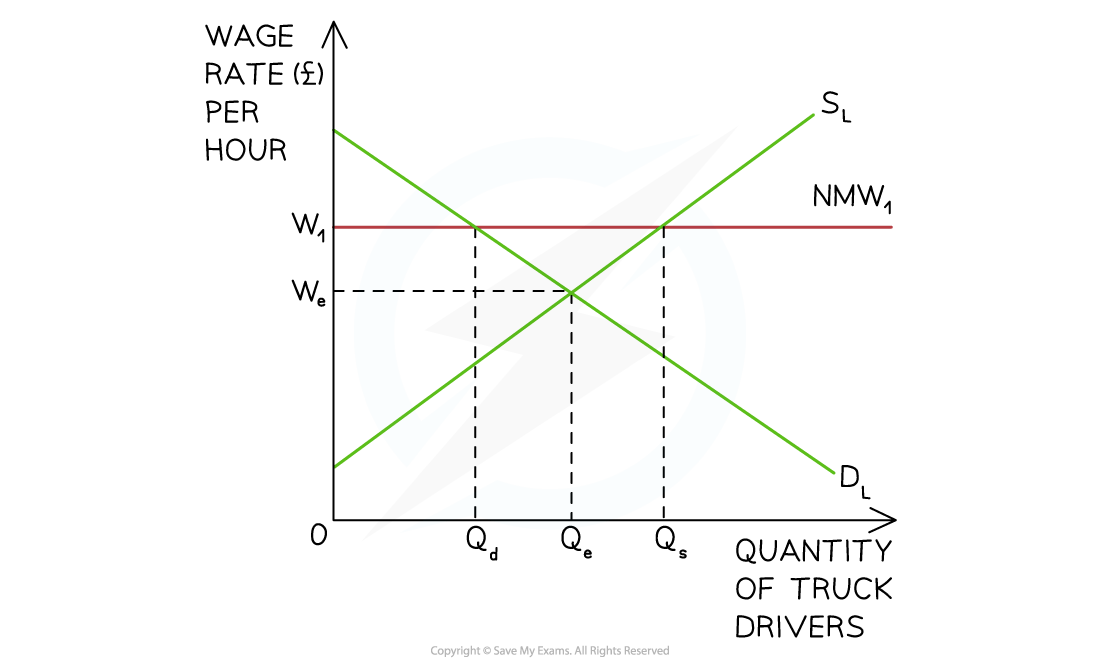
Diagram analysis
Competitive equilibrium at We, Qe — where DL = SL
NMW imposed at W₁ above We
Higher wage increases incentive to supply labour
quantity supplied rises from Qe → Qs
Higher wage raises cost of labour - firms reduce quantity demanded from Qe → Qd
Excess supply of labour equal to QdQs equals potential unemployment
Workers who retain employment gain; workers priced out of employment lose
Evaluating the national minimum wage
Advantages | Disadvantages |
|---|---|
|
|
|
|
|
|
|
|
|
|
Case Study
The National Minimum Wage in Brazil
The context
Brazil has one of the most unequal income distributions in the world, with a large low-wage workforce concentrated in agriculture, domestic service and informal urban employment.
The salário mínimo (minimum wage) is a federally mandated minimum that applies to all formal sector workers and is adjusted annually to maintain its real value — with increases linked to GDP growth and inflation under a formula established in 2011.
Actions taken
The real value of the minimum wage more than doubled between 2003 and 2015 under Presidents Lula and Dilma, rising significantly faster than inflation
By 2024 the monthly minimum wage stood at R$1,412 — used as the reference point for social security benefits, pensions and transfer payments as well as wages
Annual uprating is recommended by the Inter-union Department of Statistics and Socioeconomic Studies (DIEESE)
Outcomes
The policy contributed significantly to poverty reduction alongside Bolsa Família — research estimates that minimum wage increases accounted for around 40% of the fall in income inequality between 2001 and 2012.
However a large informal sector, estimated at over 40% of the workforce, means many of the lowest-paid workers fall entirely outside the legal framework and receive no benefit.
This illustrates a fundamental limitation of minimum wage policy in lower-income economies - effectiveness depends critically on the capacity to enforce compliance.
Examiner Tips and Tricks
Always challenge the standard unemployment prediction with empirical evidence - Card and Krueger found minimal unemployment effects from moderate NMW increases, suggesting real labour markets are closer to monopsony than perfect competition.
Unemployment effects depend critically on PED for labour - inelastic demand means small employment losses; elastic demand means significant unemployment. Always state this explicitly.
Connect NMW back to price controls.
Monopsony power
A monopsony occurs when there is a single buyer of labour in a market
the employer has dominant purchasing power and can influence the wage rate
Unlike a wage taker in a competitive market, a monopsonist is a wage maker
it sets the wage rate rather than accepting it
A pure monopsony is rare - but dominant buyers with significant wage-setting power are common, particularly where:
The government is the dominant employer in an occupation — teachers, nurses, military personnel
A single large firm dominates employment in a region or industry
Characteristics of a monopsonist
Wage maker: sets wages below the competitive level by restricting employment
Profit maximiser: minimises labour costs by paying workers as little as possible
Purchases a large share of the labour supplied in that market

Diagram analysis
The Labour Supply (= ACL) curve is upward sloping
To attract more workers the monopsonist must offer a higher wage to all existing workers
This means the MCL curve lies above and is steeper than ACL throughout
The marginal cost of hiring one more worker exceeds the wage paid to that worker
The monopsonist maximises profit by hiring where MRPL = MCL - at employment level E₂
The wage paid is read off the ACL = SL curve at E₂ - giving the monopsony wage W₃
The competitive outcome would be where MRPL = ACL - at the higher employment level E₁ and higher wage W₁
W₂ is the wage at which MCL intersects MRPL - it is not the wage paid, but is used to identify the profit-maximising employment level E₂
Monopsony therefore produces:
Lower wages: W₃ < W₁ - the monopsony wage is below the competitive wage
Lower employment: E₂ < E₁ - fewer workers are hired than in the competitive outcome
A deadweight welfare loss - workers who would have been productively employed at the competitive wage W₁ are not hired
Correcting monopsony
A minimum wage set between W₃ and W₁ can correct monopsony wage suppression - raising both wages and employment simultaneously towards the competitive outcome
This is the strongest economic case for a national minimum wage - it corrects market failure rather than creating unemployment
Evaluating monopsony
Point | Explanation |
|---|---|
Allocative inefficiency |
|
Equity concern |
|
Minimum wage as a corrective |
|
Pure monopsony is rare |
|
Dynamic efficiency concern |
|
Examiner Tips and Tricks
Always explain why MCL lies above ACL - hiring one more worker requires raising the wage for all existing workers, making marginal cost exceed average cost.
The monopsony outcome - lower wages (W₃) and lower employment (E₂) than the competitive benchmark (W₁, E₁) - is the key result. Always identify both effects and the resulting deadweight welfare loss.
Note that W₂ is not the wage paid - it is simply the point where MCL intersects MRPL, used only to identify the profit-maximising employment level E₂. Students frequently confuse W₂ with the monopsony wage - the wage paid is always W₃, read off ACL at E₂.
The minimum wage corrective is particularly powerful here - unlike in a competitive market where NMW risks unemployment, in a monopsony it can raise both wages and employment simultaneously.

Unlock more, it's free!
Join the 100,000+ Students that ❤️ Save My Exams
the (exam) results speak for themselves:

Was this revision note helpful?
