Measuring Enthalpy Change (DP IB Chemistry: SL): Exam Questions

3 hours57 questions
1a
1 mark

Chemical reactions can be exothermic or endothermic. State which type of reaction is indicated by a decrease in temperature. 

1b
1 mark

State the type of reaction in which the energy of the system decreases. 

1c
1 mark

The reaction of propane with oxygen is represented by the following equation

C3H8 + 5O2 → 3CO2 + 4H2O          ΔH = -2219 kJ mol-1

State the classification of the enthalpy change is occurring in this reaction. 

1d
6 marks

Define the term enthalpy of formation, ΔHf , and state the standard conditions. 

2a
2 marks

Define the term enthalpy change of reaction, ΔHr

2b
3 marks

The equations below can be identified as any of the following enthalpy changes. Identify the enthalpy change for each reaction. 

  • Enthalpy of reaction, ΔHr

  • Enthalpy of formation, ΔHf

  • Enthalpy of combustion, ΔHc

  • Enthalpy of neutralisation, ΔHneut 

C2H5OH (l) + O2 (g) → CO2 (g) + H2O (l) …………………………………………  

CaSO3 (s) → CaO (s) + SO2 (g) ……………………………………………  

HCl (aq) + NaOH (aq) → NaCl (aq) + H2O (l) …………………………………………

2c
2 marks

Hydrochloric acid, HCl (aq), and sodium hydroxide, NaOH (aq), react as follows 

HCl (aq) + NaOH (aq) → NaCl (aq) + H2O (l)    ΔHr  = -57.9 kJ mol-1

Determine the enthalpy change, in kJ, when 25 cmof 0.5 mol dm-3 hydrochloric acid reacts with 25 cm3 of 0.5 mol dm-3 sodium hydroxide. Give your answer to 2 decimal places. 

3a
2 marks

A student performs a calorimetry experiment to determine the enthalpy of reaction for the displacement of copper by zinc.

Zn (s) + CuSO4 (aq) → ZnSO4 (aq) + Cu (s)

The student uses the apparatus shown.

IB Chem 5.1 SQ E Q3a

Suggest a suitable material for the cup and justify your choice.

3b
1 mark

State one other modification to the apparatus that would reduce heat loss.

3c
4 marks

The student added excess zinc powder to the cup with 50.0 cm3 of 1.0 mol dm-3 copper(II) sulfate solution in a calorimeter. The maximum temperature rise was 22.6 oC.

i) Calculate the energy change, q, in kJ. (Assume the specific heat capacity and density of the solution are the same as pure water)

[2]

ii) Calculate the number of moles of copper(II) sulfate solution.

[1]

iii) Calculate the enthalpy change of the reaction.

[1]

4a
2 marks

Another calorimetry experiment was set up to determine the enthalpy of combustion for ethanol. 

6-3

Define standard enthalpy of combustion, ΔHc

4b
5 marks

The student burned 0.61 g of ethanol in a spirit burner, which heated 100.0 g of water in a copper calorimeter, causing the temperature to rise by 40.0 °C.

i) Calculate the energy absorbed by the water, q, in kJ.

[2]

ii) Calculate the molar mass of ethanol.

[1]

iii) Calculate the amount, in moles, of ethanol burned.

[1]

iv) From this experimental data, determine the enthalpy of combustion of ethanol in kJ mol⁻¹.

[1]

4c
1 mark

Suggest a major reason why the experimental value calculated in (b)(iii) is significantly less exothermic than the data booklet value.

5a
1 mark

4.00 g of powdered iron was reacted with 25.0 cm3 of 2.00 mol dm−3 copper(II) sulfate solution in an insulated beaker. Temperature was plotted against time.

Graph showing temperature in °C over time in seconds. A solid line rises from 20°C to 60°C, peaks at point Y, then declines. Dashed line decreases from 80°C.

Estimate the time at which the powdered iron was added to the beaker.

5b
Sme Calculator
3 marks

A student added point Y to the graph.

i) State what point Y indicates on the graph.

[1]

ii) By extrapolating the cooling curve, determine the maximum temperature change for the reaction.

[2]

5c
1 mark

Explain why the student has recorded the temperature of the copper sulfate solution for a period of time before adding the iron powder. 

5d
Sme Calculator
1 mark

The student used the equation q = mcΔT  to calculate the enthalpy change for the reaction that took place in the beaker. State the value that the student should use for m

6a
2 marks

During chemical reactions, enthalpy changes occur as bonds are broken and formed.

i) Thermal energy is needed to overcome the attractive forces between atoms. In terms of thermal energy, name the process where bonds are broken.

[1]

ii) When bonds are formed, thermal energy is released to the surroundings. In terms of thermal energy, name the process where bonds are made.

[1]

6b
5 marks

The energy level diagram for an endothermic reaction is shown below.

1-19

Complete the diagram by labelling parts A to E. 

6c
1 mark

An element X undergoes complete combustion according to the following equation. The enthalpy change, ΔH, and activation energy, Ea, for this reaction are -520 kJ mol-1 and +630 kJ mol-1 respectively. Deduce whether this reaction is exothermic or endothermic. 

X + O2 → XO2

6d
2 marks

Define the term average bond enthalpy.

7a
1 mark

The equipment set up below is used to measure the enthalpy change for a reaction.

3-11

Suggest why a polystyrene cup is used for this experiment.

7b
3 marks

A student added 50.00 cm3 of 1.50 mol dm-3 copper sulfate solution, CuSO4 (aq), to the polystyrene cup. They recorded the temperature every minute for 3 minutes. On the fourth minute, 6.00 g of powdered zinc was added. They then recorded the temperature of the reaction mixture every minute for a further 7 minutes. The maximum temperature change was estimated to be 29.0 °C. 

Use section 7 of the data booklet to answer the following questions.

i) Determine the amount, in moles, of copper sulfate used in the reaction.

[1]

ii) Determine the amount, in moles, of powdered zinc used in the reaction.

[1]

iii) Determine the limiting reagent in the reaction.

[1]

7c
3 marks

Use the information in part b) and sections 1 and 2 in the data booklet to determine the following.

i) The energy change, in J, for the reaction.

[1]

ii) The enthalpy change, in kJ mol-1, for the reaction between copper sulfate and zinc. 

[2]

1a
5 marks

The reaction between solid ammonium nitrate and water is one which is often conducted in school laboratories.

i) Describe how the heat energy transferred (q) for the reaction between solid ammonium nitrate and water could be conducted in a school laboratory. Give the names of the apparatus that is needed and state the measurements that would be taken to find the enthalpy change of reaction.

[3]


ii) Discuss one major source of error in the experiment and suggest how that error would impact on the calculation of the enthalpy change (q).

[2]

1b
1 mark

State the difference between accuracy and precision in experimental results.

1c
1 mark

Write an equation for the reaction that occurs when ammonium nitrate is added to water.

1d
2 marks

A student dissolves 3.5 g of ammonium nitrate in water. The water loses 1828 J of heat.

Determine the enthalpy change for this reaction in kJ mol-1.

2a
3 marks

Methanol is an important industrial alcohol which is mostly used to create fuel, solvents, and antifreeze. A colorless liquid, it is volatile, flammable, and unlike ethanol, poisonous for human consumption.

The equation to show the enthalpy of combustion of methanol is:

CH3OH (l) + 1½O2 (g) → CO2 (g) + 2H2O (g)

Use the equation and the information in Table 1 below, to determine the theoretical enthalpy of combustion of methanol.

Table 1

Bond

C-O

O-H

C-H

O=O

C=O

Mean bond enthalpy (kJmol-1)

358

463

414

498

804

2b
4 marks

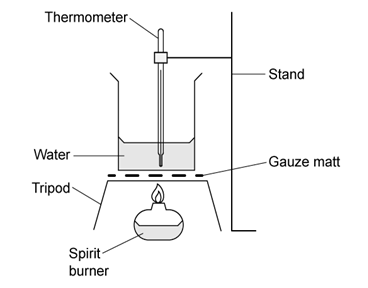
The enthalpy of combustion of an alcohol can be determined in a school laboratory using the following apparatus.

Figure 1

Diagram of a laboratory setup showing a spirit burner heating water in a beaker on a tripod with gauze mat; thermometer and stand included.

In an experiment, a spirit burner containing methanol was weighed and used to heat water in a beaker as shown above. The following results were obtained:

Starting mass of spirit burner and methanol / g

80.56

Final mass of spirit burner and methanol / g

80.03

Mass of water in the beaker / g

100.00

Initial water temperature / oC

21.5

Final water temperature / oC

32.1

i) Calculate the amount of methanol combusted in moles.

[2]

ii) Calculate the heat energy transferred to the water, q, in kJ. Take the specific heat capacity of water as 4.18 J g-1 K-1.

[1]

iii) Find the enthalpy of combustion of methanol in kJ mol-1.

[1]

2c
1 mark

Suggest one improvement that could be made to the apparatus in part (b) that would give a more accurate result.

2d
3 marks

The accepted data book value for the enthalpy of combustion of methanol is -726 kJ mol-1.

i) Suggest why the data value is different from the values calculated in part (a).

[2]

ii) Suggest why the data value is different from the values calculated in part (b).

[1]

3a
3 marks

A teacher instructs a class to complete a calorimetry practical, to calculate the enthalpy change that occurs when hydrochloric acid and sodium hydroxide react together.  

Each student was given:

  • 60 cm3 of 0.35 mol dm-3 hydrochloric acid

  • 60 cm3 of 0.35 mol dm-3 sodium hydroxide

  • A polystyrene cup

  • Access to all standard laboratory equipment.

i) Draw a diagram to demonstrate the practical set up that the students would need to use to determine the enthalpy change during this neutralisation reaction.

[2]

ii) State the key measurements that the students would have to make.

[1]

3b
5 marks

The students then completed the practical from part (a), using their own method and measurements that they had chosen.

One student found that when they reacted 35.0 cm3 of the hydrochloric acid with 35.0 cm3 of the sodium hydroxide, the temperature rose from 19.6 oC to 22.3 oC.

Determine the enthalpy change, ΔH, for this reaction in kJ mol-1. Assume that both solutions have a density of 1.00 g cm-3 and a specific heat capacity of 4.18 J g-1 K-1.

3c
1 mark

State how the students’ practical could be improved to allow the students to calculate a more accurate value which is closer to the correct value given in data books.

3d
1 mark

Explain why the value that you have calculated for the students’ practical in part (b), might be different from the correct value given in a data book.

4a
1 mark

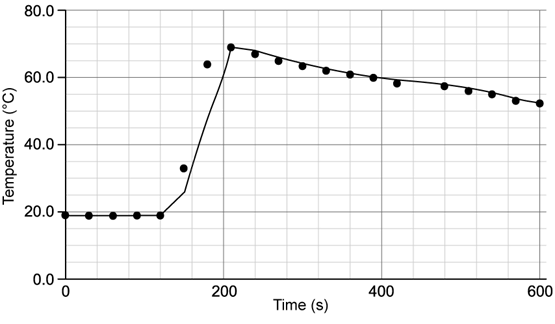
A group of students carried out a calorimetry experiment to determine the enthalpy change for the decomposition of hydrogen peroxide using manganese dioxide as a catalyst.

Each group added 1 g of manganese dioxide to 50.00 cm3 of 2.00 mol dm-3 of hydrogen peroxide.

They recorded their data and drew a graph shown in Figure 1.

Figure 1

Line graph showing temperature in °C against time in seconds. Temperature rises sharply from 20°C to 60°C at 200s, then gradually decreases.

Use the graph to determine the temperature change, ΔT.

4b
4 marks

Using your answer to part (a) determine the enthalpy change, ΔH, for this reaction in kJ mol-1.

 Assume the solution has a density of 1.00 g cm-3 and a specific heat capacity of 4.18 J g-1 K-1 .

5a
3 marks

Define the term standard enthalpy of neutralisation , ΔHϴneut.

5b
4 marks

A student carried out a neutralisation reaction and recorded the temperature change.25.00 cm3 of 1.0 mol dm-3 nitric acid, HNO3 (aq) was neutralised by 50.00 cm3 of 1.0 mol dm-3 of potassium hydroxide, KOH (aq).

Both solutions were initially at 20.5 oC and the reaction reached a maximum temperature of 24.5 oC.

Determine the enthalpy of neutralisation, ΔHϴneut, assuming the solutions has a density of 1.00 g cm-3 and a specific heat capacity of 4.18 J g-1 K-1 . Give your answer in kJ mol-1 to three significant figures.

5c
1 mark

Write an equation to demonstrate how nitric acid can behave as a Brønsted-Lowry acid when it reacts with water.

5d
1 mark

The accepted theoretical value from the literature of this enthalpy change is -57 kJ mol-1. Calculate the percentage error to two significant figures.

6a
2 marks

Chemical reactions can be classified as endothermic or exothermic, a property that can be represented on an enthalpy level diagram.

An enthalpy level diagram for an endothermic reaction is shown below.

Figure 1

Graph showing an enthalpy diagram with reactants at a lower energy level and products at a higher energy level, indicating an endothermic reaction.


i) Give the sign of ΔH for the reaction.

[1]

ii) State whether the bonds in the products or the reactants are stronger overall.

[1]

6b
5 marks

The complete combustion of propan-1-ol is an exothermic reaction with ΔH꜀ө = -2021 kJ mol⁻¹.

i) Define the term standard enthalpy of combustion.

[2]

ii) Draw a labelled enthalpy level diagram for the combustion of propan-1-ol.

[3]

7a
1 mark

Alkanes can be used as fuels in internal combustion engines. When sufficient oxygen is present, they undergo complete combustion reactions.

Write an equation for the enthalpy of combustion of butane.

7b
3 marks

Define the term standard enthalpy of combustion, ΔHϴc.

7c
3 marks

Table 1 below contains bond enthalpy data for the reaction shown in part (a).

Table 1


C-C

C-H

O=O

C=O

O-H

Mean bond enthalpy (kJ mol-1)

346

414

498

804

463


Using the data in Table 1 and the equation in part (a), calculate the enthalpy change of combustion of butane.

7d
1 mark

In the absence of sufficient oxygen, butane will undergo incomplete combustion.

Write an equation for the incomplete combustion of butane.

8a
1 mark

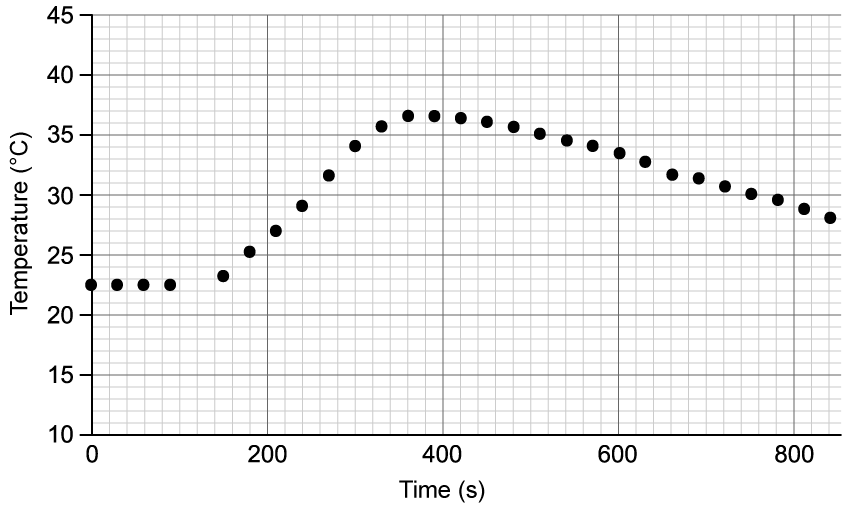
A student measured the energy change when 1.35 g of zinc was added to 50 cm3 of 0.5 mol dm-3 copper sulfate, CuSO4 (aq), solution. The initial temperature of 21 oC was recorded before the addition of the zinc and a temperature reading was taken every 30 seconds.

Line graph showing temperature changes over time. Temperature rises from 20°C to 36°C between 200s and 500s, then falls to 32°C by 850s.

Use the graph to determine the overall temperature change for the reaction

8b
4 marks

Calculate the enthalpy change for the reaction in kJ mol-1.

8c
1 mark

Calculate the percentage error between your value for the enthalpy change of reaction and the literature value of -217 kJ mol-1. Give your answer to two significant figures. 

8d
3 marks

Explain why your calculated value for the enthalpy change of reaction is different from the literature value of -217 kJ mol-1

1a
Sme Calculator
3 marks

When anhydrous copper(II) sulfate is left in the atmosphere it will slowly turn to a blue pentahydrate solid. It is possible to measure the heat changes directly when both anhydrous and pentahydrated copper(II) sulfate are separately dissolved in water.

i) Write an equation for the reaction of anhydrous copper(II) sulfate with water to form pentahydrated copper(II) sulfate.

[1]

ii) Construct an energy cycle which can be used to determine the enthalpy change indirectly. 

[2]

1b
4 marks

To determine the enthalpy change a student placed 50 cm3 of water in a polystyrene cup and used a data logger to measure the temperature.

After two minutes she dissolved 6.30 g of anhydrous copper(II) sulfate in the water and continued to record the temperature while continuously stirring. She obtained the following results.


51-ib-sl-sq-hard-q1b-cooling-curve


i) Using section 6 in the data booklet, determine the amount, in moles, of copper(II) sulfate.

[1]

ii) Determine the temperature change, in °C, for the reaction assuming no heat had been lost to the surroundings. 

[1]

iii) Using sections 1 and 2 in the data booklet, determine the heat change, in kJ mol-1, for the reaction.

[2]

1c
Sme Calculator
3 marks

The student repeated the experiment using 7.83 g of pentahydrated copper(II) sulfate and observed the temperature decreased by 2.5 °C. The student used the same volume of water.

i) Use section 6 of the data booklet to determine the amount, in moles, of pentahydrated copper(II) sulfate.

[1]

ii) Use sections 1 and 2 in the data booklet to determine the heat change, in kJ mol-1

[2]

1d
Sme Calculator
2 marks

Using your answers to parts a), b) and c), determine the enthalpy change for the hydration of anhydrous copper(II) sulfate.

2a
Sme Calculator
2 marks

A student investigated the temperature change for the neutralisation of malonic acid, HOOCCH2COOH, and sodium hydroxide solution. 

25.0 cm3 of 0.400 mol dm-3 of malonic acid was added to a beaker and the temperature was recorded every minute for three minutes using a thermometer with an uncertainty of ±0.1° C. On the fourth minute, the student added 50.0 cm3 of 0.500 mol dm-3 sodium hydroxide solution.

Finally, she recorded the temperature every minute for eight minutes. 

Determine the percentage uncertainty in the student’s 2.9 oC temperature rise.

2b
Sme Calculator
3 marks

Another student completed the same investigation and recorded a maximum temperature of 23.5 °C. The student calculated the heat energy, q, for the reaction to be 8.923 x 10-1 kJ.

Use sections 1 and 2 in the data booklet and the information in part a) to estimate the initial temperature for this student’s investigation.

2c
Sme Calculator
1 mark

State the balanced symbol equation for the neutralisation of malonic acid with sodium hydroxide solution.

2d
Sme Calculator
4 marks

Using the data from part (b), determine the standard enthalpy of neutralization, ΔHneut, for this reaction in kJ mol-1.

3a
Sme Calculator
2 marks

Ethanol is a common biofuel. Its enthalpy of combustion can be determined theoretically using bond enthalpies and experimentally using calorimetry.

State the balanced chemical equation for the complete combustion of ethanol.

3b
Sme Calculator
3 marks

Using bond enthalpy values from section 12 of the data booklet, determine the theoretical enthalpy of combustion of ethanol.

3c
5 marks

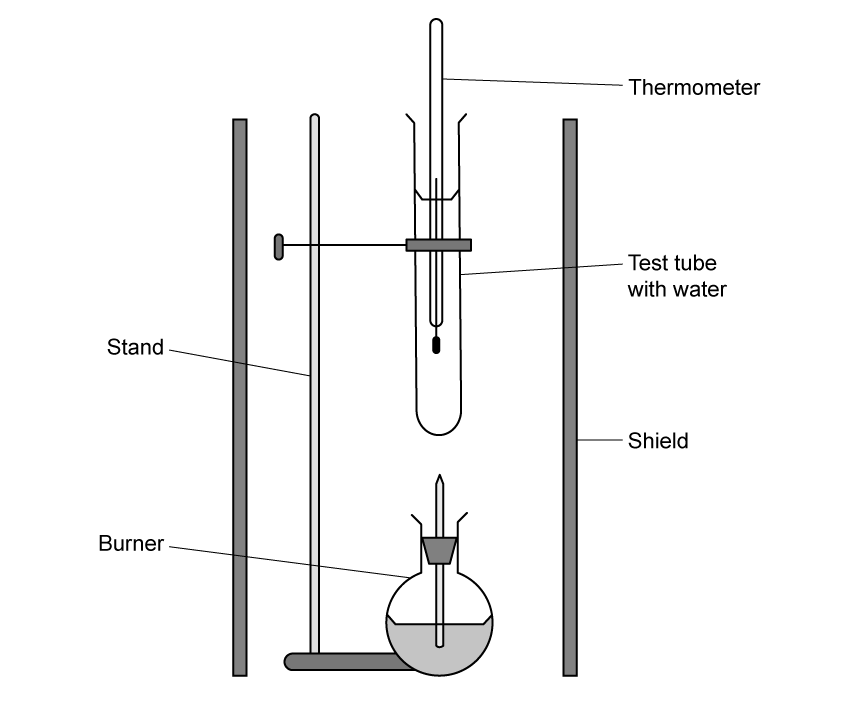
A burner containing ethanol was weighed and used to heat water in a test tube as illustrated below.

Diagram of a laboratory setup with a test tube containing water, a thermometer, a stand, a burner, and protective shields on both sides.

The following data was collected when a spirit burner containing ethanol was used to heat 20.000 g of water.

Initial mass of burner and ethanol / g

76.137 

Final mass of burner and ethanol / g

75.614 

Volume of water in test tube / g

20.000

Initial temperature of water / °C

19.2

Final temperature of water / °C

24.3

Using this data, determine the experimental enthalpy change for the combustion of ethanol in kJ mol-1.

3d
2 marks

The accepted data book value for the enthalpy of combustion of ethanol is -1367 kJ mol-1 (section 14).

i) Suggest one reason why the theoretical value calculated from bond enthalpies in part (b) is different from the accepted data book value.

[1]

ii) Suggest one reason why the experimental value calculated in part (c) is significantly different from the accepted data book value.

[1]

4a
Sme Calculator
1 mark

The standard enthalpy of solution for lithium chloride is -37.0 kJ mol-1. A student performs an experiment by dissolving 1.20 g of lithium chloride in 20.0 cm3 of water, initially at 19.5 oC.

Determine the amount, in moles, of lithium chloride dissolved.

4b
Sme Calculator
1 mark

Calculate the heat energy, q, in Joules, that would be released during this process

4c
Sme Calculator
2 marks

Calculate the theoretical temperature change, ΔT, of the water.

Assume the specific heat capacity and density of the solution are the same as pure water.

4d
Sme Calculator
1 mark

Hence, determine the final temperature of the solution.