Hess's Law (DP IB Chemistry: SL): Revision Note

Hess's Law
In 1840, the Russian chemist Germain Hess formulated a law which went on to be known as Hess’s Law
This went on to form the basis of one of the laws of thermodynamics. The first law of thermodynamics relates to the Law of Conservation of Energy
It is sometimes expressed in the following form:
Energy cannot be created or destroyed, it can only change form
This means that in an isolated system, the total amount of energy present is always constant
Hess’s law can be used to calculate the standard enthalpy change of a reaction from known standard enthalpy changes
Hess’s Law states that:
"The total enthalpy change in a chemical reaction is independent of the route by which the chemical reaction takes place as long as the initial and final conditions are the same."
This means that whether the reaction takes place in one or two steps, the total enthalpy change of the reaction will still be the same
Diagram to show Hess's Law
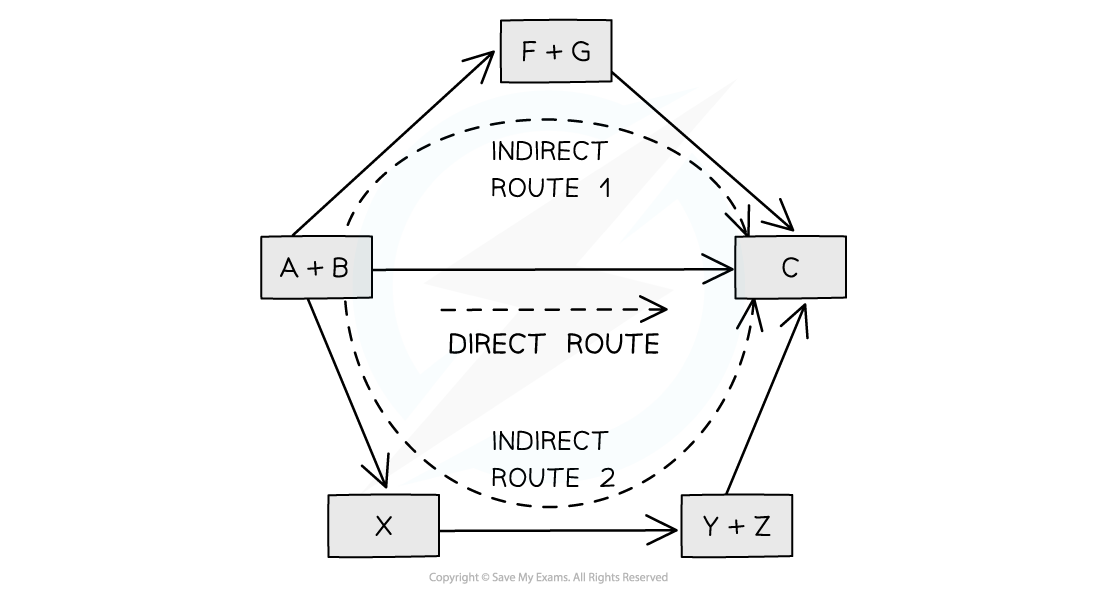
Hess’ Law is used to calculate enthalpy changes which can’t be found experimentally using calorimetry, eg:
3C (s) + 4H2 (g) → C3H8(g)
The enthalpy change for this reaction can't be found experimentally, because carbon and hydrogen don't react directly under standard conditions
Examiner Tips and Tricks
You do not need to learn Hess's Law word for word, but you do need to understand the principle as it provides the foundation for all the problem solving in Chemical Energetics

Unlock more, it's free!
Join the 100,000+ Students that ❤️ Save My Exams
the (exam) results speak for themselves:

Was this revision note helpful?
Build on this topic