Probability & Expectation (AQA Level 3 Mathematical Studies (Core Maths): Paper 2B: Critical Path & Risk Analysis): Exam Questions

Exam code: 1350

2 hours17 questions
1
6 marks

John takes part in a Go Kart race every Saturday.

The probability that he finishes a race is 0.8

If he finishes a race the probability that he wins is 0.5 For each race there is an entry fee of £50

For each race there is a prize of £500 for the winner.

John enters 20 races.

How much money should he win?
You must show your working to justify your answer.

2a
2 marks

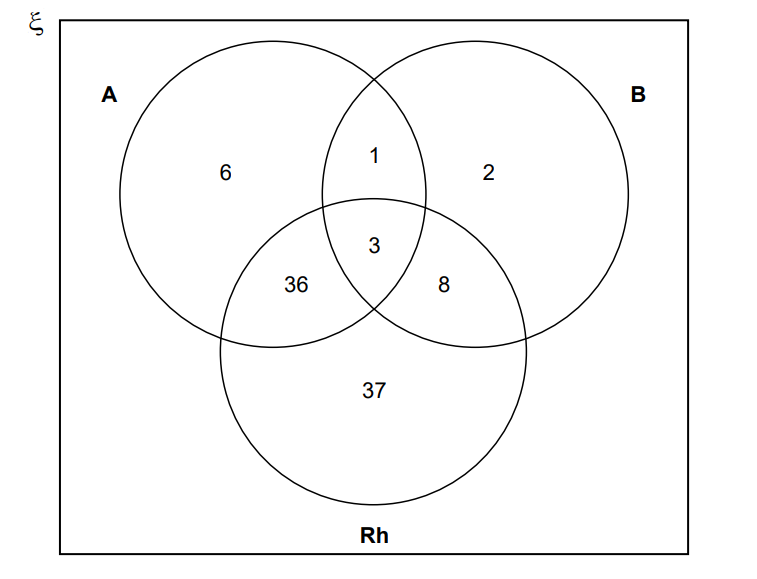
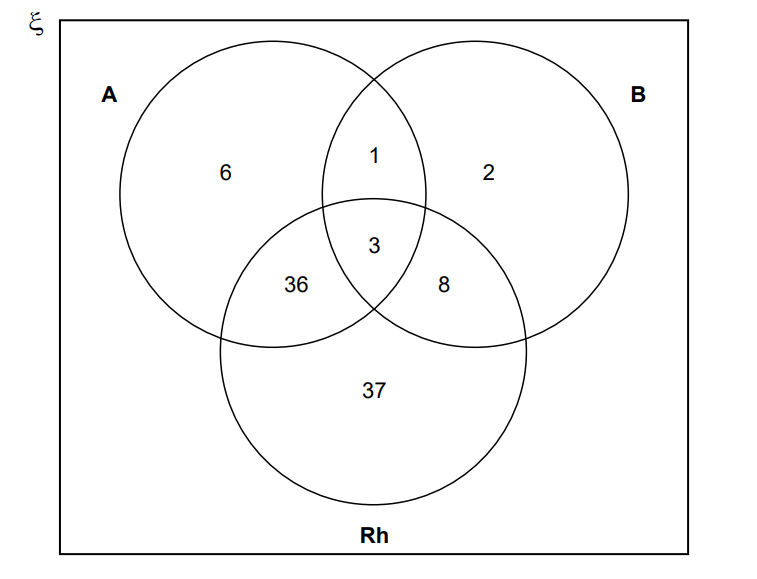
Your blood has none, some or all of three substances: A, B and Rh.

The Venn diagram shows the percentages of people in a population whose blood has different combinations of these substances.

Venn diagram with three circles A, B, and Rh showing overlapping and non-overlapping areas labelled with numbers: 1, 2, 3, 6, 8, 36, 37.

What is the probability that a person whose blood contains substance B also contains substance A?

2b
3 marks

David’s blood contains substances A and B but not Rh.

For Sarah to be able to donate her blood to David, any substance found in her blood must also be in David’s blood.

What is the probability that Sarah can donate her blood to David?

3a
1 mark

A survey asked 250 households if they own a laptop and if they have access to full fibre broadband. The table shows the results.

Full fibre broadband

Yes

No

Laptop

Yes

64

82

No

42

62

One household included in the survey owns a laptop.

Work out the probability the household does not have access to full fibre broadband

3b
3 marks

In the UK, 12.4 million households have access to full fibre broadband.

Use the information in the table to estimate the number of households in the UK that own a laptop.

3c
1 mark

Give one reason why your answer to question 4 (b) might not be a good estimate.

4a
2 marks

In a town there are two secondary schools, Audley Academy and Banford School.

At Audley Academy

     there are 120 students in Year 10
     all students study either history or geography.

The Venn diagram shows the number of students in Year 10 that study each subject at Audley Academy.

Venn diagram with three circles labeled A, B, and Rh. Numbers 6, 1, 2, 3, 36, 8, 37 denote intersections and unique values for each set.

Two students in Year 10 at Audley Academy are chosen at random.

Work out the probability that one studies history and one studies geography.

4b
3 marks

At Banford School

     there are 180 students in Year 10
     8 students in Year 10 study both history and geography      50 students in Year 10 study neither history nor geography      twice as many students study history as geography.

Complete the Venn diagram.

4c
3 marks

One student in Year 10 is chosen at random from each school.

Work out the probability that they both study geography.

5a
1 mark

Pupils from one primary school and one secondary school in Rochdale were asked,

“What is the main type of transport you use to travel to school?”

The table shows the results.

Main type of transport

Primary school

Secondary school

Walk

191

328

Bicycle  4

4

85

Car

180

330

Bus  9

9

211

Other  6

6

36

Total

390

990

One secondary school pupil is chosen at random.

Write down the probability that the pupil travels to school by bicycle.

5b
2 marks

One pupil is chosen at random from each school.

Work out the probability that both pupils travel to school by car.

5c
3 marks

In Rochdale,

22650 pupils attend primary school
13721 pupils attend secondary school.

Using the information in the table, estimate how many pupils in Rochdale travel to school by bicycle.

5d
1 mark

Give one reason why your answer to Question 4(c) might not be a good estimate.

6a
2 marks

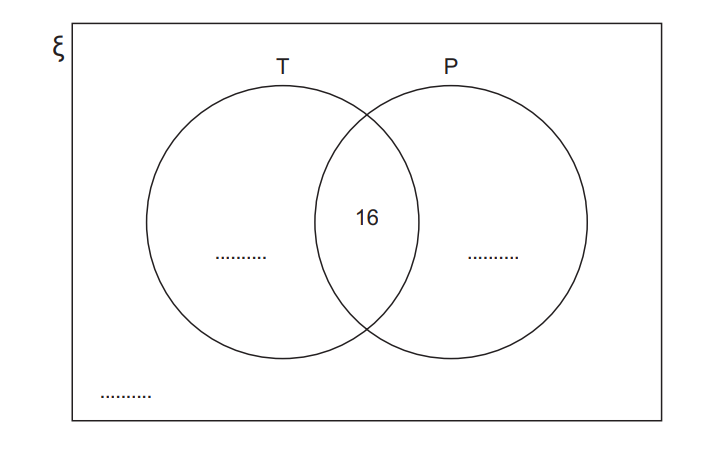
At a school, 32 students in Year 13 passed both parts of their driving test.

  • 16 passed both the theory test and the practical test at the first attempt.

  • 19 passed the theory test at the first attempt.

  • 21 passed the practical test at the first attempt.

In the Venn diagram,

ξ represents the 32 students who passed their driving test

T represents the students who passed the theory test at the first
attempt

P represents the students who passed the practical test at the first
attempt

Complete the Venn diagram.

Venn diagram with two intersecting circles labelled T and P within a rectangle labelled ξ; intersection contains number 16, other areas have dotted lines.
6b
2 marks

One student who passed their theory test at the first attempt is chosen at random.

Work out the probability that they also passed their practical test at the first attempt.

6c
3 marks

Two students are chosen at random.

Work out the probability that both students passed their theory test at the first attempt

7a
1 mark

Matilda is going to compete in a cross-country running race.

The runners who finish first, second or third in the race will win a cash prize.

The table shows the value of the prize for each place.

Place

First

Second

Third

Prize

£50

£20

£10

Matilda asked her coach to estimate the probability of her finishing in each of the first three places.

His estimates are in the table.

Place

First

Second

Third

Probability

0.15

0.55

0.2

Work out the coach’s estimate of the probability that Matilda will not win a prize.

7b
3 marks

Use the coach’s estimates to work out the expected value of Matilda’s prize.

8
3 marks

Between January and March 2020, 97.4% of trains were early or on time in the UK.

The rest of the trains were late.

Trains were late for one of three reasons.

The table shows the reasons why trains were late.

Reason

Percentage of late trains

Extreme weather

2.0%

Rail infrastructure

57.6%

Train operation

40.4%

Work out the percentage of all trains that were late due to extreme weather.

9a
2 marks

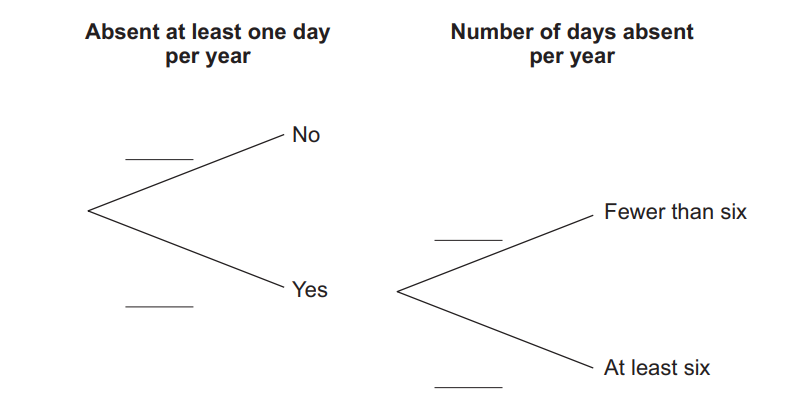
The owners of a business are concerned about the cost of employee absence.

Experience shows that 60% of employees are absent for at least one day per year.

Of those employees who are absent, 30% are absent for at least six days.

Complete the tree diagram.

Flowchart showing absence frequency. Left: "Absent at least one day per year" splits into "No" and "Yes." Right: Days absent "Fewer than six" or "At least six."
9b
5 marks

Each employee costs the business £200 per day that they are absent.

The table shows the average number of days that employees are absent.

Absence in the year

Average number of days absent

Fewer than six days

3

At least six days

12

Work out the expected cost of absence per employee per year.

9c
4 marks

The business can buy an Employee Absence insurance policy.

The policy costs £600 per employee per year.

The policy pays the business £150 per employee for each day they are absent.

Advise the business owners on whether they should buy the policy.

You should base your advice on the expected costs.

10a
2 marks

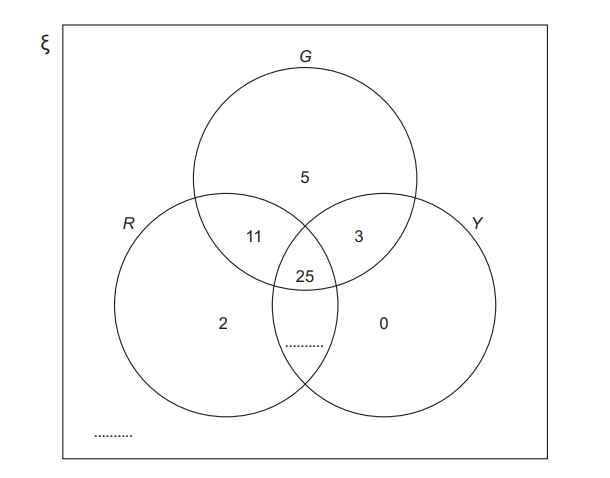
There are 55 countries in the African Union.

In the Venn diagram,

ξ represents the 55 countries in the African Union
R represents the 45 countries with red in their flag
G represents the countries with green in their flag
Y represents the countries with yellow in their flag.

Three intersecting circles labelled G, R, Y within a rectangle. Numbers in regions: 5 in G, 3 in Y, 2 in R, 25 in all three, 11 in G and R, 0 in Y, R.

Complete the Venn diagram with the missing two numbers.

10b
2 marks

One of the countries is chosen at random.

Work out P(G ∪ Y)

10c
1 mark

Describe the flag of a country in the section R′ ∩ G

You do not need to work out the probability of choosing the country.

10d
2 marks

One of the countries with red in their flag is chosen at random.

Work out the probability that the flag also has yellow.

11a
2 marks

A polygraph machine shows whether the answer to a question is the truth or a lie.

When a person answers a question, the polygraph shows one of two results.

Result

Meaning

Truth

The polygraph believes the answer is the truth

Lie

The polygraph believes the answer is a lie

However, the result shown on the polygraph is not always correct.

When the answer is the truth, the polygraph incorrectly shows ‘Lie’ 10% of the time.

When the answer is a lie, the polygraph incorrectly shows ‘Truth’ 5% of the time.

A group of people are asked to test a polygraph by answering the question, “In what year were you born?”

80% of the group are told to answer with the truth.

The rest of the group are told to answer with a lie.

A person in the group is chosen at random to answer the question.

Work out the probability that the polygraph incorrectly shows ‘Lie’.
11b
5 marks

Each person in the group answers the question once.

The polygraph incorrectly shows ‘Lie’ 56 times to answers that are the truth.

The polygraph correctly shows ‘Lie’ x times to answers that are a lie.

Work out the value of x.

11c
3 marks

One person in the group is chosen at random.

When this person answered the question the polygraph showed ‘Truth’.

Work out the probability that this person did tell the truth.

12a
1 mark

A survey asked adults whether they suffered from asthma and whether they suffered from migraine.

The table shows the results.

Asthma

Yes

No

Migraine

Yes

13

52

No

28

398

Work out the probability that an adult in the survey who suffers from asthma does not suffer from migraine.

12b
3 marks

In the UK, 5.4 million people suffer from asthma.

Use the information in the table to estimate the number of people in the UK who suffer from migraine.

12c
1 mark

Give one reason why your answer to question 3(b) might not be a good estimate

13a
7 marks

A toy company has a contract to supply a new kind of toy for a supermarket.

The toy company will design and make the toys.

The packaging will be made by another company, based overseas.

When completed, the packaging will be delivered to the toy company by ship.

The toy company will then pack the finished toys and deliver them to the supermarket.

The table below lists the activities needed to deliver the toy to the supermarket.
The duration of each activity and its immediate predecessors are shown.

Task

Activity

Immediate predecessor(s)

Duration (days)

A

Design toy

8

B

Test toy

A

7

C

Finalise toy design

B

5

D

Make toy

C

18

E

Write instructions for use

C

2

F

Print instructions

E

2

G

Design packaging

A

2

H

Make packaging

G

4

I

Deliver packaging

H

23

J

Package toy

D, F, I

3

K

Deliver toy to supermarket

J

2

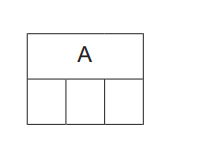
Letter 'A' in a top rectangle above three equal smaller rectangles aligned horizontally. The design resembles a simple organisational chart.
13b
4 marks

Draw a Gantt chart (cascade diagram) for the project.

Grid paper with small squares, bordered in white. Lines are evenly spaced, forming a regular pattern, often used for mathematics or design.
13c
3 marks

The toy company has been warned that bad weather may cause the delivery of the packaging to take longer than the expected 23 days.

(i) What is the float, in days, for activity I (Deliver packaging)?

[1]

(ii) The company delivering the packaging estimates the probability of delay as follows.

Delay (days)

Probability

0

0.08

1

0.21

2

0.35

3

0.30

4 or more

0.06

Estimate the probability that the delivery of the toys to the supermarket will be delayed

[2]

  • 1

  • 14

  • 15

  • 23

14a
4 marks

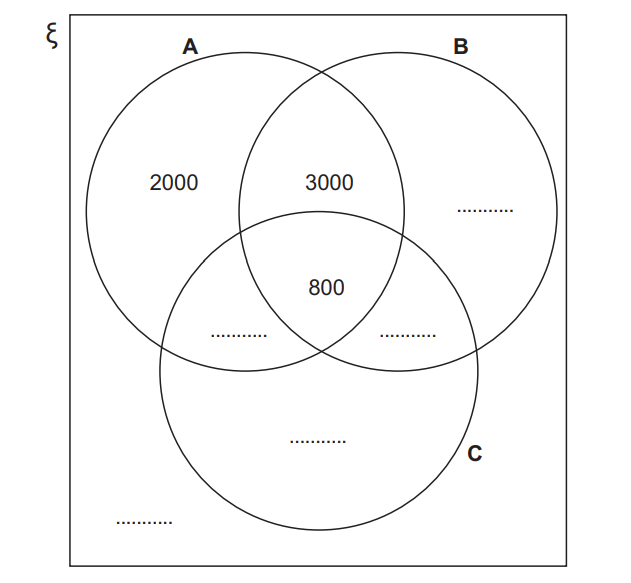
20 000 students enrolled at a university in 2017

Of these 20 000 students,

  • 6800 students were aged 25 or over

  • 10 800 students were female, and the rest were male

  • 4400 were non-UK students, with 2000 of these being female.

Complete the Venn diagram.

Key: A aged 25 or over
B female
C non-UK

Venn diagram with three overlapping circles labelled A, B, C; numbers: 2000 in A, 3000 in A-B overlap, 800 in all; three blank sections.
14b
1 mark

Use the Venn diagram to state how many male students from the UK aged under 25 enrolled at the university in 2017

14c
2 marks

A female student is chosen at random from the 20 000 students.

Work out the probability that she is aged under 25.
Give your answer as a fraction in its lowest terms.

14d
2 marks

Two students are chosen at random from the 20 000 students.

Work out the probability that one is a non-UK student and the other is from the UK.
Give your answer to two decimal places.

15a
2 marks

A company has two offices, Office A and Office B, at different locations.

The company carries out a survey into the main ways of travelling to work by employees at both offices.

The results are shown in the table below.

Main way of travelling to work

Number of employees

Office A

Office B

Bus

34

38

Train

57

50

Car

80

31

Bicycle

22

36

Walking

13

49

Other

25

11

An employee is chosen at random from all employees who travel to work by bus or train.

Calculate the probability that the employee is from Office A.

15b
2 marks

One of the offices is in the centre of a town. The other office is in a business park, 10 miles outside the town.

State which office, A or B, is more likely to be in the centre of the town.

Give a reason for your answer.

16a
1 mark

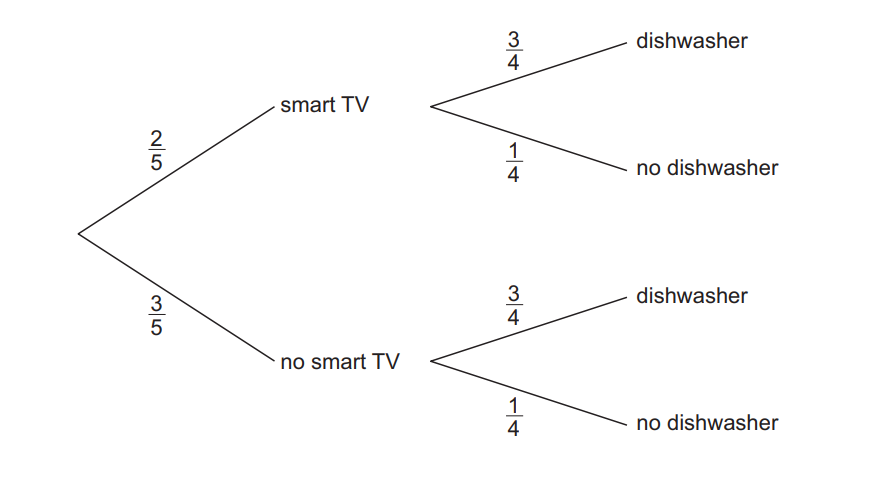
Hugo asks 40 students at his school if they have at home:

  • a smart TV
    a dishwasher.

He uses their answers to construct the tree diagram below.

Probability tree diagram showing choices between owning a smart TV or not, and then having a dishwasher or not, with respective probabilities.

Hugo claims that, for these students, “having a smart TV” and “having a dishwasher” are independent.

Explain why Hugo’s claim is correct.

16b
3 marks

In Hugo’s school there are 1220 students.

(i) Estimate the number of students in Hugo’s school who have neither a smart TV nor a dishwasher at home.

[2]

(ii) State one assumption you made in the above question

[1]

17a
3 marks

Statisticians collect data on the number of points won by tennis players when they are serving.

If the player gets their first serve in, they have a chance to win the point on their first serve.

If the player does not get their first serve in, they get a second serve and have a chance to win the point on that serve.

A statistician uses data about the tennis player Venus Williams to work out the probabilities in the table.

Event

Probability

Venus gets her first serve in

0.68

Venus wins the point if she gets her first serve in

0.80

Venus wins the point if she does not get her first serve in

0.49

Work out the probability of Venus Williams winning the point when she is serving.

17b
1 mark

For a particular tournament, a tennis racket manufacturer offers Venus Williams a bonus payment of 50 y dollars, where y percent sign is the percentage of points that she wins when she is serving.

Estimate the expected bonus payment that Venus Williams receives.

17c
4 marks

The statistician works out the following probabilities for another tennis player, Johanna Konta, when she is serving.

Event

Probability

Johanna gets her first serve in

0.66

Johanna wins the point if she gets her first serve in

0.75

Johanna wins the point if she does not get her first serve in

x

The probability of Johanna Konta winning the point when she is serving is 0.69
Calculate the value of x, giving your answer to two significant figures.