Cell Potential & Thermodynamic Favorability (College Board AP® Chemistry): Study Guide

Cell potential & thermodynamic favorability
Standard electrode potential
The position of equilibrium and therefore the electrode potential depends on factors such as:
Temperature
Pressure of gases
Concentration of reagents
So, to be able to compare the electrode potentials of different species, they all have to be measured against a common reference or standard
Standard conditions also have to be used when comparing electrode potentials
These standard conditions are:
Solutions at a concentration of 1 M
Gases at a pressure of 1 atm (or 1 bar)
Pure solids and liquids; standard potentials are usually tabulated at 298 K
Standard measurements are made using a high resistance voltmeter so that no current flows and the maximum potential difference is achieved
The electrode potentials are measured relative to a standard hydrogen electrode
Standard electrode potentials
The standard hydrogen electrode is given a value of 0.00 V, and all other electrode potentials are compared to this standard
This means that the electrode potentials are always referred to as standard electrode potentials (E°)
The standard electrode potential (E°) is the potential difference (sometimes called voltage) produced when a standard half-cell is connected to a standard hydrogen electrode under standard conditions
For example, the standard electrode potential of bromine suggests that relative to the hydrogen half-cell it is more likely to get reduced, as it has a more positive E° value
Br2 (l) + 2e− ⇌ 2Br− (aq) E° = +1.09 V
2H+ (aq) + 2e− ⇌ H2 (g) E° = 0.00 V
The standard electrode potential of sodium, on the other hand, suggests that relative to the hydrogen half-cell it is less likely to get reduced as it has a more negative E° value
Na+ (aq) + e− ⇌ Na (s) E° = −2.71 V
2H+ (aq) + 2e− ⇌ H2 (g) E° = 0.00 V
Once the E° of each half-cell is known, the cell potential (voltage) of an electrochemical cell made up of any two half-cells can be calculated
These could be any half-cells, and neither has to be a standard hydrogen electrode
The half-cell with the more positive E° is reduced
This is the cathode
The half-cell with the less positive E° is oxidized
This is the anode
How to calculate E°cell
The standard cell potential is E°cell = E°cathode − E°anode, using the standard reduction potential of each half-reaction
The cathode is the half-reaction that is reduced (the more positive E°)
The anode is the half-reaction that is oxidized
For example, in a cell made from a silver half-cell (E° = +0.80 V) and a copper half-cell (E° = +0.34 V):
Silver ions are reduced at the cathode
Copper is oxidized at the anode
E°cell = E°cathode − E°anode
E°cell = (+0.80) − (+0.34) = +0.46 V
Worked Example
Calculating the standard cell potential
Calculate the standard cell potential for the electrochemical cell below, in which both solutions are 1.00 M. The half-equations are as follows:
Cu2+ (aq) + 2e− ⇌ Cu (s) E° = +0.34 V
Zn2+ (aq) + 2e− ⇌ Zn (s) E° = −0.76 V

Answer:
Cu2+/Cu has the more positive E°, so Cu2+ is reduced at the cathode and Zn is oxidized at the anode.
Write the equation:
E°cell = E°cathode − E°anode
Substitute the values:
E°cell = (+0.34) − (−0.76)
E°cell = +1.10 V
The voltmeter will therefore give a value of +1.10 V
Examiner Tips and Tricks
Identify the anode as the electrode where oxidation happens and the cathode as where reduction happens.
Do not decide by position. For example, “the anode is on the left” earns no credit.
Reverse only the half-reaction that is oxidized, and never multiply E° by a coefficient.
Thermodynamic favorability
The E° values of a species indicate how easily it is oxidized or reduced
The more positive the E°, the more easily the species on the left of the half-equation is reduced, so that half-reaction tends to go forward
The less positive the E°, the more easily the species on the right of the half-equation is oxidized, so that half-reaction tends to go backward
A cell reaction is thermodynamically favored when E°cell is positive
For example, two half-cells in the following electrochemical cell are:
Cl2 (g) + 2e− ⇌ 2Cl− (aq) E° = +1.36 V
Cu2+ (aq) + 2e− ⇌ Cu (s) E° = +0.34 V
Cl2 molecules are reduced as they have the more positive E° value
The chemical reaction that occurs in this half-cell is:
Cl2 (g) + 2e- → 2Cl- (aq)
Cu atoms are oxidized, because the Cu2+/Cu half-reaction has the less positive E° value
The chemical reaction that occurs in this half-cell is:
Cu (s) → Cu2+ (aq) + 2e-
The overall equation of the electrochemical cell is (after cancelling out the electrons):
Cu (s) + Cl2 (g) → 2Cl- (aq) + Cu2+ (aq)
The forward reaction is thermodynamically favored, as it has a positive E°cell of +1.02 V
Calculated from (+1.36) - (+0.34)
The backward reaction is thermodynamically unfavored, as it has a negative E°cell of −1.02 V
Calculated from (+0.34) - (+1.36)
A cell containing Cu2+/Cu and Cl2/2Cl–
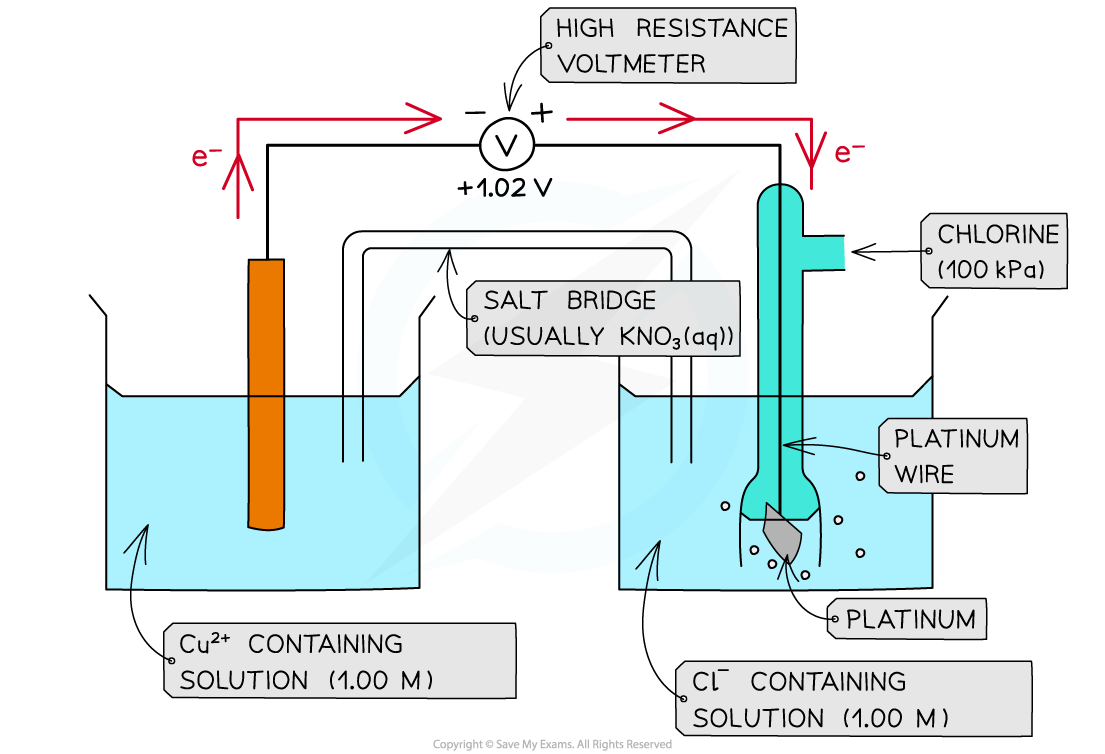
A cell reaction is thermodynamically favored when its standard cell potential, E°cell, is positive
Unfavored reactions and applied voltages
For thermodynamically favored reactions:
ΔG° is negative
E°cell is positive
Conversely, for thermodynamically unfavored reactions:
ΔG° is positive
E°cell is negative
So, an external voltage is needed to drive the reaction
This is the case with electrolytic cells that involve a thermodynamically unfavored reaction, so an external voltage must be applied
To find the minimum external voltage, calculate E°cell, which is negative for an electrolytic reaction
The applied voltage must be greater than its magnitude (for E°cell = −1.23 V, more than 1.23 V)
In real-world systems, the required voltage may exceed the magnitude of the calculated E°cell due to:
Overpotentials: Kinetic barriers associated with electron transfer at the electrodes
Resistance: Losses from the solution resistance or electrode inefficiencies
Thus, the practical voltage applied might be slightly higher than the magnitude of E°cell to ensure the reaction proceeds efficiently
Worked Example
The decomposition of water into hydrogen and oxygen in an electrolytic cell:
2H2O (l) → O2 (g) + 4H+ (aq) + 4e−
(the reverse of O2 (g) + 4H+ (aq) + 4e− → 2H2O (l), E° = +1.23 V)
This reaction involves two half-reactions:
Oxidation at the anode (oxygen evolution):
2H2O (l) → O2 (g) + 4H+ (aq) + 4e−
(the reverse of O2 (g) + 4H+ (aq) + 4e− → 2H2O (l), E° = +1.23 V)
Reduction at the cathode (hydrogen evolution):
4H+ (aq) + 4e− → 2H2 (g) E° = 0.00 V
Determine whether an applied voltage of 1.0 V is sufficient for the reaction to occur.
Answer:
For the overall reaction in an electrolytic cell, the net cell potential is given by:
E°cell = E°cathode − E°anode
Here:
E°cathode = the standard reduction potential of the cathode half-reaction (H+/H2), 0.00 V
E°anode = +1.23 V (the standard reduction potential of O2/H2O; do not change its sign)
Substitute the values:
E°cell = 0.00 − (+1.23) = −1.23 V
This negative value means the reaction is thermodynamically unfavored, as expected for an electrolytic process.
The applied voltage must be greater than 1.23 V (the magnitude of E°cell), so 1.0 V is not sufficient for the reaction to occur.
Cell potential & Gibbs free energy
The standard free energy change can be calculated using the standard cell potential of an electrochemical cell
ΔG° = −nFE°cell
ΔG° = standard Gibbs free energy change
n = number of electrons transferred in the reaction
E°cell = standard cell potential (V)
F = Faraday constant (96,485 C mol−1)
Worked Example
Calculating the standard Gibbs free energy change
Calculate the standard Gibbs free energy change for the following electrochemical cell:
2Fe3+ (aq) + Cu (s) → 2Fe2+ (aq) + Cu2+ (aq)
Answer:
Step 1: Write the two half-equations and their standard reduction potentials (in the exam, these are given in the question):
Fe3+ (aq) + e− ⇌ Fe2+ (aq) E° = +0.77 V
Cu2+ (aq) + 2e− ⇌ Cu (s) E° = +0.34 V
Step 2: Calculate E°cell
E°cell = E°cathode − E°anode
E°cell = (+0.77) − (+0.34)
E°cell = +0.43 V
Step 3: Determine the number of electrons transferred in the reaction
The Cu2+/Cu half-reaction has the smaller E° value, so Cu is oxidized
It transfers two electrons to two Fe3+ ions
Each Fe3+ ion accepts one electron, so the total number of electrons transferred is two
Step 4: Substitute the values into the standard Gibbs free energy equation
ΔG° = −nFE°cell
ΔG° = −2 × 96,485 × (+0.43)
ΔG° = −82,977.1 J mol−1 = −83 kJ mol−1
Examiner Tips and Tricks
E° does not change when you multiply a half-equation to balance electrons
Fe3+ + e− → Fe2+ has E° = +0.77 V
2Fe3+ + 2e− → 2Fe2+ also has E° = +0.77 V
The coefficients go into n in ΔG° = −nFE°, never into E°.

Unlock more, it's free!
Join the 100,000+ Students that ❤️ Save My Exams
the (exam) results speak for themselves:

Was this revision note helpful?
Build on this topic