1
5 marks
Analyse one way in which ethics may influence the activities of a business.
Was this exam question helpful?
Exam code: 9609
Analyse one way in which ethics may influence the activities of a business.
Was this exam question helpful?
Analyse two reasons why it is important for a business to set SMART objectives.
Evaluate the view that a mission statement is only important to a bank if it significantly influences the strategy and tactics of that business.
Was this exam question helpful?
Charlie’s Chocolates (CC)
CC is a large public limited company that manufactures a wide range of chocolate bars. Production takes place in low wage countries so that costs can be kept low. CC has suffered recently from poor publicity due to the high levels of sugar used in the production of its chocolate. A national newspaper has recently published an article about how CC exploits employees in low wage countries. The Marketing Director, Alan, is aware of recent trends showing that consumers are becoming more ethical in their buying decisions. He thinks this might explain why sales decreased by 10% last year.
He has asked to meet with the Managing Director, Ikram, to discuss a major change towards more ethical production methods. This could mean re-locating production back to the home country. This will increase costs and involve the recruitment of additional employees. In response to recent Government guidelines to improve health, Alan wants to decrease the amount of sugar used in the chocolate bars.
Alan is also thinking about the financial accounts for this year that he received this morning from Ikram (see Table 1 and Table 2).
Table 1 – Extract from Income Statement
$000s | |
Revenue | 7000 |
Cost of sales | 4150 |
Gross profit | 2850 |
Profit for the year | 1350 |
Retained earnings | 565 |
Table 2 – Extract from Statement of Financial Position
$000s | |
Non-current assets | 3000 |
Current assets | 900 |
Current liabilities | 400 |
Working capital | 500 |
Net assets | 3500 |
With sales declining from last year, Alan has to think carefully about the next steps for marketing. He knows that the product range is of good quality – the problem is the poor image of the company. For example, he is aware that a local consumer group is trying to organise a demonstration outside one of CC’s factories in the next few weeks.
Discuss the factors that CC should consider in making a decision on whether or not to become a more ethical business.
Was this exam question helpful?
Evaluate whether DL should consider corporate social responsibility in its decision-making.
Was this exam question helpful?
Analyse two reasons why a business should set SMART objectives.
‘Ethics should always influence the human resource management (HRM) activities of a mining business.’
Evaluate this view.
Was this exam question helpful?
Delicious Cocoa (DC)
DC is a co-operative owned by cocoa farmers in country X. It has 500 workers. In 2022, DC produced 2000 tonnes of raw cocoa beans. Productivity is expected to increase by 5% in 2023. Although DC is profitable, it has no retained earnings.
DC focuses on the triple bottom line as its main objective. The members of the co-operative (farmers) are motivated within the current operation.
Zara, the Managing Director, has recently completed a workforce plan. She has identified that young people do not want to work on DC’s farms. Their concerns are:
lack of investment in training
most of the work is manual
lack of control over earnings.
Ranjit, the Operations Director, has identified an opportunity to create added value by investing in a capital intensive factory.
The factory will process raw cocoa beans produced by DC’s farms into cocoa butter. Cocoa butter is a premium product and attracts higher profit margins than raw cocoa beans. The processing factory will require a significant capital investment (see Table 2.1).
Table 2.1 Data for the cocoa processing factory
$ | |
Initial investment: | 100 000 |
Average variable costs per tonne | 5 000 |
Average selling price per tonne | 10 000 |
Identify one element of the triple bottom line.
Was this exam question helpful?
Define the term ‘corporate social responsibility’ (CSR).
Explain two disadvantages to a business of having CSR as a business objective.
Was this exam question helpful?
Motorcycle Components (MC)
MC is a large public limited company that produces a range of components used by motorcycle manufacturers. MC’s mission statement is ‘to be the world leader in delivering quality motorcycle components to our customers’.
The motorcycle component industry is very competitive and MC’s customers expect high quality and a short lead time. MC operates a Just in Time (JIT) inventory control system. MC’s good relationships with its suppliers ensure that JIT operates efficiently. The production workers at MC are highly skilled and the business benefits from a low labour turnover.
Liquidity management is very important in the motorcycle component industry. The industry average for the acid test ratio is 1. A summary of some key data for MC has been prepared by the Finance Director, as shown in Table 2.1.
Table 2.1: Summary financial data as at 30 April 2022 ($ million)
Trade receivables | 26 |
Cash | 19 |
Inventory | 1 |
Trade payables | 30 |
Other current liabilities | 20 |
The Operations Director, Jay, is proposing new capital expenditure of $4 million. Jay thinks that automation of the production process will have significant financial benefits for MC. He wishes to gain approval from the Board of Directors to implement a process innovation project. Jay believes that, with good communication and the involvement of employees, he can effectively manage the project.
Explain the term ‘mission statement’ (line 2).
Was this exam question helpful?
Read the following extract before answering
Analyse two benefits to HD of increasing its focus on corporate social responsibility (CSR).
Was this exam question helpful?
Rehana Recycles (RR)
Rehana is very environmentally aware. One year ago, Rehana identified a business opportunity to reuse waste products and set up Rehana Recycles (RR) as a sole trader.
A local company sells bottled drinks and reuses the empty glass bottles that are returned by customers. It cannot reuse any damaged bottles, so they are dumped as waste. Rehana asked this company if she could have the damaged glass bottles. The company agreed she could have them at no cost.
RR melts down the glass and makes unique vases and other glassware products. RR’s mission statement is ‘Make waste beautiful’. Rehana markets her products as ‘Lovely for the planet, lovely for you’. The business has a strong local brand image. Rehana has recently invested in marketing which focuses on her unique selling point of recycling waste.
To help satisfy demand, Rehana recently employed two local artists who are also very environmentally aware. They are skilled in making handmade glass jewellery. RR currently makes handmade products using job production.
Rehana has a democratic leadership style. Rehana has produced some financial data shown in Table 1.1.
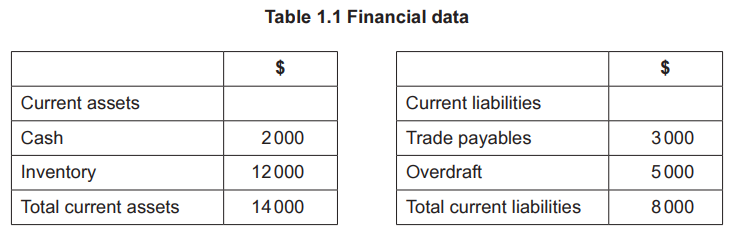
As demand has grown, Rehana needs to increase her output. Rehana has identified two ways of increasing output. She could either:
keep using job production and employ more artists to create unique glassware products using the RR brand, or
change to batch production and make a larger number of standardised glassware using the RR brand.
Define the term ‘mission statement’ (line 7).
Was this exam question helpful?
Auto Bike (AB)
AB is a private limited company that repairs and maintains motorbikes. AB has nine garages in country J and employs eight highly qualified mechanics in each garage.
Two of the most popular motorbike services that AB sells are the standard service and the advanced service. Table 2.1 contains price and cost information for these services.
Table 2.1: Price and cost information
Price | Direct costs per service | Allocated indirect costs per service | |
Standard service | $250 | $50 | $60 |
Advanced service | $400 | $60 | $100 |
In April, AB sold 1000 standard services and 200 advanced services. The profit margin for an advanced service is higher than the standard service. The directors have decided to promote the advanced service to try and increase sales. Each garage has been given a budget to use for below the line promotion methods with an objective of increasing sales of advanced services in the next six months.
The level of motivation of the mechanics is low. Many mechanics believe that they are not paid well and the conditions of work are dirty and noisy. AB uses a time-based payment method which rewards each mechanic at the same hourly rate. In a recent survey, many mechanics complained that the payment method was unfair. They believe it rewards ‘lazy workers’ as much as those who work hard. It also does not take into account the difficulties involved in some jobs and the simplicity of others. The Human Resources Director has been asked to investigate a new payment method.
Define the term ‘objective’ (line 13).
Was this exam question helpful?
Super Candy (SC)
SC is a large public limited company that sells low-sugar candy (sweets) with natural flavourings. The candy is made using flow production in SC’s four large factories in country T.
SC uses psychographic market segmentation when planning its marketing mix.
SC has completed some secondary market research using published accounts. The data is about one of SC’s main competitors, Organic Kandy (OK) and compares the results with data about SC (see Table 2.1). OK is in the same market as SC.
Table 2.1: Secondary market research about OK and SC for 2020
OK | SC | |
Revenue | $60m | X |
Market share by revenue | 40% | 34% |
Different varieties of candy | 12 | 18 |
Main channels of distribution | Wholesalers | Wholesalers |
Target market(s) | Mass market | People with interests in:
|
There have been a number of media reports in country T about the increasing importance of corporate social responsibility (CSR). A large food manufacturing business in country T recently lost many customers due to reports about its use of plastic packaging.
The directors of SC are particularly concerned about this trend because of SC’s use of plastic in its packaging. The marketing department has been told to conduct some primary market research on this issue. The directors are planning to discuss making CSR a new business objective for SC.
Evaluate the benefits to SC of having corporate social responsibility (CSR) as a business objective.
Was this exam question helpful?
Read the following extract before answering
Discuss whether JGS should maintain high standards of corporate social responsibility (CSR).
Was this exam question helpful?
Read the following extract before answering
Analyse the likely impact on HBG’s costs and revenues of increasing its focus on corporate social responsibility (CSR).
Was this exam question helpful?
Analyse why mission statements are important to many businesses.
Discuss why the shareholders of a public limited company might not support corporate social responsibility (CSR) as a business objective.
Was this exam question helpful?
UPlane Components (UC)
UC is a private limited company providing engine parts for commercial aircraft. It uses batch production in factory A and flow production in factory B. As part of UC’s commitment to corporate social responsibility (CSR), it provides a training scheme for the long-term unemployed, based in factory A.
UC’s products are sold to aircraft engine manufacturers. Demand for aircraft engines has increased by 45% over recent years. The aircraft engine manufacturers want inventory just when needed and are demanding a reduction in prices.
In 2017, UC opened factory B which is 5km away from factory A. Factory B has a high level of automation, resulting in low unit costs for the parts produced there. Production is capital intensive. UC has a plan to automate factory A. The production workers are not happy about this proposal and have asked for more details. The workers’ representatives have asked for a meeting with the human resource manager.
In December 2019 a fault was discovered in one of the engine components supplied by UC and produced in factory A. UC had to recall 2000 parts at a cost of $200000. This has had an impact on part of its triple bottom line and UC is unlikely to meet its targets. Table 1.1 shows some financial data for UC.
Table 1.1: Financial data for UC
Year ending 30 November 2019 ($m) | Year ending 30 November 2020 ($m forecast) | |
Revenue | 5.8 | 6.4 |
Cost of sales | 2.3 | 3.4 |
Expenses | 1.3 | 1.6 |
Cost of recall | - | 0.2 |
Amjit, the human resource manager, believes that the fault was caused by the negligence of Jack, one of the production supervisors. Jack claims that he was made to work overtime to try and meet production targets. This caused him to become tired and make a mistake in one batch of parts. Amjit wants to dismiss Jack.
(i) Define the term ‘corporate social responsibility (CSR)’ (line 3).
[2]
(ii) Explain the term ‘triple bottom line’ (line 15).
[3]
Was this exam question helpful?
Electric Cars (EC)
EC is a public limited company producing electric cars. Market research suggests that electric cars are in the early stage of the product life cycle. The demand for electric cars is likely to increase substantially in the next 10 years. EC is based in country X, where it is one of three electric car manufacturers. However, other manufacturers could start to produce electric cars if the forecast market growth is correct.
EC’s promotion has only been aimed at high income groups. The government of country X recently announced that it will support the use of electric cars. This will help EC to achieve its objective to increase sales volume by 50% over the next two years.
One year ago, EC invested $10m in new production facilities. The investment was funded by a long-term bank loan. Interest payments on the bank loan have reduced EC’s profit margin from 9% to 4%. EC will need to cut unit costs through increased efficiency.
EC initially launched its cars using a price skimming strategy but sales growth has been slow. If EC can achieve a 50% growth in sales over the next two years, it will be in a strong financial position. This means it will be able to spend more on the development of a larger product portfolio of electric cars.
Jancie, the Finance Director, has produced forecasts for EC’s financial data over the next two years, as shown in Table 2.1.
Table 2.1: Extract from EC’s forecast financial data
2020 ($m) | 2021 ($m) | |
Inventories | 30 | 50 |
Cash | 10 | 20 |
Trade receivables | 10 | 20 |
Trade payables | 25 | 30 |
Current ratio | 2 | X |
Analyse two reasons why clear business objectives are important for EC.
Was this exam question helpful?
Read the following extract (lines 5–7) before answering
Analyse the benefits to C4T of its two social objectives.
Was this exam question helpful?