12 marks
Define the term ‘secondary research’.
Was this exam question helpful?
Exam code: 9609
Define the term ‘secondary research’.
Was this exam question helpful?
Barbecue House (BH)
BH is a fast food restaurant and takeaway business, which sells a range of burgers, kebabs, pizzas and side orders. BH also has a delivery service to the local area.
BH is owned by Amir who mortgaged his home to finance the start-up of the business. Amir operates BH as a sole trader. His son also works within the business as a chef. Amir has been advised to change the legal structure of BH and to become a private limited company to protect the business and himself.
BH is located on a busy high street. There are many other similar businesses on the high street and in the surrounding area. Amir knows that the continued success of the business requires him to identify a gap in the market and develop a unique selling point (USP). Amir has carried out some market research (see Table 1.1 and Fig. 1.1).
Table 1.1: Market research data about competitors within 2 km of BH
Total number of competitors | 8 |
Number of competitors who offer delivery services | 4 |
Number of competitors who do not sell Asian food | 6 |
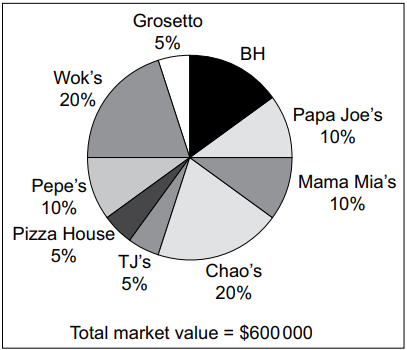
Fig. 1.1: Market share data for competitors within 2 km of BH
The two market leaders are Wok’s and Chao’s. Both businesses specialise in Asian food but neither has a delivery service. Amir would like to increase BH’s market share. He is considering starting to sell Asian food. None of his employees have any experience cooking or selling Asian food but Amir believes that the possible increase in income would be worth any extra costs.
Explain one reason why Amir carried out market research.
Was this exam question helpful?
Super Candy (SC)
SC is a large public limited company that sells low-sugar candy (sweets) with natural flavourings. The candy is made using flow production in SC’s four large factories in country T.
SC uses psychographic market segmentation when planning its marketing mix.
SC has completed some secondary market research using published accounts. The data is about one of SC’s main competitors, Organic Kandy (OK) and compares the results with data about SC (see Table 2.1). OK is in the same market as SC.
Table 2.1: Secondary market research about OK and SC for 2020
OK | SC | |
Revenue | $60m | X |
Market share by revenue | 40% | 34% |
Different varieties of candy | 12 | 18 |
Main channels of distribution | Wholesalers | Wholesalers |
Target market(s) | Mass market | People with interests in:
|
There have been a number of media reports in country T about the increasing importance of corporate social responsibility (CSR). A large food manufacturing business in country T recently lost many customers due to reports about its use of plastic packaging.
The directors of SC are particularly concerned about this trend because of SC’s use of plastic in its packaging. The marketing department has been told to conduct some primary market research on this issue. The directors are planning to discuss making CSR a new business objective for SC.
Explain one possible disadvantage to SC of using secondary market research.
Was this exam question helpful?
The Shop (TS)
Thomas worked for 30 years as a manager of a factory. Although he was very good at his job he was recently made redundant.
Thomas always wanted to open a shop. He thinks he has the qualities an entrepreneur is likely to need for success. He has undertaken some primary market research to identify possible opportunities in city X where he lives (see Fig. 1.1).
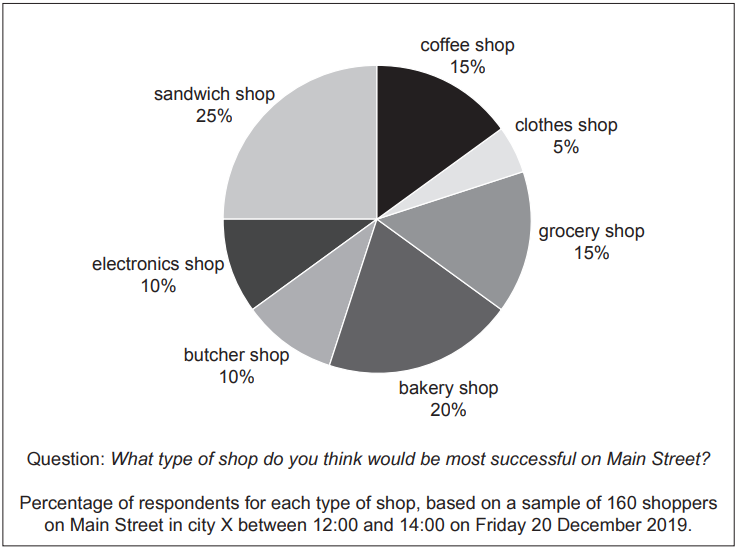
Fig. 1.1: Market research
Thomas now needs to make a decision about which type of shop to open. He has used the data in Fig. 1.1 and some secondary market research to identify two options.
Option 1: Coffee shop
The coffee shop would provide hot drinks that customers could take away and drink elsewhere. It would also sell some bakery items, such as biscuits and doughnuts. There are four other shops selling takeaway hot drinks and bakery items in the city, as well as five cafés. Thomas thinks that the profit margin would be 6% to 8%.
Option 2: Sandwich shop
The sandwich shop would make sandwiches using job production. Customers can choose from a range of sandwich fillings, as well as cold drinks and snacks. There is only one competitor in the city. It is a well-known international franchise that spends a lot of money on promotion. Thomas thinks that the profit margin would be 10% to 15%.
Explain the term ‘primary market research’.
Was this exam question helpful?
Explain one advantage to a business of using primary market research data.
Was this exam question helpful?
Explain one disadvantage to a business of using sampling in primary market research.
Was this exam question helpful?
Explain one benefit of using secondary market research for a business.
Was this exam question helpful?
Define the term 'sampling'.
Was this exam question helpful?
Marigold
Marigold makes natural skincare products in country J. Before launching a new face cream, it surveyed 40 shoppers as they left its own city-centre store. The survey asked: "Would you buy our excellent new face cream?" 92% answered yes. Marigold then produced 20 000 units. Six months later, more than half remained unsold.
Explain one reason why the market research data collected by Marigold may not be reliable.
Was this exam question helpful?
Pinehurst
Pinehurst produces frozen ready meals in country R. Sales of its vegetarian range fell by 18% last year, while sales of its meat range rose by 4%. Pinehurst's sales records show exactly how many meals were sold each month, but the marketing manager cannot tell from them why customers stopped buying the vegetarian meals. She has suggested holding small group discussions with customers.
Explain one benefit to Pinehurst of collecting qualitative data as well as quantitative data.
Was this exam question helpful?
Sandpiper
Sandpiper sells camping equipment in country H. It commissioned research into the camping equipment market in country H.
Table 1: Camping equipment market in country H
| 2023 | 2025 |
Number of customers | 240 000 | 288 000 |
Average annual spend per customer ($) | 85 | 95 |
Using Table 1, calculate the percentage growth in the size of the camping equipment market in country H between 2023 and 2025.
Was this exam question helpful?
Bellview Dental
Bellview Dental operates six dental practices in country W and is considering opening evening clinics. To gauge demand it surveyed 60 patients, all of whom attended appointments between 9am and 11am on weekdays. 31% said they would use an evening clinic, and on this basis the directors decided not to proceed.
The practice manager has pointed out that patients able to attend a weekday morning appointment are the least likely to need evening opening. Bellview Dental's patient list contains 9 400 people.
Analyse two problems that Bellview Dental's unrepresentative sample could cause for the business.
Was this exam question helpful?
Woodpecker Toys
Woodpecker Toys manufactures wooden toys in country L and plans to launch a range for children aged one to three. It has free access to government reports on birth rates and household spending on toys in country L.
It is also considering running trials in which families test prototype toys at home for a month. Woodpecker Toys has limited funds, and its owner wants to know whether to use both types of research or only one.
Analyse the benefits to Woodpecker Toys of using both primary and secondary research before launching its new range.
Was this exam question helpful?
Inkwell Press
Inkwell Press publishes books in country T. Sales of its printed novels have fallen while its audiobook sales have risen, but the business has never collected data on who its readers are.
A consultant has recommended building customer profiles covering age, income, reading habits and preferred format. Inkwell Press plans to launch a new crime series next year.
Analyse two ways in which building detailed customer profiles could help Inkwell Press launch its new crime series.
Was this exam question helpful?
Selkirk
Selkirk hires cars in country G and is deciding whether to open a branch at a new airport terminal. Government tourism statistics give passenger numbers at the airport, forecast passenger growth, and average visitor length of stay. Industry reports list the car hire firms already operating there.
Selkirk has three months to decide before the retail units at the terminal are allocated.
Analyse two benefits to Selkirk of using secondary research when deciding whether to open a branch at the new airport terminal.
Was this exam question helpful?
Discuss the usefulness of secondary market research to a business planning to launch a new luxury perfume.
Was this exam question helpful?
Discuss the usefulness to a furniture retailer of using secondary market research when planning to enter a new market.
Was this exam question helpful?
Discuss whether a successful soft drinks business needs to continue to carry out market research.
Was this exam question helpful?
Saffron Kitchen
Saffron Kitchen operates 12 restaurants in country D. It is considering adding a vegetarian menu across all sites. To test the idea, the marketing team surveyed 50 diners at one restaurant on a Friday evening; 68% said they would order from a vegetarian menu at least once a month.
Repeating the survey at all 12 restaurants across different days would cost $9 000 and delay the launch by three months. The finance director argues the existing result is clear enough and that competitors are already adding vegetarian dishes. The marketing director argues that 50 diners at one site on one evening cannot represent all of Saffron Kitchen's customers.
Evaluate whether Saffron Kitchen should increase the size of its sample before launching the new vegetarian menu.
Was this exam question helpful?
Copperleaf
Copperleaf manufactures wooden furniture in country M and sells through independent retailers. It is considering selling directly to customers online.
Free government trade reports show that online furniture sales in country M grew by 22% last year. Copperleaf's marketing manager wants to commission primary research: a survey of 800 households and six focus groups, costing $40 000 and taking four months. The managing director points out that the secondary data is free, already available and shows clear growth. Copperleaf's profit last year was $310 000.
Evaluate whether Copperleaf should commission primary market research before deciding to sell directly to customers online.
Was this exam question helpful?
Redwing
Redwing manufactures sports footwear in country F. It commissioned an agency to research a new running shoe. The agency surveyed 1 200 people at three city sports events. 74% rated the shoe 'good' or 'excellent' and 61% said they would pay $85 for it. Redwing is considering investing $600 000 in production.
The operations director has noted two concerns: everyone surveyed was already attending a sports event, and the shoe was shown only as a prototype in a single colour. Two weeks after the research finished, a rival launched a similar running shoe priced at $70.
Evaluate the extent to which Redwing should rely on its market research findings when deciding whether to invest $600 000 in the new running shoe.
Was this exam question helpful?
Tansy Foods
Tansy Foods produces pet food in country K. Its best-selling range competes mainly on low price. The marketing team surveyed 500 pet owners and asked which feature they considered most important when choosing pet food.
Table 1: Feature ranked most important by pet owners in country K
Feature | 2023 (%) | 2025 (%) |
Price | 41 | 33 |
Natural ingredients | 22 | 35 |
Brand familiarity | 25 | 19 |
Packaging size | 12 | 13 |
Reformulating the range to use natural ingredients would raise Tansy Foods' costs per bag by 18%.
Using Table 1, evaluate whether Tansy Foods should reformulate its pet food range to emphasise natural ingredients.
Was this exam question helpful?
Stonebridge Fitness
Stonebridge Fitness operates fitness studios in country B and is considering entering a new region. Research shows the fitness market in that region grew by 14% last year and is forecast to grow by 9% next year.
Three national chains already operate in the region and hold 71% of the market between them; two have opened new sites in the past year. The region has one gym for every 2 400 residents, compared with one for every 4 100 residents in Stonebridge Fitness's current region. The finance director argues that 14% growth makes entry attractive.
Evaluate whether market growth is the most important feature Stonebridge Fitness should research before entering the new region.
Was this exam question helpful?