Enterprise (Cambridge (CIE) A Level Business): Exam Questions

Exam code: 9609

2 hours19 questions
1
3 marks

Case Study

Designer Clothing (DC)

DC is a medium-sized private limited company. It has been trading for 10 years. DC makes luxury dresses for women using job production methods. DC has an excellent reputation for quality. A DC designer has a meeting with every customer to design a dress that satisfies the customer’s individual needs, including choice of fabric and colour. Cost-based pricing is used with 50% added to the average cost of each dress.

DC’s employees are highly skilled and paid hourly rates (a time-based method). Ikram, one of the designers, has just had a meeting with a new customer, Lydia. Lydia wants Ikram to design and make a new dress for her. Ikram has worked out the production data shown in Table 2.1 for the dress.

Table 2.1: Production data for the dress for Lydia

Production time

20 hours

Hourly rate

$10

Material costs

$250

Indirect cost allocation

$25

Other costs such as packaging

$25

Jenny, the Managing Director, wants to use DC’s excellent reputation and move into a new market. Jenny wants to create a new range of DC branded trousers for women. Jenny has developed some elements of a marketing mix for the new trousers:

  • Product: quality trousers aimed at women aged 25–50

  • Distribution channel: sold in large shops

  • Promotion: branded with the DC logo

Jenny will develop a business plan when she receives the market research report, which includes feedback from a focus group. Jenny thinks that the pricing strategy DC currently uses will not be appropriate for the new trousers.

The new product range would use a batch production method. The Production Director, Khaleal, has identified the machinery needed for the new production method. Khaleal is worried about the problems that introducing the new production method might cause DC’s employees.

Explain the term ‘business plan’.

2
1 mark

Case Study

Great Resources (GR)

GR is a business partnership that creates educational resources. It sells direct to schools and teachers via its own website.

Sanjay, Rukmal and Boris are entrepreneurial teachers who formed the GR partnership. One year ago, they identified a gap in the market to supply interactive, digital resources. GR’s website is subscription only. An online marketing campaign, which used penetration pricing, attracted 250 subscribers in the first six months of operation. The start-up costs were financed with a $5000 bank overdraft, which is GR’s only debt.

Reviews for GR’s products in teaching journals are positive but cash flow is poor. Many customers have taken advantage of a recent sales promotion for one month’s free membership and posted positive reviews. Unfortunately, few have then taken out a regular subscription.

As revenue has not increased as much as the entrepreneurs had hoped, they must now consider alternative promotion methods. They have researched possible promotion methods and decided to advertise in an educational newspaper. The newspaper has a readership of half a million people.

Expert Materials (EM) is a large national company that also advertises in the newspaper. EM is GR’s closest competitor. The EM brand is well-known and trusted in the educational resources market. Table 1.1 shows some marketing data.

Table 1.1 Marketing data

GR

EM

Total market

Revenue ($000)

15

300

500

Number of customers

300

5000

7000

Annual advertising spend ($000)

7.5

45

60

Identify one barrier to entrepreneurship.

3
3 marks

Case Study

Delicious Cocoa (DC)

DC is a co-operative owned by cocoa farmers in country X. It has 500 workers. In 2022, DC produced 2000 tonnes of raw cocoa beans. Productivity is expected to increase by 5% in 2023. Although DC is profitable, it has no retained earnings.

DC focuses on the triple bottom line as its main objective. The members of the co-operative (farmers) are motivated within the current operation.

Zara, the Managing Director, has recently completed a workforce plan. She has identified that young people do not want to work on DC’s farms. Their concerns are:

  • lack of investment in training

  • most of the work is manual

  • lack of control over earnings.

Ranjit, the Operations Director, has identified an opportunity to create added value by investing in a capital intensive factory.

The factory will process raw cocoa beans produced by DC’s farms into cocoa butter. Cocoa butter is a premium product and attracts higher profit margins than raw cocoa beans. The processing factory will require a significant capital investment (see Table 2.1).

Table 2.1 Data for the cocoa processing factory

$

Initial investment:
Land
Machinery
Training


100 000
150 000
15 000

Average variable costs per tonne

5 000

Average selling price per tonne

10 000

Explain the term 'added value'.

4
4 marks

Case Study

Priya’s Bookshop (PB)

Priya lives in town R which is situated in beautiful countryside with nice walks nearby. Many tourists visit town R.

The town’s council would like town R to become branded as a ‘booktown’, a town with many bookshops selling new and used books. The council announced a new financial scheme offering grants to attract entrepreneurs willing to open a bookshop.

Priya applied for a grant to start up Priya’s Bookshop (PB). Part of her grant application included a cash flow forecast, shown in Table 1.1.

Table 1.1: Cash flow forecast, first three months of trading ($000)

Month 1

Month 2

Month 3

Cash in:

Owner’s capital

15

0

0

Grant

20

0

0

Revenue

4

6

11

Cash out:

Initial set up costs

20

0

0

Utilities (power, water etc)

0

0

2

Employee costs

1

1

3

Purchases

6

3

4

Marketing

10

5

4

Opening balance

0

2

-1

Closing balance

2

-1

X

Priya’s grant application was successful and she opened PB well aware of the need for both cash and profit.

Priya now wants to raise awareness of PB in town R. Priya did some market research and decided to use market segmentation. This will help her to decide on the promotional methods she could use for her bookshop. See Table 1.2.

Table 1.2: Age and gender of residents in town R

Age group (years)

Percentage of residents in age group

Percentage of age group who are female

0–15

19%

50%

16–64

63%

55%

65+

18%

60%

Explain two entrepreneurial qualities that Priya has shown.

5
2 marks

Case Study

Clever Televisions (CTV)

CTV is a public limited company that produces and sells televisions. It has been operating in country A for 30 years. CTV owns 3 factories and has over 100 employees. CTV’s factories use a combination of capital and skilled labour to produce the televisions. The leadership style in all the factories is autocratic. Employees’ pay is based on time worked each week.

The CTV brand is known for high‑quality and reliability. It targets high‑income customers. CTV uses price skimming when it launches a new product.

In total, 6 million televisions were sold in country A in 2019. Table 2.1 shows market growth data.

Table 2.1: Television sales in country A

Year

Market growth

2020

+2%

2021

+1%

2022

–3% (forecast)

The market for televisions in country A is very competitive and the business environment is dynamic. CTV plans to introduce a lower priced television brand to appeal to the mass market. This brand will be known as STV.

CTV has decided to introduce automation into one of its factories to produce the STV televisions. This will lead to redundancies in that factory.

The employees in the other two factories are concerned they might also face redundancy and so motivation is currently low. The Human Resources Director recommends that CTV should find ways in which employees can participate in the management and control of the business.

Define the term ‘capital’.

6
2 marks

Define the term ‘entrepreneur’.

7
2 marks

Define the term ‘opportunity cost’.

8
3 marks

Case Study

NaturaBite Foods (NF)

NaturaBite Foods (NF) is a private limited company in country G that produces organic snack foods, including energy bars, dried fruit mixes, and nut butters. NF sells its products to supermarkets and health food stores across country G. NF has built a strong brand with the slogan 'nothing artificial, nothing hidden'.

NF currently uses flow production to manufacture its products in large quantities. The production manager believes that switching to batch production will allow NF to produce a wider range of flavours and varieties, responding to changing customer preferences. However, the Finance Director has raised concerns about the cost of reorganising the production process.

NF employs 60 workers in one factory. The Production Manager believes there is significant room to improve labour productivity without increasing headcount. Table 2.1 shows NF's financial data for 2023.

Table 2.1: NF financial data 2023

Selling price per unit ($)

4.00

Variable cost per unit ($)

1.50

Total fixed costs ($)

75,000

Current annual output (units)

40,000

Maximum capacity (units)

55,000

Explain the term 'added value'.

9
3 marks

Case Study

Clever Televisions (CTV)

CTV is a public limited company that produces and sells televisions. It has been operating in country A for 30 years. CTV owns 3 factories and has over 100 employees. CTV’s factories use a combination of capital and skilled labour to produce the televisions. The leadership style in all the factories is autocratic. Employees’ pay is based on time worked each week.

The CTV brand is known for high‑quality and reliability. It targets high‑income customers. CTV uses price skimming when it launches a new product.

In total, 6 million televisions were sold in country A in 2019. Table 2.1 shows market growth data.

Table 2.1: Television sales in country A

Year

Market growth

2020

+2%

2021

+1%

2022

–3% (forecast)

The market for televisions in country A is very competitive, and the business environment is dynamic. CTV plans to introduce a lower-priced television brand to appeal to the mass market. This brand will be known as STV.

CTV has decided to introduce automation into one of its factories to produce the STV televisions. This will lead to redundancies in that factory.

The employees in the other two factories are concerned they might also face redundancy and so motivation is currently low. The Human Resources Director recommends that CTV should find ways in which employees can participate in the management and control of the business.

Explain what is meant by ‘the business environment is dynamic’.

10
4 marks

Explain two qualities of a successful entrepreneur.

11
4 marks

Explain two reasons why many new businesses fail in their first year of operation.

1
8 marks

Analyse two ways marketing could be used to add value to a product.

2
8 marks

Case Study

The Shop (TS)

Thomas worked for 30 years as a manager of a factory. Although he was very good at his job he was recently made redundant.

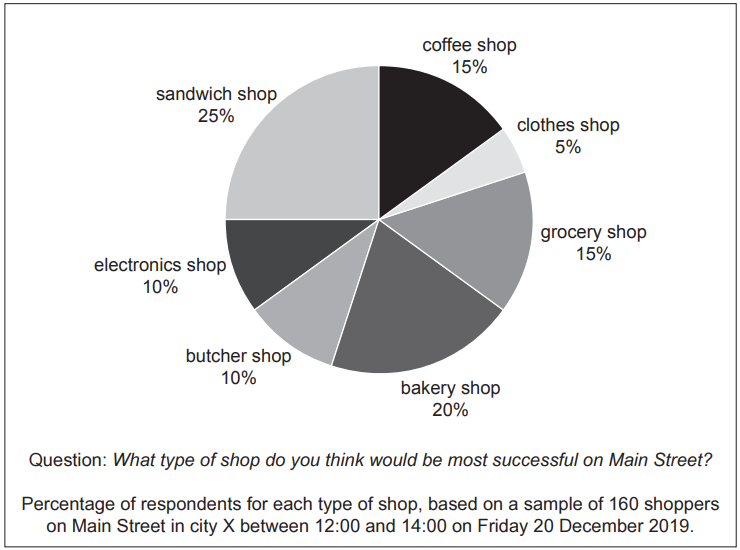
Thomas always wanted to open a shop. He thinks he has the qualities an entrepreneur is likely to need for success. He has undertaken some primary market research to identify possible opportunities in city X where he lives (see Fig. 1.1).

Pie chart showing shop preference: sandwich shop 25%, bakery shop 20%, coffee and grocery shops 15% each, electronics and butcher shops 10% each, clothes shop 5%.

Fig. 1.1: Market research

Thomas now needs to make a decision about which type of shop to open. He has used the data in Fig. 1.1 and some secondary market research to identify two options.

Option 1: Coffee shop
The coffee shop would provide hot drinks that customers could take away and drink elsewhere. It would also sell some bakery items, such as biscuits and doughnuts. There are four other shops selling takeaway hot drinks and bakery items in the city, as well as five cafés. Thomas thinks that the profit margin would be 6% to 8%.

Option 2: Sandwich shop
The sandwich shop would make sandwiches using job production. Customers can choose from a range of sandwich fillings, as well as cold drinks and snacks. There is only one competitor in the city. It is a well-known international franchise that spends a lot of money on promotion. Thomas thinks that the profit margin would be 10% to 15%.

Analyse two qualities that Thomas will need to be a successful entrepreneur.

3
8 marks

Case Study

Kiln (KL)

Priya worked for twelve years as a secondary school art teacher in country X. She has always made handmade ceramic tableware in her spare time and sells it at local craft markets. Last year she decided to leave teaching and set up Kiln (KL) as a sole trader, producing handmade plates, bowls and mugs to sell to homeware shops.

Priya has $18,000 in personal savings. She estimates that KL needs $45,000 before it can begin trading, as shown in Table 1.1. She approached two banks for a loan. Both refused, saying that KL has no trading record and no assets to offer as security.

Table 1.1: KL estimated start-up costs

Item

Cost ($)

Industrial kiln

20,000

Workshop equipment and tools

9,000

First three months' rent on workshop

8,500

Raw materials (clay and glazes)

5,000

Safety certification and licences

2,500

Total

45,000

The homeware market in country X is dominated by three established manufacturers. The largest holds 40% of the market and supplies plates to retailers at $12 each. Priya has calculated that KL's cost of making one plate is $9.

Before KL can begin production, its workshop must pass a safety inspection. Priya has been told that the certification process usually takes about four months.

Priya is confident about the quality of her designs. However, she has no experience of pricing, managing cash flow or negotiating with suppliers. A friend has advised her to write a business plan before going any further.

Analyse two barriers to entrepreneurship faced by Priya.

4
8 marks

Case Study

Lattice (LT)

Lattice (LT) is a private limited company based in country Y. It was founded fourteen years ago and now employs 320 people. LT develops software that helps delivery companies plan their routes.

Almost all of LT's income comes from a single product, RouteMaster, which was launched eleven years ago. Two competitors have released newer route-planning software in the past eighteen months, and several of LT's customers have asked why RouteMaster has changed so little.

Table 1.1: LT selected data

Revenue in 2025 ($m)

24

Share of revenue from RouteMaster (%)

78

Labour turnover, software developers (%)

22

Industry average labour turnover (%)

14

Several of LT's software developers have suggested ideas for new products, but they have no time to work on them because they are fully occupied maintaining RouteMaster for existing customers.

LT's Managing Director, Anika, wants to encourage intrapreneurship. She has proposed that every developer is given one day each fortnight to work on their own project, and that LT sets aside an annual fund of $200,000 to develop the most promising employee ideas.

LT's Finance Director disagrees. He estimates that the lost development time would cost LT around $900,000 each year, and points out that most employee ideas never become products that customers will pay for.

Analyse two benefits to LT of encouraging intrapreneurship among its employees.

5
8 marks

Case Study

Thread (TH)

Thread (TH) makes school uniforms in country Z. It was set up four years ago by Mariam, who had spent nine years working as a buyer for a large clothing retailer.

While working as a buyer, Mariam noticed that schools in her region were paying high prices for uniforms imported from overseas. She believed the same garments could be made locally for far less. She left her job, invested $30,000 of her own savings, and formed a partnership with her sister, who contributed a further $20,000.

Mariam rented a small factory unit and bought twelve industrial sewing machines. She recruited 60 workers from the local area, most of whom had never used industrial equipment before, and trained them herself over three months. She also negotiated directly with a fabric mill in a neighbouring country, cutting out the wholesalers that her competitors use.

TH now sells a hard-wearing cotton blend that Mariam developed with the mill. Schools report that the uniforms last around a year longer than the imported ones they replaced.

Table 1.1: TH selected data

Revenue in year 1 ($)

180,000

Revenue in year 4 ($)

940,000

Number of schools supplied

34

TH price compared with imported uniforms

25% lower

Mariam is now considering whether TH should begin supplying schools in a neighbouring region.

Analyse two ways in which Mariam has carried out the role of an entrepreneur at TH.

1
12 marks

Discuss the possible challenges for an entrepreneur in starting a new business selling only vegetarian food products.

2
12 marks

Case Study

Seaside Hotel (SH)

SH is a large hotel located in a tourist area of country H. SH has 120 rooms and employs 42 workers during the peak (busiest) season, which is from April to September. Table 2.1 shows employee data for SH’s peak season.

Table 2.1: Employee data for SH’s peak season

Type

Number

Main tasks

Manager

3

  • decision-making

  • supervising other employees

Cleaner

12

  • cleaning rooms, corridors and reception area to required standard

  • maintaining a clean and safe working environment

Customer service

16

  • greeting guests upon arrival

  • making sure guests are satisfied

Marketing

7

  • designing promotional materials

  • promoting hotel to increase number of guests

Other

4

  • various

SH makes half of the cleaners and customer service employees redundant at the end of the peak season.

To break even, the hotel must sell 72 rooms per night. The hotel offers good views of the sea and it is very busy in the peak season when the weather is hot. Table 2.2 shows SH’s sales of rooms.

Table 2.2: SH’s sales of rooms 2021–2022

Time period

Average percentage of rooms sold per night

April 2021 – September 2021

95%

October 2021 – March 2022

45%

SH does not have a restaurant. It has a joint venture with a restaurant close to the hotel where SH’s customers receive a discount on their food and drink. The hotel advertises the restaurant on social media and the restaurant advertises the hotel on its menu.

Tia is one of the managers of SH. She has an autocratic leadership style and is responsible for the cleaners and marketing employees.

The directors of SH aim to increase the value added to the service that SH provides.

Recommend how SH could increase the value added to its service. Justify your recommendation.

3
12 marks

Case Study

The Shop (TS)

Thomas worked for 30 years as a manager of a factory. Although he was very good at his job, he was recently made redundant.

Thomas always wanted to open a shop. He thinks he has the qualities an entrepreneur is likely to need for success. He has undertaken some primary market research to identify possible opportunities in city X where he lives (see Fig. 1.1).

Pie chart showing shop preference: sandwich shop 25%, bakery shop 20%, coffee and grocery shops 15% each, electronics and butcher shops 10% each, clothes shop 5%.

Fig. 1.1: Market research

Thomas now needs to make a decision about which type of shop to open. He has used the data in Fig. 1.1 and some secondary market research to identify two options.

Option 1: Coffee shop
The coffee shop would provide hot drinks that customers could take away and drink elsewhere. It would also sell some bakery items, such as biscuits and doughnuts. There are four other shops selling takeaway hot drinks and bakery items in the city, as well as five cafés. Thomas thinks that the profit margin would be 6% to 8%.

Option 2: Sandwich shop
The sandwich shop would make sandwiches using job production. Customers can choose from a range of sandwich fillings, as well as cold drinks and snacks. There is only one competitor in the city. It is a well-known international franchise that spends a lot of money on promotion. Thomas thinks that the profit margin would be 10% to 15%.

Recommend which of the two options Thomas should choose for his new shop. Justify your recommendation.