The Nature of Marketing (Cambridge (CIE) A Level Business): Exam Questions

Exam code: 9609

3 hours25 questions
1
3 marks

Case Study

Charlie’s Chocolates (CC)

CC is a large public limited company that manufactures a wide range of chocolate bars. Production takes place in low wage countries so that costs can be kept low. CC has suffered recently from poor publicity due to the high levels of sugar used in the production of its chocolate. A national newspaper has recently published an article about how CC exploits employees in low wage countries. The Marketing Director, Alan, is aware of recent trends showing that consumers are becoming more ethical in their buying decisions. He thinks this might explain why sales decreased by 10% last year.

He has asked to meet with the Managing Director, Ikram, to discuss a major change towards more ethical production methods. This could mean re-locating production back to the home country. This will increase costs and involve the recruitment of additional employees. In response to recent Government guidelines to improve health, Alan wants to decrease the amount of sugar used in the chocolate bars.

Alan is also thinking about the financial accounts for this year that he received this morning from Ikram (see Table 1 and Table 2).

Table 1 – Extract from Income Statement

$000s

Revenue

7000

Cost of sales

4150

Gross profit

2850

Profit for the year

1350

Retained earnings

565

Table 2 – Extract from Statement of Financial Position

$000s

Non-current assets

3000

Current assets

900

Current liabilities

400

Working capital

500

Net assets

3500

With sales declining from last year, Alan has to think carefully about the next steps for marketing. He knows that the product range is of good quality – the problem is the poor image of the company. For example, he is aware that a local consumer group is trying to organise a demonstration outside one of CC’s factories in the next few weeks.

Briefly explain the term ‘marketing’ (line 26).

2
2 marks

Case Study

George’s Gym (GG)

George identified a potential niche market for a new gym in his local area. He set up GG as a sole trader business three years ago. GG is a modern gym with the latest equipment.

George has recently gained planning permission to build a new swimming pool. George wants to open the swimming pool because a national competitor is planning to open a new gym close by and he wants GG to remain competitive. The swimming pool will cost $400 000 and George has yet to decide on the best source of fi nance. He has $50 000 in savings that he could use and he does not have any mortgage or loans. George is thinking about seeking a private investor but is unsure of the risks involved.

The local population is wealthy. Last year (2012), GG had 300 members who each paid a membership fee of $60 per month. George is thinking about new ways of increasing revenue such as offering additional ‘keep fit’ classes. He also plans to increase the monthly fee he charges members to $66. His accountant has told him he needs to think about the price elasticity of demand before making a pricing decision.

Table 3 – Annual revenue and profit for the year for the previous 3 years ($000)

2010

2011

2012

Annual revenue

120

160

X

Profit for the year

20

50

80

George hopes that the information in Table 3 will help show any potential lender how attractive the gym is as an investment.

GG has a problem of a high labour turnover of personal trainers. Three of them have left in the last six months. He has just employed a new personal trainer, Sally. George needs to issue her contract of employment. George thinks that the reasons for the high labour turnover include:

  • George is always busy and so he can never offer an effective induction training programme for his employees

  • GG salaries are below average for the industry.

Define the term ‘niche market’ (line 1).

3
3 marks

Case Study

Barbecue House (BH)

BH is a fast food restaurant and takeaway business, which sells a range of burgers, kebabs, pizzas and side orders. BH also has a delivery service to the local area.

BH is owned by Amir who mortgaged his home to finance the start-up of the business. Amir operates BH as a sole trader. His son also works within the business as a chef. Amir has been advised to change the legal structure of BH and to become a private limited company to protect the business and himself.

BH is located on a busy high street. There are many other similar businesses on the high street and in the surrounding area. Amir knows that the continued success of the business requires him to identify a gap in the market and develop a unique selling point (USP). Amir has carried out some market research (see Table 1.1 and Fig. 1.1).

Table 1.1: Market research data about competitors within 2 km of BH

Total number of competitors

8

Number of competitors who offer delivery services

4

Number of competitors who do not sell Asian food

6

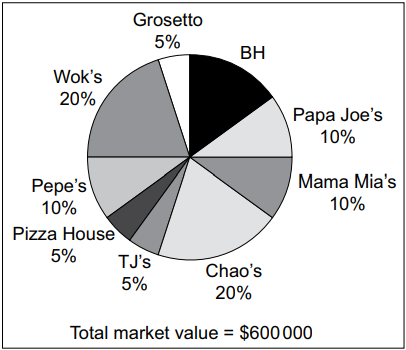
Pie chart showing market share: Wok's 20%, Chao’s 20%, Papa Joe’s 10%, Mama Mia's 10%, Pepe’s 10%, Pizza House 5%, Grosetto 5%, TJ’s 5%, BH 15%. Total is $600,000.

Fig. 1.1: Market share data for competitors within 2 km of BH

The two market leaders are Wok’s and Chao’s. Both businesses specialise in Asian food but neither has a delivery service. Amir would like to increase BH’s market share. He is considering starting to sell Asian food. None of his employees have any experience cooking or selling Asian food but Amir believes that the possible increase in income would be worth any extra costs.

Refer to Fig. 1.1. Calculate the value in dollars ($) of BH’s share of the market.

4
6 marks

Case Study

Great Resources (GR)

GR is a business partnership that creates educational resources. It sells direct to schools and teachers via its own website.

Sanjay, Rukmal and Boris are entrepreneurial teachers who formed the GR partnership. One year ago, they identified a gap in the market to supply interactive, digital resources. GR’s website is subscription only. An online marketing campaign, which used penetration pricing, attracted 250 subscribers in the first six months of operation. The start-up costs were financed with a $5000 bank overdraft, which is GR’s only debt.

Reviews for GR’s products in teaching journals are positive but cash flow is poor. Many customers have taken advantage of a recent sales promotion for one month’s free membership and posted positive reviews. Unfortunately, few have then taken out a regular subscription.

As revenue has not increased as much as the entrepreneurs had hoped, they must now consider alternative promotion methods. They have researched possible promotion methods and decided to advertise in an educational newspaper. The newspaper has a readership of half a million people.

Expert Materials (EM) is a large national company that also advertises in the newspaper. EM is GR’s closest competitor. The EM brand is well-known and trusted in the educational resources market. Table 1.1 shows some marketing data.

Table 1.1 Marketing data

GR

EM

Total market

Revenue ($000)

15

300

500

Number of customers

300

5000

7000

Annual advertising spend ($000)

7.5

45

60

(i) Refer to Table 1.1. Calculate GR’s market share by revenue.

[3]

(ii) Explain one factor which may influence the supply of GR’s products.

[3]

5
8 marks

Analyse the benefits to a business of focusing on the 4Cs when planning to increase its market share.

6
1 mark

Analyse the benefits to a business of niche marketing.

7
2 marks

Case Study

Priya’s Bookshop (PB)

Priya lives in town R which is situated in beautiful countryside with nice walks nearby. Many tourists visit town R.

The town’s council would like town R to become branded as a ‘booktown’, a town with many bookshops selling new and used books. The council announced a new financial scheme offering grants to attract entrepreneurs willing to open a bookshop.

Priya applied for a grant to start up Priya’s Bookshop (PB). Part of her grant application included a cash flow forecast, shown in Table 1.1.

Table 1.1: Cash flow forecast, first three months of trading ($000)

Month 1

Month 2

Month 3

Cash in:

Owner’s capital

15

0

0

Grant

20

0

0

Revenue

4

6

11

Cash out:

Initial set up costs

20

0

0

Utilities (power, water etc)

0

0

2

Employee costs

1

1

3

Purchases

6

3

4

Marketing

10

5

4

Opening balance

0

2

-1

Closing balance

2

-1

X

Priya’s grant application was successful and she opened PB well aware of the need for both cash and profit.

Priya now wants to raise awareness of PB in town R. Priya did some market research and decided to use market segmentation. This will help her to decide on the promotional methods she could use for her bookshop. See Table 1.2.

Table 1.2: Age and gender of residents in town R

Age group (years)

Percentage of residents in age group

Percentage of age group who are female

0-15

19%

50%

16-64

63%

55%

65+

18%

60%

Define the term ‘market segmentation’ (line 25).

8
11 marks

Case Study

Farm Produce (FP)

FP is a primary sector co-operative made up of six farms in country G. Each farm grows a range of fruit and vegetables. FP employs 26 workers across the farms and distribution centre. Each farm transports its fruit and vegetables to the distribution centre where they are packaged and sent to customers’ homes. Table 1.1 contains data about the farming industry in country G.

Table 1.1: Data about the farming industry in country G

  • Farms producing fruit and vegetables are given an annual government grant.

  • Most farms are labour intensive.

  • The government promotes the importance of eating fresh fruit and vegetables.

  • Most farms are small family businesses.

  • Minimum wage for farm workers will increase by 10% next year.

FP’s customers pay for a box of seasonal fruit and vegetables that is delivered each week. Data about the different box sizes sold by FP is shown in Table 1.2.

Table 1.2: FP’s cost and price data

Box size

Variable cost per box
($)

Allocated monthly fixed costs
($)

Price per box
($)

Sales in April 2022

Small

8

2000

10

400

Medium

10

2000

20

300

Large

15

2000

35

150

FP is concerned about the profitability of the small box size. It believes it should stop selling this product.

Evaluate the most important factor affecting the supply of FP’s boxes of fruit and vegetables to customers.

9
2 marks

Case Study

Child Play (CP)

Su is a sole trader who started a business called CP which operates a play area for children. The play area is inside a building and includes toys and other play equipment. Customers book on CP’s website for each hour that they would like to use the play area. CP is two kilometres away from the nearest city which has a large population. Su does not pay for any promotion and she relies on recommendations and reviews from previous customers.

Su currently charges a price of $10 an hour for a group of up to 5 children. Only one group can book CP for each hour. Demand is greater than supply so Su may increase the price to $15 per hour. She has completed some market research to see if this is a good idea. Her findings are in Table 1.1.

Table 1.1: Market research about prices for CP

Price

Quantity (hours) demanded per day

$10

10

$15

6

Su is also thinking about expanding the business by opening a café targeted at parents with children.

The café would be located at the entrance to CP’s play area. There are many other cafés in the city centre two kilometres away. Su believes that product differentiation is essential for the profitability of the café.

Su plans to use CP’s working capital as the source of finance to open the new café. The café will need to earn revenue quickly, so she plans to open it in four weeks. She will need quick and low‑cost promotion methods if the café is to succeed.

Define the term ‘supply’ (line 7).

10
6 marks

Case Study

Clever Televisions (CTV)

CTV is a public limited company that produces and sells televisions. It has been operating in country A for 30 years. CTV owns 3 factories and has over 100 employees. CTV’s factories use a combination of capital and skilled labour to produce the televisions. The leadership style in all the factories is autocratic. Employees’ pay is based on time worked each week.

The CTV brand is known for high‑quality and reliability. It targets high‑income customers. CTV uses price skimming when it launches a new product.

In total, 6 million televisions were sold in country A in 2019. Table 2.1 shows market growth data.

Table 2.1: Television sales in country A

Year

Market growth

2020

+2%

2021

+1%

2022

–3% (forecast)

The market for televisions in country A is very competitive and the business environment is dynamic. CTV plans to introduce a lower priced television brand to appeal to the mass market. This brand will be known as STV.

CTV has decided to introduce automation into one of its factories to produce the STV televisions. This will lead to redundancies in that factory.

The employees in the other two factories are concerned they might also face redundancy and so motivation is currently low. The Human Resources Director recommends that CTV should find ways in which employees can participate in the management and control of the business.

(i) Refer to Table 2.1 and other information. Calculate the total number of televisions sold in country A in 2021.

[3]

(ii) Explain one implication for CTV of the forecast change in market growth for 2022.

[3]

11a
2 marks

Define the term ‘customer (market) orientation’.

11b
3 marks

Explain two limitations to a business of using market segmentation.

12a
2 marks

Case Study

Benjamin’s Beds (BB)

Benjamin’s Beds (BB) is a large manufacturer of beds and has a strong brand image for quality. Its main channel of distribution is through the producer market (B2B) to national hotel chains. Recently, BB has also entered the consumer market (B2C) by selling online direct to customers.

BB uses flow production. BB’s existing machinery is old and cannot satisfy the increased demand. The directors of BB have decided its existing machinery needs replacing. Table 2.1 shows data for existing and proposed new machinery.

Table 2.1 Data for existing and proposed new machinery

Variable cost per unit
($)

Output per year

Existing machinery

50

5000

New machinery

40

7500

Fixed costs are $500 000 per year. Using new machinery would reduce this by 10%.

BB sales data suggests that its market share is growing rapidly. The consumer market (B2C) is becoming more important to BB because online orders are increasing. However, online demand is for a wide range of bed styles. The consumer market requires a substantial marketing budget and some retraining of employees.

Orders from national hotel chains in the producer market (B2B) are for a more limited range of bed styles. These orders remain constant with low marketing costs. However, BB is increasingly under pressure to reduce prices to hotels.

BB uses non-financial motivators and until recently had a motivated workforce. Efficiency is falling due to employees having to work longer hours because of increased demand. This is decreasing staff morale and welfare.

Define the term ‘market share’ (line 14).

12b
11 marks

Recommend whether BB should focus on the producer market (B2B) or the consumer market (B2C). Justify your recommendation.

13
5 marks

Explain the link between corporate objectives and marketing objectives of a business.

14
12 marks

Discuss the view that the setting of effective marketing objectives is the most important factor for the successful launch of a new women’s football (soccer) team.

15
3 marks

Case Study

Tin Mines (TM)

TM is a private limited company in the primary sector. Tin is found underground and is extracted by mining. TM operates seven mines in country C. There are several job roles at each mine including skilled engineers, managers and miners.

TM has recently discovered a new source of tin in a remote area of country C. TM has permission to develop a tin mine but will have to construct transport links. It will need new buildings such as offices, warehouses and employee housing. The Human Resources Director is developing a workforce plan to recruit miners and managers for the new mine.

TM’s Financial Director has produced a cash flow forecast for the new mine for the next five years. This is shown in Table 2.1.

Table 2.1: Cash flow forecast for the new mine ($m)

Year

2022

2023

2024

2025

2026

Opening balance

X

-80

-95

-85

5

Sales

0

0

25

105

Y

Development costs

60

15

0

0

0

Operating costs

0

0

15

15

15

Closing balance

-80

-95

-85

5

240

The remote area of country C where the new tin mine will be located has a high level of unemployment and average incomes are low. TM intends to recruit employees from the local area and buy resources from local suppliers, if they are available. The market for tin is likely to be affected by increased demand for electric vehicles. The batteries in electric vehicles contain tin. The government of country C believes that the tin mine will be of great benefit to both the local community and national economy. However, tin mining can result in pollution of local water supplies.

Explain the term ‘market’ (line 19).

16a
3 marks

Case Study

Van Man (VM)

Obi is a sole trader who operates a van service. He used to be employed by a similar business but realised that he likes to be in control. Obi used all of his savings to start his business so that he did not have to go into debt.

He owns three vans which can carry furniture, packages and other large items. He has eight full-time employees who drive the vans and move items. Customers can hire a van with two employees to move these items from one place to another. The cost per day of providing a van with two employees is $170. The prices of the service are shown in Table 1.1.

Table 1.1: Price of hiring one van (including two employees)

Price for the first day’s hire

Price for each additional day

$250

10% discount on the price for the first day’s hire

Demand for Obi’s service is growing fast. To supply this demand he needs a new van and he is investigating sources of finance. He has a choice of two vans. The details of the vans are in Table 1.2.

Table 1.2: Van details

Van A

Van B

Capital cost

$30 000

$40 000

Estimated maintenance costs per year

$600

$450

Insurance cost per year

$500

$550

Expected life

7 years

9 years

Van owner reviews

  • Easy to drive but not very fast

  • Boring but fuel efficient

  • Engine is very noisy, but reliable

  • Fast and great fun to drive

  • Looks great and the range of colours is fantastic

  • It broke down a few times, but the manufacturer repaired it quickly

Explain the difference, for a business, between price and cost.

16b
3 marks

Explain one factor which may affect the demand for Obi’s services.

17a
3 marks

Case Study

Super Candy (SC)

SC is a large public limited company that sells low-sugar candy (sweets) with natural flavourings. The candy is made using flow production in SC’s four large factories in country T.

SC uses psychographic market segmentation when planning its marketing mix.

SC has completed some secondary market research using published accounts. The data is about one of SC’s main competitors, Organic Kandy (OK) and compares the results with data about SC (see Table 2.1). OK is in the same market as SC.

Table 2.1: Secondary market research about OK and SC for 2020

OK

SC

Revenue

$60m

X

Market share by revenue

40%

34%

Different varieties of candy

12

18

Main channels of distribution

Wholesalers
Large supermarkets
Health food shops

Wholesalers
Small retailers
E-commerce

Target market(s)

Mass market

People with interests in:

  • Nature

  • Sports

  • Travel

  • Health

There have been a number of media reports in country T about the increasing importance of corporate social responsibility (CSR). A large food manufacturing business in country T recently lost many customers due to reports about its use of plastic packaging. The directors of SC are particularly concerned about this trend because of SC’s use of plastic in its packaging. The marketing department has been told to conduct some primary market research on this issue.

The directors are planning to discuss making CSR a new business objective for SC.

Explain the term ‘psychographic market segmentation’ (line 3).

17b
3 marks

Refer to Table 2.1. Calculate SC’s revenue (X) for 2020.

18a
8 marks

Analyse the possible benefits to a business of increasing its market share.

18b
12 marks

Discuss whether a change in consumer income is the most important factor influencing the demand for restaurant meals.

19a
2 marks

Define the term ‘national market’.

19b
3 marks

Explain two advantages to a business of selling in international markets.

20a
2 marks

Define the term ‘customer (market) orientation’.

20b
3 marks

Explain two limitations of niche marketing.

21
12 marks

Discuss the importance of market share to a business operating in a competitive market.

22a
2 marks

Case Study

UFilters (UF)

UF is a public limited company selling to an industrial market. It manufactures air conditioning units. UF produces two sizes of air conditioning units, medium and large. Most of its air conditioning units are sold for use in warehouses and computer server rooms. The units are expensive compared to competitors but UF believes its units are of a higher quality. Market research suggests that there is a growing demand for small air conditioning units to be placed in offices. To produce a new size of unit would require spending $180000 to purchase new machinery.

UF relies on customer recommendations for new orders. However, some customers have been dissatisfied with the service received. UF has received several complaints, including:

  • engineers turning up late or not at all

  • poor communication from UF

  • little choice in the size of units supplied

  • appointment times are not always convenient and can be difficult to change.

Sylvie, the Marketing Director of UF, is concerned about the sales data (Table 1.1) as sales have fallen 10% on the previous year.

Table 1.1: Selected sales data for UF, 2019

Unit size

Price ($)

Unit sales

Medium

900

3500

Large

2000

800

Sylvie is considering two options to increase sales (see Table 1.2).

Table 1.2: Options to increase sales

Option 1
Reduce the price of the units by 10%

  • Competitors’ prices are 8% lower on average.

  • The estimated price elasticity of demand is –0.8.

Option 2
Implement a performance related pay scheme (PRP)

  • Sales staff are currently paid a monthly salary.

  • To introduce a PRP scheme the monthly salary would be reduced by 10%.

  • Targets would be set and if sales staff met the targets then they would receive PRP increasing their monthly salary by 15%.

Define the term ‘industrial market’ (line 1).

22b
8 marks

Analyse two ways, other than the two options in Table 1.2, UF can improve customer relations.

23
3 marks

Case Study

Flight Food (FF)

FF is a large secondary sector business that supplies airlines with in-flight meals. Meals are manufactured using batch production. A different variety of meal is made each hour with a five minute changeover time between batches. FF makes use of Just in Time (JIT) to manage inventory wherever possible. Trucks arrive each hour and deliver the materials needed for production.

The market for airline meals is very competitive. FF uses market segmentation when deciding which meals are most likely to appeal to different airlines. FF must adapt to changes in tastes and the demands of each airline.

FF is a labour intensive business. The workers are employed with short-term (six month) employment contracts. They are only offered new contracts if they meet their production targets. Table 2.1 shows some production data for FF’s two work teams.

Table 2.1: Worker data for FF

Team A

Team B

Number of workers

100

50

Productivity (per worker per day)

300 meals

240 meals

The Board of Directors of FF is considering changing the manufacturing process to flow production. This would require purchasing Computer Aided Manufacturing (CAM) equipment and using a capital intensive production process. Production targets would no longer be used for employees because the machinery would be set at a specific production rate.

Sabrina, the Operations Director, has put forward the following advantages for moving to flow production:

  • more products made each hour

  • lower employment costs

  • improved quality.

Ben, the Human Resource Director, is worried about the change from a labour intensive process to a capital intensive process.

Explain the term ‘market segmentation’ (line 6).

24a
2 marks

Define the term ‘market share’.

24b
3 marks

Explain two ways a retailer could increase its market share.

25
8 marks

Case Study

Gemini Theatre (GT)

GT is a private limited company fully owned by the Gemini family. It owns a small theatre. This building is used to show live stage performances. Some of the performances are created by GT and some are created by visiting groups who rent the theatre. Table 2.1 shows the planned performances for January 2021.

Table 2.1: Planned performances for January 2021

Name of performance

Created by

Number of performances

Ticket price

Percentage of tickets sold

A Summer Dream

Visiting group

9

$40

100%

Wise Owl

GT

14

$15

60%

La Poeme Ballet

GT

5

$20

40%

GT gains all the revenue from performances created by GT. Visiting groups must pay 50% of their total ticket revenue to GT. The theatre has a maximum of 250 tickets that can be sold for each performance.

GT uses cost-based pricing to set each ticket price for its own performances. Each performance makes a profit but the company often experiences cash flow problems.

GT needs to recruit a new Theatre Manager. The person hired will have many duties, including the responsibility for all of GT’s administration as well as some accounting. The Directors are considering two people who were both recently interviewed. Table 2.2 contains information gained from the interview process.

Table 2.2: Information gained from the interview process

Nick

Portia

  • Three years working for a similar theatre business

  • A Levels in Business, Art and Chinese

  • Very organised and efficient

  • No management experience

  • Wants to move overseas in the future

  • Eight years working as a manager for a bank

  • No formal qualifications

  • Late for the interview

  • Good sense of humour

  • Looking for a long-term career

Analyse two factors which might affect the demand for the performances at GT’s theatre.