11 mark
The diagrams show part of the structures of five substances, A, B, C, D and E.

Which one of these structures, A, B, C, D or E is an alcohol?
Was this exam question helpful?
Exam code: 0620 & 0971
The diagrams show part of the structures of five substances, A, B, C, D and E.
Which one of these structures, A, B, C, D or E is an alcohol?
Was this exam question helpful?
The structure of nerol is shown below:

Draw a circle around the alcohol functional group in nerol.
Was this exam question helpful?
One of the organic acids present in milk is lactic acid.
The displayed formula of lactic acid is shown in Fig. 2.2.

Fig. 2.2
Draw a circle around the carboxylic acid functional group on the structure.
Deduce the molecular formula of lactic acid.
Was this exam question helpful?
The structure of nerol is shown.

What feature of the nerol molecule shows that it is an unsaturated compound?
Was this exam question helpful?
Sulfur dioxide, SO2, is used in the manufacture of sulfuric acid.
When propan-1-ol is heated with concentrated sulfuric acid as a catalyst an unsaturated hydrocarbon of relative molecular mass 42 is formed and one other product.
What is meant by the term unsaturated?
Was this exam question helpful?
Coal gas is made by heating coal in the absence of air. The list shows the main gases present in coal gas.
carbon dioxide
carbon monoxide
ethene
hydrogen
methane
nitrogen
Which one of these gases is an alkane?
Draw the structure of a molecule of ethene. Show all of the atoms and all of the bonds.
Was this exam question helpful?
Methane, ethane and ethene are hydrocarbons.
Draw the structure of a molecule of ethane. Show all of the atoms and all of the bonds.
Which one of these compounds belongs to the same homologous series as methane?
Draw a circle around the correct answer.
butane methanoic acid methanol propene
The structure of a monomer used to make a polymer is shown.

What structural feature of this molecule shows that it is unsaturated?
Describe a test to show that this compound is unsaturated. test .................................................... observations ....................................................
Was this exam question helpful?
Ethene, C2H4, and propene, C3H6, are members of the alkene homologous series.
State the general formula of the alkenes.
Extended Tier Only
Give the structural formula of propene.
State what is meant by the term functional group.
Was this exam question helpful?
Extended Tier Only
The displayed formulae of two organic compounds, A and B, are shown.
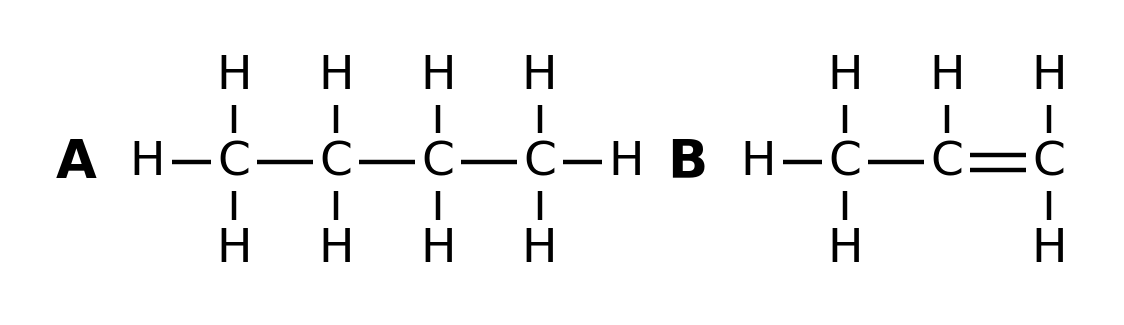
Name compound A.
Extended Tier Only
Name compound B.
Extended Tier Only
Give the structural formula of compound B.
Name the compound that belongs to the same homologous series as compound B and contains one fewer carbon atom.
Was this exam question helpful?
Extended Tier Only
Table 1.1 shows information about four organic compounds.
Table 1.1
name | structural formula | boiling point / °C |
|---|---|---|
methanol | CH3OH | 65 |
CH3CH2OH | 78 | |
propan-1-ol | CH3CH2CH2OH | 97 |
CH3CH2CH2CH2OH | 118 |
Name the two compounds that are missing from Table 1.1.
State the type of compound that all four compounds in Table 1.1 are.
State the ending that all four of their names share.
Was this exam question helpful?
A chemical company separates petroleum by fractional distillation and uses the fractions to make other organic compounds.
The formulae of four of these compounds are shown.
C3H8 C4H8 C3H7OH CH3COOH
State the type of compound present for C3H8 and for C4H8.
State the type of compound present for C3H7OH and for CH3COOH.
Extended Tier Only
Name the compound with the molecular formula C3H8.
Was this exam question helpful?
The structures of six organic compounds are shown.

Give the name of F.
Identify two of the compounds that are members of the same homologous series.
Give the general formula of this homologous series.
compounds ..................................................
general formula ..................................................
Which two compounds are isomers of each other?
Explain why they are isomers.
compounds ........................................................................
explanation ........................................................................
Explain why B is an unsaturated hydrocarbon.
Describe how D is manufactured from B. Give a chemical equation for the reaction.
Compound A forms an addition polymer.
Draw two repeat units of the addition polymer formed from A.
Was this exam question helpful?
A hydrocarbon has the following structural formula.

i) State the molecular formula and the empirical formula of this hydrocarbon.
molecular formula ........................................................
empirical formula ........................................................
[2]
ii) Draw the structural formula of an isomer of the above hydrocarbon.
[1]
iii) Explain why these two hydrocarbons are isomers.
[2]
iv) Are these two hydrocarbons members of the same homologous series? Give a reason for your choice.
[1]
Alkenes can be made from alkanes by cracking.
i) Explain the term cracking.
[2]
ii) One mole of an alkane, when cracked, produced one mole of hexane, C6H14, and two moles of ethene.
What is the molecular formula of the original alkane?
[1]
Alkenes are used in polymerisation reactions and addition reactions.
i) Draw the structural formula of the product formed by the addition polymerisation of but-2-ene. Its formula is given below.

[3]
ii) Give the name and structural formula of the addition product formed from ethene and bromine.
name ..............................................................
structural formula ..............................................................
[2]
Was this exam question helpful?
The alcohols form a homologous series. The first five members are given in the table below.
alcohol | formula | heat of combustion in kJ / mol |
methanol | CH3OH | 730 |
ethanol | CH3–CH2–OH | 1380 |
propan-1-ol |
|
|
butan-1-ol | CH3–CH2–CH2–CH2–OH | 2680 |
pentan-1-ol | CH3–CH2–CH2–CH2–CH2–OH | 3350 |
i) Complete the table.
[2]
ii) Complete the equation for the combustion of pentan-1-ol in excess oxygen.
C5H11OH + .......O2 → ..................... + .....................
[1]
State three characteristics of a homologous series other than the variation of physical properties down the series.
The following alcohols are isomers.
CH3–CH2–CH2–CH2–OH and (CH3)2CH–CH2–OH
i) Explain why they are isomers.
[2]
ii) Draw the structural formula of another isomer of the above alcohols.
[1]
Alcohols can be made by fermentation and from petroleum.
i) Ethanol is made from sugars by fermentation.
C6H12O6 → 2C2H5OH + 2CO2
The mass of one mole of glucose, C6H12O6, is 180 g.
Calculate the maximum mass of ethanol which could be obtained from 72 g of glucose.
[3]
ii) Describe how ethanol is made from petroleum.
petroleum (alkanes) → ethene → ethanol
[3]
Was this exam question helpful?
The alcohols form a homologous series.
Give three characteristics of a homologous series.
The following two alcohols are members of an homologous series and they are isomers.
CH3―CH2―CH2―CH2―OH and (CH3)2CH―CH2―OH
i) Explain why they are isomers.
[2]
ii) Deduce the structural formula of another alcohol which is also an isomer of these alcohols.
[1]
Copper(II) oxide can oxidise butanol to liquid X, whose pH is 4.

i) Give the name of another reagent which can oxidise butanol.
[1]
ii) Which homologous series does liquid X belong to?
[1]
iii) State the formula of liquid X.
[1]
The alcohol ethanol can be made by fermentation. Yeast is added to aqueous glucose.
C6H12O6 (aq) → 2C2H5OH (aq) + 2CO2 (g)
Carbon dioxide is given off and the mixture becomes warm, as the reaction is exothermic. The graph shows how the rate of reaction varies over several days.

i) Suggest a method of measuring the rate of this reaction.
[2]
ii) Why does the rate initially increase?
[1]
iii) Suggest two reasons why the rate eventually decreases.
[2]
Was this exam question helpful?
Methanoic acid is the first member of the homologous series of carboxylic acids.
Give two general characteristics of a homologous series.
In some areas when water is boiled, the inside of kettles become coated with a layer of calcium carbonate. This can be removed by adding methanoic acid.
i) Complete the equation.
............ HCOOH + CaCO3 → Ca(HCOO)2 + ................. + .................
[2]
ii) Methanoic acid reacts with most metals above hydrogen in the reactivity series.
Complete the word equation.
zinc + methanoic acid → ................................. + ..................................
[2]
Give the name, molecular formula and empirical formula of the fourth acid in this series.
name ..................................................
[1]
molecular formula ..................................................
[1]
empirical formula ..................................................
[1]
Was this exam question helpful?
Two homologous series of hydrocarbons are the alkanes and the alkenes.
One general characteristic of a homologous series is that the physical properties vary in a predictable way.
i) State three other general characteristics of a homologous series.
[3]
ii) How can the molecular formula of a hydrocarbon show whether it is an alkane or an alkene?
[2]
iii) How do alkanes and alkenes differ in their molecular structures?
[2]
Cracking is the thermal decomposition of alkanes into smaller hydrocarbons and possibly hydrogen.
i) State two conditions required for the cracking of an alkane.
[2]
ii) One type of cracking produces an alkane and an alkene.
Complete an equation for the cracking of heptane into an alkane and an alkene.
C7H16 → ................ + ................
[1]
iii) Complete an equation for the cracking of heptane into hydrogen and two other products.
C7H16 → ................ + ................ + H2
[1]
iv) Suggest one reason why cracking is important.
[1]
Was this exam question helpful?
Petrol is a mixture of hydrocarbons and additives. The combustion of petrol in car engines is a major source of air pollution. This is reduced by catalytic converters.
Petrol is obtained from the gasoline fraction, boiling point range 40 °C to 100 °C, from the distillation of petroleum.
Explain the term fraction.
In many countries, a lead compound of the type Pb(C2H5)n used to be added to petrol to improve its combustion. After combustion, lead oxide was formed.

i) Octane is a constituent of petrol. Write the equation for the complete combustion of octane.
C8H18 + .......... O2 → .......... + ..........
[2]
ii) Dibromoethane was added to petrol to remove the lead oxide from inside the engine. Lead bromide was formed which escaped into the environment through the exhaust. Leaded petrol cannot be used with a catalytic converter.
Give another reason why leaded petrol is no longer used.
[1]
iii) What does each of the following tell you about the structure of dibromoethane?
dibromo ..........................................................................................................
eth ..........................................................................................................
ane ..........................................................................................................
[2]
iv) What additional information is needed to draw the structural formula of dibromoethane?
[1]
An analysis of the compound, Pb(C2H5)n, showed that 0.026 moles of Pb was combined with 0.104 moles of C2H5 groups.
What is the value of n? Show how you arrived at your answer.
Some of the pollutants emitted by vehicle exhausts are carbon monoxide, oxides of nitrogen and unburnt hydrocarbons. Explain how the emission of these gases is reduced by a catalytic converter.
Was this exam question helpful?
Methanoic acid is the first member of the homologous series of carboxylic acids.
Give two general characteristics of a homologous series.
In some areas when water is boiled, the inside of kettles become coated with a layer of calcium carbonate. This can be removed by adding methanoic acid.
i) Complete the equation.
............ HCOOH + CaCO3 → Ca(HCOO)2 + ................. + .................
[2]
ii) Methanoic acid reacts with most metals above hydrogen in the reactivity series. Complete the word equation.
zinc + methanoic acid → ............................................ + ............................................
[2]
iii) Aluminium is also above hydrogen in the reactivity series.
Why does methanoic acid not react with an aluminium kettle?
[1]
Give the name, molecular formula and empirical formula of the fourth acid in this series.
name ..........................................................................................................
[1]
molecular formula .......................................................................................................
[1]
empirical formula ........................................................................................................
[1]
Was this exam question helpful?
Alkynes and alkenes are homologous series of unsaturated hydrocarbons. All alkynes contain a C≡C triple bond.
Complete Table 10.1 showing information about the first three alkynes.
Table 10.1
formula |
| ||
structure | |||
names | ethyne |
| but-1-yne |
Compounds in the same homologous series have the same general formula.
Give two other characteristics of members of a homologous series.
Deduce the general formula of alkynes. Use the information from Table 10.1 to help you.
Alkynes are unsaturated.
Describe a test for unsaturation.
test ........................
result ........................
Ethene and but-2-ene are alkenes. Draw the displayed formula of but-2-ene.
Draw a dot-and-cross diagram to show a molecule of ethene, CH2=CH2. Show outer shell electrons only.
Was this exam question helpful?
Propane reacts with chlorine in a photochemical reaction as shown.
Draw two structural isomers of compounds with the formula C3H7Cl.
Show all of the atoms and all of the bonds.
|
|
There are three functional groups in compound A.

Name the homologous series of compounds that contains the following structures.
C=C ...............................
–OH ..............................
–COOH ...............................
Compound A can be used as a single monomer to produce two different polymers.
Draw one repeat unit of the addition polymer formed from compound A.
Was this exam question helpful?
The structure of compound S is shown.

Draw a circle around the carboxylic acid functional group in this structure.
How many different types of atom are shown in this structure?
Ethanol can be converted into ethene by passing ethanol vapour over a catalyst of aluminium oxide.
Draw the structure of a molecule of ethanol. Show all of the atoms and all of the bonds.
Was this exam question helpful?
The structures of five alkenes, A, B, C, D and E, are shown.

What is the general formula of alkenes?
Two different alcohols can be produced from alkene B by an addition reaction.

Draw the structures of the two alcohols. Show all of the atoms and all of the bonds.
Was this exam question helpful?
The structure of myrcene is shown.

Deduce the formula of myrcene to show the number of atoms of carbon and hydrogen.
Myrcene is an unsaturated hydrocarbon. Describe a chemical test to distinguish between a saturated and an unsaturated hydrocarbon.
test ...................................
observations with saturated hydrocarbon .............................................
observations with unsaturated hydrocarbon .........................................
Butane is a saturated hydrocarbon.
To which homologous series does butane belong?
Draw a circle around the correct answer.
alcohol alkane alkene carboxylic acid
Was this exam question helpful?
Extended Tier Only
Esters are used as food flavourings and as solvents.
An ester is made by warming propan-1-ol with ethanoic acid in the presence of an acid catalyst.
Name the ester made.
Extended Tier Only
Draw the displayed formula of the ester made.
Show all of the atoms and all of the bonds.
Extended Tier Only
Name the other product of this reaction.
Extended Tier Only
Name the ester made when methanol reacts with propanoic acid.
Extended Tier Only
Name the ester made when ethanol reacts with methanoic acid.
Was this exam question helpful?
Extended Tier Only
The carboxylic acids form a homologous series.
Draw the displayed formula of methanoic acid.
Show all of the atoms and all of the bonds.
Extended Tier Only
Draw the displayed formula of butanoic acid.
Show all of the atoms and all of the bonds.
Extended Tier Only
Give the structural formula of propanoic acid.
Name the carboxylic acid that contains two carbon atoms.
Was this exam question helpful?
Extended Tier Only
The displayed formula of compound A is shown.
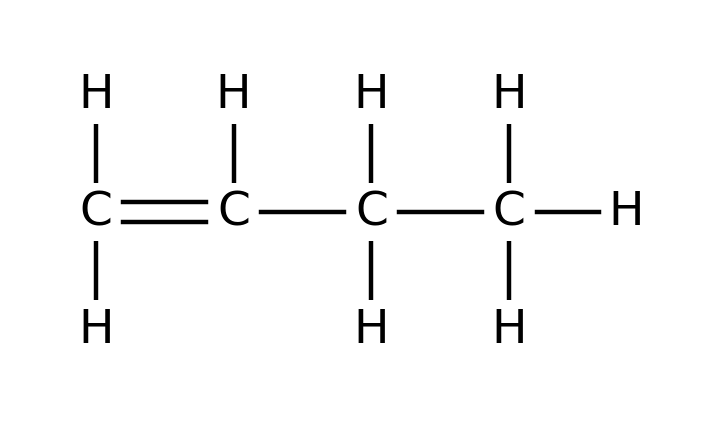
Name compound A.
Extended Tier Only
Explain why the name of compound A has to contain a number.
Extended Tier Only
Draw the displayed formula of the other unbranched alkene that contains four carbon atoms.
Show all of the atoms and all of the bonds.
Extended Tier Only
Name the compound you have drawn.
Was this exam question helpful?
Extended Tier Only
Table 1.1 gives information about four organic compounds.
Table 1.1
name | structural formula | type of compound |
|---|---|---|
butane | alkane | |
propan-2-ol | ||
CH3COOH | carboxylic acid | |
methyl ethanoate | CH3COOCH3 |
Complete Table 1.1.
Extended Tier Only
Methyl ethanoate is made by reacting an alcohol with a carboxylic acid.
Name the alcohol used.
Was this exam question helpful?
The structural formula of compound X is CH3CH2OH.
Give the molecular formula of X.
Draw the displayed formula of X.
Show all of the atoms and all of the bonds.
The structural formula of compound Y is CH2=CH2.
State why Y is an unsaturated compound.
A molecule of X and a molecule of Y each contain two carbon atoms.
State why X and Y are not members of the same homologous series.
State why a displayed formula gives more information about a molecule than a molecular formula does.
Was this exam question helpful?
Three compounds, P, Q and R, are members of the same homologous series.
Their molecular formulae are shown in the table.
compound | molecular formula |
|---|---|
P | C2H4O2 |
Q | C3H6O2 |
R | C4H8O2 |
The structural formula of P is CH3COOH.
Identify the functional group present in P.
Deduce the general formula of this homologous series.
R is not the last member of this homologous series.
Deduce the molecular formula of the member of this series that comes immediately after R.
Extended Tier Only
Draw the displayed formula of Q.
Show all of the atoms and all of the bonds.
Extended Tier Only
State what is meant by the term structural isomers.
Extended Tier Only
C4H10 has two structural isomers.
Give the structural formula of each of these two isomers.
Was this exam question helpful?
Extended Tier Only
But-1-ene reacts with bromine.
Name the organic product of this reaction.
Extended Tier Only
Draw the displayed formula of this product.
Show all of the atoms and all of the bonds.
Extended Tier Only
Explain why this product is not named 1,1-dibromobutane.
Extended Tier Only
But-2-ene also reacts with bromine.
Name the organic product of this reaction.
Explain why its name is different from your answer to part (a).
Was this exam question helpful?
Extended Tier Only
An ester called butyl ethanoate is used as a food flavouring.
Name the alcohol and the carboxylic acid that react together to make butyl ethanoate.
Extended Tier Only
Draw the displayed formula of the carboxylic acid used.
Show all of the atoms and all of the bonds.
Extended Tier Only
Name the ester made when the same alcohol reacts with methanoic acid instead.
Extended Tier Only
Explain how the name of an ester shows which alcohol and which carboxylic acid were used to make it.
Was this exam question helpful?
A student is asked to draw the displayed formula of butan-1-ol.
The student's answer is shown.
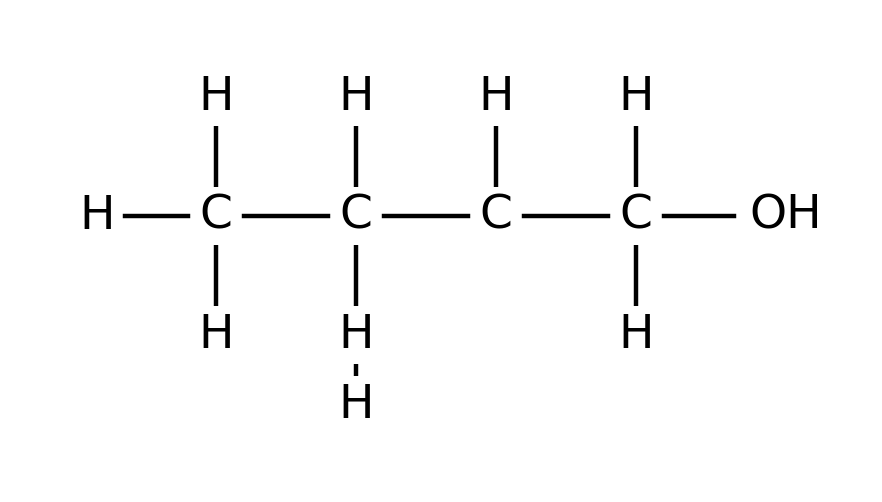
The student's answer contains three mistakes.
Identify each mistake.
Extended Tier Only
Draw the correct displayed formula of butan-1-ol.
Show all of the atoms and all of the bonds.
Extended Tier Only
Give the structural formula of butan-1-ol.
Was this exam question helpful?
Extended Tier Only
The displayed formula of an ester is shown.
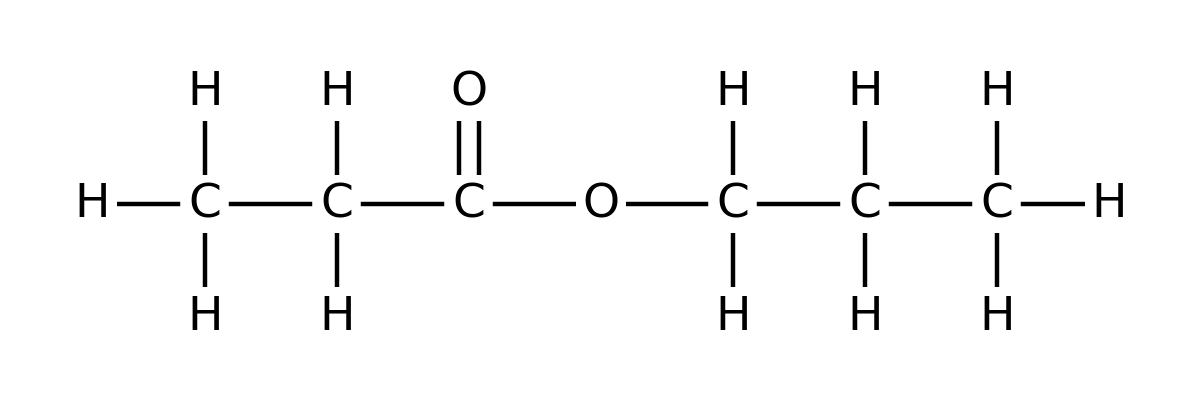
Name this ester.
Extended Tier Only
Name the alcohol and the carboxylic acid that react together to make this ester.
Extended Tier Only
Draw the displayed formula of the alcohol used.
Show all of the atoms and all of the bonds.
Extended Tier Only
Draw the displayed formula of the carboxylic acid used.
Show all of the atoms and all of the bonds.
Extended Tier Only
Explain how the number of carbon atoms on the carboxylic acid side of this ester is worked out from its displayed formula.
Was this exam question helpful?
Extended Tier Only
Fig. 1.1 is a flow diagram showing some reactions of an organic compound A.
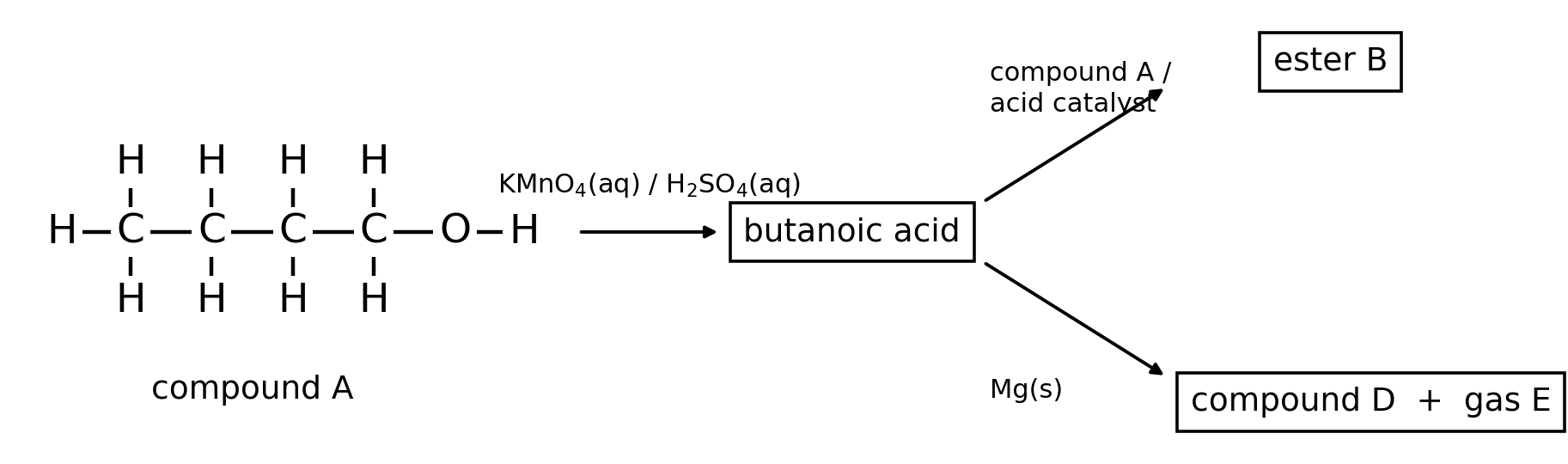
Fig. 1.1
Name compound A.
Extended Tier Only
Draw the displayed formula of the other unbranched alcohol that is a structural isomer of compound A.
Show all of the atoms and all of the bonds.
Extended Tier Only
Name ester B.
Extended Tier Only
Draw the displayed formula of ester B.
Show all of the atoms and all of the bonds.
Extended Tier Only
Butanoic acid reacts with magnesium to form compound D and gas E.
Name compound D.
Name gas E.
Was this exam question helpful?
Alkanes and alkenes are examples of hydrocarbons.
i) What is meant by the term hydrocarbon?
[1]
ii) Give the general formula of straight-chain
alkanes.
alkenes.
[2]
A compound X contains carbon, hydrogen and oxygen only.
X contains 54.54% of carbon by mass, 9.09% of hydrogen by mass and 36.37% of oxygen by mass.
i) Calculate the empirical formula of compound X.
[2]
ii) Compound X has a relative molecular mass of 88.
Deduce the molecular formula of compound X.
[2]
An ester has the molecular formula C3H6O2.
Name and give the structural formulae of two esters with the molecular formula C3H6O2.
Name of ester |
|
|
Structural formula |
|
|
Name the ester produced from the reaction of propanoic acid and methanol.
A polyester is represented by the structure shown.

i) What type of polymerisation is used for the production of polyesters?
[1]
ii) Which simple molecule is removed when the polyester is formed?
[1]
iii) Complete the diagrams below to show the structures of the monomers used to produce the polyester. Show all atoms and bonds.

[2]
Was this exam question helpful?
Propanoic acid is a carboxylic acid. Its formula is CH3–CH2–COOH.
Propanoic acid is the third member of the homologous series of carboxylic acids.
i) Give the name and structural formula of the fourth member of this series.
name ...............................................................
formula ...............................................................
[2]
ii) Members of a homologous series have very similar chemical properties.
State three other characteristics of a homologous series.
[3]
Carboxylic acids can be made by the oxidation of alcohols.
i) Draw the structural formula of the alcohol which can be oxidised to propanoic acid. Show all atoms and bonds.
[1]
ii) Name a reagent, other than oxygen, which can oxidise alcohols to carboxylic acids.
[2]
Complete the following equations for some of the reactions of propanoic acid.
The salts of this acid are called propanoates.
i) zinc + propanoic acid → .................... .................... + hydrogen
[1]
ii) calcium oxide + propanoic acid → .................... .................... + ...........................
[1]
iii) LiOH + CH3CH2COOH → .................... + ....................
[1]
A piece of magnesium was added to 100 cm3 of an aqueous acid. The time taken for the metal to react completely was measured. This experiment was repeated using different aqueous acids. The same volume of acid was used in each experiment and the pieces of magnesium used were identical. In one experiment the reaction was carried out at a different temperature.
experiment | acid | concentration in mol / dm3 | temperature / oC | time / minutes |
A | propanoic | 1.0 | 20 | 5 |
B | propanoic | 1.0 | 30 | 3 |
C | propanoic | 0.5 | 20 | 8 |
D | hydrochloric | 1.0 | 20 | 1 |
Explain the following in terms of collision rate between reacting particles.
i) Why is the rate in experiment C slower than the rate in experiment A?
[2]
ii) Why is the rate in experiment B faster than the rate in experiment A?
[2]
iii) Why is the rate in experiment D faster than the rate in experiment A?
[3]
Was this exam question helpful?
The alcohols form a homologous series. The first member is methanol and the fourth is butanol.
CH3–OH | CH3–CH2–CH2–CH2–OH butanol |
i) Give two general characteristics of a homologous series.
[2]
ii) Calculate the mass of one mole of the C8 alcohol.
[2]
Give the name and structural formula of the third member of this series.
name ..................................................
[1]
structural formula ..................................................
[1]
The structural formula of the fifth member, pentan-1-ol, is drawn below.
CH3–CH2–CH2–CH2–CH2–OH
i) Draw the structural formula of an isomer of this alcohol.
[1]
ii)Predict the names of the product(s) formed when pentan-1-ol
reacts with an excess of oxygen,
....................................... and .......................................
[1]
is dehydrated to form an alkene,
..................................................
[1]
is oxidised by acidified potassium dichromate(VI).
..................................................
[1]
Was this exam question helpful?
Butane is oxidised to a mixture of carboxylic acids by oxygen in the presence of a catalyst. The acids formed are methanoic acid, ethanoic acid and propanoic acid – the first three members of the carboxylic acid homologous series.
i) Give the name and structural formula of the fourth member of this series.
name ..........................................................................................................
structural formula showing all the atoms and bonds
[3]
ii) State three characteristics of a homologous series.
[3]
iii) All members of this series are weak acids.
What is meant by the term weak acid?
[3]
Carboxylic acids react with alcohols to form esters. Ethanol reacts with ethanoic acid to form the ester ethyl ethanoate, CH3COOCH2CH3.
i) Give the name and formula of the ester which is formed from methanol and propanoic acid.
name ..........................................................................................................
formula ..........................................................................................................
[2]
ii) What is the name of the ester which has the formula CH3COOCH3?
[1]
i) Complete the equation for the oxidation of butane to propanoic acid.
3C4H10 + .........O2 → 4C2H5COOH + .......H2O
[1]
ii) Name another compound which can be oxidised to propanoic acid.
[1]
Was this exam question helpful?
Butane is an alkane. It has the following structural formula

The equation for the complete combustion of butane is given below. Insert the two missing volumes.
2C4H10 (g) + 13O2 (g) → 8CO2 (g) + 10H2O (g)
volume of gas / cm3 .......... .......... 40
Butane reacts with chlorine to form two isomers of chlorobutane.
i) What type of reaction is this?
[1]
ii) Explain the term isomer.
[2]
iii) Draw the structural formulae of these two chlorobutanes.
[2]
One of the chlorobutanes reacts with sodium hydroxide to form butan-1-ol. Butan-1-ol can be oxidised to a carboxylic acid.
i) State a reagent, other than oxygen, which will oxidise butan-1-ol to a carboxylic acid.
[1]
ii) Name the carboxylic acid formed.
[1]
iii) Butan-1-ol reacts with ethanoic acid to form an ester. Name this ester and give its structural formula showing all the individual bonds.
name ..........................................................................................................
[1]
structural formula
[2]
Was this exam question helpful?
The table shows some information about aldehydes.
Complete the table.
name | .......................... | ethanal | propanal | butanal |
molecular formula | CH2O | C2H4O | C3H6O | ................... |
Deduce the general formula of aldehydes.
The structural formula of ethanal is shown.

The C=O group in aldehydes is at the end of the carbon chain. This is a reactive part of the molecule.
What is the name given to the reactive part of any organic molecule?
Propanone belongs to a homologous series called ketones. Ketones have the same C=O group as aldehydes but the C=O group is not at the end of the carbon chain. Propanone has the same molecular formula as propanal, C3H6O.
What term is used to describe molecules with different structures but with the same molecular formula?
Suggest the structure of propanone, C3H6O. Show all of the atoms and all of the bonds.
Was this exam question helpful?