Identification of Ions & Gases (Cambridge (CIE) IGCSE Chemistry): Theory Questions

Exam code: 0620 & 0971

8 hours73 questions
1
5 marks

Many compounds and elements have important uses.

Complete the table to show the name, formula and use of each compound and element.

name of compound or element

number of atoms in the formula

formula

use

chlorine

chlorine = 2

Cl2


carbon = 1 hydrogen = 4

CH4


calcium carbonate

calcium = 1 carbon = 1 oxygen = 3


2a
1 mark

Complete the chemical equation for the complete combustion of propane.

2C3H6 + ......O2 → 6CO2 + 6H2O

2b
2 marks

Describe a test for carbon dioxide.

test ..................................................

observations ..................................................

3a
1 mark

A list of symbols and formulae is shown.

CH4 

Cl–

CO2

Cr3+

Cu2+

 Fe2+

H2

K+ 

N2

O2

SO2

Which symbol or formula represents an ion which forms a blue precipitate when added to aqueous sodium hydroxide.

3b
1 mark

A solution is obtained by filtering a mixture of soil and water. The table shows the mass of some of the ions in 1000 cm3 of this solution.

name of ion

formula of ion

mass of ion in 1000 cm3 of soil solution / mg

aluminium

Al3+

0.2


NH4+

22.0

calcium

Ca2+

0.2

iron(II)

Fe2+

79.0

magnesium

Mg2+

0.1

nitrate

NO3–

28.0

phosphate

PO43–

14.0

potassium

K+

39.0


SO42–

5.1

State the name of the SO42– ion.

3c
2 marks

Describe a chemical test for calcium ions.

test ______________________________________ observations ______________________________

3d
2 marks

When sodium reacts with carboxylic acids, hydrogen is produced.

Describe a test for hydrogen.

test ______________________________________ observations ______________________________

4a
2 marks

Describe a test for iron(II) ions.

test _________________________________

observations _________________________

4b
2 marks

Describe a test for bromide ions.

test ___________________________

observations ___________________

4c
3 marks

Nitric acid contains nitrate ions. Complete these sentences about the test for nitrate ions using words from the list.                    aluminium      ammonia      blue        chloride         copper                       green                iron         nitrate       oxygen           red Aqueous sodium hydroxide and _____________________ foil are added to the solution being tested.    The mixture is warmed gently. The _________________ produced turns damp ___________________ litmus paper __________________ .

5a
1 mark

Hydrogen peroxide, H2O2, decomposes slowly to form water and oxygen.

Write the word equation for this reaction.

5b
2 marks

The decomposition of hydrogen peroxide also occurs in the presence of a manganese(IV) oxide, MnO2, catalyst. What is meant by the term catalyst?

5c
2 marks

Bubbles of oxygen gas are produced in when manganese(IV) oxide is added to hydrogen peroxide. Describe a test for oxygen gas. test ..................................................... observations ........................................................

5d
1 mark

The decomposition of hydrogen peroxide is exothermic. What is meant by the term exothermic?

1a
1 mark

Extended Only

Choose a gas from the following list to answer the questions below.

Each gas may be used once, more than once or not at all.

ammonia 

carbon dioxide 

carbon monoxide

fluorine

krypton

nitrogen

propene

hydrogen

It polymerises to form a poly(alkene).

1b
1 mark

It is a noble gas.

1c
1 mark

It is the main component of air.

1d
1 mark

It is a very reactive non-metal.

1e
1 mark

It burns to form water as the only product.

2a
5 marks

Choose a gas from the following list to answer the questions below. Each gas may be used once, more than once or not at all.

ammonia    argon    chlorine   ethene    hydrogen   

carbon dioxide   nitrogen   carbon monoxide   oxygen

Which gas

i) Is a noble gas?

[1]

ii) Is an acidic oxide?

[1]

iii) Can be polymerised?

[1]

iv) Is the active component of air?

[1]

v) Is used in the treatment of water?

[1]

2b
5 marks

Complete the following table.

Gas

Test for Gas

Ammonia


Bleaches damp litmus paper

Hydrogen


Relights a glowing splint 


Turns limewater milky 

3a
2 marks

Table 1 shows the mass of ions present in a 100 cm3 sample of milk.                                                                          

Table 1

ion

formula of ion

mass of ion in 100 cm3 milk / mg

calcium

Ca2+

125

chloride

Cl −

120

magnesium

Mg2+

12

negative ions of organic acids


160

phosphate

PO43−

95

potassium

K+

140

sodium

Na+

58

sulfate

SO42−

30

Describe a test for chloride ions.

 test ..................................................

 positive result  ..................................................

3b
2 marks

Calcium reacts with cold water to form two products:

  • a colourless gas, P, which ‘pops’ with a lighted splint

  • a weakly alkaline solution, Q, which turns milky when carbon dioxide is bubbled through it.

i) Name gas P.

 [1]

 ii) Name the weakly alkaline solution Q.

 [1]

4a
2 marks

This question is about ammonia and ammonium salts.

Ammonia is a gas at room temperature. What is the test for ammonia gas? Describe the positive result of this test.

test .......................................................................

result ....................................................................

4b
3 marks

Ammonia reacts with water to form ions.                                            

NH3 + H2O ⇌ NH4+ + OH–

Describe what is seen when aqueous ammonia is added to aqueous copper(II) sulfate, until no further change is seen.

4c
1 mark

Barium sulfate is an insoluble salt.

Barium sulfate can be made from aqueous ammonium sulfate using a precipitation reaction.

Name a solution that can be added to aqueous ammonium sulfate to produce a precipitate of barium sulfate.

5a
3 marks

This question is about tests for ions.

Describe the test for a nitrate ion.

test ___________________________

result __________________________

5b
2 marks

Describe a test for iodide ions.

test ______________________________

observations ______________________

6a
6 marks

Table 2.1 shows the mass of ions present in a 100 cm3 sample of milk.

Table 2.1

ion

formula of ion

mass of ion in

100 cm3 milk / mg

calcium

Ca2+

125

chloride

Cl−

120

magnesium

Mg2+

12

negative ions of organic acids

160

phosphate

PO43–

95

potassium

K+

140

sodium

Na+

58

sulfate

SO42–

30

(i)     Calculate the mass of calcium ions present in a 20 cm3 sample of this milk.

mass of calcium ions =....................................................... mg [1]

(ii)     Identify the positive ion present in the highest concentration in the 100 cm3 sample of milk.

[1]

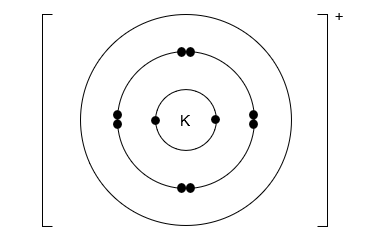
(iii)     Complete Fig. 2.1 to show the electronic configuration of a potassium ion.

Diagram of a potassium ion in square brackets with a + charge. The nucleus is labelled K. There are three shells: the inner shell has 2 electrons, the second shell has 8 electrons and the outer shell is empty for the student to complete.

Fig. 2.1

[1]

(iv)     Describe a test for chloride ions.

Test ......................................................................................

positive result ......................................................................................

[2]


(v)     Explain why the solutions used in qualitative chemical tests are made using distilled water and not tap water.

[1]
6b
1 mark

Which one of these salts is soluble in water?

  • Barium sulfate

  • Calcium carbonate

  • Ammonium sulfate

  • Iron(II) hydroxide

6c
2 marks

One of the organic acids present in milk is lactic acid. The displayed formula of lactic acid is shown in Fig. 2.2.

Displayed formula of lactic acid: a CH3 group bonded to a carbon carrying an H atom and an O–H group, which is bonded to a carbon with a C=O double bond and an O–H group

Fig. 2.2

(i)     Draw a circle around the carboxylic acid functional group on the structure.               

[1]

 (ii)     Deduce the molecular formula of lactic acid.

 [1]

7a
3 marks

The table shows the masses of some ions in a 1000 cm3 sample of toothpaste.

name of ion

formula of ion

mass of ion in 1000 cm3 of toothpaste / g

NH4+

0.2

calcium

Ca2+

1.2

Cl–

0.9

fluoride

F–

1.4

magnesium

Mg2+

2.0

phosphate

PO43–

24.4

sodium

Na+

28.1

sulfate

SO42–

9.2

tin(II)

Sn2+

0.2

zinc

Zn2+

0.1

Answer these questions using only the information in the table. 

(i) State which negative ion has the lowest mass in 1000 cm3 of toothpaste.

[1] 

(ii) Name the compound that contains NH4 + and Cl – ions.

[1] 

(iii) Calculate the mass of phosphate ions in 250 cm3 of toothpaste.

 mass = .............................. g [1]

7b
2 marks

Describe a test for sulfate ions. 

test ............................................................................................................................................

observations .............................................................................................................................................

7c
1 mark

Toothpaste also contains cinnamal.

The structure of cinnamal is shown.

Displayed formula of cinnamal: a benzene ring of six carbon atoms with alternating double bonds; five ring carbon atoms are each bonded to one hydrogen atom. The sixth ring carbon atom is bonded to a chain of two carbon atoms joined by a double bond, each with one hydrogen atom, followed by a carbon atom bonded to one hydrogen atom and double-bonded to an oxygen atom.

Deduce the formula of cinnamal to show the number of atoms of carbon, hydrogen and oxygen.

7d
3 marks

Cinnamal can be oxidised to a carboxylic acid. 

(i) Draw the structure of a carboxylic acid functional group to show all of the atoms and all of the bonds. 

[1] 

(ii) Ethanoic acid is a carboxylic acid. Ethanoic acid reacts like a typical acid. 

Complete the word equation for the reaction of ethanoic acid with sodium carbonate.

ethanoic acid + sodium carbonate → sodium ethanoate + ………………. + ……….

[2]

8a
3 marks

The table shows the masses of some ions in a 1000 cm3 sample of toothpaste.

name of ion

formula of ion

mass of ion in 1000 cm3 of toothpaste / g

ammonium

NH4+

0.5

calcium

Ca2+

3.6

carbonate

CO32–

2.5

chloride

Cl–

0.9

fluoride

F–

1.2

Mg2+

0.2

phosphate

PO43–

28.0

sodium

Na+

32.0

SO42–

10.4

tin(II)

Sn2+

0.3

Answer these questions using only the information in the table.

(i) State which positive ion has the lowest mass in 1000 cm3 of toothpaste.

[1]

(ii) Name the compound that contains Mg2+ and SO42– ions.

[1]

(iii) Calculate the mass of sodium ions in 200 cm3 of toothpaste.


mass = .............................. g [1]

8b
2 marks

Describe a test for chloride ions.

test ............................................................. 

observations ...............................................

8c
1 mark

Toothpaste also contains glycerol. The structure of glycerol is shown.

Displayed formula of glycerol: a vertical chain of three carbon atoms, each bonded to an O–H group. The top and bottom carbon atoms are each also bonded to two hydrogen atoms, and the middle carbon atom to one hydrogen atom.

Deduce the formula of glycerol to show the number of atoms of carbon, hydrogen and oxygen.

8d
4 marks

Glycerol is an alcohol. Ethanol is also an alcohol.

(i) Draw the structure of ethanol to show all of the atoms and all of the bonds.

[1]

(ii) Name the two products formed when ethanol undergoes complete combustion.

[2]

(iii) Give one use of ethanol.

 [1]

1a
3 marks

This question is about ammonium compounds.

The table shows the names and formulae of some ammonium compounds.

Name

Ammonium nitrate

Ammonium carbonate


Formula

NH4NO3


NH4Cl

 i) Complete the table by giving the missing information.

[2]

 ii) When ammonia reacts with nitric acid, ammonium nitrate is formed.

Write a chemical equation for this reaction.

 [1]

1b
3 marks

Extended Only

When ammonium chloride is heated, it undergoes thermal decomposition to form two gaseous products.

 Describe the result of testing each product with damp universal indicator paper.

1c
4 marks

Extended Only

The diagram shows the apparatus used to heat ammonium chloride.

nh4cl-thermal-decomposition-testing


i) Suggest why the damp litmus paper is two different colours.

 [1]

 ii) Explain what happens to the damp litmus paper as the ammonium chloride is heated. 

 [3]

1d
1 mark

Extended Only

Explain why a fine white powder formed on the inside of the neck of the conical flask in part (c).

2a
1 mark

A student is given an aqueous solution Q. Q contains one anion.

The student adds a small volume of acidified aqueous potassium manganate(VII) to Q. The purple colour of the manganate(VII) changes to colourless.

Name the anion present in Q.

2b
2 marks

The student warms a second sample of Q with dilute hydrochloric acid and collects the gas given off.

The gas turns acidified aqueous potassium manganate(VII) from purple to colourless.

Name the gas.

Explain why this result is consistent with your answer to part (a).

2c
3 marks

A different aqueous solution R is tested with acidified aqueous potassium manganate(VII). There is no colour change.

State what this result shows about R.

Explain why it does not identify the anion in R.

Name one other anion that R could contain together with a test, and its result, that would identify it.

2d
2 marks

A different solution may contain both sulfite ions and carbonate ions.

Explain why the student should test this solution for carbonate ions before adding acidified aqueous potassium manganate(VII) to it.