11 mark
The diagrams below show some of the uses of iron.
In which of these uses is iron most likely to rust?

Option A
Option B
Option C
Option D
Was this exam question helpful?
Exam code: 0620 & 0971
The diagrams below show some of the uses of iron.
In which of these uses is iron most likely to rust?
Option A
Option B
Option C
Option D
Was this exam question helpful?
A student prepared four iron nails as explained below in an experiment to investigate rusting. She allowed the nails to rest in individual test tubes in a laboratory for one week.
Which nail will show the greatest amount of rust?
Dipped in water and allowed to dry.
Dipped in paint and allowed to dry.
Coated in grease.
Galvanised with zinc.
Was this exam question helpful?
The diagram shows the experimental set-up a student used to investigate the composition of air. The student left the apparatus in the laboratory and observed that the water level had risen inside the test tube after one week.

Which statement explains why the water level rose?
Nitrogen monoxide was produced.
Iron oxide was produced.
The temperature of the water increased.
Sulfur dioxide was produced.
Was this exam question helpful?
A student observed the reaction between copper(II) sulfate solution and zinc.
Which observations are correct for this reaction?
| Observation 1 | Observation 2 |
A | solution colour stays the same | pale grey crystals forming |
B | solution turns darker blue | grey residue on the metal |
C | solution turns orange/brown | blue crystals form on the metal |
D | solution turns paler blue | orange / brown residue on the metal |
Option A
Option B
Option C
Option D
Was this exam question helpful?
A student was investigating the reactivity of four different metals, W, X, Y and Z, in hydrochloric acid.

Which is the most reactive metal and which is the least reactive metal?
| Most reactive metal | Least reactive metal |
A | W | X |
B | X | W |
C | Y | X |
D | W | Z |
Option A
Option B
Option C
Option D
Was this exam question helpful?
Iron rusts when exposed to air.
Which two substances in air cause iron to rust?
carbon dioxide and oxygen
nitrogen and oxygen
oxygen and water
carbon dioxide and water
Was this exam question helpful?
W, X, Y and Z are metals.
A student investigates the reactivity of these elements with dilute hydrochloric acid. The table shows the observations at room temperature.
metal | observation |
W | Slow reaction |
X | Violent reaction |
Y | Very slow reaction |
Z | No reaction |
Which row correctly identifies W, X, Y and Z?
W | X | Y | Z | |
A | iron | potassium | silver | aluminium |
B | iron | potassium | aluminium | silver |
C | aluminium | potassium | iron | silver |
D | aluminium | potassium | silver | iron |
Was this exam question helpful?
Which word equation represents the rusting of iron?
iron + water + hydrogen → hydrated iron(III) oxide
iron + water + oxygen → hydrated iron(III) oxide
iron + water + hydrogen → hydrated iron(II) oxide
iron + water + oxygen → hydrated iron(II) oxide
Was this exam question helpful?
A small piece of magnesium is added to dilute hydrochloric acid at room temperature.
Which observation is made?
Bubbles form in the liquid and the piece of magnesium gradually becomes smaller.
A brown solid forms on the magnesium and the solution becomes paler.
A white precipitate forms and the mixture becomes cloudy.
No change is seen.
Was this exam question helpful?
Which list shows aluminium, carbon, iron and zinc in order of decreasing reactivity?
aluminium, carbon, zinc, iron
carbon, aluminium, zinc, iron
aluminium, zinc, carbon, iron
aluminium, carbon, iron, zinc
Was this exam question helpful?
Aluminium is higher than both zinc and iron in the reactivity series.
Despite this, an aluminium object shows little change when it is left in contact with water.
Why?
Aluminium is below hydrogen in the reactivity series.
Aluminium is an unreactive metal.
A layer of aluminium oxide forms on the surface and keeps water away from the metal below.
Aluminium reacts with water to form a gas which escapes, leaving the metal unchanged.
Was this exam question helpful?
An iron gate is left outdoors.
Which method will not slow down the rate of rusting of the gate?
attaching blocks of magnesium to it
bolting strips of copper to it
coating it with zinc
painting it
Was this exam question helpful?
Compound Y is thermally decomposed with carbon using the apparatus below:

A brown solid is formed in the reaction tube and the limewater turns cloudy.
What is compound Y?
Copper (II) oxide
Calcium oxide
Magnesium oxide
Sodium oxide
Was this exam question helpful?
Calcium, copper, iron and magnesium are metals. They can be placed in order of reactivity.
Which of the following statements about these metals is correct?
Iron reacts with steam but magnesium does not.
Copper reacts with dilute hydrochloric acid to form copper (II) chloride.
Magnesium and calcium both react with hot water.
Iron (II) oxide cannot be reduced by heating strongly with carbon.
Was this exam question helpful?
Which row in the table below shows how the metal will react?
| metal | reacts with dilute acid | reacts rapidly with cold water | reacts with steam |
A | copper | |||
B | calcium | |||
C | zinc | |||
D | magnesium |
Option A
Option B
Option C
Option D
Was this exam question helpful?
Q, R and S are metals.
Metal | Reacts with cold water | Reacts with steam | Reacts with dilute hydrochloric acid |
Q | yes | yes | violently |
R | very slowly | slowly | less strongly |
S | no | no | no |
What are the possible identities of the metals Q, R and S?
| Q | R | S |
A | Potassium | Iron | Magnesium |
B | Sodium | Zinc | Copper |
C | Silver | Aluminium | Iron |
D | Calcium | Copper | Gold |
Option A
Option B
Option C
Option D
Was this exam question helpful?
A student was investigating the reactivity of different metals in hydrochloric acid.
The diagrams show what happens when each metal was added to dilute hydrochloric acid.
What are W, X, Y and Z?
| W | X | Y | Z |
A | Calcium | Copper | Magnesium | Zinc |
B | Copper | Zinc | Calcium | Magnesium |
C | Magnesium | Calcium | Zinc | Copper |
D | Zinc | Magnesium | Copper | Calcium |
Option A
Option B
Option C
Option D
Was this exam question helpful?
Metals W, X, Y and Z are reacted with dilute hydrochloric acid.
The oxides of metals W, X, Y and Z are heated with carbon.
The results are shown.
reaction | W | X | Y | Z |
metal + dilute hydrochloric acid | fizzing | fizzing | violent fizzing | no reaction |
metal oxide + carbon and heat | no reaction | metal produced | no reaction | metal produced |
What is the order of reactivity of the metals?
| most reactive | → |
| least reactive |
A | Y | W | X | Z |
B | Y | X | W | Z |
C | Z | W | X | Y |
D | Z | X | W | Y |
Was this exam question helpful?
The diagrams show experiments involving the rusting of iron.
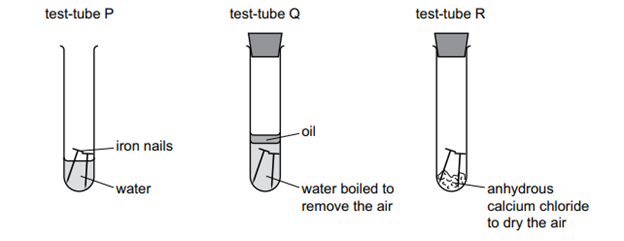
A student predicted the following results.
In test-tube P, the iron nails rust.
In test-tube Q, the iron nails do not rust.
In test-tube R, the iron nails do not rust.
Which predictions are correct?
1, 2 and 3
1 and 2 only
1 and 3 only
2 and 3 only
Was this exam question helpful?
An experiment to investigate the effect of painting iron is shown.
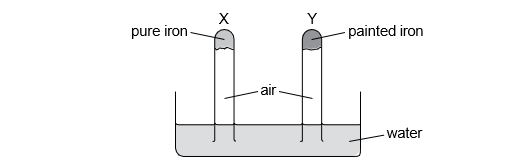
The experiment is left for seven days.
What happens to the water level in test-tubes X and Y?
test-tube X | test-tube Y | |
A | falls | rises |
B | no change | no change |
C | rises | falls |
D | rises | no change |
Was this exam question helpful?
Reactions of three metals and their oxides are shown.
metal | add dilute hydrochloric acid to metal | heat metal oxide with carbon |
1 | ✔ | ✔ |
2 | ✔ | ✘ |
3 | ✘ | ✔ |
key
✔= reacts
✘= does not react
What is the order of reactivity of these metals, from most reactive to least reactive?
1 → 2 → 3
1→ 3 → 2
2→ 1 → 3
2→ 3 → 1
Was this exam question helpful?
Mild steel is galvanised to prevent corrosion of the iron.
Which statements about galvanising are correct?
Galvanising prevents corrosion because the zinc forms an alloy.
If the coating is damaged, water and oxygen do not corrode the iron.
Zinc is a sacrificial metal and corrodes in preference to iron.
1 and 2
1 and 3
2 only
2 and 3
Was this exam question helpful?
The reactions of metals P, Q, R and S are shown.
metal | reaction with water | reaction with hydrochloric acid | reduction of the metal oxide with carbon |
P | no reaction | no reaction | reduced |
Q | slow | vigorous | no reaction |
R | vigorous | vigorous | no reaction |
S | very slow | vigorous | reduced |
What is the order of reactivity of the metals?
least reactive → most reactive | ||||
A | P | S | Q | R |
B | P | Q | S | R |
C | R | S | Q | P |
D | R | Q | S | P |
Was this exam question helpful?
Which process uses sacrificial protection to prevent steel from rusting?
galvanising
oiling
copper plating
painting
Was this exam question helpful?
A student investigates the reactivity of four different metals by adding a small piece of each metal to separate test-tubes containing aqueous iron(II) chloride.
A tick (✓) indicates a reaction occurs. A cross (×) indicates no reaction occurs.
Which row correctly predicts the results of the student's investigation?
copper | magnesium | aluminium | zinc | |
A | × | ✓ | ✓ | ✓ |
B | ✓ | × | × | × |
C | × | ✓ | × | ✓ |
D | × | ✓ | ✓ | × |
Was this exam question helpful?
Four statements about the rusting of iron are shown.
Rusting needs both oxygen and water to be present.
Rust is an alloy of iron and oxygen.
Sacrificial protection uses a metal that is less reactive than iron.
Grease prevents rusting by forming a barrier.
Which two statements are correct?
1 and 4
1 and 3
2 and 3
3 and 4
Was this exam question helpful?
Four test-tubes each contain an identical iron nail. The table shows how each nail is prepared and what else is in the tube.
tube | contents |
|---|---|
A | dry air, closed with a stopper |
B | air, and the nail is coated in grease |
C | tap water and air |
D | tap water, and the nail is coated in paint |
The tubes are left in a laboratory for two weeks.
In which tube will the nail rust?
Was this exam question helpful?
Iron can be protected from rusting in several ways.
Which method protects iron both by acting as a barrier and by sacrificial protection?
connecting the iron to a block of magnesium
coating the iron with tin
coating the iron with zinc
painting the iron
Was this exam question helpful?
Two sheets of steel are coated, one with zinc and one with tin.
Both coatings are scratched through to the steel underneath. The sheets are then left outdoors.
Which row describes what happens to the steel at the scratches?
zinc-coated sheet | tin-coated sheet | |
|---|---|---|
A | rusts | rusts |
B | rusts | does not rust |
C | does not rust | rusts |
D | does not rust | does not rust |
Was this exam question helpful?
A piece of zinc is placed in aqueous copper(II) sulfate. A reaction takes place.
Three statements about this reaction are given.
1 Zinc forms its positive ion more readily than copper.
2 Copper ions gain electrons.
3 Zinc is lower than copper in the reactivity series.
Which statements are correct?
1 only
1 and 2 only
2 and 3 only
1, 2 and 3
Was this exam question helpful?
A test-tube contains an iron nail in dry air. The tube is closed with a stopper. The nail does not rust.
A student says:
"The stopper stops oxygen getting into the tube, so the nail cannot rust."
Why is the student's explanation wrong?
The stopper does not form an airtight seal.
The tube already contains oxygen, so the stopper is there to keep water vapour out.
Oxygen is not needed for rusting, only water is.
The stopper is there to stop water vapour escaping from the tube.
Was this exam question helpful?
A student sets up four test-tubes, each containing an identical iron nail.
tube | contents | where it is kept |
|---|---|---|
1 | dry air, closed with a stopper | laboratory bench |
2 | completely filled with boiled water, closed with a stopper | laboratory bench |
3 | tap water and air | laboratory bench |
4 | tap water and air | warm cupboard |
Which two tubes should be compared to show that water is needed for rusting?
1 and 2
1 and 3
2 and 3
3 and 4
Was this exam question helpful?
An iron nail is placed in a test-tube of water that has been boiled and then allowed to cool.
A layer of oil is poured onto the surface of the water.
After two weeks, the nail has not rusted.
Which statement explains why the nail has not rusted?
The oil stops the water from reaching the nail.
Boiling the water killed the bacteria that cause rusting.
Boiling removed the dissolved air, and the oil stops air dissolving back in.
Boiling raised the temperature of the water, so the rusting was over before the two weeks ended.
Was this exam question helpful?
A sheet of iron is galvanised by coating it with zinc.
Four statements about the coated sheet are shown.
The zinc protects the iron both as a barrier and by sacrificial protection.
The zinc is gradually used up as it protects the iron.
The zinc protects the iron only while the zinc layer is unbroken.
The zinc coating is an alloy of zinc and iron.
Which two statements are correct?
1 and 2
1 and 3
2 and 4
3 and 4
Was this exam question helpful?
Reactions of three metals and their oxides are shown in the table.
metal | reacts with cold water | metal oxide reacts with carbon |
P | no | no |
Q | no | yes |
R | yes | no |
What is the order of reactivity of the metals?
| Least reactive | → | Most reactive |
A | P | Q | R |
B | Q | P | R |
C | Q | R | P |
D | R | P | Q |
Was this exam question helpful?
Five different metals P, Q, R, S and T were reacted with dilute hydrochloric acid.
The volume of hydrogen gas produced after one minute was measured. The results are shown in the bar chart below:

What is the order of reactivity of the metals?
| most reactive | → | → | → | least reactive |
A | P | Q | R | S | T |
B | R | P | S | Q | T |
C | T | Q | S | P | R |
D | T | S | R | Q | P |
Was this exam question helpful?
The following section of the reactivity series shows a newly discovered element, Y. The only oxide of Y has the formula YO.
Ca
Mg
Fe
Y
H
Cu
Which of the equations shows a reaction which would take place?
2 Y(s) + Cu2+(aq) → 2 Y+(aq) + Cu(s)
Y(s) + Fe2O3(s) → 2 Fe(s) + 3 YO(s)
Y(s) + 2 HCl (aq) → YCl2(aq) + H2(g)
Cu(s) + Y2+(aq) → Cu2+(aq) + Y(s)
Was this exam question helpful?
Four different metals P, Q, R and S were added to different aqueous solutions of their ions.
The results are shown in the table below.
Metal | P2+ | Q2+ | R2+ | S2+ |
P | ✗ | ✗ | ✓ | ✓ |
Q | ✓ | ✗ | ✓ | ✓ |
R | ✗ | ✗ | ✗ | ✗ |
S | ✗ | ✗ | ✓ | ✗ |
Key: ✗ = no reaction, ✓ = reaction
What is the order of reactivity of the metals from most reactive to least reactive?
| most reactive | → | → | least reactive |
A | Q | P | S | R |
B | Q | S | P | R |
C | R | P | S | Q |
D | R | S | P | Q |
Was this exam question helpful?
Small blocks of zinc are attached to ship hulls which are commonly made from steel, an alloy of iron. This is done to prevent the hull from rusting.
Which statement explains this process?
Zinc is higher up on the reactivity series than iron so has a higher tendency to become reduced.
Zinc is lower down on the reactivity series than iron so has a higher tendency to become reduced.
Zinc is higher up on the reactivity series than iron so has a higher tendency to become oxidised.
Zinc is lower down on the reactivity series than iron so has a higher tendency to become oxidised.
Was this exam question helpful?