Reactivity Series & Corrosion of Metals (Cambridge (CIE) IGCSE Chemistry): Exam Questions

Exam code: 0620 & 0971

7 hours78 questions
1a
3 marks

A student investigated the reaction between aqueous copper(II) sulfate and two different metals, zinc and iron. Two experiments were carried out.

Experiment 1

Using a measuring cylinder, 25 cm3 of aqueous copper(II) sulfate was poured into a polystyrene cup. The temperature of the solution was measured. The timer was started and the temperature was measured every half a minute for one minute.

At 1 minute, 5 g of zinc powder was added to the cup and the mixture stirred with the thermometer. The temperature of the mixture was measured every half minute for an additional three minutes.

Use the thermometer diagrams in the table to record the temperatures.


time / min 

thermometer diagram

temperature / oC

0.0

thermometer-reading-20c


0.5

thermometer-reading-9


1.0

thermometer-reading-9


1.5

thermometer-reading-32c


2.0

thermometer-reading-39c


2.5

thermometer-reading-42c


3.0

thermometer-reading-44c


3.5

thermometer-reading-45c


4.0

thermometer-reading-45c


1b
3 marks

Experiment 2

Experiment 1 was repeated using 5 g of iron powder instead of the zinc powder.

Use the thermometer diagrams in the table to record the temperatures.

time / min 

thermometer diagram

temperature / oC

0.0

thermometer-reading-20c


0.5

thermometer-reading-9


1.0

thermometer-reading-9


1.5

thermometer-reading-7


2.0

thermometer-reading-32c


2.5

thermometer-reading-36c


3.0

thermometer-reading-37c


3.5

thermometer-reading-38c


4.0

thermometer-reading-38c


1c
5 marks

Plot the results of both experiments on the grid below. Draw two smooth line graphs.

Clearly label your graphs. 

temp-time-graph


1d
3 marks

From your graph, work out the temperature of the reaction mixture in Experiment 1 after 1 minute 15 seconds. Show clearly on the graph how you worked out your answer.

1e
1 mark

What type of chemical process occurs when zinc and iron react with aqueous copper(II) sulfate?

1f
2 marks

i) Compare the temperature changes in Experiments 1 and 2.

 [1]

 ii) Suggest an explanation for the difference in temperature changes.

 [1]

1g
2 marks

Explain how the temperature changes would differ in the experiments if 12.5 cm3 of copper(II) sulfate solution were used.

1h
2 marks

Predict the effect of using lumps of zinc in Experiment 1. Explain your answer.

2a
4 marks

An investigation was carried out into the reactions of aqueous copper(II) sulphate with magnesium, iron and zinc.

Experiment 1

By using a measuring cylinder, 5 cm3 of aqueous copper(II) sulphate was added to each of three test-tubes. The initial temperature of the solution was measured. Zinc powder was added to the first test-tube, iron powder to the second tube and magnesium powder to the third tube. The mixtures were stirred with the thermometer. All the observations were recorded and the maximum temperature reached measured.

Use the thermometer diagrams to complete the results table.

 Table of results


metal added

initial temperature / oC

maximum temperature / oC

temperature difference / oC

observations

zinc

temperature-24c


temperature-56c


moderate effervescence, solution paler brown solid

iron

temperature-25c


temperature-41c


little effervescence, brown solid

magnesium

temperature-23c


temperature-69c


rapid effervescence, pops with lighted splint, brown solid


2b
4 marks

Use your results and observations to answer the following questions.

 i) Which metal is most reactive with aqueous copper(II) sulfate?

 [1]

 ii) Give two reasons why you chose this metal.

 1 ....................................................................................................

 2 ....................................................................................................

 [2]

 iii) Identify the gas given off when magnesium reacts with aqueous copper(II) sulfate.

 [1]

2c
6 marks

The reactions of magnesium and zinc with aqueous copper(II) sulphate were investigated in more detail.

Experiment 2

By using a measuring cylinder 10 cm3 of aqueous copper(II) sulphate was poured into a polystyrene cup. The initial temperature of the solution was measured.

A 1 g sample of zinc powder was added to the cup and the temperature measured every 10 seconds for 1 minute.

Use the thermometer diagrams to complete the results table.

Experiment 3

Experiment 2 was repeated using magnesium powder instead of zinc.

Use the thermometer diagrams to complete the results table.


time / seconds

temperature / oC

Experiment 2

Experiment 3

0

temperature-24c


temperature-26c


10

temperature-27c


temperature-54c


20

temperature-29c


temperature-62c


30

temperature-33c


temperature-67c


40

temperature-37c


temperature-68c


50

temperature-40c


temperature-67c


60

temperature-43c


temperature-65c


2d
4 marks

Plot the results of both Experiments on the grid below. Draw two smooth line graphs.

Clearly label the graphs.


blank-temp-time-graph


2e
2 marks

Use your graph to estimate the temperature of the reaction mixture in Experiment 2 after 5 seconds. Indicate clearly on the graph how you obtained your answer.

2f
2 marks

Sketch lines on the grid to show the predicted results if Experiment 2 were repeated using:

 i) larger pieces of magnesium;

 ii) iron powder.

 Clearly label the lines.

2g
1 mark

Why is a polystyrene cup used instead of a glass container?

2h
1 mark

Suggest one improvement to the method in Experiment 2.

3a
1 mark

Eight steel rods of the same size were placed in solutions of different pH for one week.

The percentage corrosion of the rods was measured and the results plotted on the grid below.

9-2-q1a

Draw a best fit straight line through the points. 

3b
1 mark

Why were the steel rods the same size?

3c
1 mark

State one other variable which should have been kept constant.

3d
1 mark

State one conclusion that could be drawn from the results.

3e
1 mark

Determine the percentage corrosion of a steel rod in a solution of pH 6.5.

4a
12 marks

An investigation was carried out on the reactions of four different metals. Equal masses of copper, magnesium, iron and zinc were used.

Experiment 1

A 15 cm3 sample of dilute sulfuric acid was added to each of four boiling tubes. The initial temperature of the acid was measured. Zinc was added to the first tube, iron to the second tube, magnesium to the third tube and copper to the fourth tube.

The maximum temperature reached in each tube was measured and any observations were recorded in the table.

i) Use the thermometer diagrams to complete the results table.

 Table of results 

displacement-blank-results-


[6]

 ii) Which metal is most reactive with sulfuric acid?

 [1]

 iii) Give two reasons why you chose this metal.


1. ....................................................................................................


2. ....................................................................................................

 [2]

 iv) Name the gas given off.

 [1]

 Experiment 2

 A 5 cm3 sample of aqueous copper(II) sulfate was measured into a test-tube. The initial temperature of the solution was measured.

 Magnesium powder was added to the test-tube and the maximum temperature reached was measured.

 v) Use the thermometer diagrams to complete the results table.

 Table of results 

displacement-blank-results-2


[2]

4b
1 mark

How do your observations show that the reaction of magnesium with aqueous copper(II) sulphate is exothermic?

4c
1 mark

Use your results from Experiments 1 and 2 to put the four metals in order of reactivity.

least reactive ..............................................................................

....................................................................................................

....................................................................................................

most reactive ..............................................................................

5a
2 marks

A student adds a short length of magnesium ribbon to dilute hydrochloric acid in a test-tube.

Describe two observations the student would make.

5b
2 marks

Describe a test, and its result, that the student could use to identify the gas given off.

5c
1 mark

Explain how these results show that magnesium is above hydrogen in the reactivity series.

5d
6 marks

Plan an experiment to place the three metals magnesium, zinc and iron in order of reactivity, using their reactions with dilute hydrochloric acid.

Your plan should include:

  • the apparatus you would use

  • the method, including the measurements you would take

  • how you would make the comparison fair

  • how you would use your results to decide the order

6a
2 marks

When iron begins to rust, iron ions pass into the water. An indicator turns dark blue when these ions are present.

A student investigates the effect of sodium chloride on the rate at which iron rusts.

Five test-tubes are set up. Each contains an identical iron nail, 20 cm3 of water, a different mass of sodium chloride and a few drops of the indicator.

The student measures the time taken for the dark blue colour to appear in each tube.

i) Name the piece of apparatus the student should use to measure 20 cm3 of water.

[1]

ii) Name a piece of apparatus that would measure the volume more accurately.

[1]

6b
2 marks

State the independent variable and the dependent variable in this investigation.

6c
1 mark

Explain why the student uses the same volume of water in every tube.

6d
3 marks

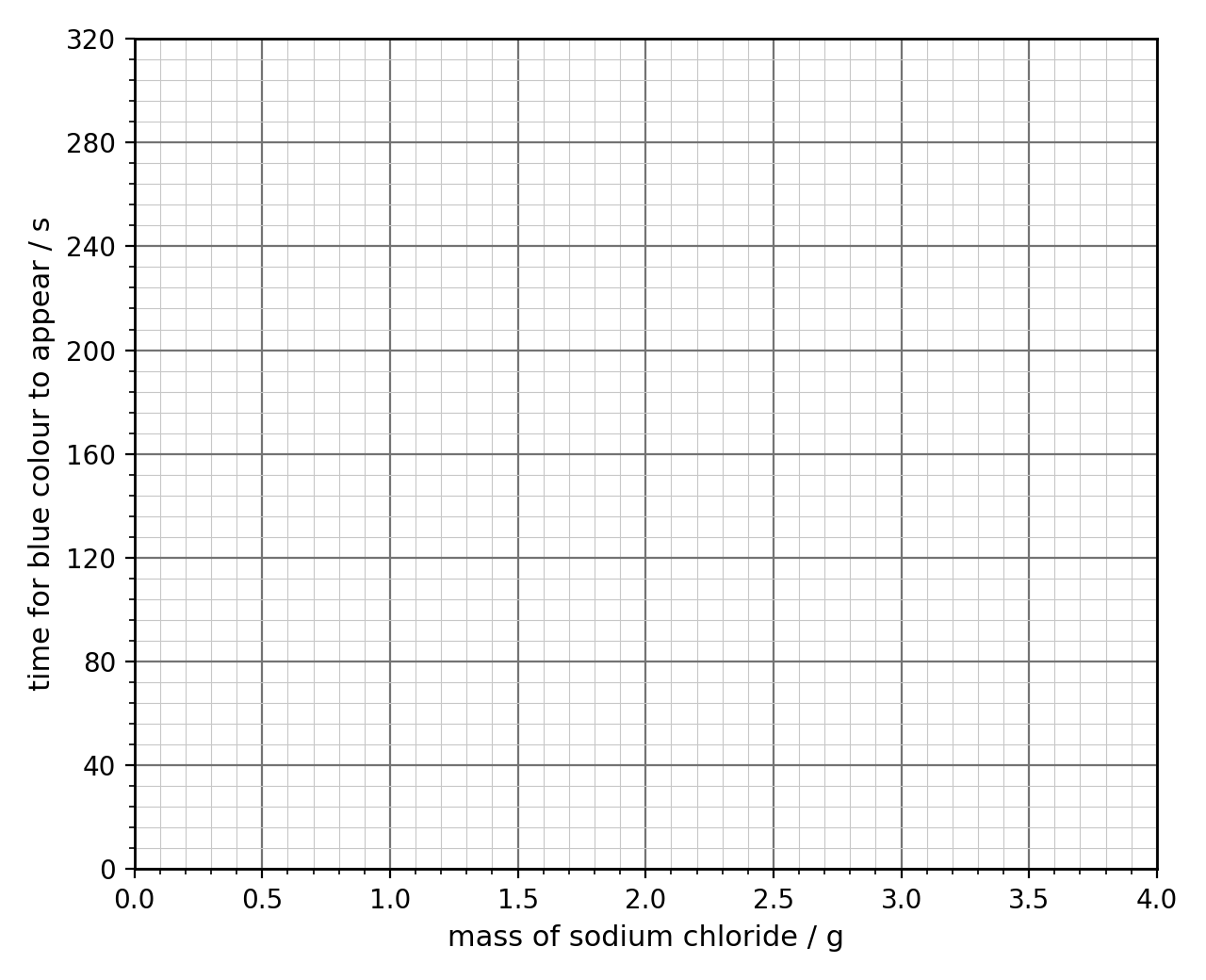
The student's results are shown.

mass of sodium chloride / g

time for blue colour to appear / s

0.0

300

1.0

220

2.0

165

3.0

130

4.0

110

Plot these results on the grid.

Draw a smooth curve through your points.

Blank graph grid for plotting mass of sodium chloride against time for blue colour to appear: horizontal axis 0–4 grams, marked every 0.5 grams; vertical axis 0–320 seconds, marked every 40 seconds.
6e
2 marks

Describe the trend shown by your graph.

6f
2 marks

Use your graph to estimate the time for the blue colour to appear when 2.5 g of sodium chloride is used.

Show clearly on your graph how you obtained your answer.

6g
2 marks

The student repeats the experiment using 2.0 g of sodium chloride, but with a nail that has been painted.

State and explain the effect this has on the time for the blue colour to appear.

6h
2 marks

Two students time the same tube and record different values.

Suggest two reasons for this.

6i
2 marks

The student later discovers that the stopwatch started five seconds late on every reading.

Explain why this does not change the trend shown by the results.

7
6 marks

A student wants to find out whether iron nails rust faster in salt water than in tap water.

Plan an investigation to answer this question.

Your plan should include:

  • the apparatus you would use

  • the method, including the measurements you would make

  • how you would make the comparison a fair test

  • how you would use your results to reach a conclusion

8a
1 mark

A student investigates rusting by measuring the mass of a piece of iron wool.

The iron wool is dampened with water and placed in an open dish. The dish and the iron wool are weighed each day for five days.

The results are shown.

day

mass of dish and iron wool / g

0

12.40

1

12.46

2

12.51

3

12.54

4

12.55

5

12.55

Calculate the total increase in mass over the five days.

8b
2 marks

Explain why the mass increases.

8c
2 marks

The mass does not change between day 4 and day 5.

Suggest two reasons for this.

8d
3 marks

i) State the smallest change in mass that the student's balance can detect.

[1]

ii) Another student records the mass on day 0 as 12.4 g.

Explain why this is not an acceptable way to record the reading.

[2]

8e
2 marks

Suggest two improvements the student could make to this investigation.

8f
2 marks

The student concludes that the rusting was complete by day 4.

Explain why this conclusion may not be valid.

9a
2 marks

A student compares four ways of treating iron nails.

Each nail is placed in a test-tube, covered with tap water and left open to the air for two weeks.

The results are shown.

nail

treatment

observation after two weeks

A

none

an orange-brown solid over the whole nail

B

painted

no change

C

wrapped in zinc foil

no change to the nail, and the zinc foil has become dull and grey

D

painted, then scratched in one place

an orange-brown solid at the scratch only

Explain the observation for nail B.

9b
3 marks

Extended Tier Only

Explain the observations for nail C.

Your answer should refer to the zinc foil as well as to the nail.

9c
2 marks

Explain why an orange-brown solid formed only at the scratch on nail D.

9d
2 marks

State two variables that the student must keep the same for all four nails.

9e
2 marks

Suggest why the student left the tubes for two weeks rather than for two days.

9f
3 marks

The student's results are written observations.

Suggest how the student could obtain a numerical measure of how much rusting had taken place on each nail.

10a
1 mark

A student investigates the conditions needed for iron to rust.

Four boiling tubes are set up. Each contains an identical iron nail.

tube

contents

1

the nail in air, with a drying agent, closed with a stopper

2

the nail covered with water that has been boiled and cooled, with a layer of oil on the surface

3

the nail covered with tap water, open to the air

4

the nail wrapped in a strip of magnesium and covered with tap water, open to the air

The tubes are left for one week.

State the purpose of the drying agent in tube 1.

10b
2 marks

The water used in tube 2 was boiled and then allowed to cool before the nail was added.

Explain why the water was boiled.

10c
2 marks

A layer of oil is poured onto the surface of the water in tube 2.

Explain the purpose of the layer of oil.

10d
4 marks

Extended Tier Only

After one week, the nail in tube 3 has rusted. The nails in tubes 1, 2 and 4 have not rusted.

i) Use the results for tubes 1, 2 and 3 to state the two conditions needed for iron to rust.

For each condition, state which tube shows that it is needed.

[2]

ii) Explain why the nail in tube 4 has not rusted.

[2]

10e
1 mark

Describe what the student would see on the nail in tube 3 after one week.

10f
2 marks

The student repeats the investigation and leaves the tubes for four weeks instead of one.

Suggest one advantage and one disadvantage of leaving the tubes for the longer time.

10g
2 marks

State two variables that the student must keep the same in all four tubes.