Solids, liquids & gases (Cambridge (CIE) IGCSE Chemistry): Theory Questions

Exam code: 0620 & 0971

6 hours81 questions
1a
1 mark

Separate: Chemistry and Extended Only

The following table gives information about six substances.

Substance

melting point / °C

boiling point /°C

electrical conductivity as a solid

electrical conductivity as a liquid

A

839

1484

good

good

B

-210

-196

poor

poor

C

776

1497

poor

good

D

-117

78

poor

poor

E

1607

2227

poor

poor

F

-5

102

poor

good

Which substance could have a macromolecular structure, similar to that of silicon(IV) oxide?

1b
1 mark

Which substances are solids at room temperature?

1c
1 mark

Extended Only

Which substance could be a metal?

1d
1 mark

Extended Only

Which substance could be aqueous sodium chloride?

1e
1 mark

Extended Only

Which substance is an ionic compound?

1f
1 mark

Which substances are liquids at room temperature?

2a
3 marks

Extended Only

Explain the following in terms of the kinetic particle theory.

The rate of most reactions increases at higher temperatures.

2b
3 marks

Extended Only

Explain the following in terms of the kinetic particle theory.

A liquid has a fixed volume but takes up the shape of the container. A gas takes up the shape of the container but it does not have a fixed volume.

cie-igcse-sq-1-1-q5b
3
6 marks

The table shows the melting points, boiling points and electrical properties of the six substances A to F.

substance

melting point / oC

boiling point / oC

electrical conductor at room temperature

electrical conductor of substance dissolved in water

A

961

2193

good

does not dissolve

B

113

444

does not conduct 

does not dissolve

C

0

100

very poor

very poor

D

803

1465

does not conduct

good

E

-5 to-1

102-105

good

good

F

-8

-6

does not conduct

does not dissolve

i) Which three substances are solids at room temperature?

[1]

ii) Which one is an ionic compound?

[1]

iii) Which one is a gas at room temperature?

[1]

iv) Which two substances are liquids at room temperature?

[1]

v) Which one substance is a metal?

[1]

vi) Which one is an impure substance?

[1]

4a
1 mark

Give the name of the process that occurs when a gas turns into a liquid.

4b
1 mark

Give the name of the process that occurs when a solid turns into a gas without first forming a liquid.

4c
3 marks

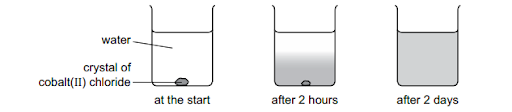
Figure 1.2 shows a coloured crystal of cobalt(II) chloride is placed at the bottom of a beaker containing water.

After two days, the colour has spread throughout the water.

Figure 1.2


q3_specimen-paper-0620-03-cie-igcse-chemistry

Explain these observations.

5a
3 marks

Complete Table 1.1 about solids, liquids and gases.

Table 1.1


particle separation

particle arrangement

type of motion

solid


regular

vibrate only

liquid

some touching


random

gas

apart

random


5b
1 mark

Extended Only

The graph shows the change in temperature as a sample of a gas is cooled.

q5b0620-s20-qp-43

Name the change of state taking place between A and B.

5c
2 marks

A bottle of liquid perfume is left open at the front of a room.

After some time, the perfume is smelt at the back of the room.

Name the two physical processes taking place.

6a
4 marks

This question is about bromine and compounds of bromine.

Use the kinetic particle model to describe the arrangement and type of motion of the molecules in:

Liquid bromine:

Bromine gas:

6b
1 mark

The graph shows how the volume of bromine gas changes with temperature. The pressure is kept constant.

q4b-0620_s19_qp_32

Describe how the volume of the bromine gas changes with temperature.

6c
1 mark

Calcium melts at 839 °C and boils at 1484 °C.

What is the physical state of calcium at 1600 °C?

7a
4 marks

This question is about chlorine and compounds of chlorine.

Use the kinetic particle model to describe the arrangement and type of motion of the molecules in:

Solid chlorine:

Chlorine gas:

7b
1 mark

The graph shows how the pressure of chlorine gas changes when temperature increases. The volume is kept constant.

q4b-0620_s19_qp_33

 Describe how the pressure of the chlorine gas changes with temperature.

7c
2 marks

The structure of compound S is shown.

q5-0620_s19_qp_33

The melting point of pure S is 159 °C.

The boiling point of pure S is 200 °C.

What is the physical state of pure S at 100 °C?

Explain your answer.

8a
1 mark

Diffusion is very slow in solids.

State the two states of matter in which diffusion happens much more quickly than in solids.

8b
2 marks

Explain, in terms of the arrangement and movement of particles, why diffusion is very slow in a solid.

8c
2 marks

State which of the two states of matter you gave in part (a) allows faster diffusion.

Explain your answer in terms of the particles.

9a
2 marks

A single drop of blue ink is added to a beaker of still water.

The beaker is left on a bench and is not stirred.

Describe what is seen in the beaker after a few minutes and after several hours.

9b
1 mark

Name the process that causes the ink to spread through the water.

9c
2 marks

Explain why the ink spreads through the whole beaker even though the water is never stirred.

10a
1 mark

An air freshener is sprayed in one corner of a room.

A few minutes later the scent can be smelled on the other side of the room.

Name the process by which the scent spreads through the room.

10b
2 marks

Explain, in terms of the movement of particles, why the scent can be smelled on the other side of the room.

10c
2 marks

The same air freshener is sprayed in the same room on a warmer day.

State the effect this has on the time taken for the scent to be smelled on the other side of the room.

Explain your answer.

11a
1 mark

Extended Tier Only

Neon, argon, krypton and xenon are four of the noble gases.

Their relative atomic masses are shown.

Noble gas

Relative atomic mass

neon

20

argon

40

krypton

84

xenon

131

State which of these four gases has the fastest rate of diffusion at 20 °C.

11b
1 mark

Extended Tier Only

Explain your answer to part (a).

11c
1 mark

For most gases, the rate of diffusion is compared using relative molecular mass.

For the noble gases, relative atomic mass is used instead.

Suggest why.

11d
1 mark

All four gases are warmed from 20 °C to 50 °C.

State the effect this has on the rate of diffusion of the four gases.

12a
2 marks

Methane, CH4, and sulfur dioxide, SO2, are both colourless gases.

Calculate the relative molecular mass, Mr, of methane and of sulfur dioxide.

Use the relative atomic masses H = 1, C = 12, O = 16 and S = 32.

12b
1 mark

Extended Tier Only

State which of the two gases diffuses faster when both are at the same temperature.

12c
1 mark

Extended Tier Only

Explain your answer to part (b).

12d
1 mark

Both gases are then warmed to a higher temperature.

State the effect this has on the rate of diffusion of each gas.

1a
8 marks

Extended Only

Concentrated ammonia solution gives off ammonia gas. Concentrated hydrochloric acid gives off hydrogen chloride gas. Ammonia, NH3, and hydrogen chloride, HCl, are both colourless gases. Ammonia reacts with hydrogen chloride to make the white solid ammonium chloride.

Apparatus is set up as shown.

cie-igcse-sq-1-1-q2

After ten minutes a white solid forms in the tube where the gases meet.

i) Write the chemical equation for the reaction of ammonia with hydrogen chloride.

[1]

ii) Name the process by which the ammonia and hydrogen chloride gases move in the tube.

[1]

iii) At which point, A, B, C or D, does the white solid form? Explain why the white solid forms at that point.

[3]

iv) The experiment was repeated at a higher temperature. Predict how the results of the experiment would be different. Explain your answer.

[3]

1b
6 marks

Some of the white solid is removed from the tube and dissolved in water.

Describe how the white solid could be tested to show it contains:

i) Ammonium ions.

Test ...........................

Result .......................

[3]

ii) Chloride ions.

Test .........................

Result .....................

[3]

1c
4 marks

Extended Only

The diagram shows the electron arrangement in a molecule of ammonia, showing only outer shell electrons.

cie-igcse-sq-1-1-q2b

i) State the type of bonding in ammonia.

[1]

ii) Hydrazine, N2H4, is another compound of nitrogen and hydrogen. Complete the diagram to show the electron arrangement in a molecule of hydrazine, showing only outer shell electrons.

cie-igcse-sq-1-1-q2bii

[3]

1d
3 marks

Separate: Chemistry and Extended Only

Nylon and proteins are both polymers containing nitrogen.

i) Name the linkages found in the polymers of nylon and protein.

[1]

ii) Describe one difference in the structures of nylon and protein.

[1]

iii) What is the general name given to the products of hydrolysis of proteins?

[1]

1e
1 mark

Extended Only

Suggest the structure of the monomer used to make the polymer shown.

cie-igcse-sq-1-1-q2e
2a
4 marks

Extended Only

Compound X is a colourless liquid at room temperature.

A sample of pure X was slowly heated from –5.0 °C, which is below its melting point, to 90 °C, which is above its boiling point. Its temperature is measured every minute and the results are represented on the graph.

cie-igcse-sq-1-1-q3a

i) Complete the equation for the equilibrium present in the region BC.

X (s) ⇌....................

[1]

ii) What is the significance of temperature t °C?

[1]

iii) What is the physical state of compound X in the region EF?

[1]

iv) What would be the difference in the region BC if an impure sample of X had been used?

[1]

2b
5 marks

Separate: Chemistry and Extended Only

Compound X is a hydrocarbon. It contains 85.7% of carbon. The mass of one mole of X is 84 g.

i) What is the percentage of hydrogen in the compound ?

[1]

ii) Calculate the empirical formula of X. Show your working.

[3]

iii) What is the molecular formula of compound X?

[1]

3a
1 mark

Extended Only

The diagram shows a heating curve for a sample of compound X.

cie-igcse-sq-1-1-q6a

Is X a solid, a liquid or a gas at room temperature, 20 °C?

3b
1 mark

Extended Only

Write an equation for the equilibrium which exists in region BC.

3c
1 mark

Extended Only

Name the change of state which occurs in region DE.

3d
2 marks

Extended Only

Explain how the curve shows that a pure sample of compound X was used.

4a
8 marks

Extended Only

Ethanoic acid is a colourless liquid at room temperature. It has the typical acid properties and forms compounds called ethanoates.

A pure sample of ethanoic acid is slowly heated from 0 oC to 150 oC and its temperature is measured every minute. The results are represented on the graph below.

1-3-q5a

i) Name the change that occurs in the region D to E.

[1]

ii) What would be the difference in the region B to C if an impure sample had been used?

[1]

iii) Sketch on the graph how the line would continue if the acid was heated to a higher temperature.

[1]

iv) Complete the following table that compares the separation and movement of the molecules in regions C to D with those in E to F.


C to D

E to F

separation (distance between particles)


movement of particles

 random and slow


Can particles move apart to fill any volume?


[5]

4b
2 marks

Complete the word equations for the reactions of ethanoic acid.

calcium + ethanoic acid → ................................................ +  .........................................

................................................  +  ethanoic acid   →  zinc ethanoate + water

4c
2 marks

Write the symbol equation for the reaction between ethanoic acid and sodium hydroxide.

5a
4 marks

Element X can undergo the following physical changes.

Figure 1.1

q1_specimen-paper-0620-03-cie-igcse-chemistry

Name each of the numbered physical changes shown in Figure 1.

5b
1 mark

One difference between boiling and evaporation is the rate at which the processes occur.

State one other difference between boiling and evaporation.

5c
3 marks

Element X can undergo the following physical changes.

Figure 1.1

q1_specimen-paper-0620-03-cie-igcse-chemistry

Describe the separation, arrangement and motion of particles of element X in the solid state.

 Separation: ..................................................

 Arrangement: ..................................................

 Motion: ..................................................

6a
4 marks

This question is about iodine and compounds of iodine.

Use the kinetic particle model to describe the separation between the molecules and the type of motion of the molecules in:

Solid iodine:

Iodine gas:

6b
1 mark

The graph shows how the volume of iodine gas changes with pressure. The temperature is kept constant.

q4b-0620_s19_qp_31

Describe how the volume of iodine gas changes with pressure.

6c
2 marks

Sulfur dioxide melts at –73 °C and boils at –10 °C.

What is the physical state of sulfur dioxide at –20 °C?

Explain your answer.

7a
3 marks

Some physical properties of matter can be explained using the kinetic particle theory.

The diagrams show the arrangement of particles in three different substances.

Diagram showing three particle arrangements. The first has particles close but disordered, the second has tightly packed particles, and the third has particles that are spaced apart.

Identify the state of matter represented by each diagram.

7b
3 marks

Extended Only

Explain, in terms of particles, what happens when a solid is heated until it becomes a gas.

7c
4 marks

A student investigates how changing the temperature and pressure affects the volume of a gas.

The student fills a balloon with helium gas and places it in a freezer.

i) Predict what happens to the volume of the balloon as the temperature decreases. Explain your answer using the kinetic particle theory.

[2]

ii) The balloon is removed from the freezer and taken to a mountain where the atmospheric pressure is lower.

Predict what happens to the volume of the balloon and explain your answer.

[2]

8a
2 marks

The diagram shows a gas jar that initially contains bromine gas at the bottom and air above it. After a few minutes, the two gases have mixed more evenly.

Diagram of a vertical gas jar with a lid, containing air at the top and bromine as a darker gradient at the bottom, labelled accordingly.

Describe and explain what has happened to the bromine gas in the jar over time.

8b
2 marks

Extended Only

The experiment is repeated with chlorine gas instead of bromine.

State and explain whether diffusion is faster, slower or the same.

9a
3 marks

A coloured crystal of cobalt(II) chloride is placed at the bottom of a beaker containing water.

Colour spreads throughout the water over time. Fig 3.1 shows the spread of colour after two days.

Three beakers of water labelled at the start, after 2 hours and after 2 days. At the start a crystal of cobalt(II) chloride sits at the bottom; after 2 hours a smaller crystal with shading in the lower water; after 2 days no crystal and evenly shaded water.

Fig. 3.1

 Explain these observations.

9b
3 marks

Cobalt(II) chloride can be used to test for the presence of water.

anhydrous cobalt(II) chloride ⇌ hydrated cobalt(II) chloride

CoCl2 + 6H2O ⇌ CoCl2•6H2O

(i) State the meaning of the symbol ⇌.

 [1]

(ii) State the colour change when water is added to anhydrous cobalt(II) chloride.

from ………………...............……………….. to................................................................ 

[2]

9c
3 marks

(i) Table 3.1 compares the reactivity of cobalt with that of three other metals.

Table 3.1

metal

reactivity with cold water

reactivity with steam

barium

reacts rapidly

cobalt

no reaction

reacts slowly when heated

magnesium

reacts very slowly

reacts rapidly

zinc

no reaction

reacts easily when heated

Use this information to put the four metals in order of their reactivity. Put the least reactive metal first.

least reactive      ----------------        most reactive

[2]

(ii) State the boiling point of pure water at atmospheric pressure.

 ........................................................ °C

[1]

10a
2 marks

This question is about Group IV elements and their compounds. 

The changes of state of lead are shown.

Flowchart showing states of lead: solid to liquid by melting, liquid to gas by B, gas to liquid by condensing, and liquid to solid by A.

Name the changes of state represented by A and B.

10b
4 marks

Use the kinetic particle model to describe the differences between liquid lead and lead gas in terms of: 

  • the separation of the particles

  • the motion of the particles

10c
1 mark

Lead is extracted from lead(II) oxide by heating with carbon.

PbO + C → Pb + CO

Describe how this equation shows that lead(II) oxide is reduced.

10d
4 marks

Diamond is a form of carbon. 

(i) Choose the word which best describes the structure of diamond. 

Draw a circle around your chosen answer.

giant ionic metallic simple 

[1] 

(ii) Name the type of bonding in diamond.

[1] 

(iii) Give one use of diamond.

[1] 

(iv) Deduce the electronic structure of carbon. Use the Periodic Table to help you.

[1]

11a
1 mark

Iron is extracted from its ore in a blast furnace. Aluminium is extracted from its ore by electrolysis.

State the name of the main ore of aluminium.

11b
2 marks

Explain why aluminium cannot be extracted by heating its oxide with carbon in a blast furnace.

11c
2 marks

The following equation shows a reaction occurring in the blast furnace for extracting iron from its ore.

Fe2O3 + 3CO → 2Fe + 3CO2

Identify the substance that is oxidised in this reaction. Give a reason for your answer.

Substance oxidised:

Reason:

11d
4 marks

Iron reacts with dilute hydrochloric acid to form iron(II) chloride, which is a soluble salt. Describe the steps a student should use to prepare pure, dry crystals of iron(II) chloride from excess iron powder and dilute hydrochloric acid.

12a
2 marks

Nitrogen, N2, and ethene, C2H4, are both colourless gases.

Calculate the relative molecular mass, Mr, of nitrogen and of ethene.

Use the relative atomic masses H = 1, C = 12 and N = 14.

12b
2 marks

Extended Tier Only

Both gases are held at the same temperature.

Predict which of the two gases diffuses faster.

Explain your answer.

12c
1 mark

A third colourless gas, carbon monoxide, CO, is also tested at the same temperature.

Calculate the relative molecular mass of carbon monoxide.

Use the relative atomic masses C = 12 and O = 16.

12d
2 marks

Extended Tier Only

Nitrogen, ethene and carbon monoxide contain different elements and have different chemical properties.

Suggest what these three gases show about using relative molecular mass to predict the rate of diffusion of a gas.

13a
1 mark

A student places a small crystal of a purple dye at the bottom of a beaker of water and measures the time taken for the colour to spread 8 cm up the beaker.

The student repeats the experiment at three temperatures.

Temperature of the water / °C

Time for the colour to spread 8 cm / min

20

62

40

41

60

28

Describe the trend shown by the results.

13b
2 marks

Explain the trend using kinetic particle theory.

13c
1 mark

Predict the time it would take for the colour to spread 8 cm if the experiment were repeated at 30 °C.

13d
1 mark

The student was careful not to stir the water at any point during the experiment.

Explain why.

14a
1 mark

Natural gas has no smell of its own. A small amount of a strongly smelling gas, called an odourant, is added to it so that leaks can be noticed.

Two odourants are tested. A small amount of each is released at one end of a room. The time taken for the smell to be noticed 12 m away is recorded.

Odourant

Relative molecular mass

Time for the smell to be noticed / s

X

62

45

Y

48

38

Using the table, state which odourant is noticed sooner.

14b
2 marks

Extended Tier Only

Explain, in terms of the particles, why that odourant is noticed sooner.

14c
1 mark

A third odourant, Z, has a relative molecular mass of 76.

Predict how the time taken for the smell of Z to be noticed 12 m away would compare with the times in the table.

14d
2 marks

Both tests were carried out at the same temperature.

Explain why this is important.

15a
2 marks

Extended Tier Only

Two identical balloons are filled to the same size. One is filled with helium and the other is filled with air.

The rubber of each balloon contains very small holes.

After two days the helium balloon has shrunk noticeably. The air-filled balloon has hardly changed in size.

relative atomic mass of helium = 4

average relative molecular mass of air = 29

Use the data to explain why the helium balloon shrinks faster.

15b
1 mark

State one variable that must be kept the same if the comparison between the two balloons is to be fair.

15c
2 marks

Extended Tier Only

The experiment is repeated using a balloon filled with argon in place of the helium.

relative atomic mass of argon = 40

Predict how the rate at which argon diffuses out of the balloon compares with the rate at which air diffuses in.

Explain your answer.

15d
1 mark

An average relative molecular mass is quoted for air, rather than a single exact value.

Suggest why.

1a
3 marks

Substance Z is a pure solid at room temperature.

Z melts at 113 °C and boils at 445 °C.

Describe the changes in the separation, arrangement and motion of the particles of Z as Z melts.

1b
2 marks

The separation of the particles of Z increases far more when Z boils than when Z melts.

Explain why.

1c
2 marks

Extended Tier Only

Z is heated steadily.

While Z is melting, the temperature of Z stays constant at 113 °C even though Z is still being heated.

Explain why.

2a
3 marks

Extended Tier Only

A sample of chlorine gas has a volume of 240 cm3 at room temperature and pressure.

The pressure on the sample is increased. The temperature of the sample stays the same.

Describe and explain, in terms of kinetic particle theory, what happens to the volume of the sample.

2b
3 marks

Extended Tier Only

The original sample of chlorine gas is heated. The pressure on the sample stays the same.

Describe and explain, in terms of kinetic particle theory, what happens to the volume of the sample.

2c
2 marks

Extended Tier Only

In part (a), the average speed of the chlorine particles does not change.

Explain why.

3a
1 mark

Extended Tier Only

Chlorine and bromine are both in Group VII of the Periodic Table.

A sample of chlorine gas and a sample of bromine vapour are released into separate identical tubes at the same temperature.

relative atomic mass of chlorine = 35.5

relative atomic mass of bromine = 80

State which of the two diffuses faster.

3b
2 marks

Extended Tier Only

Explain your answer to part (a).

3c
2 marks

Extended Tier Only

A student explains the difference by writing:

"The two gases diffuse at different rates because chlorine and bromine have different relative atomic masses."

The relative atomic masses are different, but the explanation does not gain credit.

Explain why not.

3d
1 mark

A second student suggests that the gases diffuse at different rates because chlorine is more reactive than bromine.

Explain why this suggestion is not correct.

4a
4 marks

Nitrogen dioxide, NO2, is a dark brown gas.

When nitrogen dioxide is cooled, it forms a yellow liquid and then pale yellow crystals.

These crystals are heated and the temperature is measured every minute. The following graph can be drawn.

states-of-matter-graph

i) Describe the arrangement and movement of the molecules in the region A–B.

[3]

ii) Name the change that occurs in the region B–C.

[1]

4b
4 marks

Extended Only

Nitrogen dioxide and other oxides of nitrogen are formed in car engines.

i) Explain how these oxides are formed.

[2]

ii) How are they removed from the exhaust gases?

[2]

4c
3 marks

Extended Only

Nitrogen dioxide, oxygen and water react to form dilute nitric acid.

Describe how lead(II) nitrate crystals could be prepared from dilute nitric acid and lead(II) oxide.

5a
3 marks

A small amount of liquid bromine is added to a container which is then sealed.

Br2(l) → Br2(g)

Use the ideas of the Kinetic Theory to explain why, after about an hour, the bromine molecules have spread uniformly to occupy the whole container.

5b
6 marks

Extended Only

The diagrams below show simple experiments on the speed of diffusion of gases.

1-2-q-2b-i
1-2-q-2b-ii

Complete the following explanations. Diagram 1 has been done for you.

Diagram 1 There is air inside and outside the porous pot so the rate of diffusion of air into the pot is the same as the rate of diffusion of air out of the pot. The pressure inside and outside the pot is the same so the coloured liquid is at the same level on each side of the tube.

Diagram 2.

................................

Diagram 3

................................

6a
5 marks

Separate: Chemistry and Extended Only

Acid-base reactions are examples of proton transfer.

Ethylamine is a weak base and sodium hydroxide is a strong base.

i) In terms of proton transfer, explain what is meant by the term weak base.

[2]

ii) Given aqueous solutions of both bases, describe how you could show that sodium hydroxide is the stronger base. How could you ensure a ‘fair’ comparison between the two solutions?

[3]

6b
4 marks

Ethylamine reacts with acids to form salts.

CH3CH2NH2      +     HCl    →   CH3CH2NH3Cl

                                                                ethylammonium chloride

i) Complete the equation for the reaction between sulfuric acid and ethylamine. Name the salt formed.

......  CH3CH2NH2       +       ............     →     .........................

Name of salt ........................................................................

[3]

ii) Amines and their salts have similar chemical properties to ammonia and ammonium salts.

Suggest a reagent that could be used to displace the weak base, ethylamine, from its salt ethylammonium chloride.

[1]

6c
5 marks

Extended Only

Gases diffuse, which means that they move to occupy the total available volume.

i) Explain, using kinetic particle theory, why gases diffuse.

[2]

ii) When the colourless gases hydrogen bromide and ethylamine come into contact, a white solid is formed.

CH3CH2NH2 (g) + HBr (g)     →     CH3CH2NH3Br (s)

      white solid

The following apparatus can be used to compare the rates of diffusion of the two gases ethylamine and hydrogen bromide.

1-3-q1

Predict at which position, A, B or C, the white solid will form. Explain your choice.

[3]

7a
2 marks

Extended Only

Different gases diffuse at different speeds.

i) What is meant by the term diffusion?

[1]

ii) What property of a gas molecule affects the speed at which it diffuses?

[1]

7b
2 marks

Extended Only

Helium is a gas used to fill balloons. It is present in the air in very small quantities. Diffusion can be used to separate it from the air. Air at 1000°C is on one side of a porous barrier. The air which passes through the barrier has a larger amount of helium in it.

i) Why does the air on the other side of the barrier contain more helium?

[1]

ii) Why is it an advantage to have the air at a high temperature?

[1]

7c
3 marks

Most helium is obtained from natural gas found in the USA. Natural gas contains methane and 7% helium. One possible way to obtain the helium would be to burn the methane.

i) Write an equation for the complete combustion of methane.

[1]

ii) Suggest why this would not be a suitable method to obtain the helium.

[1]

iii) Suggest another method, other than diffusion, by which helium could be separated from the mixture of gases in natural gas.

[1]

8a
1 mark

Extended Only

Z is a covalent substance. In an experiment, a sample of pure solid Z was continually heated for 12 minutes.

The graph shows how the temperature of the sample of pure Z changed during the first 9 minutes.

q2-0620_s19_qp_41

What is the melting point of pure Z?

8b
1 mark

Extended Only

The sample of pure Z began to boil at 9 minutes. It was boiled for 3 minutes.   Use this information to sketch on the grid, in part (a), how the temperature of the sample of pure Z changed after 9 minutes.

8c
2 marks

Extended Only

The sample of pure Z was continually heated between 2 minutes and 5 minutes.  

Explain, in terms of attractive forces, why there was no increase in the temperature of the sample of pure Z between 2 minutes and 5 minutes.

8d
2 marks

Extended Only

Describe how the motion of particles of pure Z changed from 0 minutes to 2 minutes.

8e
2 marks

The experiment was repeated using a solid sample of impure Z.

Suggest the differences, if any, in the melting point and boiling point of the sample of impure Z compared to the sample of pure Z.

melting point:

boiling point:

8f
2 marks

Extended Only

A sample of pure Z was allowed to cool from 120 °C to 20 °C. The total time taken was 8 minutes.

q2f-0620_s19_qp_41

 Starting from point ×, sketch on the grid how the temperature of the sample of pure Z changed between 0 minutes and 8 minutes.

9a
5 marks

Extended Only

Kinetic theory explains the properties of matter in terms of the arrangement and movement of particles.

Nitrogen is a gas at room temperature. Nitrogen molecules, N2, are spread far apart and move in a random manner at high speed.

i) Draw the electronic structure of a nitrogen molecule. Show only the outer electron shells.

[2]

ii) Compare the movement and arrangement of the molecules in solid nitrogen to those in nitrogen gas.

[3]

9b
2 marks

Extended Only

A sealed container contains nitrogen gas. The pressure of the gas is due to the molecules of the gas hitting the walls of the container.

Use the kinetic theory to explain why the pressure inside the container increases when the temperature is increased.

9c
3 marks

Extended Only

The following apparatus can be used to measure the rate of diffusion of a gas.

cie-igcse-sq-1-1-qac

The following results were obtained.

gas

temperature/ oC

rate of diffusion in cm3 / min

nitrogen

25

1.00

chlorine

25

0.63

nitrogen

50

1.05

i) Explain why nitrogen gas diffuses faster than chlorine gas.

[2]

ii) Explain why the nitrogen gas diffuses faster at the higher temperature.

[1]