Electrolysis (Cambridge (CIE) IGCSE Chemistry): Exam Questions

Exam code: 0620 & 0971

5 hours54 questions

Smart practice available on this topic

Answer questions with adaptive difficulty and personalised feedback

Start practising
1
1 mark

A student was investigating the electrolysis of zinc chloride. 

yuzRBqeD_q6

What is the correct reason for electrolysis not working? 

  • Solid zinc chloride has been used 

  • The electrodes don't conduct electricity 

  • The power supply is not connected properly 

  • The crucible is too small to allow ions to flow 

2
1 mark

Solid lead(II) bromide is heated until it is molten. The molten lead (II) bromide then undergoes electrolysis. 

Which substances are formed at each electrode?


anode

cathode

A

bromine

lead

B

lead

bromine

C

bromine

hydrogen

D

hydrogen

lead

    3
    1 mark

    The electrolysis of concentrated hydrochloric acid is shown.

    cie-igcse-5-1m-mcq3

    Which statement describes what happens to the electrons during the electrolysis?

    • They are removed from hydrogen ions at the negative electrode

    • They are added to hydrogen ions at the negative electrode

    • They are added to chloride ions at the positive electrode

    • They move through the electrolyte solution to the positive electrode

    4
    1 mark

    Concentrated aqueous sodium chloride can be electrolysed.

    Which statement is correct?

    • Hydrogen gas is formed at the anode, and chlorine gas is formed at the cathode.

    • Hydrogen gas is formed at the cathode, and chlorine gas is formed at the anode.

    • Sodium metal is formed at the anode, and chlorine gas is formed at the cathode.

    • Sodium metal is formed at the cathode, and chlorine gas is formed at the anode.

    5
    1 mark

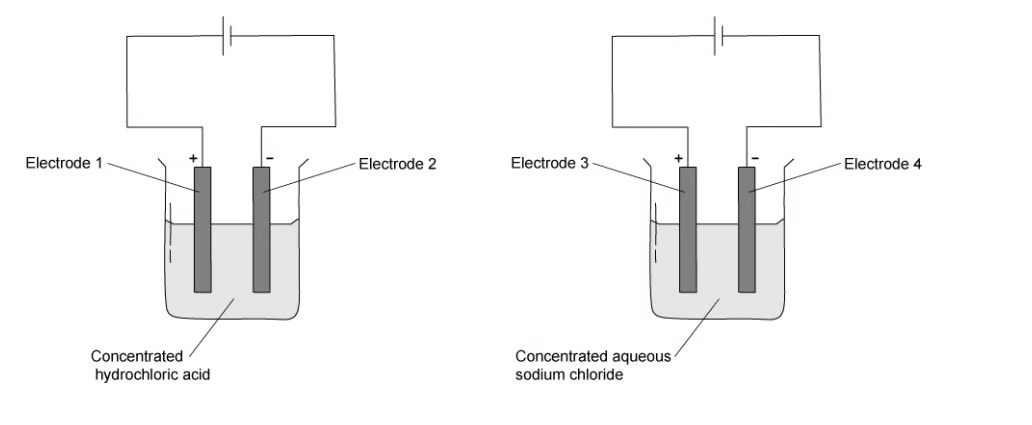
    The diagram shows the electrolysis of concentrated hydrochloric acid and concentrated aqueous sodium chloride using carbon electrodes.

    Diagram showing two electrochemical cells: one with concentrated hydrochloric acid and electrodes, the other with concentrated aqueous sodium chloride and electrodes.

    At which electrode(s) is hydrogen produced?

    • Electrode 1 only

    • Electrodes 1 and 3

    • Electrode 2 only

    • Electrodes 2 and 4

    6
    1 mark

    Three statements about the electrolysis of molten lead (II) bromide are listed.

    1. A green gas is produced at the negative electrode.

    2. Lead ions will gain electrons at the cathode.

    3. The electrodes for the electrolysis must be from an inert material, such as graphite.

    Which statements are correct?

    • 1, 2 and 3

    • 2 only

    • 2 and 3 only

    • 3 only

    1
    1 mark

    Which statement about electrolysis is correct?

    • Electrons move through the electrolyte from the cathode to the anode.

    • Electrons move towards the cathode in the external circuit.

    • Negative ions move towards the anode in the external circuit.

    • Positive ions move through the electrolyte towards the anode during electrolysis.

    2
    1 mark

    Dilute sulfuric acid is electrolysed using inert electrodes. 

    What are the products of this electrolysis?


    cathode

    anode

    A

    oxygen

    sulfur 

    B

    hydrogen

    sulfur dioxide

    C

    oxygen

    hydrogen

    D

    hydrogen

    oxygen

      3
      1 mark

      Electricity is passed through concentrated aqueous sodium chloride. Inert electrodes are used.

      q3-4-1-medium-cie-igcse-chemistry

      Which products are formed at the electrodes?


      cathode

      anode

      A

      hydrogen

      chlorine

      B

      hydrogen

      oxygen

      C

      sodium

      chlorine

      D

      sodium

      oxygen

        4
        1 mark

        The diagram shows the electrolysis of aqueous copper(II) sulfate.

        cie-igcse-5-1h-mcq4

        Which statement is correct?

        • Copper metal is deposited at the positive electrode.

        • In the external circuit the electrons move from positive to negative.

        • In the solution the electrons move from positive to negative.

        • Oxygen gas is produced at the positive electrode.

        5
        1 mark

        Concentrated aqueous potassium bromide solution is electrolysed using inert electrodes. The ions present in the solution are K+, Br, H+ and OH.

        To which electrodes are the ions attracted during this electrolysis?


        attracted to anode

        attracted to cathode

        A

        Br and K+

        H+ and OH

        B

        Br and OH

        H+ and K+

        C

        H+ and K+

        Br and OH

        D

        H+ and OH

        Br and K+

          6
          1 mark

          Which is the correct equation for the formation of chlorine gas at the anode during the electrolysis of concentrated sodium chloride solution?

          • Cl + e- → Cl-

          • 2Cl- + 2e- → Cl2

          • 2Cl- → Cl2 + 2e-

          • Cl- → Cl + e-

          7
          1 mark

          Concentrated aqueous magnesium chloride is electrolysed using inert graphite electrodes.

          Which row shows the correct observations at the cathode and at the anode?

          observation at the cathode

          observation at the anode

          A

          bubbles of a colourless gas

          bubbles of a colourless gas

          B

          bubbles of a colourless gas

          bubbles of a pale yellow-green gas

          C

          silvery solid deposited

          bubbles of a colourless gas

          D

          silvery solid deposited

          bubbles of a pale yellow-green gas

            1
            1 mark

            The diagram shows the electrolysis of concentrated aqueous sodium chloride.

            q1-4-3-hard-cie-igcse-chemistry

            What is the colour of the litmus at each electrode after five minutes?


            colour at anode

            colour at cathode

            A

            blue

            red

            B

            red

            blue

            C

            red

            colourless

            D

            colourless

            blue

              2
              1 mark

              Four substances are electrolysed. The substances are concentrated aqueous sodium chloride, concentrated hydrochloric acid, molten lead(II) bromide and molten sodium oxide.

              Which statement about these electrolysis reactions is correct?

              • A colourless gas is formed at the anode when molten sodium oxide is electrolysed.

              • A green gas is formed at the cathode when concentrated hydrochloric acid is electrolysed.

              • A metal is formed at the anode when molten lead(II) bromide is electrolysed.

              • A metal is formed at the cathode when concentrated aqueous sodium chloride is  electrolysed.

              3
              1 mark

              Four solutions are separately electrolysed.

              experiment

              solution

              electrodes

              1

              dilute aqueous sodium chloride

              carbon

              2

              aqueous copper(II) sulfate

              copper

              3

              concentrated hydrochloric acid

              carbon

              4

              dilute sulfuric acid

              carbon

              In which two experiments is a colourless gas evolved at the anode?

              • 1 & 2

              • 1 & 4

              • 2 & 3

              • 3 & 4

              4
              1 mark

              During electrolysis of brine, a gas is produced at the cathode. What is the half-equation for the reaction on the cathode?

              • 2Cl- → Cl2 + 2e-

              • 2Cl- + 2e- → Cl2

              • 2H+ + 2e- → H2

              • 2H+ → H2 + 2e-

              5
              1 mark

              The amount of gases P and Q are formed when substance X is electrolysed. 

              4-1-q9-cie-igcse-mcq-volume-of-gases-during-electrolysis

              What is substance X?

              • molten zinc bromide 

              • dilute sulfuric acid 

              • concentrated aqueous sodium bromide

              • concentrated hydrochloric acid 

              6
              1 mark

              Concentrated aqueous sodium chloride, dilute sulfuric acid and molten lead bromide were electrolysed separately in experiments 1, 2 and 3. 

              4-1-q10-cie-igcse-mcq-three-electrolysis-experiments

              Which statement about the electrode products is correct?

              • Metals were formed at the anode in experiments 1 and 3 only 

              • Metals were formed at the cathode in experiments 1 and 3 only

              • Gases are given off at the cathode in experiments 1 and 2 only 

              • Gases are given off at the anode in experiments 2 and 3 only 

              7
              1 mark

              A student wants to identify the gas produced at the negative electrode during the electrolysis of aqueous sodium chloride. 

              4-1-q11-cie-igcse-mcqgas-tests-for-products

              What is the correct test for the gas produced?

              • A glowing splint will relight

              • A burning splint gives a squeaky pop sound

              • Damp litmus paper bleaches

              • Damp red litmus paper turns blue