Solids, liquids & gases (Cambridge (CIE) IGCSE Chemistry): Multiple Choice Questions

Exam code: 0620 & 0971

6 hours81 questions
1
1 mark

Many chemical processes involve substances in either the liquid or the gaseous state.

Which of the following statements is correct?

  • A specific mass of a gas has a fixed volume at room temperature

  • A specific mass of a liquid has a fixed volume at room temperature

  • 25 cm3 of gas contains more particles than 25 cm3 of liquid

  • Liquid particles placed inside a sealed container have fixed positions

2
1 mark

Four substances are shown below. 

In which of these substances are the particles close together and moving slowly past each other?

  • Ice

  • Air

  • Steam

  • Water

3
1 mark

A student noted the following observation in his laboratory notebook:

“The particles moved slowly from an area of high concentration to an area of low concentration.”

Which process is being described?

  • Diffusion of substance in a liquid.

  • The particles of a solid during melting.

  • A liquid being frozen.

  • Diffusion of a substance through air.

4
1 mark

Extended Only

A small amount of bleach was accidentally spilled on a kitchen floor. After a while it was observed that the floor appeared to be dry and the whole kitchen smelled of bleach.

Which processes have occurred?

  • Evaporation and diffusion

  • Distillation and diffusion

  • Evaporation only

  • Diffusion only

5
1 mark

Which words complete the gaps 1 & 2 in these sentences?

As the temperature of air in a balloon ............1.............. the volume increases. When the volume of air in a balloon increases the pressure ...............2...................


1

2

 A

increases

increases

 B

increases

decreases

 C

decreases

increases

 D

decreases

decreases

    6
    1 mark

    Substances change state when their temperature is changed. 

    Which changes of state take place when the temperature of a substance is lowered? 

    1. boiling 

    2. condensation 

    3. freezing 

    4. melting

    • 1 and 4

    • 2, 3 and 4

    • 2 and 3 only

    • 3 only

    7
    1 mark

    Water boils at 100 °C to form steam.

    Which statement about the particles of steam is correct?

    • The arrangement of the molecules is regular.

    • The molecules move quickly in random directions.

    • The forces of attraction between the molecules are strong.

    • The molecules are close together.

    8
    1 mark

    Which statement about diffusion is correct?

    • It is a chemical change.

    • The net movement of particles is from a region of lower concentration to a region of higher concentration.

    • The particles spread in order with a fixed pattern.

    • The net movement of particles is from a region of higher concentration to a region of lower concentration.

    9
    1 mark

    Solid candle wax turns into liquid wax when it is heated.

    What is the name of this change of state?

    • boiling

    • condensing

    • freezing

    • melting

    10
    1 mark

    Diffusion is very much slower in a solid than in a liquid or a gas.

    Which statement explains why?

    • The particles in a solid have no energy.

    • The particles in a solid are all the same size.

    • The particles in a solid can only vibrate about fixed positions.

    • The particles in a solid are held together by weak forces.

    11
    1 mark

    Extended Only

    The table shows the relative molecular masses of four gases.

    Gas

    Relative molecular mass

    hydrogen, H2

    2

    nitrogen, N2

    28

    sulfur dioxide, SO2

    64

    chlorine, Cl2

    71

    All four gases are at the same temperature.

    Which gas diffuses most quickly?

    • hydrogen

    • nitrogen

    • sulfur dioxide

    • chlorine

    1
    1 mark

    The following four statements describe the arrangement of particles in a substance.

    1

    Particles are moving in all directions

    2

    Particles are arranged in neat rows

    3

    Particles can move past each other

    4

    Particles vibrate about their positions

    Which of the four statements describe the arrangement of particles in a solid?

    • 1 and 2

    • 2 and 4

    • 1 and 3

    • 2 only

    2
    1 mark

    The diagram shows a cup of hot chocolate which was prepared by mixing boiling water with chocolate powder.

    M0vngQ7d_q2-1-1-mcq-medium-cie-igcse-che

    Which row correctly describes the particles of water in the air above the cup compared to those in the hot chocolate drink inside the cup?


    Particles move faster

    Particles are closer together

    A

    ✓

    ✓

    B

    ✓

    ×

    C

    ×

    ✓

    D

    ×

    ×

      3
      1 mark

      The diagram shows what happens when a blue soluble crystal is placed in a beaker of water.

      q3

      Which row correctly describes the processes taking place?


      Chemical process

      Dissolving

      Diffusion

      A

      ✓

      ✓

      ✓

      B

      ×

      ×

      ✓

      C

      ✓

      ×

      ✓

      D

      ×

      ✓

      ✓

        4
        1 mark

        Substance X can occur in three different physical states as shown in the diagram.

        q4-1-1-mcq-medium-cie-igcse-che

        Which statement is correct?

        •  In state 1 the particles vibrate around fixed positions but don't move

        • Diffusion occurs in the phase change from state 1 to 2

        • The volume of the substance in state 3 is fixed

        • Condensation occurs in the phase change from state 3 to 2

        5
        1 mark

        Matter exists in three states which are solid, liquid and gas. Phase changes occur when matter changes from one state to another.

        In which changes do the particles move closer together?

        gas   ⇌31  liquid   ⇌42  solid

        •  3 and 4

        •  1 and 3

        • 4 only

        • 1 and 2

        6
        1 mark

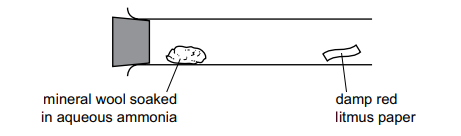
        Mineral wool soaked in aqueous ammonia is placed in the apparatus shown.

        Test tube with mineral wool soaked in aqueous ammonia on the left and damp red litmus paper on the right, showing chemical reaction setup.

        After five minutes, the damp red litmus paper turns blue. 

        Which process led to this change?

        • condensation

        •  crystallisation

        • diffusion

        • distillation

        7
        1 mark

        Extended Only

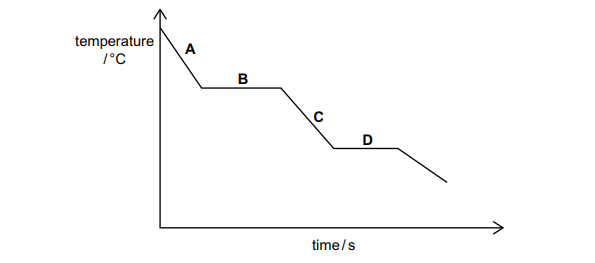
        A gaseous substance is slowly cooled and the temperature recorded every second.

        The results are shown on the graph.

        Graph showing temperature over time with four stages: A, B, C, and D. Temperature decreases in steps from left to right along the time axis.

        At which point is the substance a solid?

          8
          1 mark

          Extended Only

          Which two gases will diffuse at the same rate, at the same temperature?

          • carbon monoxide and carbon dioxide 

          • carbon monoxide and nitrogen 

          •  chlorine and fluorine

          • nitrogen and oxygen 

          9
          1 mark

          The graph shows the heating curve for substance B. The regions are labelled P, Q, R and S.

          Temperature (°C) against time (s). The curve rises from the start (P), becomes horizontal at Q, rises again at R, then becomes horizontal at S.

          Using the kinetic particle model, which statement is correct?

          • In region P, the particles gain kinetic energy and move around each other in an irregular arrangement.

          • In region Q, the particles gain kinetic energy and move further apart as the substance is heated.

          • In region R, thermal energy is used to overcome the attractive forces between the particles, which are in a random arrangement.

          • In region S, thermal energy is used to overcome the attractive forces between the particles and they move far apart.

          10
          1 mark

          A few drops of a strongly smelling liquid are spilled on a bench. The smell is noticed across the room within one minute.

          A few drops of the same liquid are added to a beaker of water. Its colour takes about an hour to spread through the water.

          Both the room and the water are at the same temperature.

          Which explains why the substance spreads so much more quickly through the air?

          • The liquid reacts with the water.

          • The liquid dissolves in water rather than diffusing through it.

          • The particles in air are much further apart than the particles in water.

          • Air has a lower relative molecular mass than water.

          11
          1 mark

          Extended Only

          A gas with a strong smell leaks at one end of a long corridor.

          The smell is noticed at the far end of the corridor after 30 seconds.

          Which change would make the smell reach the far end in a shorter time?

          • using a gas with a higher relative molecular mass

          • lowering the temperature of the corridor

          • using a gas with a lower relative molecular mass

          • using a longer corridor

          12
          1 mark

          Extended Only

          Three statements about diffusion are shown.

          1 Diffusion happens because particles are moving randomly.

          2 Diffusion is faster in a gas than in a liquid at the same temperature.

          3 A gas with a higher relative molecular mass diffuses more quickly.

          Which statements are correct?

          • 1, 2 and 3

          • 1 and 2 only

          • 1 and 3 only

          • 2 and 3 only

          1
          1 mark

          Extended Only

          The rate of diffusion of two gases, methane, CH4, and propene, C3H6, is measured using the apparatus shown.

          q11-1-mcq-hard-cie-igcse-che

          Which gas diffuses at a faster rate and why?


          Fastest gas

          Reason

          A

          Propene

          Propene molecules are heavier and so move faster.

          B

          Methane

          Methane is a lighter molecule.

          C

          Propene

          Propene is unsaturated so is more reactive.

          D

          Methane

          Methane molecules are smaller so fit through the hole more easily.

            2
            1 mark

            Extended Only

            Hydrogen chloride and ammonia are gases which are given off by cotton wool soaked in concentrated solutions and placed at either end of a glass tube as shown.

            When the gases react together they produce ammonium chloride, a white solid.

            Which line on the diagram correctly shows where the ammonium chloride is formed?

            q3-1-1-mcq-hard-cie-igcse-che
            • Line A

            • Line B

            • Line C

            • Line D

            3
            1 mark

            In a change of state at constant temperature and pressure:

            • energy is released to the surroundings

            • the particles change from a random arrangement to a regular, ordered arrangement

            Which change of state is being described?

            • condensing

            • evaporating

            • freezing

            • melting

            4
            1 mark

            The kinetic theory of matter explores the spatial relationship between the particles in solids, liquids and gases.

            Which of the following processes causes the distance between particles to increase by the most?

            • Melting

            • Freezing

            • Vaporising

            • Condensation

            5
            1 mark

            Extended Only

            A fixed mass of gas is heated at constant pressure.

            Which statement gives the correct change in the volume of the gas and the correct explanation in terms of kinetic particle theory?

            • The volume increases because the particles move further apart.

            • The volume increases because the particles get bigger.

            • The volume increases because the particles move faster and collide with each other more often.

            • The volume stays the same because the particles move faster but stay the same distance apart.

            6
            1 mark

            A student accidentally left a bottle of ammonia open in the corner of a laboratory. After a few minutes the entire laboratory smelled of ammonia.

            Which process has occurred?

            • Dispersion

            • Diffusion

            • Evaporation

            • Distillation

            7
            1 mark

            Extended Only

            A pure substance is heated steadily from solid to gas.

            Its temperature rises, then stays constant at 80 °C, then rises again, then stays constant at 210 °C, then rises again.

            Which statement about the substance is correct?

            • At 80 °C the particles stop moving until all of the solid has melted.

            • Between 80 °C and 210 °C the particles are arranged randomly and move past one another.

            • At 210 °C the average kinetic energy of the particles increases as the liquid boils.

            • Above 210 °C the forces of attraction between the particles are stronger than in the liquid.

            8
            1 mark

            A student closed the lid tightly on an empty metal container which was used for paint. She heated the container over a Bunsen burner on a low flame for a few moments and observed the sides and top of the container bend outwards slightly.

            She then turned off the burner and allowed the container to cool.

            Which statement explains her observations?

            • The heat increased the pressure inside the container

            • The heat deformed the metal which then bent

            • The heat made the container reduce in size

            • More air particles entered the container

            9
            1 mark

            A small amount of a coloured gas is released at one end of a long sealed tube containing air.

            The tube is left undisturbed for several hours, until the colour is the same everywhere along it.

            Which statement about the particles of the coloured gas is then correct?

            • They have all collected at the far end of the tube.

            • They are evenly spread and have stopped moving.

            • They are evenly spread but are still moving.

            • They have all reacted with the oxygen in the air.

            10
            1 mark

            Extended Only

            A gas is released at point Q, in the apparatus shown.

            Horizontal tube closed at the left end by a hatched bung. An arrow marks point Q just inside the left end; damp universal indicator paper lies inside the tube near the right end.

            Which gas changes the colour of the damp universal indicator paper most quickly? 

            gas

            relative molecular mass

            A

            ammonia

            17

            B

            carbon dioxide

            44

            C

            chlorine

            71

            D

            hydrogen

            2

              11
              1 mark

              Extended Only

              Fluorine, F2, and chlorine, Cl2, are released into identical tubes at the same temperature.

              Fluorine diffuses faster than chlorine.

              Which statement gives the correct reason, in terms of the particles that diffuse?

              • A fluorine atom has a smaller relative atomic mass than a chlorine atom.

              • A fluorine molecule has a smaller relative molecular mass than a chlorine molecule.

              • Fluorine is more reactive than chlorine.

              • A fluorine molecule contains fewer electrons than a chlorine molecule.

              12
              1 mark

              The rate of diffusion of four gases, neon (Ne), hydrogen chloride (HCl), ammonia (NH3​), and oxygen (O2​), is measured in a sealed container.

              What is the order of the rate of diffusion of the gases from slowest to fastest?

              • HCl → O2​ → Ne → NH3​

              • O2 ​→ HCl → NH3​ → Ne

              • NH3​ → Ne → O2 ​→ HCl

              • Ne → NH3​ → HCl → O2​