11 mark
Which metal could not be used for electroplating by using an aqueous solution?
Chromium
Copper
Silver
Sodium
Was this exam question helpful?
Exam code: 0620 & 0971
Which metal could not be used for electroplating by using an aqueous solution?
Chromium
Copper
Silver
Sodium
Was this exam question helpful?
During electroplating what are the correct anode (positive electrode) and cathode (negative electrode) products when aqueous copper(II) sulfate is electrolysed using copper electrodes?
| Anode product | Cathode product |
A | copper(II) ions | copper metal |
B | copper(II) ions | hydrogen gas |
C | oxygen gas | copper metal |
D | oxygen gas | hydrogen gas |
Was this exam question helpful?
In a fuel cell ............1........... energy is converted to ..................2................ energy.
| 1 | 2 |
A | electrical | heat |
B | chemical | electrical |
C | potential | chemical |
D | chemical | heat |
Was this exam question helpful?
Hydrogen-oxygen fuel cells can be used to power motor vehicles.
What is the correct balanced symbol equation for the reaction that occurs in a hydrogen-oxygen fuel cell?
H2O → H2 + O2
H2 + O2 → 2H2O
2H2 + O2 → 2H2O
H2 + O2 → H2O
Was this exam question helpful?
A student sets up the following equipment to investigate electroplating.

What would they see occur during the electroplating process?
The anode would be covered with an orange-pink coating
The cathode would be covered with a silver coating
The cathode would be covered with an orange-pink coating
The anode would be covered with a silver coating
Was this exam question helpful?
An iron tray is electroplated with pure silver to improve its appearance. The diagram shows the electrochemical cell with labels X, Y and Z.
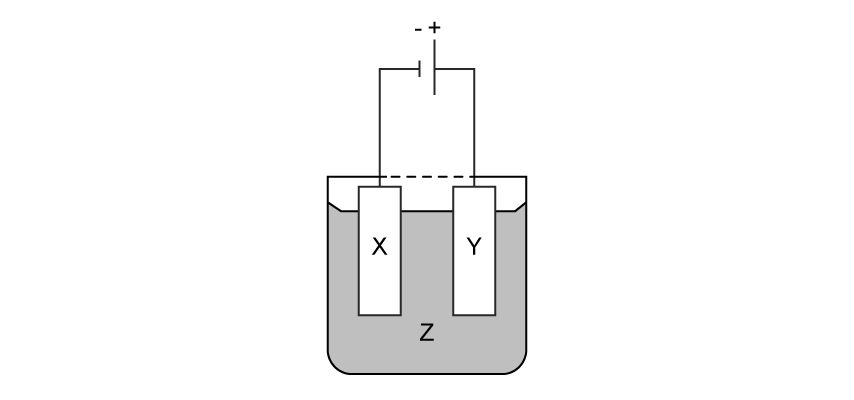
Which row correctly identifies X, Y, and the electrolyte Z?
Electrode X (at the negative terminal) | Electrode Y (at the positive terminal) | Electrolyte Z | |
A | Pure silver | Iron tray | Silver nitrate |
B | Pure silver | Iron tray | Iron (II) chloride |
C | Iron tray | Pure silver | Silver nitrate |
D | Iron tray | Pure silver | Silver chloride |
Was this exam question helpful?
Three statements comparing gasoline (petrol) combustion engines with hydrogen-oxygen fuel cells are shown
The combustion of gasoline and the formation of water are both exothermic processes with a positive enthalpy change, ΔH.
Combustion engines are more polluting than fuel cells because incomplete combustion produces carbon monoxide and particulates.
Gasoline is more difficult and expensive to store in a vehicle than hydrogen.
Which statements are correct?
1 and 2
2 only
2 and 3
1, 2 and 3
Was this exam question helpful?
What does a hydrogen–oxygen fuel cell produce?
electricity and water
heat and carbon dioxide
hydrogen and oxygen
electricity and carbon dioxide
Was this exam question helpful?
A fuel cell produces electricity.
Which two substances are supplied to the fuel cell?
hydrogen and water
hydrogen and oxygen
water and oxygen
hydrogen and carbon dioxide
Was this exam question helpful?
Which is a disadvantage of using a hydrogen–oxygen fuel cell instead of a petrol engine in a car?
Hydrogen is difficult to store in a vehicle.
The fuel cell produces carbon dioxide.
The fuel cell works only at high temperatures.
The fuel cell must be recharged from the mains.
Was this exam question helpful?
The diagram shows a failed attempt to copper-plate a pan.

Which can be done to plate the pan with copper?
Cool the copper sulfate solution in an ice bath.
Heat the copper sulfate solution to boiling point.
Increase the voltage from 3 V to 6 V.
Make the pan the cathode and the copper the anode.
Was this exam question helpful?
Which of the following are advantages of a hydrogen fuel cell to power a car?
No power is lost on transmission as there are less moving parts than in an internal combustion engine.
Power is lost on transmission as there are more moving parts than in an internal combustion engine.
They produce carbon dioxide.
They produce oxides of nitrogen.
Was this exam question helpful?
The diagram shows a simple cell.

Which statement about the process occurring when the cell is in operation is correct?
Cu2+ ions are formed in solution.
Electrons travel through the solution.
The reaction Zn → Zn2+ + 2e– occurs.
The zinc electrode increases in mass
Was this exam question helpful?
A students wants to electroplate an iron spoon with silver using an aqueous silver salt as the electrolyte.
Which set of conditions is used?
| Iron spoon | Other electrode |
A | cathode | silver |
B | anode | silver |
C | cathode | carbon |
D | anode | carbon |
Was this exam question helpful?
What are the products made by a hydrogen-oxygen fuel cell?
1 Water
2 Oxygen
3 Hydrogen
1 only
1 and 2
2 and 3
1, 2 and 3
Was this exam question helpful?
Which row shows the waste products released from the exhaust of a vehicle powered using a hydrogen–oxygen fuel cell?
| carbon dioxide | oxides of nitrogen | water |
A | ✓ | ✓ | ✓ |
B | ✘ | ✓ | ✓ |
C | ✓ | ✘ | ✘ |
D | ✘ | ✘ | ✓ |
Was this exam question helpful?
Which substance is produced by a petrol engine but not by a hydrogen–oxygen fuel cell?
water
carbon dioxide
hydrogen
oxygen
Was this exam question helpful?
A student wishes to electroplate an object with copper.
Which row is correct?
| object is made at the | a suitable electrolyte is |
A | anode | CuO(s) |
B | anode | CuSO4(aq) |
C | cathode | CuO(s) |
D | cathode | CuSO4(aq) |
Was this exam question helpful?
Winston Churchill, a British Prime Minister, had his false teeth electroplated with gold.
The teeth were coated with a thin layer of carbon and were then placed in the apparatus shown.

| terminal X is | the carbon powder could be |
A | negative | diamond |
B | negative | graphite |
C | positive | diamond |
D | positive | graphite |
Was this exam question helpful?
The diagram shows an electrolysis experiment using X and Y as electrodes.

Copper is used to coat the other metal.
Which metal becomes coated and which solution is used?
| aqueous solution | metal |
A | CoCl3 | Y |
B | CuCl2 | Y |
C | CuCl2 | X |
D | CoCl3 | X |
Was this exam question helpful?
What is the correct balanced symbol equation for the overall reaction in a hydrogen-oxygen fuel cell?
2H2 → 4H+ + 4e–
4H+ + O2 + 4e– → 2H2O
2H2 + O2 → 2H2O
2H2O → 2H2 + O2
Was this exam question helpful?
The following apparatus for plating a spoon with silver is shown.

Which statements are correct?
1 The metal electrode would be connected to the negative terminal of the power supply
2 The spoon would be connected to the negative terminal of the power supply
3 At the cathode, silver ions lose electrons to form silver atoms
4 At the anode, silver atoms lose electrons to form silver ions
2 only
1 and 4 only
2 and 4 only
1, 2 and 3
Was this exam question helpful?
Aqueous nickel(II) sulfate is used as the electrolyte to electroplate a piece of steel with nickel.
Which materials are used as the negative electrode and positive electrode?
| negative electrode | positive electrode |
A | carbon | steel |
B | nickel | steel |
C | platinum | nickel |
D | steel | nickel |
Was this exam question helpful?
When a hydrogen–oxygen fuel cell is in operation, a different reaction happens at each electrode.
at the hydrogen electrode H2 → 2H+ + 2e–
at the oxygen electrode O2 + 2H2O + 4e– → 4OH–
The electrons that are lost at the hydrogen electrode travel through the external circuit to the oxygen electrode, where they are gained by the oxygen and water.
A hydrogen–oxygen fuel cell is operated for a period of time and four moles of oxygen molecules are consumed.
Which mass of hydrogen is consumed?
2.0 g
4.0 g
8.0 g
16.0 g
Was this exam question helpful?
An iron tray is electroplated with pure silver to improve its appearance. The diagram shows the electrochemical cell with labels X, Y and Z.
Which row correctly identifies the half-equations occurring at electrodes X and Y, and the identity of electrolyte Z?
half-equation at X | half-equation at Y | electrolyte Z | |
A | Ag+ + e− → Ag | Ag → Ag++ e− | aqueous silver nitrate |
B | Ag → Ag++ e− | Ag+ + e− → Ag | aqueous silver nitrate |
C | Ag+ + e− → Ag | Fe2+ + 2e− → Fe | aqueous iron(II) nitrate |
D | Fe2+ + 2e− → Fe | Ag → Ag++ e− | aqueous silver nitrate |
Was this exam question helpful?
The table compares a hydrogen–oxygen fuel cell with a petrol engine, both used to power a car.
Which row is correct?
Produces carbon dioxide | Produces water | Releases energy to the surroundings | |
|---|---|---|---|
A | fuel cell only | both | petrol engine only |
B | petrol engine only | both | both |
C | petrol engine only | petrol engine only | both |
D | both | fuel cell only | fuel cell only |
Was this exam question helpful?
A petrol engine and a hydrogen–oxygen fuel cell are both used to power cars.
Both of them produce water.
Which statement explains why only the fuel cell is described as non-polluting?
The fuel cell produces water.
Water is the only chemical product of the fuel cell.
The fuel cell produces liquid water rather than water vapour.
Water is not a chemical product of the petrol engine.
Was this exam question helpful?
A city replaces its diesel buses with buses powered by hydrogen–oxygen fuel cells.
Each row gives a disadvantage of using a fuel cell instead of a diesel or petrol engine, together with a reason for that disadvantage.
In which row does the reason support the disadvantage?
Disadvantage | Reason | |
|---|---|---|
A | Hydrogen is difficult to store on the bus | because hydrogen is a gas at room temperature |
B | The fuel cell pollutes the air | because water vapour leaves the exhaust |
C | Hydrogen is expensive to produce | because hydrogen has to be separated from the air |
D | The fuel cell must be recharged regularly | because the fuel cell stores a fixed amount of energy |
Was this exam question helpful?
Which statement about using a hydrogen–oxygen fuel cell instead of a petrol engine in a car is correct?
Hydrogen is cheaper than petrol.
Hydrogen is less flammable than petrol.
More energy is released per gram of hydrogen than per gram of petrol.
Hydrogen can be obtained from the air.
Was this exam question helpful?