Polymers (Cambridge (CIE) IGCSE Chemistry): Exam Questions

Exam code: 0620 & 0971

5 hours59 questions
1
1 mark

A macromolecule is a very large molecule.

Macromolecules can be made by joining smaller molecules together. This is called  polymerisation.

Which row in the table describes the formation of a polymer?


monomer

polymer

A

ethane

poly(ethane)

B

ethene

poly(ethene)

C

ethane

poly(ethene)

D

ethene

poly(ethane)

    2
    1 mark

    The diagram shows the structure of an important product.

    q2-11-3-easy-cie-igcse-chemistry

    This product is formed by …... 1 .….. of an .….. 2 …… .

    Which words complete gaps 1 and 2?


    1

    2

    A

    addition polymerisation

    alkane

    B

    addition polymerisation

    alkene

    C

    cracking

    alkane

    D

    cracking

    alkene

      3
      1 mark

      Which process produces poly(ethene) from ethene?

      • Cracking

      • Addition polymerisation

      • Fermentation

      • Catalytic addition of steam

      4
      1 mark

      Which of the following does not cause a problem from the disposal of non-biodegradable plastics?

      • Waste plastic accumulates in oceans

      • In landfill, they take up valuable space

      • When incinerated, carbon monoxide is produced

      • Heat energy is released when burnt

      5
      1 mark

      Poly(ethene) is commonly used to make plastic bags.

      Which property of poly(ethene) makes it difficult to dispose of?

      • Excellent resistance to chemical reactions

      • Flexible

      • High strength

      • Good transparency

      6
      1 mark

      Polyethene is a synthetic polymer made in a factory.

      What is one use of polyethene?

      • artificial leather

      • wire insulation

      • plastic bags

      • ropes

      1
      1 mark

      Which statement about polymers is correct?

      • Addition polymers are all biodegradable.

      • Condensation polymers can all be hydrolysed to give amino acids.

      • Condensation polymers only exist in nature.

      • Forming addition polymers produces only one product.

      2
      1 mark

      The diagram shows three repeat units in the structure of an addition polymer.

      q2-1-11-3-medium-cie-igcse-chemistry

      Which alkene monomer is used to make this polymer?

      q2-2-11-3-medium-cie-igcse-chemistry
        3
        1 mark

        Which process does not produce carbon dioxide?

        • Combustion of methane

        • Fermentation of sugar

        • Polymerisation of ethene

        • Respiration

        4
        1 mark

        Polyesters and polyamides are types of synthetic polymer.

        Which statements are correct?

        1

        They are made by addition polymerisation.

        2

        They are made by condensation polymerisation.

        3

        The monomers from which they are made are unsaturated hydrocarbons.

        4

        The monomers from which they are made contain reactive functional groups at their ends.

        • 1 and 3

        • 1 and 4

        • 2 and 3

        • 2 and 4

        5
        1 mark

        Poly(ethene) is an addition polymer.

        Which term describes the monomer from which it is formed?

        • A saturated compound called ethane

        • A saturated compound called ethene

        • An unsaturated compound called ethane

        • An unsaturated compound called ethene

        6
        1 mark

        Extended Only

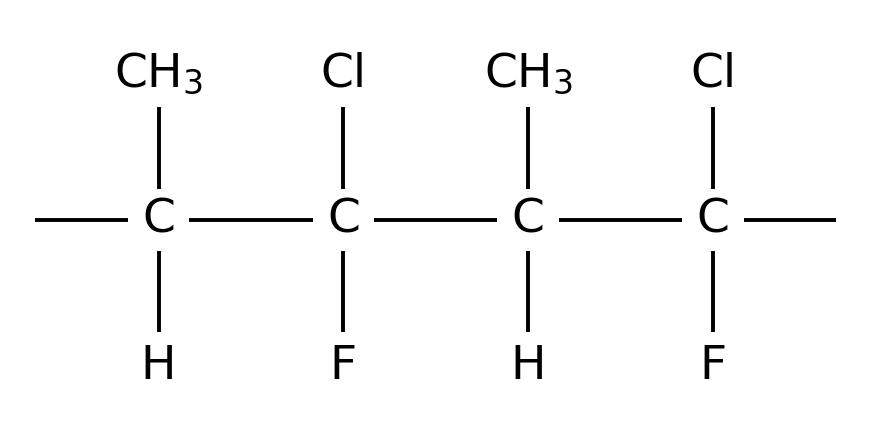
        Part of the structure of a polymer is shown.

        Displayed formula of part of a polymer chain: four carbon atoms joined in a row, with bonds continuing at each end. The first and third carbon atoms each have CH3 above and H below; the second and fourth each have Cl above and F below.

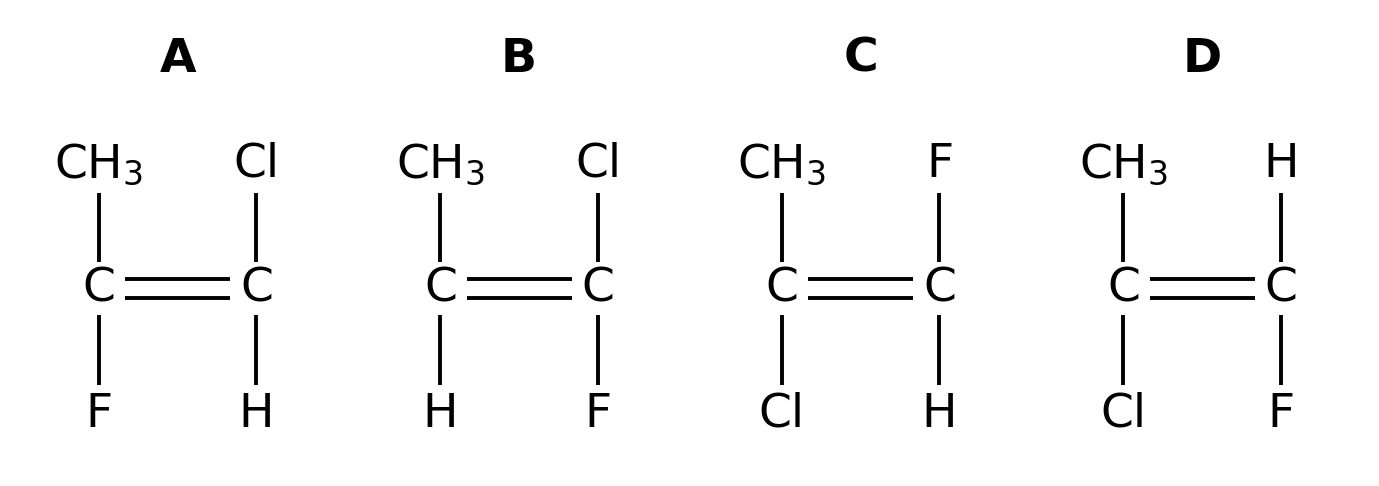
        Which monomer is used to make this polymer?

        Four monomers, A to D, each two carbon atoms joined by a double bond with CH3 above the left carbon. A: F below the left carbon; Cl above and H below the right carbon. B: H below the left carbon; Cl above and F below the right carbon. C: Cl below the left carbon; F above and H below the right carbon. D: Cl below the left carbon; H above and F below the right carbon.
          7
          1 mark

           Many molecules of J join together in reaction R to form a long chain molecule K. 

          K is the only product. 

          Which row describes molecule J, reaction R and molecule K? 

          molecule J 

          reaction R

          molecule K

          A

          polymer

          addition

          monomer

          B

          monomer

          addition

          polymer

          C

          polymer

          cracking

          monomer 

          D

          monomer

          cracking

          polymer

            8
            1 mark

            Which statement about polymerisation is correct?

            • Large monomer molecules join to form small polymer molecules. 

            • Large polymer molecules join to form small monomer molecules.

            • Small monomer molecules join to form large polymer molecules. 

            • Small polymer molecules join to form large monomer molecules.

            9
            1 mark

            Poly(ethene) is insoluble in water and is not broken down by bacteria.

            Waste poly(ethene) is buried in a landfill site.

            Which statement explains why this causes a long-term environmental challenge?

            • It will dissolve in rainwater and pollute rivers.

            • It will be broken down into its monomers by bacteria in the soil.

            • It will remain in the landfill site unchanged for many years.

            • It will slowly release toxic gases into the air as it decays.

            1
            1 mark

            In which row are the monomer and polymer chain correctly matched?


            monomer

            part of polymer chain

            A

            CH3CH=CHCH3

            –CH(CH3)–CH(CH3)–CH(CH3)–CH(CH3)–

            B

            CH2=CHCl

            –CHC–CHCl–CHCl–CHCl –

            C

            CH3CH=CH2

            –CH3–CH–CH2–CH3–CH–CH2–

            D

            CH2=CHCH2CH3

            –CH2–CH2–CH2–CH(CH2CH3)–

              2
              1 mark

              A polymer has the formula shown.

              q2-11-3-hard-cie-igcse-chemistry

              From which monomers can it be formed?

              q2-1-11-3-hard-cie-igcse-chemistry
              • 1 and 2

              • 1 and 3

              • 2 and 4

              • 3 and 4

              3
              1 mark

              The equation shows the formation of a polymer called Kevlar.

              q3-11-3-hard-cie-igcse-chemistry

              Which row describes Kevlar?


              how the monomer is formed

              type of polymer

              A

              addition polymerisation

              polyamide

              B

              addition polymerisation

              polyester

              C

              condensation polymerisation

              polyamide

              D

              condensation polymerisation

              polyester

                4
                1 mark

                A polymer can be made from methylpropene.

                q4-1-11-3-hard-cie-igcse-chemistry

                Which diagram shows the structure of the polymer?

                q4-2-hard-cie-igcse-chemistry
                  5
                  1 mark

                  Which row shows a natural polymer with the same linkages as a synthetic polymer?


                  natural polymer

                  synthetic polymer

                  A

                  complex carbohydrate

                  nylon

                  B

                  complex carbohydrate

                  PET

                  C

                  protein 

                  nylon

                  D

                  protein

                  PET

                    6
                    1 mark

                    The structure of polylactic acid (PLA) is given below.

                    q6-11-3-hard-cie-igcse-chemistry

                    What is the name given to the polymer link that is circled?

                    • Peptide

                    • Carbonyl

                    • Amino

                    • Ester

                    7
                    1 mark

                    The structure of a synthetic polymer is shown.

                    The structure shows the synthetic polymer is a ......1...... . It is formed by ......2...... polymerisation.

                    q7-11-3-hard-cie-igcse-chemistry

                    Which words complete gaps 1 and 2?


                    1

                    2

                    A

                    polyamide

                    addition

                    B

                    polyamide

                    condensation

                    C

                    polyester

                    addition

                    D

                    polyester

                    condensation

                      8
                      1 mark

                      Extended Only

                      Waste plastics are sometimes disposed of by burning.

                      When some polymers burn, oxides of nitrogen are formed from nitrogen atoms in the polymer itself.

                      Which polymer can form oxides of nitrogen in this way?

                      • nylon

                      • PET

                      • poly(chloroethene)

                      • poly(ethene)

                      9
                      1 mark

                      Ethene forms an addition polymer as shown.

                      q8-11-3-hard-cie-igcse-chemistry

                      Which terms describe this polymer?

                      • A saturated compound called poly(ethane).

                      • A saturated compound called poly(ethene).

                      • An unsaturated compound called poly(ethane).

                      • An unsaturated compound called poly(ethene).

                      10
                      1 mark

                      Which two polymers have the same linkages bonding the monomers together?

                      • Nylon and complex carbohydrate

                      • Nylon and protein

                      • PET and complex carbohydrate

                      • PET and protein

                      11
                      1 mark

                      Extended Only

                      Which polymer is a synthetic polyamide?

                      • nylon

                      • poly(ethene)

                      • protein

                      • PET

                      12
                      1 mark

                      Extended Only

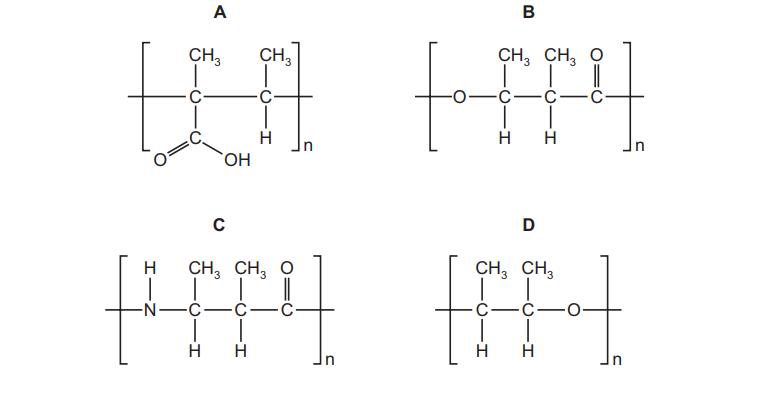
                      Which polymer structure has the same linkages as PET?

                      Four polymer repeat units labelled A to D, each in brackets with subscript n. A: two linked carbons each with a CH3 group, one also bearing a COOH group. B: O, CH(CH3), CH(CH3), C=O in the chain. C: NH, CH(CH3), CH(CH3), C=O in the chain. D: CH(CH3), CH(CH3), O in the chain.
                        13
                        1 mark

                        Which statement about polymers is correct?

                        • Chloroethene is the monomer of PVC, which is mainly used to manufacture plastic bags.

                        • Nylon is a synthetic polymer containing ester linkages and is mainly used to make clothing.

                        • Proteins are addition polymers formed by joining amino acid monomers with amide linkages.

                        • Condensation polymers are formed when monomers join together with the removal of a small molecule such as water