11 mark
The rate of a reaction was monitored by recording the volume of gas produced every 5 seconds.

What is the mean rate of reaction in the first 10 seconds of the reaction, in cm3/s?
2.9
3.0
3.5
2.5
Was this exam question helpful?
Exam code: 0620 & 0971
The rate of a reaction was monitored by recording the volume of gas produced every 5 seconds.
What is the mean rate of reaction in the first 10 seconds of the reaction, in cm3/s?
2.9
3.0
3.5
2.5
Was this exam question helpful?
Which of the following processes represents a physical change?
Acid base neutralisation
Metal displacement reactions
Boiling ethanol
Combustion of magnesium
Was this exam question helpful?
Physical and chemical changes are different processes. Which of the following rows correctly identifies characteristics of each one?
chemical change - no new substance formed
physical change - change of state
chemical change - no new substance formed
physical change - involves electron transfer
chemical change - new substance formed
physical change - involves electron transfer
chemical change - new substance formed
physical change - change of state
Was this exam question helpful?
A student was measuring the rate of reaction using the apparatus in the diagram.

What reaction is the student studying?
CaO + H2SO4 → CaSO4 + H2O
Mg(OH)2 + 2HCl → MgCl2 + 2H2O
Fe + H2SO4 → FeSO4 + H2
KCl + AgNO3 → KNO3 + AgCl
Was this exam question helpful?
A student was investigating the rate of reaction between iron and a solution of sulfuric acid. Two experiments were performed, P and Q, in which the volume of hydrogen was recorded at regular intervals.

Which change could explain the difference in results between P and Q?
The student added a catalyst in P.
Larger pieces of iron were used in P.
Less concentrated acid was used in P.
Larger quantities of both reactants are used P.
Was this exam question helpful?
Which changes are physical changes?
melting ice to form water
burning hydrogen to form water
adding sodium to water
boiling water to form steam
1 and 2
1 and 4
2 and 3
3 and 4
Was this exam question helpful?
Which row identifies a chemical change and a physical change?
chemical change | physical change | |
A | boiling ethanol | burning ethanol |
B | burning ethanol | evaporating ethanol |
C | dissolving ethanol in water | burning ethanol |
D | evaporating ethanol | dissolving ethanol in water |
Was this exam question helpful?
Which statement about rate of reaction is correct?
Catalysts increase the time for the reaction to be completed.
Decreasing particle size increases the rate of reaction.
Decreasing temperature increases the rate of reaction.
Rate of reaction decreases as the concentration increases.
Was this exam question helpful?
A student investigates the rate of reaction between aqueous sodium thiosulphate and aqueous hydrochloric acid by measuring the time taken for a precipitate to obscure a cross underneath the beaker.
Which statement is correct for the reaction?
The precipitate will be formed faster if ice is placed in contact with the beaker.
The precipitate will be formed faster if 10.0 cm3 of water are added to the aqueous sodium thiosulphate.
The precipitate will be formed slower if a catalyst is added to the reaction mixture.
The precipitate will be formed faster if drops of concentrated hydrochloric acid are added to the reaction mixture.
Was this exam question helpful?
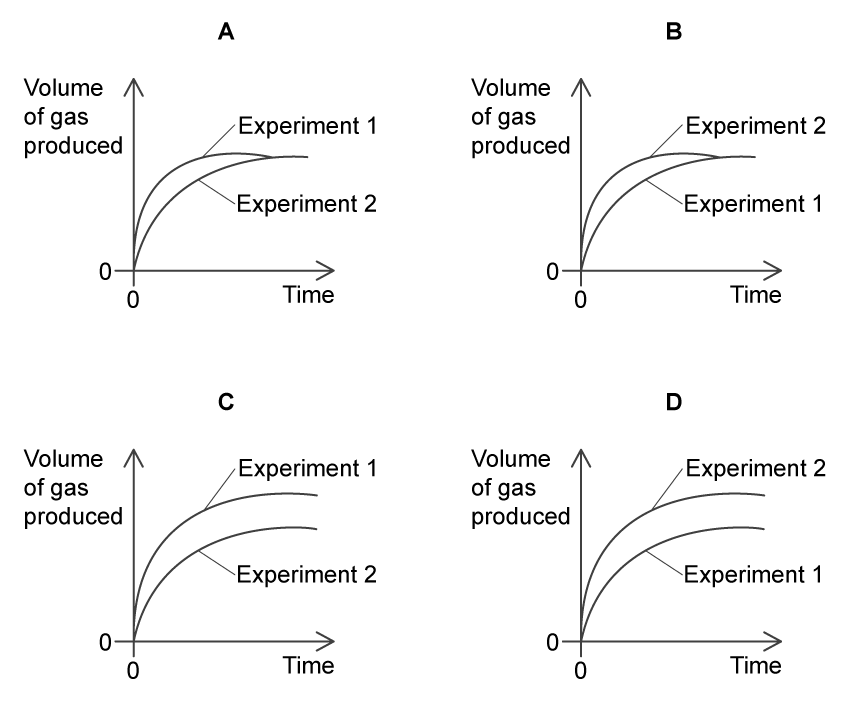
A student investigates the effect of temperature on the rate of a reaction.
In Experiment 1, the reaction is performed at 10 °C. In Experiment 2, the reaction is repeated at 20 °C. All other conditions stay the same.
Which graph shows the results for the volume of gas produced against time?
Was this exam question helpful?
Which process is a physical change?
cracking of an alkane
hydration of ethene
fractional distillation of petroleum
thermal decomposition of calcium carbonate
Was this exam question helpful?
Which pair of changes are both physical changes?
melting candle wax and dissolving sugar in water
burning candle wax and dissolving sugar in water
melting candle wax and rusting iron
heating limestone and freezing water
Was this exam question helpful?
Three statements about chemical changes are shown.
1 One or more new substances are formed.
2 The change is always easy to reverse.
3 The total mass of the products equals the total mass of the reactants.
Which statements are correct?
1, 2 and 3
1 and 2 only
1 and 3 only
2 and 3 only
Was this exam question helpful?
Which observation is evidence that a chemical change has taken place?
A green solid turns black and gives off a gas that turns limewater milky.
A grey solid turns to a purple vapour when it is warmed.
A white solid disappears when it is stirred into water.
A blue solution becomes paler when more water is added to it.
Was this exam question helpful?
Marble chips react with dilute hydrochloric acid. Carbon dioxide is given off.
CaCO3 (s) + 2HCl (aq) → CaCl2 (aq) + H2O (l) + CO2 (g)
A student uses a balance to follow the rate of this reaction.
Which measurement should the student record at regular time intervals?
the mass of the flask and its contents
the mass of the empty flask
the volume of acid measured out at the start
the temperature of the laboratory
Was this exam question helpful?
Two gas jars contain the same gas at the same temperature. Jar X contains more particles in the same volume than jar Y.
Which statement about the particles in jar X is correct?
They collide with each other more frequently than the particles in Y.
They have a higher average kinetic energy than the particles in Y.
They are further apart than the particles in Y.
They need less energy to react than the particles in Y.
Was this exam question helpful?
A student was investigating the rate of reaction between a solid base and a solution of sulfuric acid. Two experiments were performed, S and T, in which the mass of the reaction flask was recorded as shown in the graph.

Which of the following changes could explain the difference in results between S and T?
The sulfuric acid is less concentrated in T.
The sulfuric acid is more concentrated in T.
A higher temperature is used in S.
Larger sized particles are used in T.
Was this exam question helpful?
Which graph correctly shows the effect of increasing the temperature on the rate of reaction between magnesium and sulfuric acid in which neither reactant runs out?

Option A
Option B
Option C
Option D
Was this exam question helpful?
A student reacts a metal carbonate with nitric acid and measures the volume of carbon dioxide gas released at regular intervals. The results of the experiment are shown in the graph.

Between which two measurements was the reaction the fastest?
0 and 2 minutes
2 and 4 minutes
4 and 6 minutes
10 and 12 minutes
Was this exam question helpful?
Magnesium metal reacts with an excess of hydrochloric acid solution to form magnesium chloride and hydrogen:
Mg (s) + 2HCl (aq) → MgCl2 (aq) + H2 (g)
Which of the following will not increase the rate of this reaction?
Increase the temperature of the acid
Increase the surface area to volume ratio of the pieces of magnesium
Increase the concentration of the hydrochloric acid
Increase the volume of hydrochloric acid solution used
Was this exam question helpful?
Catalysts are often used in chemical reactions.
Which letter represents two correct features of catalysts?
Feature 1 - Lower activation energy for the reaction
Feature 2 - More products made in total
Feature 1 - Alternative pathway for the reaction is provided
Feature 2 - Not used up over the course of the reaction
Feature 1 - Makes industrial processes cheaper
Feature 2 - Metal catalysts are cheap to buy
Feature 1 - Reduce the overall energy change of the reaction
Feature 2 - Can be present in biological systems as enzymes
Was this exam question helpful?
The diagram shows an experiment to measure the rate of a chemical reaction
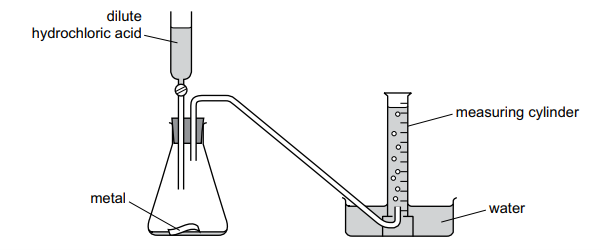
Which change decreases the rate of reaction?
adding water to the flask
heating the flask during the reaction
using more concentrated acid
using powdered metal
Was this exam question helpful?
Which row describes the effect of increasing concentration and increasing temperature on the collisions between reacting particles?
increasing concentration | increasing temperature | |
A | more collisions per second only | more collisions per second only |
B | more collisions per second only | more collisions per second and more collisions with sufficient energy to react |
C | more collisions per second and more collisions with sufficient energy to react | more collisions per second only |
D | more collisions per second and more collisions with sufficient energy to react | more collisions per second and more collisions with sufficient energy to react |
Was this exam question helpful?
Excess magnesium ribbon is reacted with a fixed volume of hydrochloric acid and the volume of gas given off over time is measured.
The results of two different experiments are shown.
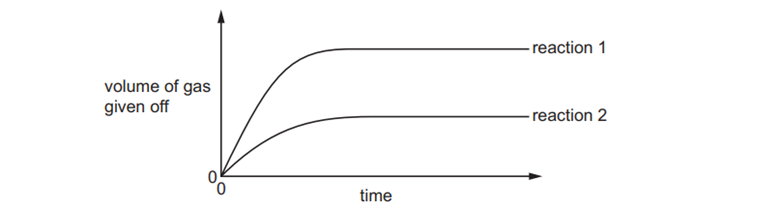
Which statement explains the differences between the results of the two experiments?
Reaction 1 uses a catalyst.
The acid used is twice as concentrated in reaction 1.
The magnesium ribbon is in smaller pieces in reaction 2.
The temperature is higher in reaction 2.
Was this exam question helpful?
Which statements explain why increasing the concentration of a reactant increases the rate of reaction?
It increases the collision rate of particles.
It lowers the activation energy.
A greater proportion of the colliding molecules have the required activation energy.
There are more particles per unit volume.
1 and 3
1 and 4
2 and 3
2 and 4
Was this exam question helpful?
In each of these four processes a change is made and then reversed, so that the original substance is obtained again.
In which process does no reaction take place at either stage?
Water is frozen to ice, then the ice is melted.
Blue hydrated copper(II) sulfate is heated to a white solid, then water is added to the white solid.
Pink cobalt(II) chloride is warmed until it turns blue, then damp air is passed over it.
Calcium oxide is added to water, then the product is heated strongly.
Was this exam question helpful?
A student carries out two changes.
change 1: solid wax is melted
change 2: magnesium is burned in air
Which row correctly describes what happens to the particles in each change?
change 1 | change 2 | |
|---|---|---|
A | the particles are rearranged into new substances | the particles are rearranged into new substances |
B | the particles are rearranged into new substances | the same particles are arranged differently |
C | the same particles are arranged differently | the particles are rearranged into new substances |
D | the same particles are arranged differently | the same particles are arranged differently |
Was this exam question helpful?
Solid calcium chloride is stirred into water. All of the solid dissolves and the temperature of the water rises from 19 °C to 27 °C.
Which row gives the type of change and the correct reason for it?
type of change | reason | |
|---|---|---|
A | chemical | the temperature of the water rises |
B | chemical | the calcium chloride is no longer visible |
C | physical | no energy is transferred between the calcium chloride and the water |
D | physical | the calcium chloride can be recovered unchanged by evaporating the water |
Was this exam question helpful?
Solid carbon dioxide is left in a warm room. It turns directly into carbon dioxide gas without forming a liquid.
Which row gives the type of change and the correct reason for it?
type of change | reason | |
|---|---|---|
A | chemical | a gas is produced |
B | chemical | the covalent bonds inside the carbon dioxide molecules break |
C | physical | the carbon dioxide molecules move much further apart |
D | physical | the covalent bonds inside the carbon dioxide molecules break |
Was this exam question helpful?
In each of these four experiments a white solid appears in a colourless solution.
In which experiment is the change physical?
A hot saturated solution of potassium nitrate is cooled.
Aqueous barium nitrate is added to aqueous sodium sulfate.
Carbon dioxide is bubbled through limewater.
Aqueous silver nitrate is added to aqueous sodium chloride.
Was this exam question helpful?
Each of these four changes produces a gas.
In which change is no new substance formed?
Liquid air is warmed and nitrogen boils off.
Zinc is added to dilute hydrochloric acid.
Solid sodium hydrogencarbonate is heated.
Aqueous hydrogen peroxide is mixed with manganese(IV) oxide.
Was this exam question helpful?
A chemical change takes place inside a sealed container.
1 the total mass of the substances in the container
2 the total number of atoms in the container
3 the total number of molecules in the container
Which quantities are always unchanged by a chemical change in a sealed container?
1, 2 and 3
1 and 2 only
1 and 3 only
2 and 3 only
Was this exam question helpful?
Blue hydrated copper(II) sulfate crystals are heated. Steam is given off and a white solid is left behind.
When water is added to the white solid it turns blue again.
Which row gives the type of change when the crystals are heated, and the correct reason for it?
type of change | reason | |
|---|---|---|
A | physical | the change can be reversed by adding water |
B | physical | water is only driven out from between the crystals |
C | chemical | the copper(II) sulfate is broken down into its elements |
D | chemical | a substance with a different formula is formed |
Was this exam question helpful?
A student was investigating the rate of reaction between acid and metals. The experimental set-up is shown below.

Which test tube would give the quickest reaction?
Option A
Option B
Option C
Option D
Was this exam question helpful?
The graph shows the results of two separate reaction rate investigations using excess calcium carbonate and sulfuric acid.

Which statement explains the difference between the results?
The temperature was higher in experiment 2.
Experiment 2 was allowed more time to react.
Same volume of a more concentrated acid was used in experiment 2.
More calcium carbonate was used in experiment 2.
Was this exam question helpful?
Which of the following statements explains how increasing temperature increases the rate of a reaction?
Increasing the temperature increases the kinetic energy of the particles so there are a smaller number of successful collisions.
Increasing the temperature increases the kinetic energy of the particles so there are a larger number of unsuccessful collisions.
Increasing the temperature decreases the kinetic energy of the particles so there are a larger number of successful collisions.
Increasing the temperature increases the kinetic energy of the particles so there are a larger number of successful collisions.
Was this exam question helpful?
Which of the following statements best describes the activation energy of a reaction?
The minimum energy released when colliding particles react.
The minimum energy required for particles to react when they collide.
The maximum energy required for particles to react when they collide.
The maximum energy released when colliding particles react.
Was this exam question helpful?
Which of the following statements correctly describes the effects of increasing concentration on the rate of a reaction?
Increasing the concentration increases the kinetic energy of the particles, resulting in more successful collisions between particles per unit time.
Increasing the concentration increases the rate of reaction as there is more space between particles.
Increasing the concentration increases the rate of reaction as there are more collisions between particles per unit time.
Increasing the concentration increases the rate of reaction as there are more collisions between particles at the beginning of the reaction.
Was this exam question helpful?
A student investigates the rate of reaction between sodium carbonate granules and dilute hydrochloric acid.
The investigation is carried out twice, as Experiment 1 and Experiment 2. The volume of acid, the temperature, and the mass of the sodium carbonate granules are kept the same in both experiments.
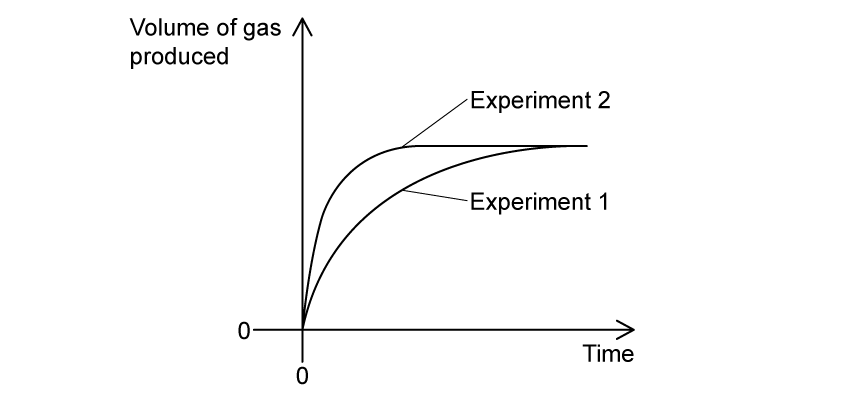
Which row correctly compares the concentration of the acid (C), the average kinetic energy of the particles (KE), and the frequency of successful collisions in the two experiments?
| average kinetic energy of particles | frequency of successful collisions | |
A | C2 > C1 | KE1 = KE2 | greater in experiment 2 |
B | C2 > C1 | KE2 > KE1 | greater in experiment 2 |
C | C1 > C2 | KE1 = KE2 | greater in experiment 1 |
D | C1 > C2 | KE2 > KE1 | greater in experiment 1 |
Was this exam question helpful?