Properties, Uses & Alloys of Metals (Cambridge (CIE) IGCSE Chemistry): Exam Questions

Exam code: 0620 & 0971

8 hours103 questions
1a
5 marks

A student investigated the temperature change produced when equal lengths of magnesium ribbon reacted with excess dilute sulfuric acid of different concentrations (labelled solutions A, B, C, D and E).

Five experiments were carried out.

Experiment 1

Using a measuring cylinder, 20 cm3 of sulfuric acid solution A was poured into a beaker. The initial temperature of the solution was measured. A length of magnesium ribbon was added to the solution and stirred. The highest temperature reached was measured.

Experiment 2

Experiment 1 was repeated using solution B instead of solution A. The initial and highest temperatures were measured as before.

Experiment 3

Experiment 1 was repeated using solution C. The initial and highest temperatures were measured.

Experiment 4

Experiment 1 was repeated using solution D. The initial and highest temperatures were measured.

Experiment 5

Experiment 1 was repeated using solution E. The initial and highest temperatures were measured.

Use the thermometer diagrams in the table, to record the initial and highest temperatures in each experiment.


solution of sulfuric acid

thermometer diagram

initial temperature / oC

thermometer diagram

highest temperature / oC

change in temperature / oC

A

thermometer-reading-7


thermometer-reading-39c-2


B

thermometer-reading-26c


thermometer-reading-37c


C

thermometer-reading-25c


thermometer-reading-35c


D

thermometer-reading-7


thermometer-reading-31c


E

thermometer-reading-26c


thermometer-reading-29c


  Work out the temperature change for each experiment and record the values in the table.

1b
4 marks

Draw a labelled bar chart of the results for Experiments 1, 2, 3, 4 and 5 on the grid below. 

temp-change-bar-chart-blank
1c
1 mark

Use the results and observations to answer the following questions.

What type of chemical reaction occurs when magnesium reacts with dilute sulfuric acid?

1d
2 marks

i) Which Experiment produced the largest temperature change?

 [1]

 ii) Suggest why this Experiment produced the largest temperature change.

 [1]

1e
3 marks

Predict the effect on the temperature changes that would happen if

 i) equal masses of magnesium powder were used in the Experiments.

 [1]

 ii) 40cm3 of dilute sulfuric acid was used in Experiment 1.

 [1]

 iii) Explain your answer to (e)(ii).

 [1]

1f
1 mark

Give one possible source of experimental error in this investigation.

2a
2 marks

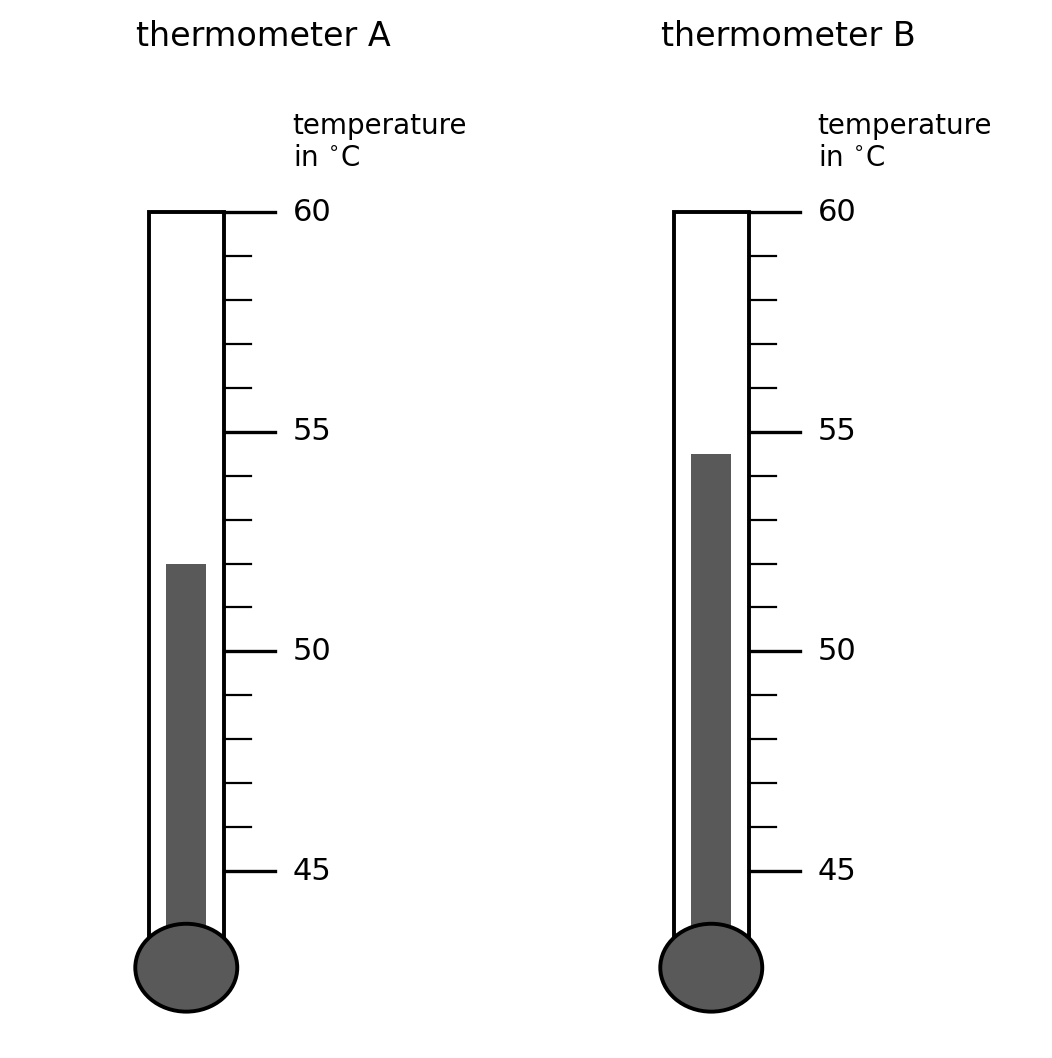
A student determined the melting point of a solid, X.

A small sample of X was packed into a capillary tube. The tube was attached to a thermometer and placed in a beaker of oil. The oil was heated slowly and stirred throughout.

Thermometer A shows the temperature at which the solid first began to melt.

Thermometer B shows the temperature at which the solid had completely melted.

Fig. 2.1

Two thermometer diagrams side by side, labelled thermometer A and thermometer B. Each is a narrow vertical tube with a round bulb at the bottom and a shaded liquid column rising from the bulb. A scale beside each tube runs from 45 at the bottom to 60 at the top, with a short mark at every unit and a longer numbered mark every five units, headed temperature in degrees Celsius.

Record the two temperatures shown in Fig. 2.1.

2b
1 mark

Calculate the melting range of X.

2c
1 mark

A second student recorded the same two readings as 52 °C and 54.5 °C.

State which of these values is recorded to the wrong degree of precision, and give the value as it should have been recorded.

2d
2 marks

A pure substance melts over a range of less than 1 °C.

The student claims that X is a pure substance that melts at 53 °C.

Explain why the results do not support this claim.

2e
2 marks

Explain why the oil was stirred throughout the heating.

2f
2 marks

Suggest one improvement the student could make to obtain a more accurate melting point.

Explain how it would help.

3a
1 mark

A student heated 2.00 g of copper powder in an open crucible.

The crucible was heated, allowed to cool and reweighed. This was repeated until the mass no longer changed.

The results are shown.

heating

mass of solid / g

1

2.35

2

2.48

3

2.50

4

2.50

Name the piece of apparatus the student used to find the mass of the solid.

3b
1 mark

Calculate the increase in the mass of the solid during the investigation.

3c
2 marks

Explain why the mass of the solid increased during the investigation.

3d
2 marks

Explain why the student heated, cooled and reweighed the solid several times instead of heating it once.

3e
2 marks

A second student carries out the same investigation but keeps a tightly fitting lid on the crucible throughout the heating.

Explain the effect this would have on the final mass of the solid.

3f
1 mark

State which heating the results show the reaction was complete by, and give the reason for your answer.

3g
1 mark

Suggest one reason why a student carrying out this investigation might obtain a final mass lower than expected.

4
6 marks

Plan an investigation to compare how quickly magnesium and zinc react with dilute hydrochloric acid.

You are provided with magnesium ribbon, zinc granules, dilute hydrochloric acid and the apparatus normally found in a school laboratory.

Your plan should include:

  • the apparatus you would use

  • the method and the measurements you would make

  • how you would make the comparison a fair one

  • how you would use your results

No other chemicals should be used.