Atomic Structure & the Periodic Table (Cambridge (CIE) IGCSE Chemistry): Exam Questions

Exam code: 0620 & 0971

7 hours102 questions
1a
2 marks

Cobalt is an element in Period 4 of the Periodic Table.

Use your copy of the Periodic Table to help you complete the table below.

particle

number of protons

number of neutrons

number of electrons

Co


Co2+


1b
3 marks

Extended Only

60Co is an isotope.

i) Explain the term isotope.

[2]

 ii) Explain why two isotopes of the same element have identical chemical properties.

[1]

2a
5 marks

Substances can be classified as:

elements    mixtures     compounds 

Elements can be divided into:

metals       non-metals

Define each of the following terms.

i) element

[2] 

ii) compound

  [2] 

iii)  mixture 

[1] 

2b
3 marks

Classify each of the following as either an element, compound or mixture.

i) brass ..........................................................................................................

[1] 

ii) carbon dioxide ..................................................................................................... 

[1] 

iii) copper ..........................................................................................................

[1] 

2c
1 mark

Which physical property is used to distinguish between metals and non-metals?

It is possessed by all metals but by only one non-metal.

3
8 marks

Complete the following table which gives the number of protons, electrons and neutrons in each of the five particles.

particle

number of protons

number of electrons

number of neutrons


19

19

20

Fe2656


3

2


Ga3+3170


34

36

45

4a
2 marks

Define the term isotope.

4b
7 marks

The table gives information about four particles, A, B, C and D.

Complete the table.

The first line has been done for you.

particle

number of protons

number of electrons

number of neutrons

nucleon number

symbol or formula

A

6

6

6

12

C

B

11

10

12


C

8


8


O2-

D


10


28

Al3+

5a
4 marks

Complete the table to show the relative charge and approximate relative mass of a proton, a neutron and an electron.

type of particle

relative charge

approximate relative mass

proton


1

neutron


electron

−1


5b
2 marks

Deduce the number of electrons and neutrons in an atom of the isotope of potassium shown.

K1941

number of electrons:   number of neutrons: 

6a
1 mark

The diagrams show part of the structures of five substances, A, B, C, D and E.

weQVv1Ct_q1a-0620_s19_qp_31

Answer the following questions about these structures.

Each structure may be used once, more than once or not at all.

Which one of these structures, A, B, C, D or E, is a compound?

6b
1 mark

Substance B is an element.

What is meant by the term element ?

6c
1 mark

Complete the diagram to show the electron arrangement in an oxygen atom.

q3b-0620_s19_qp_31
6d
4 marks

Complete the table to show the number of electrons, protons and neutrons in the sulfur atom and copper ion shown.


number of electrons

number of neutrons

number of protons

S1634


Cu2+2963


29

7a
5 marks

A list of symbols and formulae is shown. 

CaO
CH4
C2H4
C2H6
Cl–
Cu2+
H2
He
K+
N2
Na+
SO2

Answer the following questions using these symbols or formulae.
Each symbol or formula may be used once, more than once or not at all. 

State which symbol or formula represents:

(i) a compound produced by the thermal decomposition of calcium carbonate

[1] 

(ii) a positive ion that gives a blue-green colour in a flame test

[1] 

(iii) an element used as a fuel

[1] 

(iv) the monomer used to produce poly(ethene)

[1] 

(v) an ion formed when an atom gains an electron.

[1]

7b
2 marks

Complete the table to show the relative charges of a proton, a neutron and an electron.

type of particle

relative charge

proton

+1

neutron

electron

7c
2 marks

Choose the two correct statements about nitrogen. 

Tick (✓) two boxes.

Nitrogen molecules are monoatomic.

All nitrogen atoms have seven protons.

Nitrogen atoms cannot be split into simpler substances by chemical means.

All nitrogen atoms have 14 neutrons.

Nitrogen is 21% of clean, dry air

8a
4 marks

A list of symbols and formulae is shown.

Br–
CH4 
CO2
Cu2+
H2 
K+
Na+ 
N2 
O2
U

Answer the following questions using these symbols or formulae.

Each symbol or formula may be used once, more than once or not at all.

State which symbol or formula represents:

(i) a compound that is a product of respiration

[1]

(ii) an ion that gives a lilac colour in a flame test

[1]

(iii) a gas which is 21% of clean, dry air

[1]

(iv) an ion formed when an atom gains an electron.

[1]

8b
2 marks

Complete the table to show the relative masses of a proton, a neutron and an electron.

Type of particle

Relative mass

proton

1

neutron

electron

8c
2 marks

Choose the two correct statements about carbon dioxide. 

Tick (✓) two boxes.

Carbon dioxide is a mixture of two elements

Carbon dioxide is an acidic oxide

Carbon dioxide has ionic bonding

Carbon dioxide has a giant covalent structure

There are three atoms in a molecule of carbon dioxide

9a
3 marks

The symbols for three atoms of hydrogen are shown.

H11 H12 H13

Complete Table 2.1 to show the number of protons, neutrons, and electrons in each atom.

Table 2.1

Atom

Number of protons

Number of neutrons

Number of electrons

H11

H12

H13

9b
1 mark

Explain why these atoms are electrically neutral.

9c
1 mark

Tick (✓) the box that describes the relationship between the three atoms listed in part a.

Allotropes

Isomers

Isotopes

Polymers

9d
2 marks

Hydrogen reacts with oxygen to form water. Complete the chemical equation for this reaction.

..... H2 (g) + ..... (g) → ..... H2O (g)

9e
2 marks

The reaction between hydrogen and oxygen is used in a fuel cell for a car

i) Name the form of energy produced by the fuel cell.

[1]

ii) Explain why the fuel cell does not increase global warming, in comparison to a combustion engine.

[1]

10a
2 marks

In this question, use a filled circle to represent a carbon atom and an open circle to represent an oxygen atom.

Draw four particles to represent a sample of the compound carbon dioxide, CO2.

10b
2 marks

Draw six particles to represent a sample of a mixture of carbon dioxide and oxygen.

Use the same symbols as in part (a).

11a
6 marks

Choose from the following substances to answer the questions.

ammonia, NH3 argon, Ar carbon dioxide, CO2 iron, Fe nitrogen, N2 sea water

Each substance can be used once, more than once or not at all.

State which substance:

i) is a mixture

[1]

ii) is an element that exists as separate single atoms

[1]

iii) is an element whose molecules each contain two atoms

[1]

iv) is a compound whose molecules each contain three atoms

[1]

v) is a compound whose molecules each contain four atoms

[1]

vi) is an element that is a solid at room temperature

[1]

11b
2 marks

Sea water can be separated into water and solid salts by evaporating the water.

Ammonia cannot be separated into nitrogen and hydrogen by evaporating, filtering or any similar method.

Explain why.

12a
2 marks

Iron and oxygen are both listed in the Periodic Table.

Iron oxide, Fe2O3, is not listed in the Periodic Table.

Explain why iron oxide is not listed in the Periodic Table.

12b
1 mark

State the number of different elements in Fe2O3.

12c
1 mark

State the total number of atoms shown in the formula Fe2O3.

13a
2 marks

Describe the structure of an atom.

In your answer, refer to the nucleus and to the electrons.

13b
1 mark

Define the term proton number.

13c
2 marks

State the relative charge and the relative mass of an electron.

13d
1 mark

An atom of element Z has proton number 20.

Deduce the electronic configuration of Z.

13e
2 marks

Use your answer to (d) to deduce the group and the period of element Z.

14a
3 marks

The symbol of a selenide ion is shown.

{}_{34}^{80}\text{Se}{}^{2-}

Complete the table to show the number of protons, neutrons and electrons in this ion.

particle

number of particles

protons

neutrons

electrons

14b
1 mark

78Se is another isotope of selenium.

State the number of neutrons in an atom of 78Se.

15a
1 mark

The table shows the numbers of protons, neutrons and electrons in five particles.

particle

number of protons

number of neutrons

number of electrons

A

16

16

16

B

16

17

16

C

16

16

18

D

17

18

17

E

20

20

18

Deduce the nucleon number of particle B.

15b
2 marks

The table shows the numbers of protons, neutrons and electrons in five particles.

particle

number of protons

number of neutrons

number of electrons

A

16

16

16

B

16

17

16

C

16

16

18

D

17

18

17

E

20

20

18

Identify the two particles that are ions.

Explain how you can tell.

15c
2 marks

The table shows the numbers of protons, neutrons and electrons in five particles.

particle

number of protons

number of neutrons

number of electrons

A

16

16

16

B

16

17

16

C

16

16

18

D

17

18

17

E

20

20

18

Identify the two atoms that are isotopes of the same element.

Explain your answer.

16a
2 marks

Extended Tier Only

Element R has two isotopes, 10R and 11R.

In a sample of R, 20% of the atoms are 10R and 80% of the atoms are 11R.

Calculate the relative atomic mass of R.

Give your answer to one decimal place.

16b
1 mark

Extended Tier Only

Explain, in terms of how relative atomic mass is calculated, why the relative atomic mass of R is closer to 11 than to 10.

16c
1 mark

Extended Tier Only

Calculate the relative atomic mass of R if the two isotopes were present in equal amounts.

1a
4 marks

The table gives the composition of three particles.

particle

number of protons

number of electrons

number of neutrons

A

15

15

16

B

15

15

16

C

15

15

17

What is the evidence in the table for each of the following? 

i) Particle A is an atom.

 [1]

 ii) A, B and C are all particles of the same element.

 [1]

iii) Particles A and C are isotopes of the same element.

[2]

1b
2 marks

i) What is the electronic structure of particle A?

[1]

 ii) Is element A, a metal or a non-metal? Give a reason for your choice.

[1]

2a
3 marks

Protons, neutrons and electrons are subatomic particles.

Complete the table to show the relative mass and relative charge of a proton, a neutron and an electron.

particle

relative mass

relative charge

proton


neutron 


electron

11840


[3]

2b
4 marks

Extended Only

Bromine has two isotopes. 

i) Define the term isotope.

[2] 

ii) Explain why the two isotopes of bromine have the same chemical properties.

[2]

2c
5 marks

The table shows the number of protons, neutrons and electrons in some atoms and ions.

Complete the table.

particle

number of protons

number of neutrons

number of electrons

Li37


S2−1634


19

22

18

3a
3 marks

i) Define the term atomic number.

[1]

 ii) Define the term nucleon number.

[2]

3b
5 marks

The table shows the number of protons, neutrons and electrons in some atoms or ions.

Complete the table. The first line is given as an example.

particle

number of protons

number of electrons

number of neutrons

symbol or formula

A

6

6

6

C612

B

12

12

12


C

8


O2−816

D

11

10

13


4a
4 marks

The table below gives information about particles.

Complete the table. The first line has been done for you.

particle

number of protons

number of electrons

electronic configuration

charge on particle

A

12

10

2,8

2+

B


18

2,8,8

1-

C

18


2,8,8

0

D

8

10


4b
1 mark

Gallium is a Group III element.

Define the term element.

4c
3 marks

The following are gallium atoms.

Ga3169         Ga3171

Complete the following table.

atom

number of protons

number of neutrons

number of electrons

Ga3169


Ga3171


5a
2 marks

The table below gives the composition of six particles which are either atoms or ions.

Particle

number of protons

number of neutrons

number of electrons

A

33

40

33

B

19

20

18

C

34

45

36

D

33

42

33

E

13

14

13

F

24

28

21

Which particles are atoms? Explain your choice.

5b
2 marks

Which particle is a negative ion and why has this particle got a negative charge?

5c
1 mark

Which particles are positive ions?

5d
2 marks

Explain why particle A and particle D are isotopes.

6a
1 mark

Figure 1.1 shows the electronic configurations of five atoms, A, B, C, D and E.

Figure 1.1

~wdLeemf_q1_specimen-paper-0620-03-cie-igcse-chemistry

Each letter may be used once, more than once or not at all.

Give the letter of the atom, A, B, C, D or E, that is in Group III of the Periodic Table.

6b
1 mark

Give the letter of the atom, A, B, C, D or E, that  has 13 protons.

6c
1 mark

Give the letter of the atom, A, B, C, D or E, that  is a noble gas. 

6d
1 mark

Give the letter of the atom, A, B, C, D or E, that forms a stable ion with a single negative charge.

7a
1 mark

Sulfuric acid is a compound.

Define the term compound.

7b
3 marks

Complete Table 2.1  to show the number of electrons, neutrons and protons in the sulfur atom and oxide ion.

Table 2.1 


number of electrons

number of neutrons

number of protons

S1634

16


O2−818


10


7c
1 mark

Complete Figure 2.2 to show the electronic configuration of a potassium ion.

Figure 2.2

q2aiii_specimen-paper-0620-03-cie-igcse-chemistry
8a
2 marks

This question is about elements X, Y and Z.

An atom of element X is represented as X1634

Name the different types of particles found in the nucleus of this atom of X.

8b
1 mark

What is the term for the total number of particles in the nucleus of an atom?

8c
1 mark

What is the total number of particles in the nucleus of an atom of X1634 ?

8d
1 mark

What is the electronic structure of the ion X2–?

8e
1 mark

What term is used to describe atoms of the same element with different numbers of particles in the nucleus?

8f
3 marks

Separate: Chemistry and Extended Only

Part of the definition of relative atomic mass is ‘the average mass of naturally occurring atoms of an element’. Some relative atomic masses are not whole numbers. Element Y has only two different types of atom, 69Y and 71Y The ratio of atoms present in element Y is shown.

69Y : 71Y = 3 : 2

  • Calculate the relative atomic mass of element Y to one decimal place.

relative atomic mass: ..........

  • Identify element Y.   

  • element Y: ..........

8g
2 marks

Element Z is in Period 3 and Group V.

Explain in terms of electron transfer why Z behaves chemically as a non-metal.

9a
2 marks

Extended Only

Chlorine is in Group VII of the Periodic Table. Two isotopes of chlorine are chlorine‑35 and chlorine‑37

State why these two isotopes of chlorine have the same chemical properties.

9b
3 marks

Chlorine is in Group VII of the Periodic Table. Two isotopes of chlorine are chlorine‑35 and chlorine‑37.

Complete the table to show the number of electrons, neutrons and protons in each atom and ion.


number of electrons

number of neutrons

number of protons

Cl1735


Cl−1737


9c
3 marks

Na1122, Na1123 and Na1124 are isotopes of sodium.

Describe how these sodium isotopes are the same and how they are different in terms of the total number of protons, neutrons and electrons in each.

same:

different:

9d
1 mark

Na1122, Na1123 and  Na1124 are isotopes of sodium.

Why do all three isotopes have an overall charge of zero?

10a
2 marks

The diagram shows part of the structures of five substances, A, B, C, D and E.

xewDNp~1_q1-0620_s19_qp_33

Answer the following questions about these structures. Each structure may be used once, more than once or not at all.

Which two of these structures, A, B, C, D or E, are compounds?

10b
2 marks

Substance E is present in air. Air is a mixture of different gases. Describe two characteristics of a mixture.

10c
4 marks

Complete the table to show the number of electrons, protons and neutrons in the sulfur atom and zinc ion shown.


number of electrons

number of neutrons

number of protons

S1636


Zn2+3067


30

11a
2 marks

This question is about the structures of atoms and ions.

Define the term proton number.

11b
2 marks

Complete the table to show the number of protons, neutrons and electrons present in atoms of Mg1224 and Mg1226.


number of protons

number of neutrons

number of electrons

Mg1224


Mg1226


11c
1 mark

What term is used to describe atoms of the same element, such as Mg1224 and Mg1226?

11d
2 marks

Extended Only

Explain why the chemical properties of Mg1224 and Mg1226 are the same.

11e
4 marks

Complete the table to identify the atoms and ions which have the following numbers of protons, neutrons and electrons.


number of protons

number of neutrons

number of electrons

Na+1123

11

12

10


4

5

4


17

20

18

11f
2 marks

State the electronic structure of the following atom and ion.

Al:

S2–:

12a
3 marks

Iron and oxygen combine to form more than one compound, including iron(II) oxide, FeO, and iron(III) oxide, Fe2O3.

i) State the ratio of iron atoms to oxygen atoms in iron(II) oxide

[1]

ii) Explain how iron(II) oxide and iron(III) oxide can be two different compounds when they contain the same two elements

[2]

12b
2 marks

A sample of iron(III) oxide is taken from a rock.

A second sample of iron(III) oxide is made in a laboratory.

State what can be said about the ratio of iron to oxygen by mass in the two samples.

Explain your answer.

12c
2 marks

A third sample contains iron and oxygen only.

The ratio of iron to oxygen by mass in this third sample is not the same as in iron(II) oxide, and not the same as in iron(III) oxide.

Suggest what this third sample could be.

Explain your answer.

13a
1 mark

A gas cylinder contains methane, CH4, carbon dioxide, CO2 and nitrogen, N2.

State the number of different substances in the cylinder.

13b
2 marks

One of the three gases is an element. The other two are compounds.

Identify the element.

Explain your choice.

13c
2 marks

State the total number of different elements present in the cylinder.

Name each of these elements.

13d
2 marks

The cylinder is emptied and then refilled with the same three gases, but with twice as much nitrogen as before.

Explain why the contents of the cylinder are still a mixture.

14a
5 marks

Atoms are made of protons, neutrons and electrons. Atoms of the same element with different numbers of neutrons are known as isotopes.

(i) Complete the table.

particle

relative charge

relative mass 

electron

1 / 1840

neutron

proton

+1

[2]

(ii) Mg1224 and Mg1225 are isotopes of magnesium. 

Complete the table to show the numbers of electrons, neutrons and protons in these isotopes of magnesium.

isotope

number of electrons

number of neutrons

number of protons

Mg1224

Mg1225

[2]

(iii) Explain why magnesium ions have a charge of 2+.

[1]

14b
3 marks

Mg2+ ions have the electronic structure 2,8. 

Give the formula of the following particles which have the same electronic structure as Mg2+ ions. 

● a cation (positive ion)

● an anion (negative ion)

● an atom

15a
2 marks

Chlorine gas consists of Cl2 molecules.

Hydrogen chloride gas consists of HCl molecules.

Both substances are made of molecules, but only one of them is a compound.

Explain which substance is the compound.

15b
2 marks

A sample of gas contains both Cl2 molecules and HCl molecules.

Classify this sample.

Give a reason for your answer.

16a
2 marks

Air contains nitrogen, oxygen, argon and carbon dioxide.

Air is a mixture.

State two pieces of evidence that air is a mixture and not a compound.

16b
2 marks

Carbon dioxide has the formula CO2.

Air cannot be given a chemical formula.

Explain why.

17a
1 mark

The symbols of three particles are shown.

Pb82206

Pb82208

{}_{82}^{206}\text{Pb}{}^{2+}

Give the number of neutrons in an atom of Pb82208

17b
2 marks

The symbols of three particles are shown.

Pb82206

Pb82208

{}_{82}^{206}\text{Pb}{}^{2+}

Explain why Pb82206 and Pb82208 are isotopes of each other.

17c
2 marks

The symbols of three particles are shown.

Pb82206

Pb82208

{}_{82}^{206}\text{Pb}{}^{2+}

The ion {}_{82}^{206}\text{Pb}{}^{2+} has the same number of protons and the same number of neutrons as the atom Pb82206

Explain why {}_{82}^{206}\text{Pb}{}^{2+} is not an isotope of Pb82206

1a
1 mark

A sample is made by stirring together solid sodium chloride, NaCl, and solid potassium chloride, KCl.

Both sodium chloride and potassium chloride are compounds.

State the number of different elements present in the sample.

1b
2 marks

Explain why the sample is a mixture, even though both of the substances in it are compounds.

1c
3 marks

Both sodium chloride and potassium chloride contain chlorine.

Explain why the proportion of chlorine by mass is fixed in sodium chloride, but is not fixed in the sample as a whole.

2a
3 marks

Four samples each contain magnesium and oxygen only.

The table shows the mass of each element in each sample.

sample

mass of magnesium / g

mass of oxygen / g

P

2.4

1.6

Q

4.8

3.2

R

3.6

1.8

S

1.2

0.8

Magnesium oxide is a compound with the formula MgO.

[Ar: Mg, 24; O, 16]

Three of the four samples could be magnesium oxide.

Identify the three samples.

Explain how the data shows this.

2b
3 marks

Explain what sample R must be, and how the data in the table supports your answer.

2c
2 marks

Sample Q contains twice the mass of magnesium and twice the mass of oxygen that sample P contains.

Explain why P and Q can still be the same compound.

3a
2 marks

Sodium is a soft, highly reactive metal.

Chlorine is a poisonous green gas.

Sodium chloride is a white solid that is safe to eat.

Explain why sodium chloride does not have the properties of sodium or of chlorine.

3b
2 marks

A mixture of sodium and chlorine is not the same as the compound sodium chloride.

Describe how the properties of this mixture would differ from the properties of sodium chloride.

3c
1 mark

State one other difference between a mixture of sodium and chlorine and the compound sodium chloride.

4a
2 marks

A student stirs together iron filings and sulfur powder.

Describe two ways the student could show that the material in the beaker is a mixture.

4b
2 marks

The student heats the mixture strongly. A new substance, iron(II) sulfide, is formed.

Explain why iron(II) sulfide is a compound and not a mixture.

4c
2 marks

In the first experiment all of the iron and all of the sulfur reacted, leaving nothing unreacted in the beaker.

The student repeats the experiment using the same mass of iron but twice as much sulfur.

Explain what effect this has on the composition of the iron(II) sulfide that forms.

5a
2 marks

Copper(II) oxide has the formula CuO.

[Ar: Cu, 64; O, 16]

Calculate the ratio by mass of copper to oxygen in copper(II) oxide.

Give your answer in its simplest form.

5b
2 marks

A sample contains copper and oxygen only, in a ratio of 3 : 1 by mass.

Explain whether this sample can be copper(II) oxide.

5c
2 marks

A different sample contains copper and oxygen only, in the same ratio by mass as copper(II) oxide.

Explain why this sample is not necessarily copper(II) oxide.

6a
3 marks

Extended Tier Only

Element L has three isotopes, 20L, 22L and 24L.

In a sample of L, 90.0% of the atoms are 20L and the relative atomic mass of L is 20.3

Calculate the percentage abundance of 22L and of 24L in this sample.

6b
2 marks

Extended Tier Only

A second sample of L also contains 90.0% 20L, but this sample has a relative atomic mass of 20.2

Deduce the percentage abundance of each isotope in this second sample.

7a
2 marks

Element W has three isotopes, 54W, 56W and 57W.

In a sample of W, 90.0% of the atoms are 56W.

Of the remaining atoms, there are 4 times as many 54W atoms as 57W atoms.

Deduce the percentage abundance of 54W and of 57W.

7b
2 marks

Extended Tier Only

Calculate the relative atomic mass of W.

Give your answer to one decimal place.

8a
2 marks

Extended Tier Only

Element G has two isotopes. One isotope has a nucleon number of x and the other has a nucleon number of x + 4.

In a sample of G, the two isotopes are present in the ratio 2 : 3, with the lighter isotope first.

Show that the relative atomic mass of G is x + 2.4

8b
2 marks

Extended Tier Only

The relative atomic mass of G is 30.4

Deduce the nucleon number of each isotope of G.

9a
4 marks

The symbols of six particles are shown below.

Na+

Ca2+

Kr

P

Si

O2-

Select from the list of particles to answer the following questions. A particle may be selected once, more than once or not at all.

i) Which two ions have the same electronic structure?

[1]

ii) Which ion has the same electronic structure as an atom of argon?

[1]

iii) Which atom can form an ion of the type X3–? 

[1]

iv) Which atom can form a hydride which has a formula of the type XH4?

[1]

9b
4 marks

i) How many protons, neutrons and electrons are there in one copper(II) ion Cu2+2964

[2]

ii) Sc2145 represents an atom of scandium. How many nucleons and how many charged particles are there in one atom of scandium?

[2]

9c
3 marks

Two different atoms of sodium are Na1123 and Na1124.

i) Explain why these two atoms are isotopes.

 [2]

ii) Na1124 is radioactive. It changes into an atom of a different element which has one more proton. Identify this element.

 [1]

10a
5 marks

The table gives the composition of three particles.

particle

number of protons

number of electrons 

number of neutrons

A

15

15

16

B

15

18

16

C

15

15

17

What is the evidence in the table for each of the following?

i) Particle A is an atom.

[1]

ii) They are all particles of the same element.

[1]

iii) Particle B is a negative ion.

[1]

iv) Particles A and C are isotopes.

[2]

10b
3 marks

i) What is the electronic structure of particle A?

[1]

ii) What is the valency of the element?

[1]

iii) Is the element a metal or a non-metal? Give a reason for your choice.

[1]

11a
3 marks

Complete the table which gives the names, symbols, relative masses and relative charges of the three subatomic particles.

name

symbol

relative mass

relative charge

electron


proton


1


n


0


11b
7 marks

Use the information in the table to explain the following.

i) Atoms contain charged particles but they are electrically neutral because they have no overall charge.

[2]

ii) Atoms can form positive ions.

[2]

iii) Atoms of the same element can have different masses.

[2]

iv) Scientists are certain that there are no undiscovered elements missing from the Periodic Table from hydrogen to lawrencium.

[1]

12a
6 marks

The table below gives the number of protons, neutrons and electrons in atoms or ions.

particle

number of protons

number of electrons

number of neutrons

symbol or formula

A

9

10

10

F−919

B

11

11

12


C

18

18

22


D

15

18

16


E

13

10

14


Complete the table. The first line is given as an example.

12b
2 marks

Which atom in the table is an isotope of the atom which has the composition 11p, 11e and 14n?

Give a reason for your choice.

13a
5 marks

This question is concerned with the elements in Period 5, Rb to Xe.

The electron distributions of some of these elements are given in the following list.

  • element A    2 + 8 + 18 + 10

  • element B    2 + 8 + 18 + 18 + 8

  • element C    2 + 8 + 18 + 18 + 5

  • element D    2 + 8 + 18 + 18 + 6

  • element E    2 + 8 + 18 + 18 + 4

  • element F    2 + 8 + 18 + 18 + 7

i) Identify element C.

[1]

ii) Which element in the list does not form any compounds?

[1]

iii) Which element in the list forms a chloride of the type XCl2?

 [1]

iv) Which two elements would react together to form a compound of the type XY4?

[1]

v) Which element in the list would react with cold water to form an alkaline solution and hydrogen?

[1]

13b
4 marks

Predict two differences in physical properties and two differences in chemical properties between rubidium and the transition metal niobium.

physical .............................................................................................

chemical ............................................................................................

14a
1 mark

Magnesium, calcium and strontium are Group II elements.

Complete Table 2.1 to show the electronic configuration of a calcium atom.

Table 2.1

shell

1st

2nd

3rd

4th

Number of electrons

14b
2 marks

Describe how the electronic configuration of a strontium atom is:

(i) similar to the electronic configuration of a calcium atom

[1]

 (ii) different from the electronic configuration of a calcium atom.

[1]

14c
5 marks

Calcium reacts with cold water to form two products:

  • a colourless gas, P, which ‘pops’ with a lighted splint

  • a weakly alkaline solution, Q, which turns milky when carbon dioxide is bubbled through it.

(i) Name gas P.

[1]

(ii) Identify the ion responsible for making solution Q alkaline.

[1] 

(iii) Suggest the pH of solution Q.

[1]

(iv) Write a symbol equation for the reaction of calcium with cold water.

[2]

14d
5 marks

Extended Tier Only

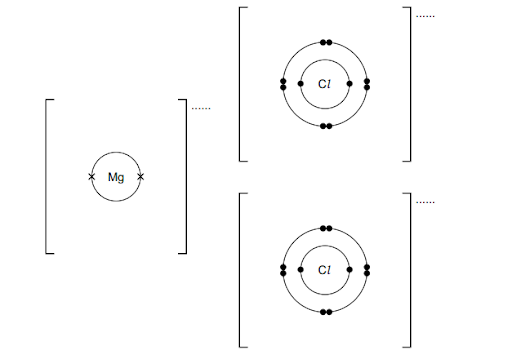
Magnesium reacts with chlorine to form magnesium chloride, MgCl2.

Magnesium chloride is an ionic compound.

(i) Complete the dot-and-cross diagram in Fig. 2.1 of the ions in magnesium chloride.

Show the charges on the ions.

Incomplete dot-and-cross diagram: a magnesium ion and two chloride ions, each in square brackets with a dotted line for the charge. Mg shows one inner shell with two crosses; each Cl shows two inner shells with dots. The outer shells are not drawn and are to be added.

Fig. 2.1

[3]

(ii) One physical property typical of ionic compounds, such as MgCl2, is that they are soluble in water. 

Give two other physical properties that are typical of ionic compounds.

1  ......................................................................................

2   ......................................................................................

[2]

14e
2 marks

Extended Tier Only

Aqueous silver nitrate is added to aqueous magnesium chloride. A white precipitate forms. Write an ionic equation for this reaction. Include state symbols.