11 mark
Which option correctly describes the relative charges and masses of the subatomic particles?
| Proton | Neutron | Electron | Relative mass of proton |
A | +1 | 0 | 0 | 0.00054 |
B | 0 | +1 | +1 | 1 |
C | 0 | +1 | -1 | 0.00054 |
D | +1 | 0 | -1 | 1 |
Was this exam question helpful?
Exam code: 0620 & 0971
Which option correctly describes the relative charges and masses of the subatomic particles?
| Proton | Neutron | Electron | Relative mass of proton |
A | +1 | 0 | 0 | 0.00054 |
B | 0 | +1 | +1 | 1 |
C | 0 | +1 | -1 | 0.00054 |
D | +1 | 0 | -1 | 1 |
Was this exam question helpful?
The atomic number of element Q is 9 and its mass number is 19.
In which group of the Periodic Table should element Q be placed?
Group 0
Group I
Group VII
Group II
Was this exam question helpful?
The diagram shows the atomic structure of an element.

Which element is it?
Carbon
Beryllium
Oxygen
Boron
Was this exam question helpful?
The atomic structure of atoms Q, R, S and T are shown in the table.
Atom | Number of protons | Number of neutrons | Number of electrons |
Q | 6 | 7 | 6 |
R | 7 | 7 | 7 |
S | 6 | 8 | 6 |
T | 8 | 8 | 8 |
Which two atoms are isotopes?
Q and S
Q and T
R and T
R and S
Was this exam question helpful?
Substances can be broadly classified into three categories which are elements, compounds and mixtures.
Which of the following statements is correct?
Elements contain different atoms
Compounds consist of elements that are not chemically combined
Mixtures consist of elements that are chemically combined
A mixture can contain elements and compounds
Was this exam question helpful?
Which diagram shows a mixture of compounds?
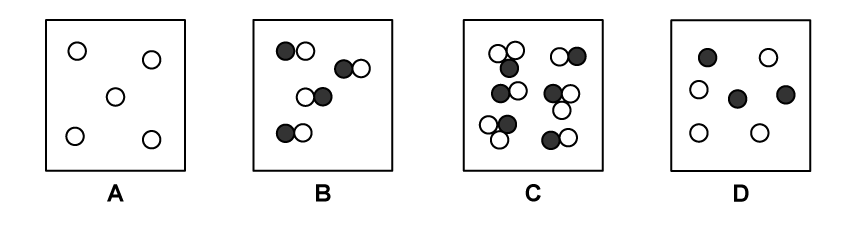
Was this exam question helpful?
Which statement about carbon is correct?
It has 4 electron shells.
It has 2 outer shell electrons.
It has 12 nucleons.
It has an electron configuration of 2,8,2.
Was this exam question helpful?
Two atoms, X and Y can be represented as shown
Which row is correct for both atoms?
electron configuration of X | electron configuration of Y | Is Y an isotope of X? | |
A | 2,1 | 2,1 | Yes |
B | 2,1 | 2,6 | Yes |
C | 2,5 | 2,1 | No |
D | 2,5 | 2,6 | No |
Was this exam question helpful?
Which substance is an element?
ammonia, NH3
carbon monoxide, CO
phosphorus, P4
water, H2O
Was this exam question helpful?
A sample of sea water is left in an open dish.
The water evaporates and solid salt is left behind.
Which statement explains why sea water is a mixture?
The salt and the water are not chemically bonded together.
The salt and the water are chemically bonded together.
Sea water contains only one type of atom.
Sea water has the formula H2O.
Was this exam question helpful?
Which substance is a mixture?
air
carbon dioxide
copper
sodium chloride
Was this exam question helpful?
Sodium and chlorine are both listed in the Periodic Table.
Sodium chloride is not listed in the Periodic Table.
Why is sodium chloride not listed?
It is an element.
It is a compound.
It is a mixture.
It is an alloy.
Was this exam question helpful?
Which statement about the structure of an atom is correct?
The nucleus contains protons and electrons.
The nucleus contains protons and neutrons.
The nucleus contains neutrons only, and the protons are in shells.
The nucleus contains protons only, and the neutrons are in shells.
Was this exam question helpful?
An atom of iron is shown.
How many neutrons does this atom contain?
26
30
56
82
Was this exam question helpful?
An atom of argon, 40Ar, and an atom of calcium, 40Ca, both have a nucleon number of 40.
These two atoms are not isotopes of each other.
Which statement explains why?
Isotopes must contain equal numbers of protons and neutrons.
Isotopes must contain the same number of neutrons.
Isotopes must contain the same number of nucleons.
Isotopes must contain the same number of protons.
Was this exam question helpful?
An atom contains 9 protons, 10 neutrons and 9 electrons.
Which symbol represents this atom?
Was this exam question helpful?
An atom of calcium is represented as
Which atom is an isotope of this atom?
Was this exam question helpful?
Chlorine has two isotopes, 35Cl and 37Cl.
The two isotopes have identical chemical properties.
Why is this?
They have the same electronic configuration.
They have the same nucleon number.
They have the same number of neutrons.
They have the same relative atomic mass.
Was this exam question helpful?
The structure of four particles is described in the table.
Particle | Number of protons | Number of neutrons | Number of electrons |
Li | 3 | X | 3 |
Li+ | 3 | 4 | 2 |
F | Y | 10 | 9 |
F- | 9 | 10 | Z |
What are the correct values for X, Y and Z?
| X | Y | Z |
A | 4 | 7 | 9 |
B | 3 | 9 | 9 |
C | 4 | 9 | 10 |
D | 3 | 7 | 10 |
Was this exam question helpful?
Element X contains 12 of each sub-atomic particle.
What is the correct Group number for element X?
Group 0
Group I
Group VII
Group II
Was this exam question helpful?
Element X contains 4 electrons in its outer shell and 125 neutrons in its nucleus. What is element X?
Beryllium
Carbon
Tin
Lead
Was this exam question helpful?
Potassium fluoride is an ionic compound formed when one atom of potassium bonds with one atom of fluorine.
Which row correctly describes the charge and electronic configuration of each ion in the compound?
| Potassium ion | Fluorine ion | ||
A | 1 - | 2, 8, 8 | 1 + | 2, 8 |
B | 1 + | 2, 8, 8 | 1 - | 2, 8 |
C | 1 + | 2, 8, 8 ,1 | 1 - | 2, 7 |
D | 1 - | 2, 8, 8, 2 | 1 + | 2, 6 |
Was this exam question helpful?
A section of the Periodic Table is shown below.

The electronic structure of elements W, X, Y and Z are shown in the table.
| Electronic structure |
W | 2, 1 |
X | 2, 4 |
Y | 2, 8, 2 |
Z | 2, 8 |
Which elements have the correct electronic structure?
W and X
Y and Z
W and Y
X and Z
Was this exam question helpful?
Which pair of atoms contain the same number of neutrons?
Was this exam question helpful?
Which information is needed to calculate the relative atomic mass of an element?
The total number of protons and neutrons in the most abundant isotope.
The nucleon numbers and the total number of isotopes.
The mass number and abundance of each of its isotopes.
The atomic number and abundance of each of its isotopes.
Was this exam question helpful?
Information about the structures of three atoms, X, Y and Z, is shown.
atom | proton number | nucleon number |
X | 1 | 1 |
Y | 1 | 2 |
Z | 1 | 3 |
Which statements about atoms X, Y and Z are correct?
They are isotopes of the same element.
They contain the same number of electrons.
They contain the same number of neutrons.
They contain one occupied electron shell.
1, 2 and 4
1 and 2 only
3 and 4
3 only
Was this exam question helpful?
The numbers of protons and neutrons and the electronic structures of four particles, W, X, Y and Z, are shown.
number of protons | number of neutrons | electronic structure | |
W | 8 | 8 | 2,8 |
X | 8 | 10 | 2,6 |
Y | 8 | 8 | 2,6 |
Z | 10 | 8 | 2,8 |
Which particles have the same chemical properties?
W and Y
W and Z
X and Y
X and Z
Was this exam question helpful?
The electronic structure of element Z is 2,8,1.
Which statements about Z are correct?
It is a metal.
It has two outer-shell electrons.
It is in Period 3.
1, 2 and 3
1 and 2 only
1 and 3 only
2 only
Was this exam question helpful?
Which diagram represents the arrangement of the outer-shell electrons of a noble gas?
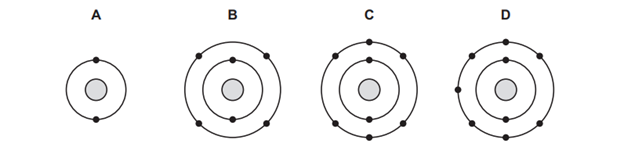
Was this exam question helpful?
X and Y are two different elements.
X and Y have the same number of nucleons.
Which statement about X and Y is correct?
They have the same physical properties.
Their atoms have the same number of electrons.
They are in different groups of the Periodic Table.
They have different relative masses.
Was this exam question helpful?
The number of protons and the number of neutrons in the atoms of elements X, Y and Z are shown.
number of protons | number of neutrons | |
X | 6 | 6 |
Y | 7 | 6 |
Z | 8 | 10 |
Which statement about the elements is correct?
X and Y are isotopes of the same element.
Z forms an ion with a +2 charge
X and Z react together to form an ionic compound
X, Y and Z are non-metals
Was this exam question helpful?
Which substance contains atoms of three different elements?
calcium carbonate
magnesium oxide
sodium chloride
zinc sulfide
Was this exam question helpful?
Which diagram shows a mixture of noble gases?
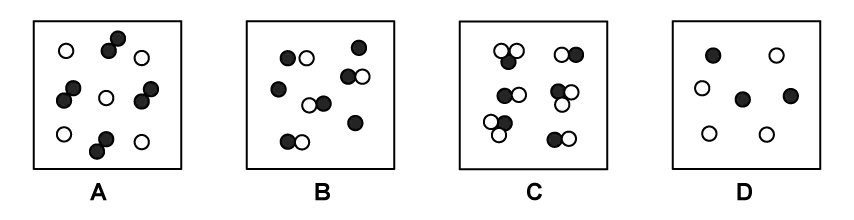
Was this exam question helpful?
Carbon and oxygen combine to form two different compounds, carbon monoxide, CO, and carbon dioxide, CO2.
Which statement is correct?
Carbon monoxide and carbon dioxide are the same compound, because they contain the same two elements.
Only one of them can be a compound, because a compound has a fixed composition.
Each of them is a compound, and each has its own fixed ratio of carbon to oxygen.
A container holding both gases holds a compound, because everything in it contains only carbon and oxygen.
Was this exam question helpful?
Two atoms, X and Y can be represented as shown
Which statement is correct for both atoms?
They have the same chemical properties because they have the same number of neutrons.
They have the same chemical properties because they have the same number of electrons in their outer shell.
They have the same physical properties because they have the same number of electrons in their outer shell.
They have the same physical properties because they have the same number of protons.
Was this exam question helpful?
The diagrams show the particles present in four different samples.
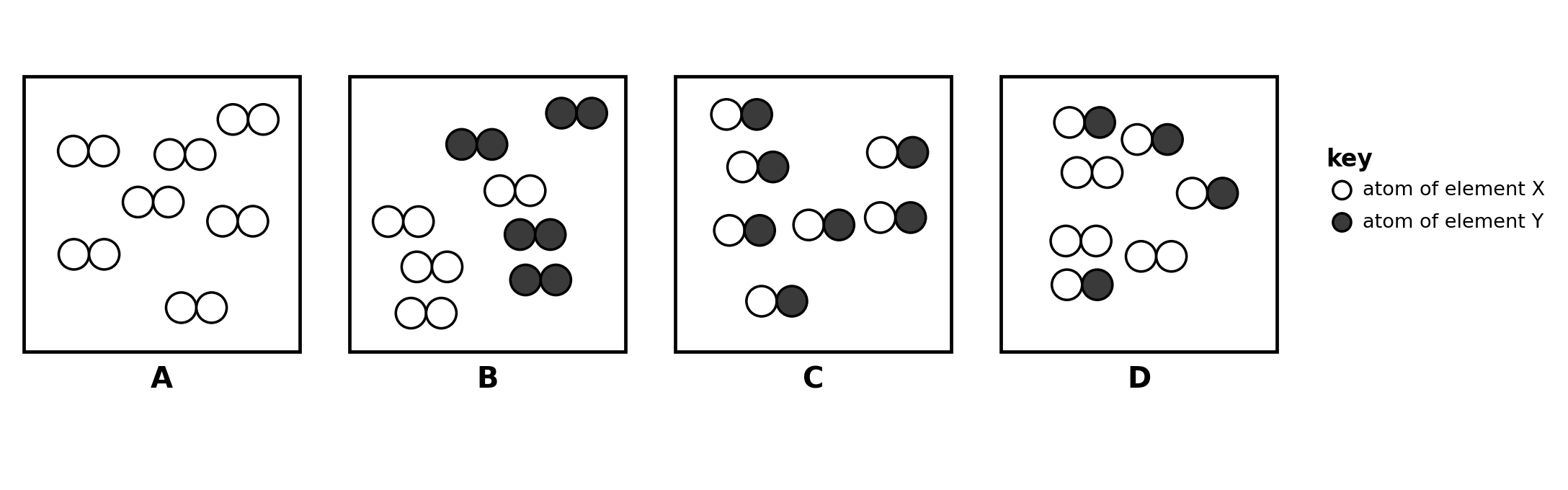
Which diagram shows a mixture of a compound and an element?
Was this exam question helpful?
Substance X is made of molecules.
Every molecule of X contains four atoms, and all four atoms are of the same type.
Which statement about X is correct?
X is a compound, because each molecule contains more than one atom.
X is a compound, because all of its molecules are identical.
X is an element, because each molecule contains only one type of atom.
X is an element, because each molecule contains four atoms.
Was this exam question helpful?
Aluminium has only one naturally occurring isotope,
How many neutrons are there in an atom of , and how many electrons are in its second shell?
13 neutrons and 3 electrons
13 neutrons and 8 electrons
14 neutrons and 3 electrons
14 neutrons and 8 electrons
Was this exam question helpful?
The table shows the numbers of protons, neutrons and electrons in four particles.
particle | number of protons | number of neutrons | number of electrons |
1 | 20 | 20 | 20 |
2 | 20 | 20 | 18 |
3 | 20 | 22 | 20 |
4 | 22 | 22 | 22 |
Which two particles are isotopes of the same element?
1 and 2
1 and 3
1 and 4
2 and 4
Was this exam question helpful?
The table shows the percentage abundance of the three isotopes of element Z.
Isotope | 24Z | 25Z | 26Z |
Percentage abundance | 79% | 10% | 11% |
What is the relative atomic mass of Z?
24.0
24.1
24.3
25.0
Was this exam question helpful?
Substance Z is made of two elements chemically bonded together.
Which statements about Z must be true?
Z has a fixed composition
Z can be separated into its two elements by physical means
Z has properties that are different from the properties of the elements it is made from
1 only
1 and 3
2 and 3
1, 2 and 3
Was this exam question helpful?
Three samples each contain iron and oxygen only.
sample | mass of iron / g | mass of oxygen / g |
|---|---|---|
1 | 7.0 | 3.0 |
2 | 14.0 | 6.0 |
3 | 14.0 | 3.0 |
Which samples could be the same compound?
1 and 2
1 and 3
2 and 3
1, 2 and 3
Was this exam question helpful?
The diagram shows the reaction between substances P and Q to form substance R.
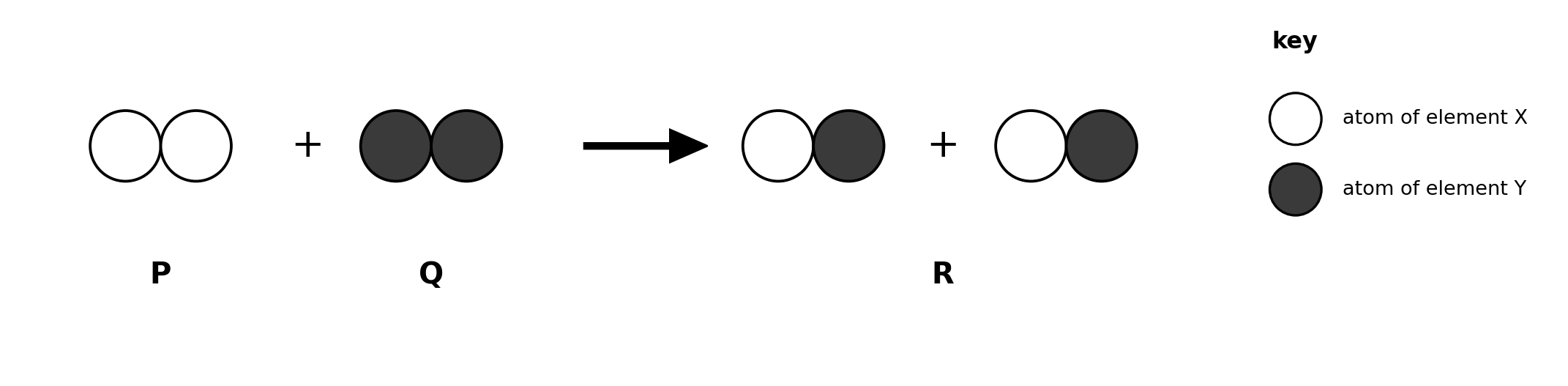
Which row correctly classifies P, Q and R?
P | Q | R | |
|---|---|---|---|
A | element | element | element |
B | element | element | compound |
C | compound | compound | compound |
D | compound | compound | element |
Was this exam question helpful?
Which substance can be separated into two different elements without a chemical reaction?
iron(II) sulfide
iron filings stirred with powdered sulfur
sulfur
sulfur dioxide
Was this exam question helpful?
An atom of element J has nucleon number 24 and proton number 12.
An atom of element L has nucleon number 40 and proton number 20.
Three statements about J and L are listed.
1 J and L are in the same group of the Periodic Table.
2 L is in a later period than J.
3 L has more outer shell electrons than J.
Which statements are correct?
1 and 2
1 and 3
2 and 3
1, 2 and 3
Was this exam question helpful?
An atom of element X has proton number 19.
Which row is correct?
electrons in the innermost shell | electrons in the outer shell | number of occupied shells | |
|---|---|---|---|
A | 2 | 1 | 4 |
B | 1 | 2 | 4 |
C | 2 | 8 | 4 |
D | 2 | 1 | 3 |
Was this exam question helpful?
The symbols for two particles are shown.

Which statement is correct?
They are isotopes of the same element.
They contain the same number of electrons.
The bromide ion contains more electrons than the krypton atom.
The bromide ion contains more protons than the krypton atom.
Was this exam question helpful?
Element J has two isotopes, 204J and 209J.
The relative atomic mass of J is 205.0
What percentage of the atoms in a sample of J are 209J?
20%
25%
50%
80%
Was this exam question helpful?
An element has two isotopes. One isotope has a relative mass of x and the other has a relative mass of x + 2.
In a sample of this element, 25% of the atoms have a relative mass of x.
What is the relative atomic mass of the element?
x + 0.5
x + 1
x + 1.5
x + 2
Was this exam question helpful?
The X+ ion of element X has 16 electrons and a nucleon number of 37.
What is the correct Group number for element X?
VII
VIII
III
I
Was this exam question helpful?
Which row of the table correctly describes the link between outer shell electrons, Group number and Period number?
| outer electrons same as | group number same as | period number same as |
A | group number | period number | outer electrons |
B | period number | group number | outer electrons |
C | group number | outer electrons | number of electron shells |
D | outer electrons | group number | number of electron shells |
Was this exam question helpful?
Which row correctly describes the number of outer shell electrons and properties of isotopes?
| Number of electrons | Chemical properties |
A | same | same |
B | same | different |
C | different | same |
D | different | different |
Was this exam question helpful?
Iridium has two isotopes, 191Ir and 193Ir. Calculate the relative atomic mass of iridium using the data given:
Mass number | 191 | 193 |
Percentage abundance | 62.7% | 37.3% |
191.2
191.6
191.7
192.5
Was this exam question helpful?
A selenide ion has the following notation.
Which row correctly describes the subatomic particles in a selenide ion?
| Protons | Neutrons | Electrons |
A | 79 | 34 | 34 |
B | 34 | 45 | 34 |
C | 34 | 45 | 36 |
D | 45 | 34 | 32 |
Was this exam question helpful?
Copper has two naturally occurring isotopes, 63Cu and 65Cu. The relative abundance of 63Cu is 69%.
What is the relative atomic mass of copper?
63.6
64.0
64.4
65.0
Was this exam question helpful?