11 mark
Which one of the following names does not correspond to a group of elements on the Periodic table?
Alkali
Group VI
Alloys
Halogens
Was this exam question helpful?
Exam code: 0620 & 0971
Which one of the following names does not correspond to a group of elements on the Periodic table?
Alkali
Group VI
Alloys
Halogens
Was this exam question helpful?
Which row describes how the elements are positioned on the Periodic table and the names used?
| elements placed by | group | period |
A | atomic number | vertical column | horizontal row |
B | mass number | vertical column | horizontal row |
C | atomic number | horizontal row | vertical column |
D | mass number | horizontal row | vertical column |
Was this exam question helpful?
Which property of elements increases as you move across the Periodic table?
The number of outer shells increases.
The number of outer shell electrons increases.
The metallic character.
The tendency to become oxidised.
Was this exam question helpful?
Element Z forms an ion with a 2- charge.
Which group of the Periodic Table is element Z found in?
1
2
6
7
Was this exam question helpful?
Element X is found in Group 7 of the Periodic Table.
Which properties are typical of element X?
1 | Poor conductor of electricity |
2 | Malleable |
3 | High melting points |
4 | Form acidic oxides |
1 and 2
1 and 4
2 and 3
3 and 4
Was this exam question helpful?
The elements sodium to argon form Period 3 of the Periodic Table.
Which row describes the trend across Period 3 from left to right?
number of outer-shell electrons | metallic character | group number | |
A | decreases | decreases | decreases |
B | decreases | increases | decreases |
C | increases | decreases | increases |
D | increases | increases | increases |
Was this exam question helpful?
The table shows the densities at room temperature of halogens W, X, Y and Z
halogens | density at room temperature / g/cm3 |
W | 0.0017 |
X | 3.1 |
Y | 0.0032 |
Z | 4.93 |
Which row correctly identifies W, X, Y and Z?
W | X | Y | Z | |
A | fluorine | chlorine | bromine | iodine |
B | fluorine | bromine | chlorine | iodine |
C | iodine | chlorine | bromine | fluorine |
D | iodine | bromine | chlorine | fluorine |
Was this exam question helpful?
Lithium and chromium are metals.
Which statement about the properties of these elements is correct?
Lithium and chromium react vigorously with water in an exothermic reaction.
Lithium and chromium have a similar melting point because their atoms are arranged in a metallic lattice.
Lithium can form coloured compounds because it can have more than one oxidation state.
Chromium can form coloured compounds because it can have more than one oxidation state.
Was this exam question helpful?
The early Periodic table was used to classify the known elements and was used to predict the properties of the elements that had not yet been discovered.
Which row correctly describes how this was possible?
Elements in the same Period displayed similar properties.
The arrangement of the known elements provided trends in behaviour which was used to make predictions about the unknown elements.
Elements in different Groups displayed similar properties.
The unknown elements were used to fill the gaps in the original Periodic table and were placed according to their physical properties.
Was this exam question helpful?
Potassium and krypton are elements in Period 4. Potassium is at the beginning of the period and is more metallic than krypton which is at the end of the period.
What makes potassium more metallic than krypton?
It has less electrons than krypton.
It has less protons than krypton.
It has less electron shells.
It has less outer shell electrons.
Was this exam question helpful?
The elements of the Periodic table can be broadly classified into two main characters which are metals and nonmetals. Which statements are correct?
1 | Magnesium is more metallic than silicon. |
2 | Boron is more metallic than lithium. |
3 | Carbon is less metallic than beryllium. |
4 | Sodium is less metallic than aluminium. |
1 and 3
1 and 2
2, 3 and 4
1, 2 and 4
Was this exam question helpful?
The metallic character of the elements changes as you move across a period.
Which statement explains this trend?
The mass number increases as you move across.
The physical properties change as you move across.
The tendency to lose or gain electrons changes moving across.
The atomic number changes as you move across.
Was this exam question helpful?
An element has an electronic configuration of 2,8,6.
Which group and period can the element be found in?
| group | period |
A | 6 | 3 |
B | 6 | 8 |
C | 3 | 6 |
D | 8 | 2 |
Was this exam question helpful?
Period 3 of the Periodic Table is shown.
Na | Mg | Al | Si | P | S | Cl | Ar |
What increases from Na to Ar across Period 3?
density
melting point
non-metallic character
the number of electron shells
Was this exam question helpful?
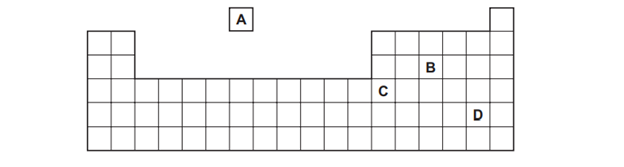
Part of the Periodic Table is shown.
Which element is a metal?
Was this exam question helpful?
Elements in Group IV of the Periodic Table are shown.
carbon
silicon
germanium
tin
lead
What does not occur in Group IV as it is descended?
The proton number of the elements increases.
The elements become more metallic.
The elements have more electrons in their outer shell.
The elements have more electron shells.
Was this exam question helpful?
Elements X and Z are both in Period 3 of the Periodic Table.
X is in Group I and Z is in Group VII.
Which row is correct?
more metallic | forms a negative ion when it reacts | |
|---|---|---|
A | X | X |
B | X | Z |
C | Z | X |
D | Z | Z |
Was this exam question helpful?
Potassium has a lower relative atomic mass than argon but on the Periodic table potassium appears after argon.
Why is potassium placed after argon?
Argon has less neutrons than potassium.
Argon has more protons than potassium.
Potassium has more protons than argon.
Potassium has more neutrons than argon.
Was this exam question helpful?
Oxygen, sulfur, selenium and tellurium are Group VI elements. What do all these elements have in common?
They all have 6 outer shell electrons and have similar physical properties.
They are all non-metals.
They all have 5 outer shell electrons and have similar chemical properties.
They all have 6 outer shell electrons and have similar chemical properties.
Was this exam question helpful?
Elements W, X, Y and Z are shown.

Which of the following statements are correct?
1 | Z is found in nature in the elemental state |
2 | W is more metallic than X |
3 | W is more metallic than Y |
4 | X forms a covalent compound with hydrogen |
2 and 3
1, 2 and 3
2 and 4
All
Was this exam question helpful?
As you move down a group on the Periodic table the elements become more metallic in character.
Which statement explains this observation?
Electrons are more easily gained due to increasing atomic radius.
Electrons are more easily lost due to increasing atomic radius.
The elements are heavier due to the atomic number increasing as you move down a group.
The elements are heavier due to the mass number increasing as you move down a group.
Was this exam question helpful?
The table shows four possible sets of charges on the ions formed by metals in Groups II and III and by non-metals in Groups VI and VII of the Periodic Table.
Which row is correct?
Group II | Group III | Group VI | Group VII | |
|---|---|---|---|---|
A | 2+ | 3+ | 6+ | 7+ |
B | 2+ | 3+ | 2- | 1- |
C | 2- | 3- | 2+ | 1+ |
D | 2+ | 3+ | 6- | 7- |
Was this exam question helpful?
X and Y are two elements from the same period in The Periodic Table
The table gives some properties of X and Y
| X | Y |
appearance | shiny grey | dull yellow |
malleability | malleable | brittle |
electrical conductivity when solid | good | poor |
Which statements are correct about X and Y?
1 Y has a higher melting point than X
2 Y forms negative ions when it reacts
3 X forms covalent compounds
4 X forms a basic oxide
1 and 2
2 and 4
2 and 3
3 and 4
Was this exam question helpful?