Experimental Techniques (Cambridge (CIE) IGCSE Chemistry): Theory Questions

Exam code: 0620 & 0971

9 hours87 questions
1a
2 marks

A student does three titrations with dilute hydrochloric acid and potassium hydroxide solution.

Complete the equation to show the products formed during this reaction.

potassium hydroxide + hydrochloric acid  →   potassium ______ +  _______

1b
1 mark

Some of the apparatus the student uses is shown below.

17a

Name the piece of equipment the student will use to measure out the 25.0 cm3 of potassium hydroxide solution.

1c
1 mark

In her first titration the student measures the initial volume of hydrochloric acid in the burette.

She slowly adds the acid until the potassium hydroxide is just neutralised. She then measures the volume of the hydrochloric acid again. Describe how she can tell when the potassium hydroxide solution is just neutralised.

1d
2 marks

Look at the diagrams. They show parts of the burette during the first titration.

q17c-paper-2-specimen-2016-ocr-gcse-chem

Here is the student’s results table.

Titration number

1

2

3

final reading in cm3


37.5

32.1

initial reading in cm3


20.4

15.0

titre (volume of acid added) in cm3


17.1

17.1

 Complete the table by recording the burette readings from the diagrams.

2a
1 mark

The names of some pieces of equipment are shown.

stopwatch   balance    thermometer   gas syringe   burette   pipette

For each question, name the piece of apparatus that would be used in each case.

Each piece of equipment can be used once, more than once or not at all. 

Name the piece of apparatus that would be used to measure the time taken for a white precipitate to form when barium chloride is added to sodium sulfate.

2b
1 mark

Name the piece of apparatus that would be used to determine whether the reaction between magnesium and hydrochloric acid is exothermic.

2c
1 mark

Name the piece of apparatus that would be used to measure the volume of carbon dioxide produced when marble chips are added to hydrochloric acid.

2d
1 mark

Name the piece of apparatus used to add hydrochloric acid to 25 cm3 of sodium hydroxide solution during a titration.

3a
1 mark

A student investigated the effect of temperature on the mass of sodium chloride that dissolves in 100 cm3 of water. 

Name the piece of apparatus that would be used to measure the mass of sodium chloride.

3b
1 mark

A control variable is one which must be kept constant each time the investigation is repeated.  Give one control variable in this investigation. 

The temperature of the water

The volume of water

The mass of sodium chloride

The beaker used 

3c
4 marks

Complete these sentences using the word from the list.

solution

saturated

solute

solvent

residue

filtrate

liquid

The salt is the .................................. because it dissolves in water. The water is the .................................. because it has the salt dissolved in it.

The mixture of salt and water is known as a ...................................

When no more salt can dissolve in water at a specific temperature, the solution has become..................................

3d
1 mark

Separate: Chemistry Only

The student used a thermometer to measure the temperature during their investigation.

Name a different piece of apparatus that would give the student a more precise reading. 

4a
1 mark

A student made copper sulfate crystals. 

The first two steps of their method are shown below. 

q6


Why should copper carbonate be added in excess to sulfuric acid?

4b
1 mark

The contents of the beaker in step 2 are separated using filtration. 

Identify the residue.  Draw a circle around the correct answer.

water

copper carbonate

copper(II) sulfate

sulfuric acid

4c
1 mark

Identify the filtrate.  Draw a circle around the correct answer.

water

copper carbonate

copper(II) sulfate

sulfuric acid

4d
2 marks

Describe how you would obtain dry copper(II) sulfate crystals from the solution. 

5a
2 marks

A student carried out a titration using sodium hydroxide and hydrochloric acid. 

Their method is written below. 

A

 Add a few drops of phenolphthalein 

B

 Add the HCl slowly until the endpoint is reached 

C

 Add HCl into the burette and record initial volume 

D

 Pipette 25 cm3 of NaOH  into a conical flask 

E

 Record the volume of acid added 

Put the statements A, B, C, D, E in the correct order.

The first step has been done for you. 

 first step 


 last step

C


5b
1 mark

What colour change will be observed when the end point is reached? Tick one box.

Red to yellow


Pink to colourless


Colourless to pink


Yellow to red 


5c
1 mark

Why can universal indicator not be used to show the end point in a titration?

5d
1 mark

Separate: Chemistry Only

A measuring cylinder could have been used to measure 25 cm3 of sodium hydroxide.  Give one advantage of using a pipette

6a
2 marks

Water from a reservoir is treated to make it suitable for drinking.

Fig. 8.1 shows the steps in the water treatment process. Complete Fig. 8.1 by naming the missing stages

reservoirwater→......................→filtration→finefiltration→..........................→drinkingwater

Fig. 8.1

6b
2 marks

Ozone can also be used in water treatment. Ozone is a gas that makes up less than 1% of the air.

State the name of the two gases that are the main components of clean, dry air.

6c
2 marks

A student uses a sample of the water reservoir to react with four metals, W, X, Y, and Z. The results are shown in Table 8.1

metal

reaction with cold water

W

reacts slowly

X

reacts violently

Y

no reaction

Z

reacts very slowly

Put the four metals in order of their reactivity.

Put the least reactive metal first

least reactive −−−−−−−−−−→ most reactive

6d
2 marks

Metal X forms a basic oxide. When this oxide is placed in water, a soluble hydroxide is produced.

Suggest a suitable indicator to check the pH of the solution formed and the expected observation.

Indicator:

Observation:

6e
1 mark

A flame test is performed on an ionic compound of metal Y. A blue-green flame is observed.

Name metal Y.

6f
1 mark

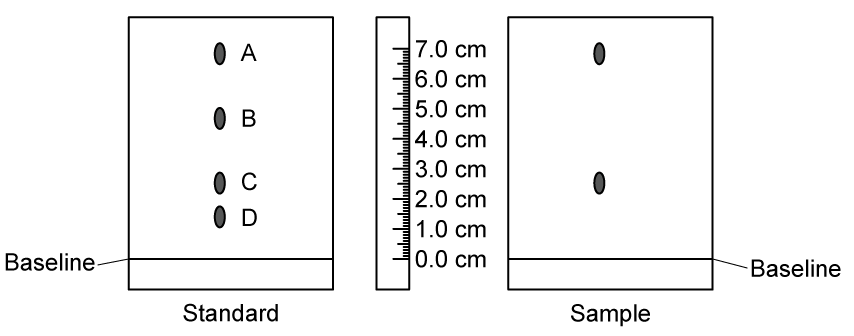
A student monitors the health of the reservoir. They notice a green bloom of algae and use paper chromatography to identify the natural pigments present in a sample of the algae.

Fig. 8.2 shows four known standard pigments, A, B, C, and D, and the chromatogram of the algae sample.

Two chromatograms labelled Standard and Sample, each with a baseline at 0.0 cm. A ruler between them shows 0.0 to 7.0 cm.

Standard: four spots above the baseline — A at about 6.5 cm, B at about 5.0 cm, C at about 2.5 cm, D at about 1.5 cm.

Sample: two spots — one at about 6.5 cm and one at about 2.5 cm.

Fig. 8.2

Identify which of the standard pigments, A, B, C, or D, are present in the algae sample.

7a
2 marks

A student makes a solution of potassium nitrate.

The method is shown.

step 1

Take 5.0 g of solid potassium nitrate.

step 2

Add the solid to 100 cm3 of distilled water in a beaker and stir.

step 3

Transfer 25.0 cm3 of the solution into a conical flask.

step 4

Record the temperature of the solution in the flask.

Name the most suitable apparatus to use:

i) in step 1

[1]

ii) to measure the 100 cm3 of distilled water in step 2.

[1]

7b
2 marks

Name the most suitable apparatus to use:

i) in step 3

[1]

ii) in step 4.

[1]

7c
1 mark

State why the student stirs the mixture in step 2.

7d
2 marks

The apparatus the student used to measure the water in step 2 holds at most 100 cm3.

The student now needs to make a second solution using 250 cm3 of distilled water.

i) Name a piece of apparatus that would measure 250 cm3 of distilled water in a single measurement.

[1]

ii) The student instead measures the 250 cm3 with the apparatus used to measure the water in step 2, in three portions.

Suggest why this gives a less accurate volume than a single measurement with the apparatus named in i).

[1]

8a
2 marks

A student investigates how the temperature of dilute hydrochloric acid affects how quickly a strip of magnesium disappears.

The student measures out 25 cm3 of the acid, records its temperature, adds the magnesium and times how long the magnesium takes to disappear.

Name the apparatus the student uses to measure:

i) the time taken for the magnesium to disappear

[1]

ii) the volume of the dilute hydrochloric acid.

[1]

8b
2 marks

Name the apparatus the student uses to measure:

i) the temperature of the acid

[1]

ii) the mass of the magnesium.

[1]

8c
1 mark

The student decides to follow the reaction by measuring the volume of gas given off, instead of timing how long the magnesium takes to disappear.

Name the apparatus the student uses to measure the volume of gas.

8d
2 marks

State the unit in which each of the following is measured.

i) time

[1]

ii) the volume of a gas

[1]

9a
2 marks

A student titrates aqueous sodium hydroxide with dilute sulfuric acid.

Complete the word equation for the reaction that takes place.

sodium hydroxide + sulfuric acid → +

9b
1 mark

The aqueous sodium hydroxide is placed in a conical flask and the dilute sulfuric acid is placed in a burette.

Explain why the indicator is added to the conical flask and not to the burette.

9c
1 mark

Name a suitable indicator for this titration.

9d
2 marks

Before carrying out the accurate titrations, the student does one rough titration, adding the acid quickly.

Suggest why a rough titration is carried out first.

10a
1 mark

A student carries out a titration to find the concentration of dilute nitric acid.

25.0 cm3 of the dilute nitric acid is placed in a conical flask and a few drops of thymolphthalein are added to it.

Aqueous sodium hydroxide is run into the conical flask from a burette.

State the colour of the solution in the conical flask before any aqueous sodium hydroxide is added.

10b
1 mark

State the colour of the solution in the conical flask at the end point.

10c
1 mark

When taking a burette reading, the student puts their eye level with the bottom of the curved surface of the liquid.

State why the reading is taken in this way.

10d
2 marks

On one titration the student runs the aqueous sodium hydroxide in quickly and the solution in the conical flask becomes strongly coloured.

Explain what this tells the student about the volume they have recorded.

11a
1 mark

A student carries out a titration to find the volume of dilute sulfuric acid needed to neutralise 25.0 cm3 of aqueous ammonia.

State what is meant by the end point of a titration.

11b
2 marks

The 25.0 cm3 of aqueous ammonia is placed in a conical flask and a few drops of methyl orange are added to it.

The dilute sulfuric acid is run into the conical flask from a burette.

State the colour change seen in the conical flask at the end point.

11c
2 marks

The student carries out the titration twice and records the burette readings.

titration 1

titration 2

final burette reading / cm3

24.9

49.2

initial burette reading / cm3

0.0

24.9

Calculate the volume of acid used in each titration.

11d
1 mark

The conical flask is swirled throughout the titration.

State why the conical flask is swirled.

1a
1 mark

The following paragraph was taken from a student’s notebook.

To make potassium chloride

25.0 cm3 of aqueous potassium hydroxide were placed in a flask and a few drops of indicator were added. Dilute hydrochloric acid was added to the flask until the indicator changed colour. The volume of acid used was 19.0 cm3.

What piece of apparatus should be used to measure the aqueous potassium hydroxide? 

1b
3 marks

i) Name a suitable indicator that could be used.

 [1]

 ii) The indicator would change from ........................... to ................................

 [2]

1c
2 marks

Which solution was more concentrated? Explain your answer.

1d
3 marks

How could pure crystals of potassium chloride be obtained from this experiment? 

2a
2 marks

A student investigated the reaction between two different solutions of dilute hydrochloric acid, A and B, and solution C which is alkaline. Two experiments were carried out

Experiment 1 A burette was filled with solution A of dilute hydrochloric acid to the 0.0 cm3 mark. Using a measuring cylinder, 20 cm3 of solution C was poured into a conical flask. A few drops of methyl orange were added to the flask.

Solution A was added to the flask, with shaking, until the mixture just changed colour. Use the burette diagram to record the burette reading in the table and complete the table.

screenshot-2024-03-11-114301


burette readings

final volume / cm3


initial volume / cm3


difference / cm3


2b
2 marks

Experiment 2 The burette was emptied and rinsed, first with distilled water, and then with a little of solution B. The burette was filled with solution B of dilute hydrochloric acid to the 0.0 cm3 mark.

Experiment 1 was repeated using solution B.

Use the burette diagram to record the burette reading in the table and complete the table.

12-1-q9b


burette readings

final volume / cm3


initial volume / cm3


difference / cm3


2c
2 marks

i) What type of chemical reaction takes place when hydrochloric acid reacts with alkaline solutions?

[1]

ii) Why is methyl orange added to the flask?

[1]

2d
2 marks

Why was the burette rinsed, first with distilled water and then with solution B, before starting Experiment 2?

2e
4 marks

Separate: Chemistry and Extended Only 

i) In which experiment was the greater volume of dilute hydrochloric acid used?

 [1]

 ii) Compare the volumes of dilute hydrochloric acid used in Experiments 1 and 2.

 [1]

 iii) Suggest, in terms of the concentration of solutions A and B, an explanation for the difference in volumes used. 

 [2]

2f
2 marks

Separate: Chemistry and Extended Only

If Experiment 2 was repeated using 10 cm3 of solution C, what volume of dilute hydrochloric acid would be used? Explain your answer. 

2g
2 marks

Separate: Chemistry Only

Give one advantage and one disadvantage of using a measuring cylinder for solution C.

2h
4 marks

Describe a method other than titration, using a different reactant, that could be used to compare the concentrations of the two solutions of dilute hydrochloric acid, A and B.

3a
1 mark

A student investigated the effect of temperature on the rate of reaction between sodium thiosulfate solution and dilute hydrochloric acid:

Na2S2O3 (aq) + 2HCl (aq)  → 2NaCl (aq) + S (s) + SO2 (g) + H2O (l)

The reaction between these two substances produces a precipitate which makes the mixture turn cloudy. 

A student timed how long it took until the cross could no longer be seen through the precipitate, shown in Figure 1.

They then calculated the rate of reaction and repeated the experiment at different temperatures. 

Figure 1 

c3oYktGM_disappearing-cross-experiment

Name the product that made the mixture go cloudy.

3b
2 marks

Suggest two control variables for the investigation that would ensure valid results are obtained.

3c
3 marks

Define the terms:

i) Solution 

[1]

ii) Solvent

[1]

iii) Solute 

[1]

3d
2 marks

From the products formed in part a) identify:

i) The solute

[1]

ii) The solvent 

[1]

4a
2 marks

Rock salt is a mixture of sand and salt. Salt dissolves in water while sand does not. 

A group of students separated rock salt. 

They used the following method.

  1. Add the rock salt to a beaker.

  2. Add 250 cm3 of water.

  3. Leave without disturbing to allow the sand to settle to the bottom.

  4. After a while, filter the salt water into an evaporating dish.

  5. Heat the evaporating dish with a Bunsen burner until salt crystals begin to form.

i) Suggest one improvement to step 2 that the students could have done to make sure all the salt is dissolved.

 [1]

 ii) What name is given to the solution when no more salt can dissolve at this specific temperature?

 [1]

4b
2 marks

Identify the residue and filtrate in step 4. 

4c
1 mark

Suggest one safety precaution the students should take in step 5.

4d
2 marks

Another student separated water from salty water using the apparatus in the diagram below.

saltwater-distillation-aqa-sq-1-1m-7d

 By referring to points 1 and 2 in the diagram, describe how this technique works.

4e
1 mark

Identify the residue in the experiment being carried out in part (d).

5a
4 marks

A chemist used a volumetric pipette to add 25.0 cm3 of a solution of sodium hydroxide of unknown concentration to a conical flask.

The chemist then carried out a titration to find out the volume of 0.150 mol / dm3 sulfuric acid needed to neutralise the sodium hydroxide.

Describe how the chemist would complete the titration.

You should state a suitable indicator and give the colour change that would be observed.

5b
2 marks

Explain why a pipette would be used to measure the sodium hydroxide solution but a burette would be used to measure the sulfuric acid solution.

6a
2 marks

A student carries out three titrations, adding dilute acid from a burette to 25.0 cm3 of aqueous sodium hydroxide.

The burette readings are shown in Table 1.1.

Table 1.1

titration

initial reading / cm3

final reading / cm3

volume of acid added / cm3

1

0.0

23.5

2

1.4

24.9

3

0.6

24.1

Complete Table 1.1.

6b
2 marks

A second student records the volume of acid added in titration 2 as 24.9 cm3.

State the volume the second student should have recorded.

Explain the error that has been made.

6c
2 marks

When taking each burette reading, the student lowers their eye until it is level with the bottom of the curved liquid surface.

Explain why the reading is taken in this way.

6d
2 marks

Before filling the burette with the dilute acid, the student rinses the burette with a small volume of that acid.

i) Suggest why.

[1]

ii) State the effect on the recorded volume of acid if the burette were filled while still wet with distilled water.

[1]

7a
2 marks

A student needs to measure several different volumes of liquid during an investigation.

The student measures 100 cm3 of water by filling a beaker to the mark labelled 100 cm3 on its side.

Explain why this is not a suitable way to measure the volume.

7b
2 marks

Later in the investigation the student needs to add 25.0 cm3 of dilute acid to each of five conical flasks.

Name the most suitable piece of apparatus for this task.

Explain why it suits this task.

7c
2 marks

The student then needs to add exactly 37.5 cm3 of the dilute acid to a sixth flask, once only.

Name the most suitable piece of apparatus for this.

Explain your choice.

7d
1 mark

The beaker is still used to hold the reaction mixture during the investigation.

Suggest why a beaker is suitable for holding the mixture, even though it is not suitable for measuring a volume.

8a
1 mark

Limewater is a solution of calcium hydroxide in water.

A student titrates 25.0 cm3 of limewater with dilute hydrochloric acid, using a suitable indicator.

Suggest why the limewater used must be a clear solution and not a cloudy mixture.

8b
2 marks

The student repeats the titration using 25.0 cm3 of limewater that has been filtered from a bottle left open to the air for a week.

The volume of acid used is smaller than before.

Suggest why.

8c
2 marks

The student takes some of the original limewater and mixes it with an equal volume of distilled water.

25.0 cm3 of this mixture is then titrated with the same dilute hydrochloric acid.

State and explain the effect on the volume of acid used.

8d
1 mark

A student records a burette reading as 23 cm3.

Explain why it should be recorded as 23.0 cm3.

9a
1 mark

A student uses a volumetric pipette to place 25.0 cm3 of aqueous sodium hydroxide in a conical flask and adds a few drops of methyl orange.

Dilute hydrochloric acid is then run in from a burette.

Name the salt formed in the conical flask at the end point.

9b
2 marks

Before starting one titration, the student adds 25 cm3 of distilled water to the aqueous sodium hydroxide already in the conical flask.

State and explain the effect this has on the volume of acid used.

9c
2 marks

On a later titration the student uses a pipette that delivers 50.0 cm3 of the same aqueous sodium hydroxide instead of 25.0 cm3.

State and explain the effect this has on the volume of acid used.

9d
1 mark

State why the student uses the same indicator in every titration.

10a
1 mark

A student carries out a titration using an indicator called thymolphthalein.

The student adds the indicator to the solution in the conical flask, then runs the second solution in from the burette. The solution in the conical flask changes from blue to colourless.

State which solution was in the conical flask.

10b
2 marks

Explain how the colour change shows which solution was in the conical flask.

10c
2 marks

The student carries out a second titration, placing the acid in the conical flask and running the alkali in from the burette.

Predict the colour change that would be seen in the conical flask.

Give a reason for your answer.

10d
2 marks

A third student carries out the same titration but forgets to add any indicator.

Suggest why this student cannot find the volume of solution used.

11a
2 marks

A student carries out a titration four times, running dilute hydrochloric acid from a burette into 25.0 cm3 of aqueous potassium hydroxide.

Explain how carrying out the titration several times produces a more reliable result than carrying it out once.

11b
1 mark

State one quantity the student must keep the same in every titration.

11c
2 marks

A second student obtains four volumes of acid used that are spread widely apart from one another, and calculates a mean from them.

Explain why this mean cannot be trusted.

11d
2 marks

The student does not refill the burette to the zero mark between titrations, so each titration begins at a different point on the scale.

Explain why this does not affect the volumes of acid used.

1a
3 marks

A student investigated the effect of the size of calcium carbonate lumps, CaCO3, on the rate of reaction with hydrochloric acid, HCl, using the following method:

  1. Put 50 cm3 of hydrochloric acid into a conical flask 

  2. Add 12 g of large calcium carbonate lumps into the flask

  3. Attach the gas syringe

  4. Measure the volume of gas produced every 30 seconds for 180 seconds 

  5. Repeat steps 1 - 4 using 12 g of small calcium carbonate lumps.

  6. The number of moles of gas for each volume was calculated.

The results for large calcium carbonate lumps are shown below.

Table 1

Time in seconds

Number of moles of gas 

0

0.000

30

0.0012

60

0.0022

90

0.0030

120

0.0034

150

0.0037

180

0.0038

The student had already plotted the data for small calcium carbonate lumps.

   Plot the data for the large calcium carbonate lumps and draw a line of best fit.

aqa-gcse-6-1h-tq5a-moles-of-gas-against-time-rates-graph
1b
4 marks

Determine the mean rate of reaction for small calcium carbonate lumps between 35 seconds and 90 seconds. 

Give the unit. 

Use the graph in part (a)

1c
2 marks

Extended Only

What conclusion can be made about the rate of reaction of small calcium carbonate lumps compared to large calcium carbonate lumps?

Give one reason for your answer. 

1d
2 marks

Complete and balance the equation for the reaction between calcium carbonate and hydrochloric acid.

_______   +   _______      →     CaCl2   +   _______    +    _______ 

1e
3 marks

Separate: Chemistry Only

State one advantage and two disadvantages of using a gas syringe as opposed to a upturned measuring cylinder when collecting gas.

2
6 marks

The diagram shows two bottles of liquid oven cleaner. 

oven-cleaner

The oven cleaners contain sodium hydroxide solution. Plan an investigation to show which oven cleaner contains the highest concentration of sodium hydroxide. 

3a
2 marks

A student investigated the reaction between aqueous sodium hydroxide and acid K. Two experiments were carried out. 

Experiment 1

Using a measuring cylinder, 25 cm3 of acid K was poured into a conical flask. Phenolphthalein indicator was added to the flask. A burette was filled with aqueous sodium hydroxide to the 0.0 cm3 mark. Aqueous sodium hydroxide was added from the burette to the flask and the mixture shaken until the solution showed a permanent colour change. The final volume was measured. Use the burette diagram to record the final volume in the table and complete the table.

12-1-q11a


burette readings

final volume / cm3


initial volume / cm3


difference / cm3


3b
2 marks

Experiment 2

The solution was poured away and the conical flask rinsed.

Using a measuring cylinder, 50 cm3 of acid K was poured into the conical flask. 0.3 g of powdered calcium carbonate was added to the flask and the flask shaken until no further reaction was observed.

Phenolphthalein was added to the mixture in the flask.

A burette was filled with the same aqueous sodium hydroxide and the initial volume measured. Aqueous sodium hydroxide was added from the burette to the flask and the mixture shaken until the solution showed a permanent colour change.

Use the burette diagrams to record the initial and final volumes in the table and complete the table.

12-1-q11b


burette readings

final volume / cm3


initial volume / cm3


difference / cm3


3c
1 mark

What type of chemical reaction occurred when acid K reacted with sodium hydroxide?

3d
1 mark

If Experiment 1 were repeated using 50 cm3 of acid K, what volume of sodium hydroxide would be required to change the colour of the indicator?

3e
5 marks

i) What were the effects of adding 0.3 g of powdered calcium carbonate to acid K? 

[2]

ii) Use your answer in (d) to work out the difference between the volume of sodium hydroxide needed to completely react with 50 cm3 of acid K and the volume of sodium hydroxide used in Experiment 2.

[2]

iii) Estimate the mass of calcium carbonate that would be needed to be added to 50 cm3 of acid K to require 0.0 cm3 of sodium hydroxide.

[1]

3f
2 marks

What would be the effect on the results if the solutions of acid K were warmed before adding the sodium hydroxide?
Give a reason for your answer.

3g
4 marks

Separate: Chemistry Only

Suggest the advantage, if any, of 

i) using a pipette to measure the volume of acid K.

[2]

ii) using a polystyrene cup instead of a flask.

[2]

4a
5 marks

A student investigated what happened when sodium thiosulphate dissolved in water.    

Experiment 1

By using a measuring cylinder, 20 cm3 of distilled water was poured into a polystyrene cup.

Use the thermometer diagram to record the temperature of the water in the table.

1 g of powdered sodium thiosulphate was added to the cup and the mixture stirred with a thermometer. Use the thermometer diagram to record the temperature of the solution.    

Experiment 2

Experiment 1 was repeated using 2 g of powdered sodium thiosulphate. Record the temperature in the table.    

Experiments 3, 4 and 5

Experiment 1 was repeated using 3 g, 4 g and 5 g of powdered sodium thiosulphate respectively. Record the temperatures in the table.

5-1-q2a
4b
1 mark

What type of chemical reaction occurs when sodium thiosulphate dissolves in water?

4c
2 marks

Explain how the temperature changes would differ in the experiments if 40 cm3 of water were used.

4d
1 mark

Suggest one change you could make to the apparatus used in the experiments to obtain more accurate results.

5a
1 mark

Ammonia is produced when aqueous sodium hydroxide is warmed with ammonium sulfate. Ammonia is less dense than air and very soluble in water. The apparatus below was used to prepare a sample of dry ammonia gas.

12-1-q4a

Name substance C.

5b
1 mark

Name substance D.

5c
1 mark

What necessary piece of equipment is missing in the diagram?

5d
1 mark

Suggest why concentrated sulfuric acid should not be used to dry ammonia.

5e
4 marks

There are two other mistakes in the apparatus shown in the diagram. Identify and explain these mistakes.

mistake 1 ..........................................................................................................
explanation ..........................................................................................................

mistake 2 ..........................................................................................................
explanation ..........................................................................................................

6a
2 marks

Two students investigate the same reaction.

Acidified aqueous potassium manganate(VII) is mixed with a solution that reacts with it, and the purple colour slowly disappears.

Each student uses a stop-watch to time how long the purple colour takes to disappear.

Explain why the stop-watch must be started at the moment the two solutions are mixed, rather than when the student has finished stirring them.

6b
2 marks

The two students record different times for the same reaction.

Suggest two reasons why.

6c
2 marks

The two students decide to take the mean of their two times.

Explain why taking the mean does not necessarily give a more accurate value.

6d
2 marks

One of the stop-watches displays the time to the nearest 0.01 s.

The other displays the time to the nearest 1 s.

Explain why the student using the first stop-watch does not necessarily obtain a more accurate time.

7a
1 mark

A student carries out a rough titration, which is not shown, followed by four accurate titrations.

The volumes of acid added are shown in Table 2.1.

Table 2.1

titration

1

2

3

4

volume of acid added / cm3

24.60

24.65

23.85

24.60

Results are concordant when they lie within 0.10 cm3 of each other.

State which titrations gave concordant results.

7b
2 marks

Calculate the mean volume of acid added.

Make clear which values you have used.

7c
2 marks

Another student says that titration results are concordant when they are the same.

Explain why this is not an adequate statement.

7d
2 marks

Explain why including a discordant result in the mean would make the result less reliable, rather than more reliable.

8a
1 mark

A volumetric pipette is always filled to the same level, whatever liquid it is used with.

Name the feature of a volumetric pipette that fixes the volume it delivers.

8b
2 marks

Explain why a volumetric pipette can accurately deliver only one volume.

8c
2 marks

A student has a 25 cm3 volumetric pipette and a 50 cm3 burette.

The student needs to deliver 15.0 cm3 of a solution accurately.

State which piece of apparatus the student should use.

Explain your choice.

8d
2 marks

A burette has to be read twice to find the volume of liquid it has delivered.

A volumetric pipette needs no reading to find the volume it has delivered.

Explain why.

9a
3 marks

A student investigates the temperature rise when aqueous sodium hydroxide is neutralised by dilute hydrochloric acid.

The method is shown.

step 1

Measure 25.0 cm3 of aqueous sodium hydroxide into a polystyrene cup.

step 2

Record the temperature of the aqueous sodium hydroxide.

step 3

Add 25.0 cm3 of dilute hydrochloric acid, stir and record the highest temperature reached.

step 4

Rinse the cup with about 100 cm3 of distilled water before the next experiment.

Name the most suitable apparatus for:

i) step 1

[1]

ii) step 2

[1]

iii) the rinsing in step 4.

[1]

9b
2 marks

A second student suggests measuring the water for the rinsing in step 4 more closely than the apparatus named in part (a)(iii) allows.

Explain why this would not improve the investigation.

9c
2 marks

In the method, one volume is written as 25.0 cm3 and another is written as about 100 cm3.

Explain what the way each of these volumes is written tells the student about how it should be measured.

9d
1 mark

The method gives a volume of water for the rinsing in step 4.

Suggest why it does so.

10a
2 marks

A student writes the following method for finding the concentration of a dilute acid.

step 1

Rinse the volumetric pipette with distilled water and use it while still wet to measure 25.0 cm3 of the dilute acid into a conical flask

step 2

Add a few drops of thymolphthalein to the conical flask

step 3

Fill the burette with the aqueous sodium hydroxide

step 4

Add the aqueous sodium hydroxide until the first flash of colour is seen, even if the colour fades again on swirling, and record the volume added

step 5

Carry out the titration once

Identify the fault in step 1.

State its effect on the volume of alkali used.

10b
2 marks

Identify the fault in step 4.

State its effect on the volume of alkali used.

10c
2 marks

Identify the fault in step 5.

Explain why it matters.

11a
2 marks

A student is titrating 25.0 cm3 of aqueous sodium hydroxide with dilute hydrochloric acid.

By mistake, the student adds the thymolphthalein to the dilute hydrochloric acid in the burette rather than to the aqueous sodium hydroxide in the conical flask.

Describe what the student sees as the acid is run into the conical flask.

11b
2 marks

Predict how the colour in the conical flask changes as more acid is run in before the end point.

Explain your prediction.

11c
2 marks

The student decides to start again, this time adding the thymolphthalein to the conical flask.

Explain why adding the indicator to the conical flask is still the better method.

12a
2 marks

A fruit drink contains an acid. The drink is a deep red colour.

A student tries to find the concentration of the acid in the drink. 25.0 cm3 of the drink is placed in a conical flask and a few drops of thymolphthalein are added. Aqueous sodium hydroxide is then run in from a burette.

Explain why the student is unable to obtain a reliable value for the volume of alkali used.

12b
2 marks

The student suggests using methyl orange instead of thymolphthalein.

Explain why this would not solve the problem.

12c
2 marks

Suggest how the student could change the method so that a reliable volume of alkali used can be obtained.

Explain why your change works.

13a
2 marks

A student is going to titrate aqueous potassium hydroxide with dilute sulfuric acid.

The student washes the burette with distilled water and then fills it with the dilute sulfuric acid straight away.

State and explain the effect this has on the volume of acid used.

13b
2 marks

The student's results all agree closely with one another, so the student does not realise anything is wrong.

Suggest a check the student could carry out that would reveal the problem.

13c
2 marks

Suggest what the student should do to the burette after washing it with distilled water.

Explain how this prevents the problem.

14a
2 marks

A student carries out several titrations, using a volumetric pipette to place 25.0 cm3 of aqueous sodium hydroxide in a conical flask and running dilute hydrochloric acid in from a burette.

Between titrations the student empties the conical flask and rinses it with the aqueous sodium hydroxide, instead of with distilled water.

State and explain the effect this has on the volumes of acid used.

14b
2 marks

A second student makes a different mistake, and rinses the conical flask with the dilute hydrochloric acid between titrations.

State and explain the effect this has on the volumes of acid used.

14c
2 marks

The first student's results agree closely with one another.

Explain why this agreement does not show that the results are correct.