Organic Families (Cambridge (CIE) IGCSE Chemistry): Exam Questions

Exam code: 0620 & 0971

17 hours186 questions
1a
2 marks

The alkanes are a family of saturated hydrocarbons. Their reactions include combustion, cracking and substitution.

 i) What is meant by the term hydrocarbon?

 [1]

 ii) What is meant by the term saturated?

 [1]

1b
3 marks

i) What is the general formula for the homologous series of alkanes?

 [1]

 ii) Calculate the mass of one mole of an alkane with 14 carbon atoms.

 [2]

1c
4 marks

Cracking is used to obtain short-chain alkanes, alkenes and hydrogen from long-chain alkanes.

 i) Give a use for each of the three products listed above.

 short-chain alkanes ..................................................

 alkenes ..................................................

 hydrogen ..................................................

 [3]

 ii) Write an equation for the cracking of decane, C10H22, which produces two different alkenes and hydrogen as the only products.

 [1]

1d
2 marks

Separate: Chemistry and Extended Only

Chlorine reacts with propane in a substitution reaction to form 1-chloropropane.

 CH3–CH2–CH3 + Cl2 → CH3–CH2–CH2–Cl + HCl


i) What is the essential condition for the above reaction?

 [1]

 ii) There is more than one possible substitution reaction between chlorine and propane.

 Suggest the structural formula of a different product.

 [1]

2a
4 marks

Separate: Chemistry and Extended Only

A compound X contains 82.76% of carbon by mass and 17.24% of hydrogen by mass.

i) Calculate the empirical formula of compound X.

[2]

ii) Compound X has a relative molecular mass of 58.

Deduce the molecular formula of compound X.

[2]

2b
2 marks

Separate: Chemistry Only

Alkenes are unsaturated hydrocarbons.

i) State the general formula of alkenes.

[1]

ii) State the empirical formula of alkenes.

[1]

2c
2 marks

What is meant by the term unsaturated hydrocarbon?

unsaturated

hydrocarbon 

2d
3 marks

Describe a test that would distinguish between saturated and unsaturated hydrocarbons.

Reagent: 

Observation (saturated hydrocarbon):

Observation (unsaturated hydrocarbon):

2e
4 marks

Extended Only

Addition polymers can be made from alkenes. The diagram shows part of an addition polymer.

polymer-polybutene

i) Draw a circle on the diagram to show one repeat unit in this polymer.

[1]

ii) Give the structure and the name of the monomer used to make this polymer.

[2]

iii) Give the structure of an isomer of the alkene in (e)(ii).

[1]

3a
4 marks

Natural gas, which is mainly methane, is a fossil fuel.

 i) What is meant by the term fuel?

 [1]

 ii) Name two other fossil fuels.

 [2] 

iii) Name a solid fuel which is not a fossil fuel.

 [1]

3b
4 marks

Fossil fuels are formed by the anaerobic decomposition of organic matter. Anaerobic means in the absence of oxygen.

 i) The organic matter contains hydrogen and carbon. Suggest the products that would be formed if the decomposition occurred in the presence of oxygen.

 [2]

 ii) What are the two main disadvantages in the widespread use of fossil fuels?

 [2]

4a
7 marks

Separate: Chemistry and Extended Only

Esters, polyesters and fats all contain the ester linkage.

Esters can be made from alcohols and carboxylic acids. For example, the ester ethyl ethanoate can be made by the following reaction.

CH3COOH + CH3CH2OH → CH3COOCH2CH3 + H2O

i) Name the carboxylic acid and the alcohol from which the following ester could be made.

ethyl-ethanoate

[2]

ii) 6.0 g of ethanoic acid, Mr = 60, was reacted with 5.5 g of ethanol, Mr = 46.  Determine which is the limiting reagent and the maximum yield of ethyl ethanoate, Mr = 88.

Number of moles of ethanoic acid =

[1]

Number of moles of ethanol =

[1]

The limiting reagent is

[1]

Number of moles of ethyl ethanoate formed =

[1]

Maximum yield of ethyl ethanoate =

[1]

4b
3 marks

Separate: Chemistry and Extended Only

The following two monomers can form a polyester.

diol-and-dioic-acid

       Draw the structural formula of this polyester. Include two ester linkages.

4c
5 marks

Fats and vegetable oils are esters. The formulae of two examples of natural esters are given below.

natural-esters

i) One ester is saturated, the other is unsaturated. Describe a test to distinguish between them. Test: Result with unsaturated ester: Result with saturated ester:

[3]

ii) Deduce which one of the above esters is unsaturated. Give a reason for your choice.

[2]

5a
2 marks

A major source of energy is the combustion of fossil fuels.

i) Name a solid fossil fuel.

 [1]

 ii) Name a gaseous fossil fuel.

 [1]

5b
5 marks

Petroleum is separated into more useful fractions by fractional distillation.

 i) Name two liquid fuels obtained from petroleum.

 ........................................ and ........................................

[2]

 ii) Name two other useful products obtained from petroleum that are not used as fuels.


........................................ and ........................................


[2]

 iii) Give another mixture of liquids that is separated on an industrial scale by fractional distillation.

 [1]

6a
1 mark

Large hydrocarbons can be cracked to form smaller hydrocarbons. Complete the chemical equation for cracking tridecane, C13H28, to form an alkene and one other hydrocarbon.

C13H28 → C3H6 + ..............

6b
1 mark

Separate: Chemistry and Extended Only

Ethene is an alkene.

Draw the structure of ethene showing all of the atoms and all of the bonds.

7a
1 mark

The properties of five alkenes at room temperature are shown in the table.

alkene

number of carbon atoms in a molecule

state at room temperature

density in g / cm3

boiling point / °C

ethene

2

gas

0.0012

–104

propene

3

gas

0.0018

–47

butene

4

gas

0.0024


pentene

5

liquid

0.64

30

hexene

6

liquid

0.67

63

Answer these questions using only the information in the table.

Describe the general trend in the density of the alkenes.


7b
1 mark

Predict the boiling point of butene.

8a
5 marks

Islay is an island off the west coast of Scotland. The main industry on the island is making ethanol from barley.

Barley contains the complex carbohydrate, starch. Enzymes catalyse the hydrolysis of starch to a solution of glucose.

Yeast cells are added to the aqueous glucose. Fermentation produces a solution containing up to 10% of ethanol.

 i) Complete the word equation for the fermentation of glucose.

 glucose → .......................... + ..........................

 [1]

 ii) Explain why is it necessary to add yeast and suggest why the amount of yeast in the mixture increases.

 [2]

 iii) Fermentation is carried out at 35°C. For many reactions a higher temperature would give a faster reaction. Why is a higher temperature not used in this process?

 [2]

8b
3 marks

The organic waste, the residue of the barley and yeast, is disposed of through a pipeline into the sea. In the future this waste will be converted into biogas by the anaerobic respiration of bacteria. Biogas, which is mainly methane, will supply most of the island’s energy.


i) Anaerobic means in the absence of oxygen. Suggest an explanation why oxygen must be absent.

 [1]

 ii) The obvious advantage of converting the waste into methane is economic.

 Suggest two other advantages.

 [2]

9a
2 marks

Methanoic acid, ethanoic acid, propanoic acid, and butanoic acid are members of the same homologous series.

State two general characteristics of a homologous series.

9b
3 marks

The displayed formula of hexanoic acid is shown in Fig 7.1

Displayed structural formula of a six-carbon chain. From left to right: carbon 1 has three hydrogens and a single C–C bond. Carbons 2–5 each have two hydrogens and single bonds to neighbouring carbons. Carbon 6 has no hydrogens, is double-bonded to oxygen (C=O), and single-bonded to oxygen, which is bonded to hydrogen (–COOH). All other C–C bonds are single.

Fig 7.1

i) Complete Table 7.1 to calculate the relative molecular mass (Mr) of hexanoic acid.

Table 7.1

type of atom

number of atoms

relative atomic mass

carbon

6

12

6 x 12 = 72

hydrogen

1

oxygen

16

relative molecular mass = ...........

[2]

ii) Determine the empirical formula of hexanoic acid.

[1]

9c
1 mark

Dilute ethanoic acid reacts with powdered calcium carbonate. A gas is produced.

Circle the pH value that represents the pH of dilute ethanoic acid.

pH 4 pH 7 pH 9 pH 13

9d
3 marks

A student investigates the reaction between dilute ethanoic acid and calcium carbonate. State the effect on the time taken for the reaction to finish when the following changes are made. All other conditions stay the same.

(i) The temperature of the dilute acid is decreased.

[1]

(ii) Large lumps of calcium carbonate are used instead of powder.

[1]

(iii) 10 cm3 of water is added to the dilute acid.

[1]

9e
2 marks

Dicarboxylic acids can be used to make polymers.

i) Define the term monomer.

[1]

ii) State one pollution problem caused by non-biodegradable plastics.

[1]

10a
4 marks

Petroleum is separated into fractions, each of which has its own uses.

State a use for each of the following fractions.

  • refinery gas

  • naphtha

  • diesel oil

  • fuel oil

10b
2 marks

Kerosene and bitumen are both obtained from petroleum.

Explain why kerosene, rather than bitumen, is used as a fuel in aircraft.

11a
1 mark

In an oil refinery, petroleum is separated into useful fractions using a tall column.

Name the process used to separate petroleum into fractions.

11b
2 marks

As the fractions are collected further up the column, state how each of the following changes.

i) the length of the hydrocarbon chains

[1]

ii) the boiling point of the fractions

[1]

11c
3 marks

i) Name the fraction collected at the very top of the column.

[1]

ii) Give one use of this fraction.

[1]

iii) Explain why the petroleum is heated before it enters the column.

[1]

12a
2 marks

Natural gas is a fossil fuel.

i) Name the main constituent of natural gas.

[1]

ii) Give the formula of this compound.

[1]

12b
3 marks

The table shows the formulae of three compounds.

Complete the table to show whether each compound is a hydrocarbon.

Write yes or no in each box.

compound

is it a hydrocarbon?

C4H10

C2H5OH

CH3COOH

12c
1 mark

Explain why carbon dioxide is not a hydrocarbon.

13a
2 marks

Fraction X is collected near the top of a fractionating column.

Fraction Y is collected near the bottom of the same column.

i) State which fraction, X or Y, is the more volatile.

[1]

ii) State what is meant by the term volatile.

[1]

13b
2 marks

i) State which fraction, X or Y, is the more viscous.

[1]

ii) Suggest one use of fraction Y that depends on it being viscous.

[1]

13c
2 marks

Extended Tier Only

Explain, in terms of the size of the molecules, the difference in volatility between fraction X and fraction Y.

14a
2 marks

Alkanes are generally unreactive, but there are two exceptions.

For each exception, name the type of reaction and name the substance that the alkane reacts with.

14b
2 marks

Pentane, C5H12, burns completely in oxygen.

Write the equation for this reaction.

14c
1 mark

The complete combustion of every alkane gives the same two products.

Explain why.

15a
1 mark

Alkanes are a family of organic compounds.

State the type of bonding between the atoms in a molecule of an alkane.

15b
1 mark

Alkanes are hydrocarbons.

State what is meant by the term hydrocarbon.

15c
3 marks

Methane is a saturated compound.

A student is asked why methane is saturated.

The student writes:

All of the carbon–carbon bonds in methane are single bonds.

i) Explain why this answer does not gain credit.

[2]

ii) Give an answer that would gain credit.

[1]

16a
2 marks

Extended Tier Only

Propane reacts with chlorine in the presence of ultraviolet light.

One of the products is 1-chloropropane.

i) State which atom in the propane molecule has been replaced.

[1]

ii) State what has replaced it.

[1]

16b
1 mark

Extended Tier Only

Give the formula of the other product of this reaction.

16c
1 mark

Name the type of reaction that takes place.

17a
1 mark

Ethane reacts with chlorine as shown.

C2H6 + Cl2 → C2H5Cl + HCl

Name the type of reaction shown.

17b
2 marks

Extended Tier Only

i) Name the organic product of this reaction.

[1]

ii) Give the structural formula of the organic product.

[1]

17c
1 mark

Extended Tier Only

State the condition needed for this reaction to take place.

18a
1 mark

Dodecane, C12H26, is obtained from petroleum.

When dodecane is cracked, one of the products is hydrogen.

C12H26 → X + C2H4 + H2

Deduce the formula of X.

18b
2 marks

Name the homologous series to which X belongs.

State the feature of its molecules that places it in this series.

18c
1 mark

Give one reason why oil refineries crack large alkane molecules.

18d
1 mark

Suggest one use for the hydrogen formed in this reaction.

19a
1 mark

Extended Tier Only

Alkenes take part in addition reactions.

State what is meant by an addition reaction.

19b
2 marks

Extended Tier Only

Ethene can take part in an addition reaction.

Ethane cannot.

Explain why.

19c
1 mark

Ethane does react with chlorine in the presence of ultraviolet light.

State the type of reaction that takes place.

20a
2 marks

Extended Tier Only

Vegetable oils contain molecules with carbon–carbon double bonds.

Vegetable oils are hardened to make margarine by reacting them with a gas in the presence of a catalyst.

Name the gas and name the catalyst.

20b
1 mark

Extended Tier Only

State the type of reaction that takes place when vegetable oils are hardened.

20c
2 marks

Extended Tier Only

Describe what happens to the carbon–carbon double bonds in the vegetable oil during this reaction.

21a
1 mark

Ethanol is used as a solvent.

State the meaning of the term solvent.

21b
1 mark

State one use of ethanol other than as a solvent.

21c
2 marks

Ethanol burns completely in excess oxygen.

Name the two products formed.

21d
2 marks

Ethanol is burned in a limited supply of air.

Name two carbon-containing products, other than carbon dioxide, that may be formed.

21e
2 marks

Explain why burning ethanol in a limited supply of air indoors is dangerous.

22a
1 mark

Extended Tier Only

Ethanol is manufactured in industry by two methods:

  • the fermentation of aqueous glucose

  • the catalytic addition of steam to ethene

State which of these two methods uses a renewable raw material.

22b
1 mark

Extended Tier Only

State which of the two methods produces the purer ethanol.

22c
2 marks

Extended Tier Only

Explain why the other method does not produce pure ethanol.

22d
1 mark

Extended Tier Only

One of the two methods is a batch process.

State which method this is.

22e
1 mark

Extended Tier Only

Give one disadvantage of a batch process.

22f
1 mark

State which of the two methods requires the higher temperature.

23a
1 mark

Ethanol can be manufactured from ethene.

Name the substance that reacts with ethene in this process.

23b
1 mark

State the temperature used in this process.

23c
1 mark

State the pressure used in this process.

23d
1 mark

Name the type of catalyst used in this process.

23e
1 mark

State the raw material from which ethene is obtained.

23f
1 mark

Extended Tier Only

State one advantage of manufacturing ethanol from ethene rather than by fermentation.

23g
2 marks

Write the equation for the reaction in which ethene is converted into ethanol.

24a
1 mark

Ethanol can be manufactured by the fermentation of aqueous glucose.

Name the substance added to the aqueous glucose to bring about fermentation.

24b
1 mark

State the range of temperature used for fermentation.

24c
1 mark

Suggest why the rate of fermentation is low at temperatures below this range.

24d
2 marks

Explain why the temperature must not be allowed to rise far above this range.

24e
2 marks

Fermentation eventually stops on its own, even when the temperature is kept within the correct range.

Suggest two reasons why fermentation stops.

24f
1 mark

Extended Tier Only

Fermentation is carried out in the absence of oxygen.

Name the compound that would be formed from the ethanol if oxygen were present.

25a
1 mark

Ethanoic acid is added to solid calcium carbonate.

Name the salt that is formed.

25b
2 marks

Name the two other products of this reaction.

25c
1 mark

State what would be seen when the ethanoic acid is added to the calcium carbonate.

25d
2 marks

Describe a test that could be carried out on the gas produced.

Give the result of the test.

26a
1 mark

Extended Tier Only

An ester is made by reacting a carboxylic acid with an alcohol.

An ester's name is made up of two parts.

State which of the two reactants gives the first part of the name.

26b
1 mark

Extended Tier Only

State what else is needed for the reaction to take place.

26c
2 marks

Extended Tier Only

Butanoic acid reacts with propan-1-ol.

Name the two products of this reaction.

26d
1 mark

Extended Tier Only

Name the ester formed when propanoic acid reacts with methanol.

27a
1 mark

Extended Tier Only

Methanoic acid reacts with aqueous potassium hydroxide.

Name the salt that is formed.

27b
2 marks

Extended Tier Only

Propanoic acid reacts with zinc.

Name the salt and the gas that are formed.

27c
3 marks

Extended Tier Only

Butanoic acid reacts with aqueous sodium carbonate.

Name all three products of this reaction.

28a
1 mark

Extended Tier Only

Vinegar is a dilute solution of ethanoic acid in water.

Name the compound that is converted into ethanoic acid when vinegar is made.

28b
2 marks

Extended Tier Only

Name the two things that are needed for this conversion to take place.

28c
2 marks

Extended Tier Only

Construct the equation for this conversion.

1a
4 marks

Propane reacts with chlorine to form a mixture of chloropropanes. This is a photochemical reaction.

i) What is meant by the phrase photochemical reaction?

[1]

ii) The products of this reaction include two isomers, one of which has the following structural formula.

1-chloropropane

   Draw the structural formula of the other isomer.

[1]

iii) Explain why these two different compounds are isomers.

[2]

1b
3 marks

Bond breaking is an endothermic change and bond forming is an exothermic change.  Bond energy is the amount of energy in kJ / mol needed to break one mole of the specified bond.

propane--cl2

Use the following bond energies to determine whether this reaction is exothermic or endothermic. You must show your reasoning.

Bond

Bond energies in kJ / mol

C-Cl

338

C-H

412

Cl-Cl

242

H-Cl

431

C-C

348

1c
5 marks

i) Chloropropane can be hydrolysed to propanol, CH3CH2CH2OH, by sodium hydroxide. Write the equation for this reaction.

[2]

ii) Propanol can be dehydrated. It loses a water molecule to form a hydrocarbon.

Give the name and structural formula of this hydrocarbon.

[2]

iii) Propanol is oxidised to a carboxylic acid by acidified potassium manganate(VII).

Deduce the name of this acid.

[1]

1d
5 marks

Propanol reacts with methanoic acid to form the ester propyl methanoate.

CH3CH2CH2OH + HCOOH → HCOOCH2CH2CH3 + H2O

4.0 g of methanoic acid was reacted with 6.0 g of propanol.

i) Calculate the Mr of methanoic acid.

[1]

ii) Calculate the Mr of propanol.

[1]

iii) Determine which one is the limiting reagent. Show your reasoning.

[2]

iv) Calculate the maximum yield in grams of propyl methanoate, Mr = 88.

[1]

2a
2 marks

The alkenes are a series of unsaturated hydrocarbons. They have the general molecular formula CnH2n.

Deduce the molecular formula of an alkene which has a relative molecular mass of 126.

Show your working.

2b
8 marks

The structural formula of propene is drawn below.  

propene


i) Draw a diagram showing the arrangement of the valency electrons in one molecule of this covalent compound.

 Use x to represent an electron from an atom of carbon.

Use o to represent an electron from an atom of hydrogen.

 [3]

 ii) Draw the structure of the polymer formed from propene

 [2]

 iii) Bond energy is the amount of energy, in kJ, which must be supplied to break one mole of the bond. 

bond

bond energies in kJ / mol

H-H

+436

C=C

+610

C-C

+346

C-H

+415

 Use the data in the table to show that the following reaction is exothermic.


cie-igcse-hydrogenation-of-propene


[3]

2c
4 marks

This question is concerned with some of the addition reactions of but-1-ene.

 i) Name the product formed when but-1-ene reacts with water.

 [1]

 ii) Complete the equation.

 CH3–CH2–CH=CH2 + Br2 → .....................................................................

 [2]

 iii) Deduce the formula of the compound which reacts with but-1-ene to form 1-iodobutane.

 [1] 

3a
6 marks

The alcohols form a homologous series.

i) Give three characteristics which all members of a homologous series share.

[3]

ii) Give the name of the third member of this series.

[1]

iii) Deduce the molecular formula of the alcohol whose Mr = 158. Show your working.

[2]

3b
2 marks

Explain why the following two alcohols are isomers.

alcohol-isomers
3c
5 marks

This question is based on typical reactions of butan-1-ol.

i) When butan-1-ol, CH3–CH2–CH2–CH2–OH, is passed over the catalyst silicon(IV) oxide, water is lost. Deduce the name and the structural formula of the organic product in this reaction.

[2]

ii) Suggest the name of the ester formed from butanol and ethanoic acid.

[1]

iii) Butan-1-ol is oxidised by acidified potassium manganate(VII).

Deduce the name and the structural formula of the organic product in this reaction.

[2]

4a
2 marks

Alcohols can be made by fermentation or from petroleum.

Ethanol can be made by the fermentation of glucose.

C6H12O6 (aq) →yeast2C2H5OH (aq) + 2CO2 (g)       exothermic reaction

Yeast are living single-cell fungi which ferment glucose by anaerobic respiration. This reaction is catalysed by enzymes from the yeast.

i) What are enzymes?

[1]

ii) Suggest a method of measuring the rate of this reaction.

[1]

4b
4 marks

The following observations were noted.

  • When a small amount of yeast was added to the aqueous glucose the reaction started and the solution went slightly cloudy.

  • The reaction rate increased and the solution became cloudier and warmer.

  • After a while, the reaction rate decreased and eventually stopped, leaving a 14% solution of ethanol in water.

i) Why did the reaction rate increase?

[1]

ii) Suggest an explanation for the increase in cloudiness of the solution.

[1]

iii) Give two reasons why the fermentation stopped.

[2]

4c
2 marks

One use of ethanol is in alcoholic drinks.

Give two other uses of ethanol.

4d
5 marks

Alcohols can be made from petroleum by the following sequence of reactions.

alkanes from petroleum → alkene → alcohol

Describe the manufacture of ethanol from hexane, C6H14. Include in your description an equation and type of reaction for each step.

5a
2 marks

The ester linkage showing all the bonds is drawn as

ester-linkage

or more simply it can be written as –COO–.

i) Give the structural formula of the ester ethyl ethanoate.

[1]

ii) Deduce the name of the ester formed from methanoic acid and butanol.

[1]

5b
3 marks

Draw the structural formula of the polyester formed from the following monomers.

HOOCC6H4COOH and HOCH2CH2OH

You are advised to use the simpler form of the ester linkage.

5c
5 marks

Esters can be used as solvents in chromatography. The following shows a chromatogram of plant acids.

chromatogram-of-plant-acid

An ester was used as the solvent and the chromatogram was sprayed with bromothymol blue.

i) Suggest why it was necessary to spray the chromatogram.

[2]

ii) Explain what is meant by the Rf value of a sample.

[1]

iii) Calculate the Rf values of the two samples and use the data in the table to identify the plant acids.

Plant acid

Rf value

tartaric acid

0.22

citric acid

0.30

oxalic acid

0.36

malic acid

0.46

succinic acid

0.60

[2]

6a
6 marks

The alcohols form a homologous series. The first member of this series is methanol, CH3OH.

i) Give the general formula of the alcohols.

[1]

ii) The mass of one mole of an alcohol is 116 g. What is its formula? Show your reasoning.

[2]

ii) Draw a diagram showing the arrangement of the outer (valency) electrons in one molecule of methanol.

Use x to represent an electron from a carbon atom.
Use o to represent an electron from a hydrogen atom.
Use ● to represent an electron from an oxygen atom.

[3]

6b
5 marks

Methanol is manufactured using the following method.

CH4 (g) + H2O (g) → CO (g) + 3H2 (g)   reaction 1 CO (g) + 2H2 (g) ⇌ CH3OH (g)    reaction 2

The conditions for reaction 2 are:

pressure

100 atmospheres

catalyst

a mixture of copper, zinc oxide and aluminium oxide

temperature

250°C

The forward reaction is exothermic.

i) Why is high pressure used in reaction 2?

[2]

ii) Explain why using a catalyst at 250 °C is preferred to using a higher temperature of 350°C and no catalyst.

[3]

6c
3 marks

Methanol is oxidised by atmospheric oxygen. This reaction is catalysed by platinum.

i) The products of this reaction include a carboxylic acid. Give its name and structural formula.

[2]

ii) Deduce the name of the ester formed by the reaction of methanol with the carboxylic acid named in (i).

[1]

7a
4 marks

Propenoic acid is an unsaturated carboxylic acid. The structural formula of propenoic acid is given below.

propanoic-acid

i) Describe how you could show that propenoic acid is an unsaturated compound. 

Test:

Result:

[2]

ii) Without using an indicator, describe how you could show that a compound is an acid.

Test:

Result:

[2]

7b
3 marks

Propenoic acid reacts with ethanol to form an ester. Deduce the name of this ester. Draw its structural formula.

Name of ester:

Structural formula showing all bonds:

7c
5 marks

An organic compound has a molecular formula C6H8O4. It is an unsaturated carboxylic acid. One mole of the compound reacts with two moles of sodium hydroxide.

i) Explain the phrase molecular formula.

[2]

ii) One mole of this carboxylic acid reacts with two moles of sodium hydroxide. How many moles of –COOH groups are there in one mole of this compound?

[1]

iii) What is the formula of another functional group in this compound?

[1]

iv) Deduce a structural formula of this compound.

[1]

8a
3 marks

Alkanes and alkenes are both series of hydrocarbons.

i) Explain the term hydrocarbon.

[1]

ii) What is the difference between these two series of hydrocarbons?

[2]

8b
1 mark

Alkenes and simpler alkanes are made from long-chain alkanes by cracking.

Complete the following equation for the cracking of the alkane C20H42.

C20H42  → 2C4H8 + 2C2H4 + ...............

8c
7 marks

Alkenes such as butene and ethene are more reactive than alkanes.

Alkenes are used in the petrochemical industry to make a range of products, which includes polymers and alcohols.

i) Dibromoethane is used as a pesticide. Complete the equation for its preparation from ethene.

ethene-bromination

[1]

ii) The structural formula of a poly(alkene) is given below.

Deduce the structural formula of its monomer.

polybut-2-ene-q-image

[2]

iii) How is butanol made from butene, CH3 –CH2 –CH=CH2? Include an equation in your answer.

[2]

iv) Cracking changes alkanes into alkenes. How could an alkene be converted into an alkane?

Include an equation in your answer.

[2]

8d
4 marks

20 cm3 of a hydrocarbon was burnt in 175 cm3 of oxygen. After cooling, the volume of the remaining gases was

125 cm3. The addition of aqueous sodium hydroxide removed carbon dioxide leaving 25 cm3 of unreacted oxygen.

Volume of oxygen used = .......... cm3

[1]

Volume of carbon dioxide formed = .......... cm3

[1]

Deduce the formula of the hydrocarbon and the balanced equation for the reaction.

[2]

9a
6 marks

The structural formula of a butanol is given below.

CH3—CH2—CH2—CH2—OH

Butanol can be made from petroleum and also by fermentation.

i) Describe the chemistry of making butanol from petroleum by the following route.

petroleum → butene → butanol

[3]

ii) Explain, in general terms, what is meant by fermentation.

[3]

9b
2 marks

Butanol can be oxidised to a carboxylic acid by heating with acidified potassium manganate(VII). Give the name and structural formula of the carboxylic acid.

9c
4 marks

Butanol reacts with ethanoic acid to form a liquid, X, which has the sweet smell of bananas. Its empirical formula is C3H6O and its Mr is 116.

i) What type of compound is liquid X?

[1]

ii) Give the molecular formula of liquid X.

[1]

iii) Draw the structural formula of X. Show all the individual bonds.

[2]

10a
6 marks

But-1-ene is a typical alkene. It has the structural formula shown below.

CH3–CH2–CH=CH2

The structural formula of cyclobutane is given below.

cyclobutane-displayed-black

These two hydrocarbons are isomers.

 i) Define the term isomer.

 [2]

 ii) Draw the structural formula of another isomer of but-1-ene.

 [1]

 iii) Describe a test which would distinguish between but-1-ene and cyclobutane.

 reagent ..................................................

 result with but-1-ene ..................................................

 result with cyclobutane ..................................................

 [3]

10b
2 marks

Describe how alkenes, such as but-1-ene, can be made from alkanes.

10c
3 marks

Name the product formed when but-1-ene reacts with:

 bromine, ..........................................................................................................

[1]

 hydrogen, ..........................................................................................................

[1]

 steam. ..........................................................................................................

[1]

11a
3 marks

The alcohols form an homologous series.

Give three characteristics of a homologous series.

11b
3 marks

The following two alcohols are members of the series and they are isomers.


CH3—CH2—CH2—CH2—OH and (CH3)2CH—CH2OH

i) Explain why they are isomers.

[2]

ii) Give the structural formula of another alcohol which is also an isomer of these alcohols.

[1]

11c
3 marks

Copper(II) oxide can oxidise butan-1-ol to liquid X whose pH is 4.


cie-igcse-sq-11-2-practical

i) Name another reagent which can oxidise butan-1-ol.

[1]

ii) What type of compound is liquid X and what is its formula?

[2]

11d
6 marks

The alcohol ethanol can be made by fermentation. Yeast is added to aqueous glucose.

C6H12O6 (aq) → 2C2H5OH (aq) + 2CO2 (g)

Carbon dioxide is given off and the mixture becomes warm as the reaction is exothermic. The graph shows how the rate of reaction varies over several days.

cie-igcse-sq-11-2-graph

i) Suggest a method of measuring the rate of this reaction.

[2]

ii) Why does the rate increase initially?

[1]

iii) Suggest two reasons why the rate eventually decreases.

[2]

iv) Why is fermentation carried out in the absence of air?

[1]

12a
3 marks

The alcohols form a homologous series. Two characteristics of a homologous series are that the physical properties of the members vary in a predictable way and they have similar chemical properties.

Complete the table.

name

formula

mass of one mole / g

boiling point / oC

methanol

CH3 –OH

32

64

ethanol

CH3 –CH2 –OH

46

78

propan-1-ol

CH3 –CH2 –CH2 –OH

60

98

butan-1-ol

CH3 –CH2 –CH2 –CH2 –OH

74

118

pentan-1-ol


138

hexan-1-ol

CH3 –CH2 –CH2 –CH2 –CH2 –CH2 –OH

102


12b
2 marks

Give two other characteristics of a homologous series.

12c
3 marks

Draw a diagram showing the arrangement of the valency electrons in one molecule of the covalent compound methanol.

Use x to represent an electron from a carbon atom.
Use ● to represent an electron from an oxygen atom.
Use o to represent an electron from a hydrogen atom.

12d
3 marks

Alcohols can be oxidised to carboxylic acids by heating with acidic potassium manganate(VII).

i) Draw the structural formula of the carboxylic acid formed by the oxidation of propan-1-ol. Show all the bonds.

[1]

ii) Describe how ethanol could be oxidised to ethanoic acid by fermentation.

[2]

12e
2 marks

Propan-1-ol and ethanoic acid react together to form an ester. Give its name and structural formula.

13a
2 marks

The table shows the boiling ranges of four fractions obtained from petroleum.

fraction

boiling range / °C

J

40 to 100

K

250 to 350

L

below 25

M

150 to 250

Room temperature is 25 °C.

Identify the fraction that is a gas at room temperature.

Explain your answer using the data in the table.

13b
2 marks

State which fraction contains the molecules with the longest carbon chains.

Explain how you can tell this from the table.

13c
1 mark

State whether fraction M is collected above or below fraction J in the column.

13d
2 marks

Fraction J enters the column as a vapour but is collected as a liquid.

Explain why.

14a
4 marks

The alkenes are a homologous series of unsaturated hydrocarbons.

The table below gives the names, formulae and boiling points of the first members of the series.

Name

Formula

Boiling point  / oC

 ethene

C2H4

-103.7

 propene

C3H6

-47.6

 butene

C4H8

-6.3

 pentene

C5H10

30

 hexene


i) Complete the table by giving the formula of hexene and by predicting its boiling point.

[2]

ii) Deduce the formula of the alkene which has a relative molecular mass of 168. Show your working.

[2]

14b
3 marks

Describe a test that will distinguish between the two isomers, but-2-ene and cyclobutane.

test ..........................................................................................................

result with but-2-ene  ..........................................................................................................

result with cyclobutane  ..........................................................................................................

14c
3 marks

Alkenes undergo addition reactions.

i) What class of organic compound is formed when an alkene reacts with water?

[1]

ii) Draw the structure of the polymer formed from but-2-ene.

[2]

15a
1 mark

Charcoal burns well and is made by heating wood in the absence of air.

Charcoal is not a fossil fuel.

Name the three fossil fuels.

15b
2 marks

Petrol is obtained from petroleum by fractional distillation.

Explain why petroleum, rather than petrol, is named as a fossil fuel.

15c
2 marks

Methane and ethanol can both be burned as fuels.

Explain why methane is classed as a hydrocarbon but ethanol is not.

16a
7 marks

Two homologous series of hydrocarbons are the alkanes and the alkenes.

One general characteristic of a homologous series is that the physical properties vary in a predictable way.

i) State three other general characteristics of a homologous series.

[3]

ii) How can the molecular formula of a hydrocarbon show whether it is an alkane or an alkene?

[2]

iii) How do alkanes and alkenes differ in their molecular structures?

[2]

16b
5 marks

Cracking is the thermal decomposition of alkanes into smaller hydrocarbons and possibly hydrogen.

i) State two conditions required for the cracking of an alkane.

[2]

ii) One type of cracking produces an alkane and an alkene. Complete an equation for the cracking of heptane into an alkane and an alkene.

C7H16 → ................ + ................ 

[1]

iii) Complete an equation for the cracking of heptane into hydrogen and two other products.

C7H16  →................ + ................ + H2

[1]

iv) Suggest one reason why cracking is important.

 [1]

16c
2 marks

Hydrocarbons burn in excess oxygen to form carbon dioxide and water. 20 cm3 of a gaseous hydrocarbon burned in an excess of oxygen, 200 cm3. After cooling, the volume of the residual gas at r.t.p. was 150 cm3, 50 cm3 of which was oxygen.

i) Determine the volume of the oxygen used.

[1]

ii) Determine the volume of the carbon dioxide formed.

[1]

17a
2 marks

Bitumen and refinery gas are both obtained from petroleum.

State which of the two is the more viscous.

Explain your answer in terms of the molecules each contains.

17b
2 marks

Explain why the refinery gas fraction is supplied to customers in sealed metal cylinders rather than in open containers.

17c
2 marks

Two fractions are collected at almost the same height in a fractionating column.

Suggest what this tells you about the hydrocarbon molecules in the two fractions.

17d
3 marks

An oil refinery finds that it produces more fuel oil than its customers want to buy, and less gasoline than they ask for.

Explain why the amounts of each fraction that a refinery obtains do not match the amounts its customers want.

18a
3 marks

The fractional distillation of crude oil usually produces large quantities of the heavier fractions. The market demand is for the lighter fractions and for the more reactive alkenes. The heavier fractions are cracked to form smaller alkanes and alkenes as in the following example.

C8H18 → C4H10 +      C4H8

octane butane  butene

i) Write a different equation for the cracking of octane.

 C8H18 → .............................. + ..............................

 [1]

 ii) The cracking of octane can produce isomers with the molecular formula C4H8.

 Draw the structural formulae of two of these isomers.

 [2]

18b
4 marks

i) Give the essential condition for the reaction between chlorine and butane.

[1]

ii) What type of reaction is this?

[1]

iii) This reaction produces a mixture of products. Give the names of two products that contain four carbon atoms per molecule.

................................... and ......................................

[2]

18c
2 marks

Alkenes are more reactive than alkanes and are used to make a range of organic chemicals. Propene, CH3–CH=CH2, is made by cracking. Give the structural formula of the addition product when propene reacts with the following.

 i) water

 [1]

 ii) bromine

 [1]

18d
4 marks

Propene reacts with hydrogen iodide to form 2-iodopropane.

CH3−CH=CH2 + HI → CH3−CHI−CH3

1.4 g of propene produced 4.05 g of 2-iodopropane.

Calculate the percentage yield.

moles of CH3–CH=CH2 reacted = ..................................................

maximum moles of CH3–CHI–CH3 that could be formed = ..................................................

mass of one mole of CH3–CHI–CH3 = 170 g

maximum mass of 2- iodopropane that could be formed = ..................................................

percentage yield .................................................. %

19a
3 marks

Petroleum is separated into useful fractions at an oil refinery.

Describe how petroleum is separated into fractions.

19b
2 marks

Extended Tier Only

The fractions collected near the top of the column have lower boiling points than those collected near the bottom.

Explain why.

19c
1 mark

Name the fraction that is used as a fuel in ships and in home heating systems.

20a
9 marks

The alcohols form a homologous series. The first four members are methanol, ethanol, propan-1-ol and butan-1-ol.

One characteristic of a homologous series is that the physical properties vary in a predictable way. The table below gives the heats of combustion of the first three alcohols.

Alcohol

Formula

Heat of combustion in kJ / mol

methanol

CH3OH

-730

ethanol

CH3-CH2-OH

-1370

propan-1-ol

CH3-CH2-CH2-OH

-2020

butan-1-ol

CH3-CH2-CH2-CH2-OH


i) The minus sign indicates that there is less chemical energy in the products than in the reactants. What form of energy is given out by the reaction?

[1]

ii) Is the reaction exothermic or endothermic?

[1]

iii) Complete the equation for the complete combustion of ethanol.

[2]

iv) Determine the heat of combustion of butan-1-ol by plotting the heats of combustion of the first three alcohols against the number of carbon atoms per molecule.

graph-heat-of-combustion

[3]

v) Describe two other characteristics of homologous series.

[2]

20b
2 marks

Give the name and structural formula of an isomer of propan-1-ol.

20c
6 marks

Methanol is made from carbon monoxide.

CO (g) + 2H2(g)⇌ CH3OH (g) the forward reaction is exothermic

i) Describe how hydrogen is obtained from alkanes.

[2]

ii) Suggest a method of making carbon monoxide from methane.

[2]

iii) Which condition, high or low pressure, would give the maximum yield of methanol? Give a reason for your choice.

[2]

20d
3 marks

For each of the following predict the name of the organic product.

i) reaction between methanol and ethanoic acid

[1]

ii) oxidation of propan-1-ol by potassium dichromate(VI)

[1]

iii) removal of H2O from ethanol (dehydration)

[1]

21a
2 marks

Extended Tier Only

Butane, C4H10, reacts with chlorine in the presence of ultraviolet light.

Several products are formed. One of them has the molecular formula C4H8Cl2.

i) Deduce how many hydrogen atoms of the butane molecule have been replaced in this product.

[1]

ii) Explain how the molecular formula shows this.

[1]

21b
1 mark

Extended Tier Only

Give the molecular formula of the product in which only one hydrogen atom of the butane molecule has been replaced.

21c
2 marks

Extended Tier Only

A student writes the following equation for the formation of C4H8Cl2.

C4H10 + Cl2 → C4H8Cl2 + H2

The equation balances, but it does not represent the reaction correctly.

Explain why.

22a
6 marks

A hydrocarbon has the following structural formula.

hydrocarbon

i) State the molecular formula and the empirical formula of this hydrocarbon.

  molecular formula ..........................................................................................................

empirical formula ..........................................................................................................

[2]

ii) Draw the structural formula of an isomer of the above hydrocarbon.

 [1]

iii) Explain why these two hydrocarbons are isomers.

[2]

iv) Are these two hydrocarbons members of the same homologous series? Give a reason for your choice.

 [1]

22b
3 marks

Alkenes can be made from alkanes by cracking.

i) Explain the term cracking.

[2]

ii) One mole of an alkane, when cracked, produced one mole of hexane, C6H14, and two moles of ethene.

What is the molecular formula of the original alkane?

[1]

22c
5 marks

Alkenes are used in polymerisation reactions and addition reactions.

i) Draw the structural formula of the product formed by the addition polymerisation of but-2-ene. Its formula is given below.

sfVPdcYZ_but-2-ene

[3]

ii) Give the name and structural formula of the addition product formed from ethene and bromine.

name ..........................................................................................................

structural formula

[2]

23a
2 marks

Hexane is an alkane.

Aqueous bromine is added to hexane and the mixture is kept in the dark.

Describe what is observed.

Explain your answer.

23b
2 marks

Extended Tier Only

Hexane does react with chlorine when the mixture is placed in ultraviolet light.

Explain why hexane reacts with chlorine in ultraviolet light but does not react with aqueous bromine in the dark.

23c
1 mark

Extended Tier Only

Propane also reacts with chlorine in the presence of ultraviolet light.

Give the structural formula of a product in which one hydrogen atom has been replaced by a chlorine atom.

24a
3 marks

The fractional distillation of crude oil usually produces large quantities of the heavier fractions.

The market demand is for the lighter fractions and for the more reactive alkenes. The heavier fractions are cracked to form smaller alkanes and alkenes as in the following example.

C8H18

→ 

 C4H10

+

C4H8

octane 


 butane 


butene

 i) Write a different equation for the cracking of octane.

C8H18  → ...................... + .....................

[1]

ii) The cracking of octane can produce isomers with the molecular formula C4H8. Draw the structural formulae of two of these isomers.

[2]

24b
4 marks

i) Give the essential condition for the reaction between chlorine and butane.

[1]

ii) What type of reaction is this?

[1]

iii) This reaction produces a mixture of products. Give the names of two products that contain four carbon atoms per molecule.

[2]

24c
2 marks

Alkenes are more reactive than alkanes and are used to make a range of organic chemicals. Propene, CH3–CH=CH2, is made by cracking. Give the structural formula of the addition product when propene reacts with the following.

 i) water

[1]

 ii) bromine

[1]

24d
4 marks

Propene reacts with hydrogen iodide to form 2-iodopropane.

CH3−CH=CH2 + HI →  CH3−CHI−CH3

1.4 g of propene produced 4.0 g of 2-iodopropane. Calculate the percentage yield.

moles of CH3–CH=CH2 reacted = .........................................

maximum moles of CH3–CHI–CH3 that could be formed = .........................................

mass of one mole of CH3–CHI–CH3 = 170 g

maximum mass of 2- iodopropane that could be formed = .........................................

percentage yield ......................................... %

25a
2 marks

Extended Tier Only

The reaction between methane and chlorine takes place only in the presence of ultraviolet light.

Explain the role of the ultraviolet light in this reaction.

25b
1 mark

A mixture of methane and chlorine is sealed in a flask and kept in complete darkness.

State what happens in the flask.

25c
2 marks

Extended Tier Only

A student suggests that the flask could be warmed in a water bath instead of being exposed to ultraviolet light.

Explain why the student's suggestion would not work.

26a
4 marks

Hydrogen is a fuel which can be obtained from water by electrolysis.

Refinery gas and petrol are fuels obtained by the fractional distillation of petroleum.

 (i) Complete the equation for the burning of hydrogen.

 .......... H2(g) + O2(g) → ..........H2O(l)

[1]

(ii) State the meaning of (g) and (l).

      (g) ............................................................... 

       (l) ...............................................................

[2]


(iii) Thermal energy is released to the surroundings when hydrogen is burnt.

 State the name of the type of reaction which transfers heat to the surroundings.

 [1]

26b
2 marks

Extended Tier Only

Some cars use hydrogen–oxygen fuel cells as a source of energy.

Explain one advantage to the environment of using a hydrogen–oxygen fuel cell instead of a petrol engine.

26c
2 marks

Refinery gas contains methane.

Methane is a gas which is responsible for climate change.

State two strategies to reduce the amount of methane entering the atmosphere.

26d
2 marks

Petrol is a mixture of alkanes.

One of the alkanes in petrol is octane, C8H18.

Name the two products formed when octane is burnt in excess air.

26e
3 marks

More petrol can be made by cracking less useful petroleum fractions.

(i) Define the term cracking.

[2]

(ii) Complete the equation for the cracking of dodecane, C12H26, to form ethene and one other hydrocarbon.

C12H26 → C2H4 + ..........                                                     

[1]

27a
2 marks

Undecane, C11H24, is cracked.

Three products are formed, A, B and C.

Product A burns with a squeaky pop when a lighted splint is held near it.

Identify A.

State what its formation shows about cracking.

27b
3 marks

Product B has a relative molecular mass of 56.

Product B decolourises aqueous bromine.

Deduce the molecular formula of B.

Explain your reasoning.

27c
2 marks

Deduce the molecular formula of product C.

27d
1 mark

A catalyst is used in this reaction.

Suggest why.

28a
4 marks

The structures of four organic compounds, C, D, E and F, are shown.

Four molecular structures labelled C to F, each showing different chemical bonds with atoms such as hydrogen, oxygen, and bromine.


Answer the following questions about these compounds. 

Each compound may be used once, more than once or not at all. 

State which compound, C, D, E or F: 

(i) decolourises aqueous bromine ................................................................

[1] 

(ii) is an alcohol ............................................................................................  

[1] 

(iii) is unsaturated .........................................................................................

[1] 

(iv) is in the same homologous series as ethane. ........................................

[1]

28b
1 mark

Petroleum is a mixture of hydrocarbons which can be separated into fractions with different boiling points. 

Name the method used to separate these fractions.

28c
3 marks

Complete the table to show the name and uses of some petroleum fractions.

name of fraction

use of fraction

refinery gas

gasoline

waxes and polishes 

28d
4 marks

Some hydrocarbons are formed by the process of cracking. 

(i) State the meaning of the term cracking.

[2]

(ii) Describe the conditions needed for cracking.

[2]

29a
2 marks

Extended Tier Only

Esters are made by reacting a carboxylic acid with an alcohol.

A student is asked to name the ester formed when propanoic acid reacts with ethanol.

The student answers propyl ethanoate.

Explain what the student has done wrong.

Give the correct name of the ester.

29b
3 marks

Extended Tier Only

Butanoic acid reacts with methanol to form an ester.

Give the name of this ester.

Draw its structural formula.

29c
2 marks

Extended Tier Only

Methanoic acid reacts with butan-1-ol to form a different ester.

Write the structural formula of this ester.

Use the two structural formulae to explain why these two esters are not the same compound.

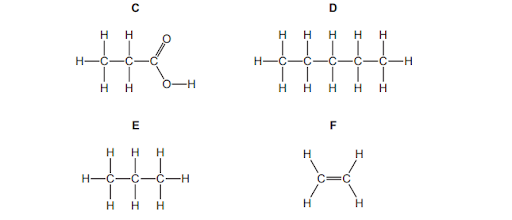
30a
3 marks

The structures of four organic compounds, C, D, E and F, are shown.

Displayed formulae of four compounds. C: a chain of three carbon atoms; the end carbon atom is double-bonded to an oxygen atom and single-bonded to an O–H group. D: a chain of five carbon atoms joined by single bonds, with hydrogen atoms on every carbon. E: a chain of three carbon atoms joined by single bonds, with hydrogen atoms on every carbon. F: two carbon atoms joined by a double bond, each bonded to two hydrogen atoms.

(i) State which two of the compounds, C, D, E and F, are in the same homologous series.

[1]

(ii) State which compound, C, D, E or F, is the monomer used to make poly(ethene).

[1]

(iii) State which compound, C, D, E or F, is a carboxylic acid.

[1]

30b
4 marks

Petroleum is a mixture of hydrocarbons, which can be separated into fractions.

Describe how petroleum is separated into fractions to include:

  • the name of the process used to separate the fractions

  • how this process separates the different fractions.

30c
3 marks

Complete the table to show the name and uses of some petroleum fractions.

name of fraction

use of fraction

naphtha

diesel oil

making roads


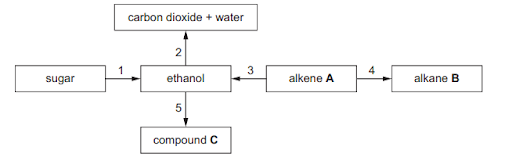
31a
1 mark

The reaction scheme shows five organic reactions, numbered 1 to 5.

Reaction scheme: reaction 1, sugar to ethanol; reaction 2, ethanol to carbon dioxide + water; reaction 3, alkene A to ethanol; reaction 4, alkene A to alkane B; reaction 5, ethanol to compound C.

Name reaction 1.

31b
3 marks

Name reaction 2 and write the chemical equation for this reaction. 

31c
4 marks

Reaction 3 forms ethanol from alkene A. 

(i) Identify alkene A. 

[1] 

(ii) State the type of reaction that occurs during reaction 3. 

[1] 

(iii) State the reagents and conditions needed for reaction 3. 

[2]

31d
3 marks

Extended Tier Only

Alkene A is converted into alkane B in reaction 4. 

(i) State the reagent and conditions for reaction 4. 

[2]

(ii) State the general formula of alkanes. 

[1]

31e
4 marks

Extended Tier Only

Ethanol is oxidised in reaction 5 by heating it with dilute sulfuric acid and one other reagent. 

(i) Identify the other reagent in reaction 5. 

[1] 

(ii) Name the homologous series compound C belongs to. 

[1] 

(iii) Draw the structure of compound C. Show all of the atoms and all of the bonds. 

[2]

1a
3 marks

Petroleum is separated into fractions in a fractionating column. The column is heated at its base.

The table shows the temperature inside the column at each of three outlets, X, Y and Z.

outlet

temperature inside the column / °C

X

40

Y

180

Z

320

The second table shows the boiling range of each of three fractions obtained from the column.

fraction

boiling range / °C

J

35 to 75

K

150 to 240

L

250 to 340

Deduce which outlet, X, Y or Z, each of fractions J, K and L is collected from.

1b
2 marks

Explain how the boiling range of a fraction and the temperature inside the column together determine the height at which that fraction is collected.

1c
3 marks

The heater at the base of the column develops a fault. The temperature inside the column at outlet Z falls to 200 °C. The temperatures at outlets X and Y are unchanged.

Explain the effect this has on fraction K and on fraction L.

2a
2 marks

A chemist is given a sample of one fraction from a fractionating column.

The only information given about the sample is that its molecules contain between 20 and 30 carbon atoms.

The kerosene fraction contains molecules with 11 to 16 carbon atoms.

Predict whether the sample is collected above or below the kerosene fraction in the column.

Justify your prediction.

2b
2 marks

Predict how each of the following properties of the sample compares with the same property of kerosene.

i) viscosity

[1]

ii) volatility

[1]

2c
3 marks

Suggest one use for the sample.

Explain why two of its properties make it suitable for that use.

3a
2 marks

A fraction collected from a fractionating column boils between 150 °C and 250 °C.

A pure sample of dodecane boils at 216 °C.

Explain why the fraction has a range of boiling points but dodecane does not.

3b
2 marks

The boiling ranges of two fractions collected next to each other in the column overlap slightly.

Explain what this tells you about the hydrocarbons in the two fractions.

3c
2 marks

Explain why the hydrocarbons in petroleum can be separated from one another by fractional distillation, rather than by a chemical reaction.

4a
2 marks

Extended Tier Only

Ethane and ethene both react with chlorine, but they react in different ways.

Ethane reacts with chlorine in the presence of ultraviolet light.

i) Name the type of reaction that takes place.

[1]

ii) Give the formula of the inorganic product of this reaction.

[1]

4b
1 mark

Extended Tier Only

Ethene reacts with chlorine at room temperature, with no ultraviolet light needed.

Name the type of reaction that takes place.

4c
3 marks

Extended Tier Only

Explain, in terms of the bonding in their molecules, why ethane and ethene react with chlorine in different ways.

5a
1 mark

Bromine chloride, BrCl, is a compound containing two different halogens.

Bromine chloride reacts in a similar way to chlorine.

Bromine chloride reacts with ethane in the presence of ultraviolet light.

Name the type of reaction that takes place.

5b
2 marks

Extended Tier Only

Two different pairs of products can be formed in this reaction.

Suggest an equation for each.

5c
2 marks

Extended Tier Only

Explain why two different pairs of products are possible.

6a
1 mark

Extended Tier Only

Cracking converts large alkane molecules into smaller molecules. Hydrogen is also produced.

Name the industrial process in which hydrogen and nitrogen react together to form ammonia.

6b
3 marks

The table shows the percentage of crude oil that separates into each group of fractions, and the percentage of each group that is in demand.

group of fractions

percentage obtained from crude oil

percentage in demand

refinery gases and petrol

25

45

naphtha and kerosene

20

20

diesel and fuel oil

55

35

Use the data in the table to explain why cracking is economically important to an oil refinery.

6c
2 marks

When a large alkane is cracked, the products cannot all be alkanes.

Explain why.

7a
3 marks

Ethanol can be manufactured by the fermentation of aqueous glucose or by the catalytic addition of steam to ethene.

The table gives information about two countries, P and Q.

Country P

Country Q

Mass of sugar cane grown each year / million tonnes

45

0.2

Crude oil reserves

none

large

Average temperature / °C

28

9

Country P plans to build a factory to manufacture ethanol.

Deduce which method Country P should use.

Justify your answer using two pieces of data from the table.

7b
2 marks

Country Q also plans to manufacture ethanol.

Suggest which method Country Q should use.

Give a reason for your answer using data from the table.

7c
2 marks

Extended Tier Only

One of the two methods of manufacturing ethanol is a batch process and the other is a continuous process.

Explain one consequence of this difference for the mass of ethanol a factory can make each year.

7d
3 marks

Extended Tier Only

State the conditions used for the catalytic addition of steam to ethene.

Explain which of these conditions makes the process expensive to run.

7e
2 marks

Extended Tier Only

Country P grows a large amount of sugar cane, but it still imports some of the ethanol it uses.

Suggest two reasons why Country P does not manufacture all of its own ethanol by fermentation.

8a
2 marks

A student writes three equations for reactions of ethanoic acid, CH3COOH.

Equation 1 CH3COOH + Mg → CH3COOMg + H2

Equation 2 2CH3COOH + ZnO → (CH3COO)2Zn + H2O

Equation 3 2CH3COOH + 2NaOH → 2CH3COONa + H2

Equation 1 is incorrect.

Write the correct equation for this reaction.

8b
2 marks

Equation 3 is also incorrect.

Explain what is wrong with equation 3.

8c
2 marks

The student suggests that ethanoic acid will react with copper to form copper ethanoate and hydrogen.

Explain why this reaction does not take place.

9a
2 marks

Extended Tier Only

A colourless liquid X mixes completely with water.

A solution of X of concentration 0.1 mol / dm3 has a pH of 3.

When solid sodium carbonate is added to this solution, effervescence is seen.

0.010 mol of X reacts exactly with 0.0050 mol of magnesium.

The Mr of X is 60.

Explain how the pH of the solution shows that X is a weak acid.

9b
1 mark

Extended Tier Only

State what the reacting ratio of X with magnesium shows about one molecule of X.

9c
2 marks

Deduce the name and the structural formula of X.

9d
2 marks

Extended Tier Only

Write the equation for the reaction of X with sodium carbonate.

10a
2 marks

Extended Tier Only

Butanoic acid, CH3CH2CH2COOH, takes part in the three reactions shown.

Reaction 1 butanoic acid + magnesium → compound X + gas Y

Reaction 2 butanoic acid + magnesium carbonate → compound X + gas Z + water

Reaction 3 butanoic acid + butan-1-ol, with a catalyst → compound W + water

State the name and the formula of compound X.

10b
2 marks

Name gas Y and gas Z.

10c
1 mark

Extended Tier Only

Name compound W.

10d
2 marks

Extended Tier Only

Write the structural formula of compound W.

11a
3 marks

The alkenes are unsaturated hydrocarbons. They form a homologous series, the members of which have the same chemical properties.

They undergo addition reactions and are easily oxidised.

The following hydrocarbons are isomers.

hydrocarbon-isomers

i) Explain why these two hydrocarbons are isomers.

[2]

ii) Give the structural formula of another hydrocarbon which is isomeric with the above.

[1]

11b
6 marks

Give the structural formula and name of each of the products of the following addition reactions.

i) ethene and bromine structural formula of product

name of product ................................................................................................... 

[2]

ii) propene and hydrogen structural formula of product

name of product ................................................................................................... 

[2]

iii) but-1-ene and water structural formula of product

name of product ................................................................................................... 

[2]

11c
4 marks

Alkenes can be oxidised to carboxylic acids.

i) For example, propene, CH3 –CH=CH2, would produce ethanoic acid, CH3 –COOH, and methanoic acid, H–COOH.

Deduce the formulae of the alkenes which would form the following carboxylic acids when oxidised.

ethanoic acid and propanoic acid

only ethanoic acid

[2]

 ii) Describe the colour change you would observe when an alkene is oxidised with acidified potassium manganate(VII).

[2]

11d
2 marks

Alkenes polymerise to form addition polymers.

Draw the structural formula of poly(cyanoethene), include at least two monomer units.

The structural formula of the monomer, cyanoethene, is given below.

polycyanoethane
12a
2 marks

The alkenes are unsaturated hydrocarbons. They form a homologous series, the members of which have similar chemical properties

  •  easily oxidised    

  • addition reactions    

  • polymerisation    

  • combustion.

All the alkenes have the same empirical formula.

i) State their empirical formula.

[1]

ii) Why is the empirical formula the same for all alkenes?

[1]

12b
3 marks

Alkenes can be oxidised to carboxylic acids by boiling with aqueous potassium manganate(VII).

i) Pent-2-ene, CH3–CH2–CH=CH–CH3, oxidises to CH3–CH2–COOH and CH3COOH.

Name these two acids.

CH3–CH2–COOH .......................................................................................................

CH3COOH ..........................................................................................................

[2]

ii) Most alkenes oxidise to two carboxylic acids. Deduce the formula of an alkene which forms only one carboxylic acid.

[1]

12c
2 marks

Complete the following equations for the addition reactions of propene.

CH3–CH=CH2 + Br2 → .................................... 

CH3–CH=CH2 + H2O → ....................................

12d
2 marks

Draw the structural formula of poly(propene).

12e
4 marks

0.01 moles of an alkene needed 2.4 g of oxygen for complete combustion. 2.2 g of carbon dioxide were formed.

Determine the following mole ratio.

moles of alkene : moles of O2 : moles of CO2

From this ratio determine the formula of the alkene.

[3]

Write an equation for the complete combustion of this alkene.

[1]

13a
5 marks

Many organic compounds which contain a halogen have chloro, bromo or iodo in their name.

The following diagram shows the structure of 1-chloropropane.

cie-igcse-sq-11-3-1-chloropropane-3a

i) Draw the structure of an isomer of this compound.

[1]

ii) Describe how 1-chloropropane could be made from propane.

[2]

iii) Suggest an explanation why the method you have described in (ii) does not produce a pure sample of 1-chloropropane.

[2]

13b
3 marks

Organic halides react with water to form an alcohol and a halide ion.

CH3–CH2–I + H2O → CH3–CH2–OH + I–

i) Describe how you could show that the reaction mixture contained an iodide ion.

[2]

ii) Name the alcohol formed when 1-chloropropane reacts with water.

[1]

13c
7 marks

The speed (rate) of reaction between an organic halide and water can be measured by the following method.

A mixture of 10 cm3 of aqueous silver nitrate and 10 cm3 of ethanol is warmed to 60 °C.

Drops of the organic halide are added and the time taken for a precipitate to form is measured.

Silver ions react with the halide ions to form a precipitate of the silver halide.

Ag+ (aq) + X- (aq) → AgX (s)

Typical results for four experiments, A, B, C and D, are given in the table.

experiment

organic halide

number of drops

time/min

A

bromobutane

4

6

B

bromobutane

8

3

C

chlorobutane

4

80

D

iodobutane

4

0.1

i) Explain why it takes longer to produce a precipitate in experiment A than in B.

[2]

ii) How does the order of reactivity of the organic halides compare with the order of reactivity of the halogens?

[2]

iii) Explain why the time taken to produce a precipitate would increase if the experiments were repeated at 50 °C.

[3]

14a
2 marks

Petroleum is a source of many important chemicals.

Name two industrial processes which must take place to produce alkenes from petroleum.

14b
4 marks

Ethene, CH2=CH2, and propene, CH2=CHCH3, can both be converted into polymers.

 i) What type of polymerisation takes place when ethene forms a polymer?

[1]

ii) What is the empirical formula of the polymer formed from ethene?

[1]

iii) Propene has the structural formula CH2=CHCH3.

Draw two repeat units of the polymer made from propene.

[2]

14c
2 marks

Ethene will react with steam to form ethanol.

Propene will react with steam to form two isomers, both of which are alcohols.

Suggest the structures of these alcohols.

14d
5 marks

Esters are organic chemicals noted for their characteristic smells. Ethanoic acid and methanol will react to form an ester.

i) Name the catalyst needed to form an ester from ethanoic acid and methanol.

[1]

ii) Name the ester formed when ethanoic acid reacts with methanol.

[1]

iii) Draw the structure of the ester formed when ethanoic acid reacts with methanol. Show all bonds.

[2]

iv) Give the name of a polyester.

[1]

15a
5 marks

Propanoic acid is a carboxylic acid. Its formula is CH3–CH2–COOH.

 i) Propanoic acid is the third member of the homologous series of carboxylic acids.

 Give the name and structural formula of the fourth member of this series.

  Name ..............................................................

  Formula ..............................................................

[2]

ii) Members of a homologous series have very similar chemical properties.

 State three other characteristics of a homologous series.

[3]

15b
3 marks

Carboxylic acids can be made by the oxidation of alcohols.

 i) Draw the structural formula of the alcohol which can be oxidised to propanoic acid. Show all atoms and bonds.

[1]

ii) Name a reagent, other than oxygen, which can oxidise alcohols to carboxylic acids.

[2]

15c
3 marks

Complete the following equations for some of the reactions of propanoic acid.

The salts of this acid are called propanoates.

 i) Zinc + propanoic acid → ........................... ........................... + hydrogen

[1]

ii) Calcium oxide + propanoic acid →........................... + ...........................

[1]

iii) LiOH + CH3CH2COOH → ............................... + ...........................

[1]

15d
7 marks

A piece of magnesium was added to 100 cm3 of an aqueous acid. The time taken for the metal to react completely was measured.

This experiment was repeated using different aqueous acids. The same volume of acid was used in each experiment and the pieces of magnesium used were identical.

In one experiment the reaction was carried out at a different temperatur

cie-igcse-sq-11-2-table

Explain the following in terms of collision rate between reacting particles.

i) Why is the rate in experiment C slower than the rate in experiment A? 

[2]

ii) Why is the rate in experiment B faster than the rate in experiment A?

[2]

iii) Why is the rate in experiment D faster than the rate in experiment A?

[3]

16a
4 marks

Plants can make complex molecules from simple starting materials, such as water, carbon dioxide and nitrates. Substances produced by plants include sugars, more complex carbohydrates, esters, proteins, vegetable oils and fats.

i) Describe how you could decide from its molecular formula whether a compound is a carbohydrate.

 [2]

 ii) Plants can change the sugar, glucose, into starch which is a more complex carbohydrate. What type of reaction is this?

 [2]

16b
5 marks

The fermentation of glucose can be carried out in the apparatus shown below. After a few days the reaction stops. A 12% aqueous solution of ethanol has been produced.

fermentation-of-glucose

 i) The enzyme, zymase, catalyses the anaerobic respiration of the yeast.

 Explain the term respiration.

 [2]

 ii) Complete the equation.

C6H12O6 →

......................... +

...................................

glucose


     carbon dioxide

 [2]

 iii) Why must air be kept out of the flask?

 [1]

16c
2 marks

The ester methyl butanoate is found in apples. It can be made from butanoic acid and methanol. Their structural formulae are given below.

butanoic-acid
methanol

butanoic acid 

methanol

 Use the information given above to deduce the structural formula of methyl butanoate showing all the bonds.

16d
3 marks

Proteins are natural macromolecules. Draw the structural formula of a typical protein. Include three monomer units. You may represent amino acids by formulae of the type drawn below.

amino-acid-representations
17a
6 marks

Methanol can be made from a mixture of carbon monoxide and hydrogen.

CO (g) + 2H2 (g) ⇌ CH3OH (g)

The forward reaction is exothermic.

i) Explain why the concentration of methanol at equilibrium does not change.

[2]

ii) Suggest conditions, in terms of temperature and pressure, which would give a high yield of methanol.

[2]

iii) How would the conditions used in practice compare with those given in (ii)? Give an explanation of any differences.

[2]

17b
4 marks

Petroleum-based diesel is a mixture of hydrocarbons, such as octane and octene.

i) ‘Oct’ means eight carbon atoms per molecule. Draw a structural formula of an octene molecule.

[1]

ii) Describe a test which would distinguish between octane and octene. Test: Result with octane: Result with octene:

[3]

18a
2 marks

Structural formulae are an essential part of Organic Chemistry.

Draw the structural formula of each of the following. Show all the bonds in the structure.

i) ethanoic acid

[1]

ii) ethanol

[1]

18b
6 marks

Ethanoic acid and ethanol react to form an ester.

i) What is the name of this ester?

[1]

ii) The same linkage is found in polyesters. Draw the structure of the polyester which can be formed from the monomers shown below.

HOOC—C6H4—COOH and HO—CH2—CH2—OH

[3]

iii) Describe the pollution problems caused by non-biodegradable polymers.

[2]

18c
2 marks

Two macromolecules have the same amide linkage. Nylon, a synthetic polymer, has the following structure.

nylon

Protein, a natural macromolecule, has the following structure.

protein

How are they different?

19a
5 marks

Carboxylic acids contain the group

-cooh

Ethanoic acid is a typical carboxylic acid. It forms ethanoates.

i) Complete the following equations.

Mg + ......CH3COOH → ............................... + ...............................

[2]

sodium hydroxide + ethanoic acid → ........................  ........................ + ........................

[1]

ii) Ethanoic acid reacts with ethanol to form an ester. Give the name of the ester and draw its structural formula. Show all of the bonds.

[2]

19b
8 marks

Maleic acid is an unsaturated acid. 5.8 g of this acid contained 2.4 g of carbon, 0.2 g of hydrogen and 3.2 g of oxygen.

i) How do you know that the acid contained only carbon, hydrogen and oxygen?

[1]

ii) Calculate the empirical formula of maleic acid.

Number of moles of carbon atoms = ................................

Number of moles of hydrogen atoms = ................................

Number of moles of oxygen atoms = ................................

The empirical formula is .................................................

[3]

iii) The mass of one mole of maleic acid is 116 g. What is its molecular formula?

[2]

iv) Maleic acid is dibasic. One mole of acid produces two moles of H+. Deduce its structural formula.

[2]

20a
4 marks

Alkenes are unsaturated hydrocarbons. They undergo addition reactions.

Two of the methods of making alkenes are cracking and the thermal decomposition of chloroalkanes.

i) Complete an equation for the cracking of the alkane, decane.

C10H22

 →

 .....................

+

......................

decane


[2]

ii) Propene can be made by the thermal decomposition of chloropropane.

Describe how chloropropane can be made from propane.

reagents:  propane and ..............................

conditions ...................................................

[2]

20b
4 marks

The following alkenes are isomers.

alkene-isomers

i) Explain why they are isomers.

[2]

ii) Give the name and structural formula of another hydrocarbon that is isomeric with the above.

name ......................................................

structural formula

[2]

20c
3 marks

Give the name of the product when but-1-ene reacts with each of the following.

steam .........................................................
hydrogen ....................................................
bromine ......................................................

20d
7 marks

Alkenes can polymerise.

i) Deduce the name and structural formula of the monomer from the structure of the polymer.

polypropene-repeat-unit

 name of monomer .......................................................     structural formula

[2]

ii) Draw the structure of the polymer formed from the following monomer.

unknown-monomer

[2]

iii) Describe the pollution problems caused by the disposal of polymers in landfill sites and by burning.

landfill sites ..........................................................................................................

[2]

burning ..........................................................................................................

[1]

21a
5 marks

Butan-1-ol is used as a solvent for paints and varnishes, to make esters and as a fuel. Butan-1-ol can be manufactured from but-1-ene, which is made from petroleum.

Biobutanol is a fuel of the future. It can be made by the fermentation of almost any form of biomass - grain, straw, leaves etc.

But-1-ene can be obtained from alkanes such as decane, C10H22, by cracking.

i) Give the reaction conditions.

[2]

ii) Complete an equation for the cracking of decane, C10H22, to give but-1-ene.

C10H22 →

[2]

iii) Name the reagent that reacts with but-1-ene to form butan-1-ol.

[1]

21b
4 marks

i) Balance the equation for the complete combustion of butan-1-ol.

...... C4H9OH + ...... O2 → ...... CO2 + ...... H2O

[2]

ii) Write a word equation for the preparation of the ester butyl methanoate.

[2]

21c
3 marks

The fermentation of biomass by bacteria produces a mixture of products which include biobutanol, propanol, hydrogen and propanoic acid.

i) Draw the structural formula of propanol and of propanoic acid. Show all the bonds.

[2]

ii) Why is it important to develop these fuels, such as biobutanol, as alternatives to petroleum?

[1]

21d
1 mark

How could you show that butanol made from petroleum and biobutanol are the same chemical?

22a
4 marks

The alkanes are generally unreactive. Their reactions include combustion, substitution and cracking.

The complete combustion of an alkane gives carbon dioxide and water.

 i) 10 cm3 of butane is mixed with 100 cm3 of oxygen, which is an excess. The mixture is ignited. What is the volume of unreacted oxygen left and what is the volume of carbon dioxide formed?

 C4H10 (g) + 6.5O2 (g) → 4CO2 (g) + 5H2O (l)

 Volume of oxygen left = .................................................. cm3

 Volume of carbon dioxide formed = ................................. cm3

 [2]

ii) Why is the incomplete combustion of any alkane dangerous, particularly in an enclosed space?

 [2]

22b
3 marks

The equation for a substitution reaction of butane is given below.

 CH3−CH2−CH2−CH3 + Cl2 → CH3−CH2−CH2−CH2−Cl + HCl

i) Name the organic product.

[1]

ii) This reaction does not need increased temperature or pressure.

 What is the essential reaction condition?

[1]

 iii) Write a different equation for a substitution reaction between butane and chlorine.

[1]

22c
5 marks

Alkenes are more reactive and industrially more useful than alkanes.

They are made by cracking alkanes.

C7H16 →

CH3−CH=CH2 + 

CH3−CH2−CH=CH2 + H2

heptane

propene

but−1−ene

i) Draw the structural formula of the polymer poly(propene).

 [2]

 ii) Give the structural formula and name of the alcohol formed when but-1-ene reacts with steam.

 name ..................................................

 [1]

 structural formula

 [1]

 iii) Deduce the structural formula of the product formed when propene reacts with hydrogen chloride.

 [1]

23a
4 marks

Esters, fats and polyesters all contain the ester linkage.

The structural formula of an ester is given below.

I4iZm0aV_butyl-ethanoate

Name two chemicals that could be used to make this ester and draw their structural formulae. Show all bonds.

 names ................................ and ..............................

[2]

   structural formulae

[2]

23b
3 marks

i) Draw the structural formula of a polyester such as Terylene.

[2]

ii) Suggest a use for this polymer.

[1]

24a
2 marks

Alkynes and alkenes are homologous series of unsaturated hydrocarbons.

All alkynes contain a C≡C triple bond.

Complete Table 6.1 showing information about the first three alkynes. 

Table 6.1

formula

C2H2

C3H4

structure

H-C≡C-H

H-C≡C-CH3

CH3-C≡C-CH3

names

ethyne

but-2-yne

24b
5 marks

Extended Tier Only

Compounds in the same homologous series have the same general formula.

(i) Give two other characteristics of members of a homologous series.

[2]

(ii) Deduce the general formula of alkynes.

Use the information from Table 6.1 to help you.

[1]

(iii) Alkynes are unsaturated.

Describe a test for unsaturation.

test  ......................................................................................

result  ......................................................................................

[2]

24c
4 marks

Extended Tier Only

Ethene and but-2-ene are alkenes.

(i) Draw the displayed formula of but-2-ene.

[2]

(ii) Draw a dot-and-cross diagram to show a molecule of ethene, CH2=CH2.

Show outer shell electrons only.

[2]

24d
4 marks

Extended Tier Only

Ethene can be converted to ethanoic acid by a two-stage process.

In stage one, ethene is converted to ethanol by catalytic addition.

C2H4 + H2O → C2H5OH

(i) Suggest why stage one is called an addition reaction.

[1]

(ii) A catalyst is used in stage one.

State one other condition that must be used.

[1]

(iii) State what must be reacted with ethanol to form ethanoic acid.

[2]

25a
1 mark

Ethanoic acid is a member of the homologous series of carboxylic acids. 

State the general formula of this homologous series. 

25b
2 marks

Extended Tier Only

Draw the structure of the carboxylic acid containing three carbon atoms.

25c
3 marks

Extended Tier Only

When carboxylic acids react with alcohols, esters are produced.

The formula of ester X is CH3CH2CH2COOCH3. 

(i) Name ester X.

[1] 

(ii) Give the name of the carboxylic acid and the alcohol that react together to produce ester X. 

carboxylic acid ................................................................................................................... 

alcohol .....................................................................................................................

[2]

25d
3 marks

Extended Tier Only

Ester Y has the following composition by mass:

C, 48.65%; H, 8.11%; O, 43.24%. 

Calculate the empirical formula of ester Y. 

25e
1 mark

Extended Tier Only

Ester Z has the empirical formula C2H4O and a relative molecular mass of 88. 

Determine the molecular formula of ester Z. 

26a
2 marks

Ethanol and propan-1-ol are members of the alcohol homologous series.

i) State the general formula of the alcohol homologous series.

[1]

ii) Name the unbranched alcohol that contains exactly four carbon atoms per molecule.

[1]

26b
2 marks

Draw the displayed formula of a structural isomer of propan-1-ol. Show all of the atoms and all of the bonds.

26c
2 marks

Ethanol can be manufactured by the catalytic addition of steam to ethene, also known as hydration. State two conditions required for this reaction.

26d
2 marks

Ethanol can also be manufactured by fermentation. State two advantages of manufacturing ethanol by fermentation rather than by the hydration of ethene.

26e
2 marks

Ethanol reacts with compound X to form the ester ethyl propanoate and compound Y. Identify compound X and compound Y.

compound X:

compound Y:

26f
3 marks

An unknown alcohol, A, has the following composition by mass: C = 37.5%; H = 12.5%; O = 50.0%

Determine the empirical formula of compound A. Show all your working.

empirical formula = .......................

26g
2 marks

An unknown ester, Z, has the empirical formula CH2​O. Its relative molecular mass, Mr​, is 60. Determine the molecular formula of ester Z.

molecular formula = ........................