11 mark
Which of the following compounds are formed by covalent bonding?
1 | Potassium fluoride |
2 | Propane |
3 | Carbon dioxide |
4 | Lithium bromide |
2 and 3
2 and 4
1, 2 and 3
1 and 4
Was this exam question helpful?
Exam code: 0620 & 0971
Which of the following compounds are formed by covalent bonding?
1 | Potassium fluoride |
2 | Propane |
3 | Carbon dioxide |
4 | Lithium bromide |
2 and 3
2 and 4
1, 2 and 3
1 and 4
Was this exam question helpful?
Which row correctly describes a simple covalent compound?
| low melting point | high boiling point |
A | ||
B | ||
C | ||
D |
Was this exam question helpful?
Which statement about bonding is not correct?
Covalent bonding involves non metal elements.
Covalent bonding involves electron sharing.
Covalent bonding involves electron transfer.
Covalent bonding does not involve metal elements.
Was this exam question helpful?
Ammonia is a covalent compound consisting of one nitrogen atom bonded to three hydrogen atoms.
Which statement is correct for a molecule of ammonia?
The number of shared pairs of electrons is five
The number of shared pairs of electrons is three
There are single covalent bonds between the hydrogen atoms.
Each hydrogen atom donates one pair of electrons to the central nitrogen atom.
Was this exam question helpful?
The structure of propane is shown below
Which correctly explains why propane can not conduct electricity?
There are weak intermolecular forces between molecules of propane
The covalent bonds in propane are strong
There are no free electrons able to move and carry a charge
Propane has a low boiling point
Was this exam question helpful?
Lithium hydroxide reacts with hydrochloric acid to form lithium chloride and water.
Which row describes correctly the properties of the products and the final reaction mixture?
melting point of lithium chloride | melting point of water | electricity conduction of the reaction mixture | |
A | high | high | good |
B | high | low | good |
C | low | high | poor |
D | low | low | poor |
Was this exam question helpful?
A dot-and-cross diagram is drawn for a molecule of hydrogen, H2.
The diagram shows the outer shell electrons only.
Which statement about the diagram is correct?
Each hydrogen atom shares two electrons, so four electrons are shared in total.
One hydrogen atom transfers its electron to the other hydrogen atom.
Each hydrogen atom shares one electron, and neither atom has any non-bonding electrons.
Each hydrogen atom shares one electron, and each atom also has one non-bonding pair of electrons.
Was this exam question helpful?
Atoms P and Q have electronic structures as shown in the diagram. They react together to form a covalent compound.

What is the formula of the compound?
P2Q3
P3Q
P3Q2
PQ4
Was this exam question helpful?
The atom of element Z has 6 electrons in its outer shell. How would this element react?
It shares two electrons with four from another atom to form two covalent bonds
It shares four electrons with four from another atom to form four covalent bonds
It shares four electrons with two from another atom to form two covalent bonds
It shares two electrons with two from another atom to form two covalent bonds
Was this exam question helpful?
CH4, H2O and HCl are covalent compounds.
Which atoms in these compounds do not use all of their outer shell electrons in bonding?
C and O
C and H
Cl and O
Cl and C
Was this exam question helpful?
The electronic configurations of four different atoms are shown below.

Which atoms form covalent compounds?
W and X
W, X and Y
W and Z
X, Y and Z
Was this exam question helpful?
Which of the following molecules contains only single covalent bonds?
N2
F2
O2
CO2
Was this exam question helpful?
A covalent molecule M contains a total of four shared electrons.
What is M?
ammonia, NH3
hydrogen chloride, HCl
methane, CH4
water, H2O
Was this exam question helpful?
Which dot-and-cross diagram shows the arrangement of outer shell electrons in a molecule of hydrogen chloride?

Was this exam question helpful?
Diagrams 1 and 2 show the electron arrangements in molecules of water and methane.
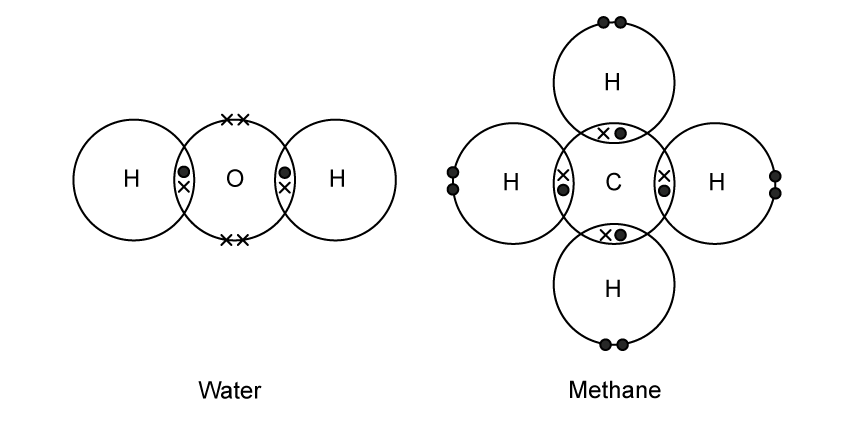
Which row describes the diagrams?
water diagram | methane diagram | |
A | correct | incorrect |
B | correct | correct |
C | incorrect | incorrect |
D | incorrect | correct |
Was this exam question helpful?
The table shows the melting point and the electrical conductivity of four substances, W, X, Y and Z.
substance | melting point / °C | conducts electricity when solid | conducts electricity when molten |
|---|---|---|---|
W | 801 | no | yes |
X | -57 | no | no |
Y | 1610 | no | no |
Z | 1083 | yes | yes |
Which substance is a simple molecular compound?
W
X
Y
Z
Was this exam question helpful?
Carbon dioxide is a simple molecular substance in which the molecules are formed by covalent bonding between one carbon atom and two oxygen atoms.
Which dot and cross diagram below shows the correct outer shell arrangement of electrons in a molecule of CO2?

Was this exam question helpful?
A student has drawn a dot and cross diagram to represent a molecule of ethene, C2H4, as shown below.

What is wrong with the students drawing?
The number of electrons shared between the carbon atoms is incorrect.
The number of electrons shared between each carbon and hydrogen is incorrect.
There is nothing wrong with the drawing.
The total number of electrons shared is incorrect.
Was this exam question helpful?
Dot and cross diagrams for four covalent molecules are shown below.
Which diagram is incorrect?

Was this exam question helpful?
Which statement about methane is correct?
It has a high melting point due to strong covalent bonds between atoms
It has a low melting point due to weak covalent bonds between the molecules
It has a low boiling point due to weak intermolecular forces between molecules
It has a high boiling point because of strong intermolecular forces between molecules
Was this exam question helpful?
A covalent molecule M contains a total of four shared electrons.
What is M?
Carbon dioxide
Oxygen
Nitrogen
Methane
Was this exam question helpful?
Which diagram represents the outer-shell electron arrangement in a nitrogen molecule?

Was this exam question helpful?
The displayed formula of ethanoic acid is shown.

Which row shows the total number of shared electrons and the total number of non-bonding electrons in one molecule of ethanoic acid?
total number of shared electrons | total number of non-bonding electrons | |
A | 14 | 0 |
B | 14 | 8 |
C | 16 | 0 |
D | 16 | 8 |
Was this exam question helpful?