Mathematical Methods & Proof (DP IB Theory of Knowledge): Revision Note

Mathematical methods & proof
Mathematics builds knowledge by working within formal systems where claims must be justified using agreed-upon rules
Mathematical methods often prioritise certainty and consistency, but their reliability depends on the assumptions and logic used
Axioms and systems
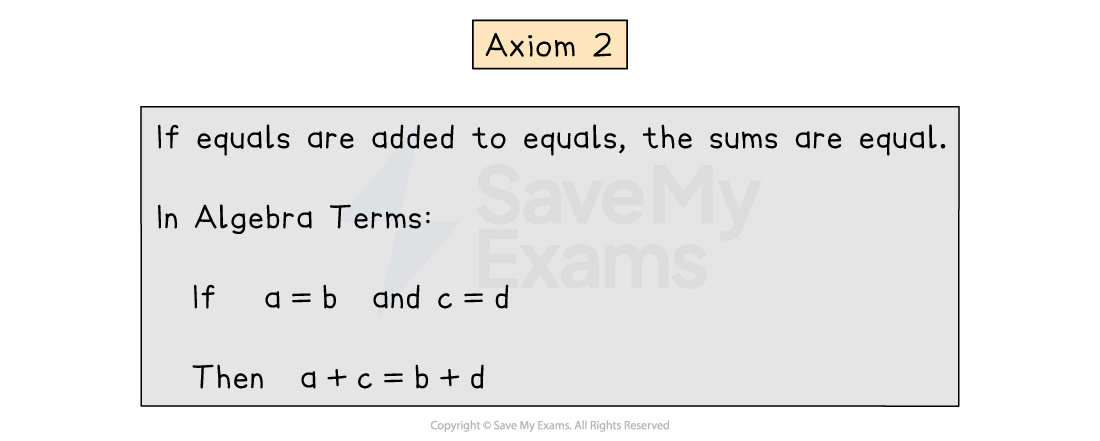
Mathematics starts from axioms, which are basic statements accepted without proof within a system
Axioms define what counts as “allowed” reasoning
They shape what can be proven and what kinds of objects can exist in the system
A mathematical system is a structured set of axioms, definitions and rules for drawing conclusions
The same statement can be true in one system and not true in another
Choosing axioms is not always “forced” by the world, but can reflect human priorities
E.g. prioritising simplicity or usefulness can influence which axioms are treated as natural
Once axioms are set, mathematical knowledge is produced by exploring what follows logically from them
This makes mathematical justification depend more on internal consistency than on observation
Different systems can coexist because they answer different knowledge needs
E.g. different geometries can be useful for different modelling situations
Working within a system creates a clear scope for mathematical knowledge claims
Claims are certain within their defined system
The scope can change if the axioms change
Deductive reasoning
Deductive reasoning moves from general rules to specific conclusions that must follow if the rules are correct:
If the premises are true and the logic is valid, the conclusion cannot be false
Deduction supports mathematical certainty because it does not depend on measuring the physical world
Proof depends on relationships between ideas, not on repeated observations
Deductive reasoning often relies on definitions that fix meaning precisely
Clear definitions reduce disagreement about what a claim is actually saying
Deduction can still produce disagreement when reasoners interpret steps differently or apply rules inconsistently
Errors in logic can create false “proofs” that appear convincing
Deductive reasoning can also reveal hidden assumptions in a knowledge claim
Making assumptions explicit can change whether a conclusion still follows
Proof vs evidence
A proof is a complete logical justification showing that a claim must be true within a system
A valid proof aims for certainty, not probability
Evidence is support for a claim based on examples, patterns or observations, but it does not guarantee truth
Many examples can suggest a claim is true
But a single counterexample shows the claim is false
Proof is treated as a stronger justification than evidence because it eliminates reliance on limited cases
In mathematics, evidence can still play an important role in producing knowledge:
It can guide conjectures before a proof is found
It can suggest which methods are worth exploring
The relationship between proof and evidence affects how mathematicians interpret confidence in claims
A claim with strong evidence may still be treated as uncertain until proven
Falsification and logic
Mathematical logic provides rules that determine when an argument is valid or invalid
Logic controls how conclusions can be justified from premises
In mathematics, falsification often takes the form of finding a counterexample to disprove a universal claim
A universal claim means it says something is true for all cases
One counterexample is enough to reject the claim as stated
Falsification shows that mathematical knowledge is not only about confirming claims but also about limiting them
Disproof can lead to refining a claim so it becomes true under clearer conditions
Some mathematical claims cannot be falsified by testing cases, because testing never checks all possibilities
This strengthens the role of proof as a method for justification
Logical structure affects how easily a claim can be disproven or defended
A claim with precise conditions is easier to assess
A claim with vague definitions creates uncertainty about what counts as falsification
Mathematical reasoning can be highly reliable but still dependent on the chosen logical framework
Changing the rules of inference can change what counts as a valid justification
Examiner Tips and Tricks
When discussing knowledge in mathematics, distinguish between evidence that suggests a pattern and proof that establishes necessity within a defined system.
Be careful with the word ‘falsify’. You may have heard someone accused of ‘falsifying data’, meaning that they made up fake data to support their case. In mathematics, ‘to falsify’ means to prove that something (for example, a statement or conclusion) is false.

Unlock more, it's free!
Join the 100,000+ Students that ❤️ Save My Exams
the (exam) results speak for themselves:

Was this revision note helpful?