The Scientific Method & Evidence (DP IB Theory of Knowledge): Revision Note

The scientific method & evidence
Scientific knowledge is justified using experimental evidence to support an explanation of an observed pattern
Confidence in scientific claims increases when studies are well-designed, results can be replicated, and findings survive critical review
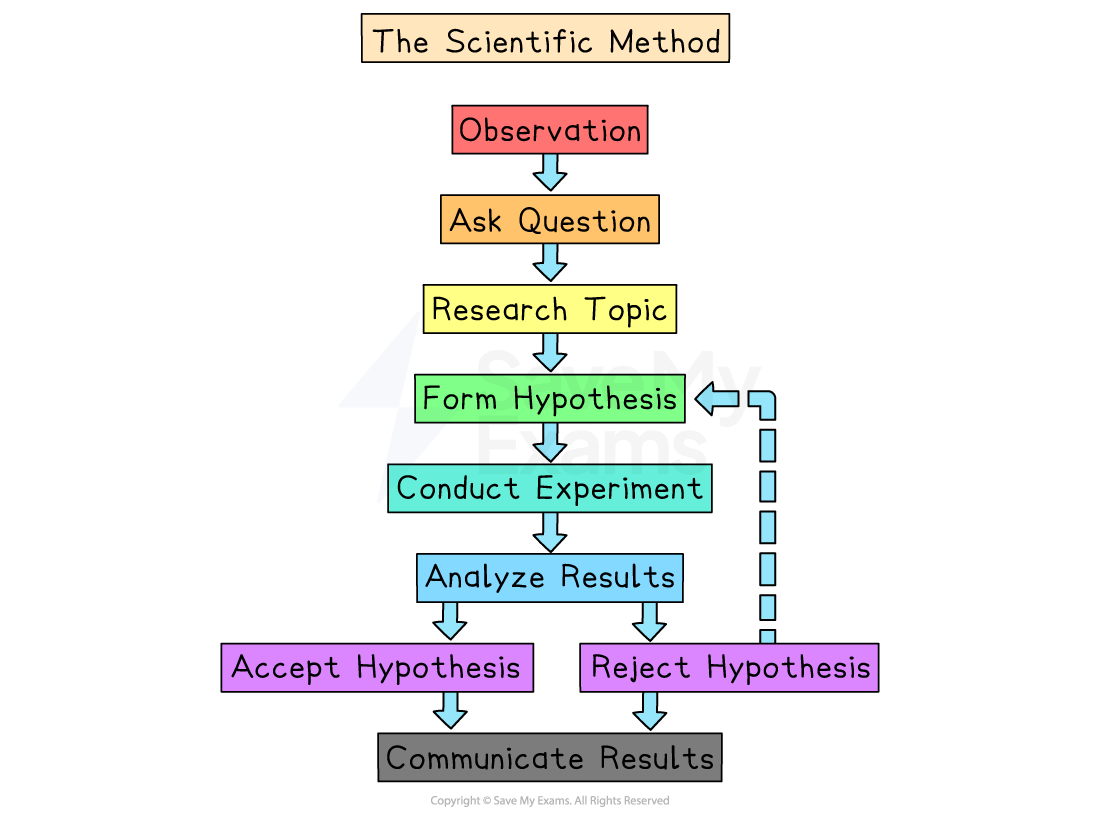
Scientific knowledge isn't produced by observation alone; imagination is needed to form hypotheses and design experiments, and reasoning is needed to interpret evidence and build theories
Observation and experimentation
Observation is noticing a pattern or process in the natural world that raises a scientific question
E.g. noticing that plants growing near a window bend towards the light, which raises the question of whether light affects the direction of plant growth
Experimentation is a planned test designed to answer that question
During an experiment, one variable is deliberately changed (the independent variable), and the outcome is measured (the dependent variable)
Other relevant factors are kept constant, or controlled, so differences in results can be more confidently attributed to the variable being tested
Evidence comes from the recorded results of the experiment, alongside details of the method that allow other scientists to judge reliability and carry out repeats
Hypothesis testing
A hypothesis is a testable statement about what will happen under certain conditions
Testing a hypothesis involves collecting data that could support it or count against it
Support for a hypothesis increases confidence, but does not give absolute proof
Confidence grows when results are consistent across repeats and different methods
Falsifiability
A claim is falsifiable if there is a possible observation or result that would show it is false
Falsifiability matters because it sets a clear standard for relevant counter-evidence
If nothing could count against a claim, it cannot be properly tested as scientific knowledge
Note that some scientific claims are about likelihood rather than certainty, so they predict a pattern in the results instead of one fixed outcome every time
E.g. a medicine may be expected to lower blood pressure in most patients, even though a few may not respond, so evidence is judged by the overall trend and how big the effect is
Peer review and replication
Peer review and replication are key methods used to evaluate scientific work and strengthen the justification of its claims
Peer review is evaluation by other experts to judge whether methods and conclusions are justified before publication
Note that peer review can reduce error, but it does not guarantee that a claim is true
Replication is repeating a study to see if similar results occur under the same conditions
This strengthens justification because it reduces the chance of a one-off error or chance result
Failed replication can reveal hidden variables, weak methods or overstated conclusions
Tools
Scientific tools are the instruments, technologies and techniques scientists use to observe, measure and analyse the natural world
Physical instruments include microscopes, telescopes and thermometers
Conceptual tools include mathematics, statistical methods and computational models
Scientific tools help us overcome the limits of human observation
The development of scientific tools has and will continue to result in shifts in what we know in the sciences
Scientific tools can provide the evidence needed to test hypotheses and support justified conclusions


Unlock more, it's free!
Join the 100,000+ Students that ❤️ Save My Exams
the (exam) results speak for themselves:

Was this revision note helpful?