Language, Meaning & the Knower (DP IB Theory of Knowledge): Revision Note

Language & meaning
Language shapes understanding by providing labels and categories that organise experience
Language may be interpreted in different ways due to:
connotation
metaphor
framing
Connotation
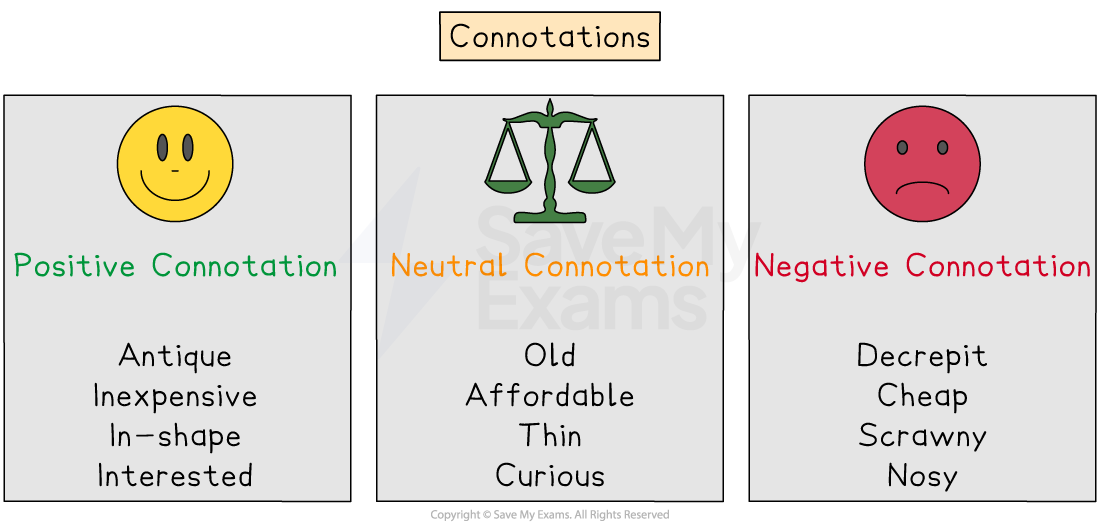
Connotation is the set of emotional or cultural associations a word carries beyond its basic definition, e.g.:
the term “cheap” means “low in price”, but it has negative connotations that suggest low quality, unreliable or stingy
the term “regime” refers to “a particular government”, but it often suggests authoritarian control, lack of legitimacy or oppression
Connotations of particular words can influence how people judge a claim by triggering approval or disapproval without changing the factual content
Different communities of knowers may have different connotations for the same words; this can lead to confusion or unintended offence
Metaphor
Metaphors shape understanding by mapping an unfamiliar idea onto a familiar one, highlighting some features and hiding others
E.g. describing the brain as a “computer” highlights processing and storage, but can hide emotion and lived experience
Metaphors influence judgment by highlighting some features of an issue and downplaying others
E.g. calling immigration a “flood” highlights ideas of threat, volume, and loss of control, and downplays the fact that migrants are individual people with different reasons and legal statuses
Metaphors also carry emotional associations, so they can persuade by shaping attitudes, e.g. through fear, hope or blame, rather than by adding new factual evidence
Framing
Framing is the way in which language presents an issue, influencing which factors seem important, what counts as a problem, and what solutions seem reasonable
Framing can steer decision-making by setting the “default” interpretation before evidence is even considered
E.g. calling a public issue a “crisis” can make urgent action seem more justified than calling it a “challenge”
Language & identify
Language influences identity because the labels people use for themselves and others shape belonging, status, treatment and expectations
Within one language there are many dialects and accents, and these carry social meaning
Some varieties are seen as more "correct" or prestigious than others, which reflects wider inequalities of power in society
E.g. when speaking UK English, a regional accent is often judged as less educated or authoritative than an accent associated with the BBC or public schools
People also use particular varieties deliberately — e.g. a regional accent, dialect or slang — to signal group identity or express emotion
Code-switching involves changing how one speaks in different contexts, e.g. people may adjust their accent or vocabulary depending on whether they are at home, with friends or in a job interview
Language affecting identity | Example |
|---|---|
The labels others apply to a person can shape how they see themselves, because those labels influence how they are treated | Being labelled “gifted” in school can change teacher expectations and student confidence |
People may accept, reject, or reshape labels depending on whether they feel accurate and match their values | A student might reject the label "lazy" and replace it with "overwhelmed", because the two labels imply very different causes and character traits |
People often adjust how they speak depending on the situation, in order to fit in, be taken seriously or signal closeness | Someone might use formal language in a job interview and then switch to slang with friends |
Arguments about identity-related words are rarely just about meaning — they are usually about respect, values and how much sympathy or blame is implied | Debates about whether to say "refugee" or "illegal immigrant" carry strong moral judgements about the people being described |
Conceptual schemes and language
A conceptual scheme is the set of concepts and distinctions a person or community uses to interpret events around them
Language is one way in which conceptual schemes are learned and shared, because words package concepts into labels that people can reuse and pass on
Language interacting with conceptual schemes | Example |
|---|---|
Use of different labels reflect different underlying conceptual schemes | In a school incident, one teacher calls a pupil “disrespectful” while another calls them “assertive” The teachers have different conceptual schemes; the first teacher interprets certain behaviours as a lack of respect for authority, while the second interprets the same behaviour as confidence and self-advocacy |
Shared language can make one way of sorting the world feel normal, because repeated labels encourage people to use the same categories | In some school systems, pupils are routinely categorised as “top set”, “middle set”, and “bottom set” The labels reflect a conceptual scheme where ‘ability’ is treated as a fixed trait that people ‘have’, so pupils are grouped into stable types rather than seen as developing in different areas |
Language does not fully control how people think, because people can have experiences or ideas they struggle to put into words | Two students both say they feel “anxious”, but one means fear of being judged and the other means a physical stress response, e.g. a racing heart and sweating The single label can hide different underlying concepts, so people may assume they share the same experience when they are actually experiencing different things |

Unlock more, it's free!
Join the 100,000+ Students that ❤️ Save My Exams
the (exam) results speak for themselves:

Was this revision note helpful?