Reason & Argument (DP IB Theory of Knowledge): Revision Note

Reason & argument
Reason
Reason involves using logic and inference to move from ideas to conclusions in a structured way:
Knowers use reason to check whether beliefs are coherent and consistent with each other
Knowers can connect different pieces of evidence to form explanations and make predictions
The importance given to reason can vary across cultures, disciplines and personal worldviews
Argument
An argument is a statement that provides reasons for or against accepting a conclusion
Arguments are used when knowers want to:
justify a claim
challenge a claim
persuade others to change their minds about a claim
Arguments appear in everyday life, in academic disciplines, in the media and in ethical or political debates
The arguments used by an individual may be shaped by:
purpose, such as whether someone want to inform, persuade or defend
audience: people may choose reasons they think will be most convincing to a particular group
background: culture, personal values and academic discipline can shape what counts as a good reason in an argument
Developing arguments: validity, soundness and strength
When knowers develop an argument, they can use validity, soundness and strength to check how clearly and effectively their reasons support their conclusion
Validity focuses on the logical link between reasons and conclusions
An argument is more valid when there is a clear, step-by-step connection between each reason and what the knower wants the audience to accept
Testing for validity helps knowers spot gaps in reasoning, such as jumping to a conclusion that does not really follow from an argument
Soundness incorporates validity, but is also about whether the reasons within an argument are true:
A sound argument uses reasons that are accurate, relevant and not misleading in the way they are presented
Soundness helps knowers avoid using weak, exaggerated or selective reasons just because they support a preferred conclusion
Strength focuses on how convincing the overall support is for the conclusion
A stronger argument uses enough well-chosen reasons and evidence for the situation and audience
Strength helps knowers build arguments that are coherent and that will allow an arguer to respond to questions or objections
Fallacies and bias in reasoning
A fallacy is a pattern of reasoning that seems persuasive but does not genuinely support the conclusion; common fallacies include:
attacking the person instead of the claim
E.g. “you are bad at science, so your argument about climate change must be wrong”
assuming that because B follows A, A must have caused B
E.g. “I wore my lucky bracelet and then passed the test, so the bracelet made the difference”
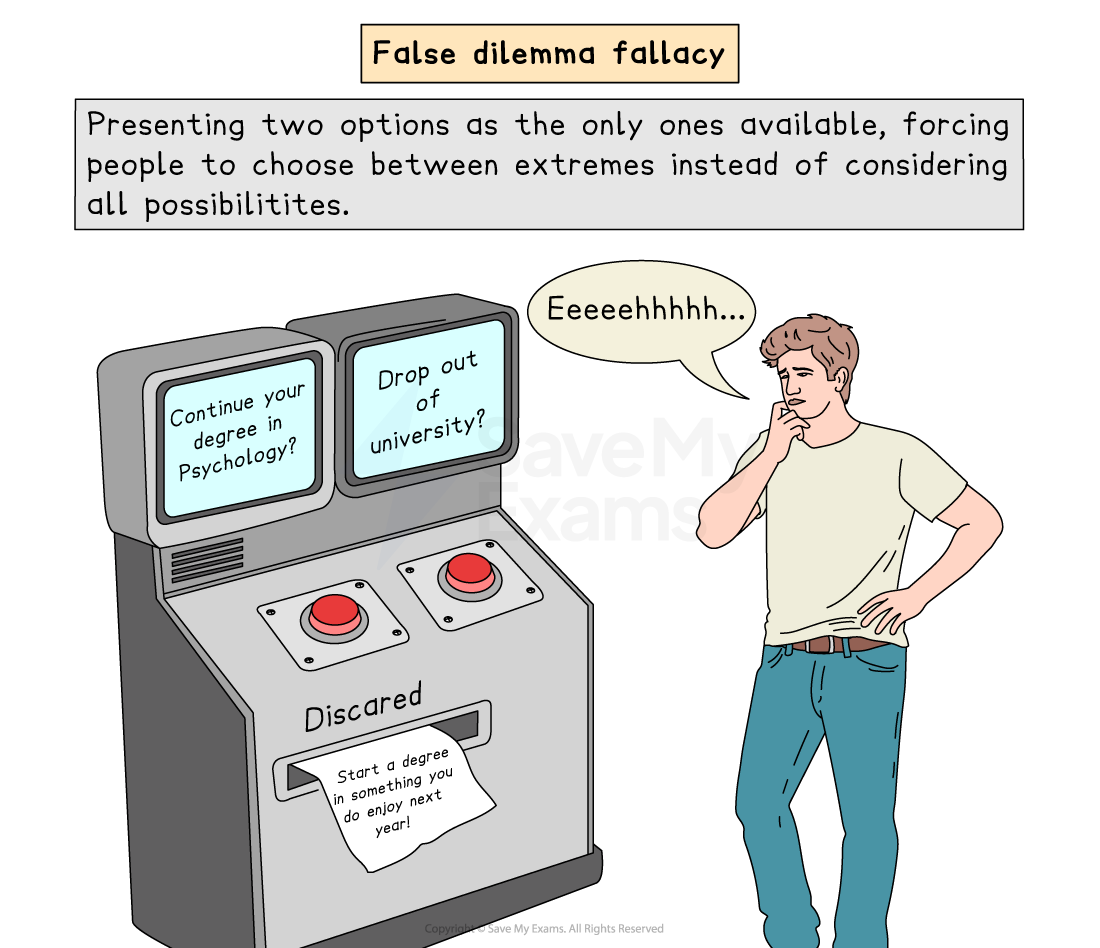
presenting only two options when more than two exist (false binary)
E.g. “either you support this policy completely or you do not care about poverty”
Biases can lead knowers to accept weak arguments that support their existing views, e.g.:
the knower may look for, notice or remember information that supports what they already believe (confirmation bias)
dramatic or recent events feel more common than they really are because they are easier to recall
the knower favours people from their own group, culture or community, and chooses to believe their arguments, or even only listen to their arguments and not to others’ outside their group (echo chamber, epistemic bubble)
Recognising fallacies and biases can be seen as an ethical responsibility when we argue in public, academic or professional contexts

Unlock more, it's free!
Join the 100,000+ Students that ❤️ Save My Exams
the (exam) results speak for themselves:

Was this revision note helpful?