Converting to & from Standard Form (WJEC Eduqas GCSE Maths: Foundation): Revision Note
Exam code: C300

Did this video help you?
Converting to and from standard form
What is standard form and why is it used?
Standard form is a way of writing numbers using powers of 10
It is helpful to see the size of very large and very small numbers
This allows us to:
Write them more concisely
Compare them more easily
Perform calculations with them more easily
How do I write a number in standard form?
Numbers written in standard form are always written as:
format('truetype')%3Bfont-weight%3Anormal%3Bfont-style%3Anormal%3B%7Dtext%7Bfill%3A%23000000%3B%3C%2Fstyle%3E%3C%2Fdefs%3E%3Ctext%20font-family%3D%22Times%20New%20Roman%22%20font-size%3D%2218%22%20font-style%3D%22italic%22%20text-anchor%3D%22middle%22%20x%3D%224.5%22%20y%3D%2217%22%3Ea%3C%2Ftext%3E%3Ctext%20font-family%3D%22math13b8a614226a953a8cd9526fca6%22%20font-size%3D%2216%22%20text-anchor%3D%22middle%22%20x%3D%2217.5%22%20y%3D%2217%22%3E%26%23xD7%3B%3C%2Ftext%3E%3Ctext%20font-family%3D%22Times%20New%20Roman%22%20font-size%3D%2218%22%20text-anchor%3D%22middle%22%20x%3D%2235.5%22%20y%3D%2217%22%3E10%3C%2Ftext%3E%3Ctext%20font-family%3D%22Times%20New%20Roman%22%20font-size%3D%2213%22%20font-style%3D%22italic%22%20text-anchor%3D%22middle%22%20x%3D%2247.5%22%20y%3D%2212%22%3En%3C%2Ftext%3E%3C%2Fsvg%3E)
Where:
format('truetype')%3Bfont-weight%3Anormal%3Bfont-style%3Anormal%3B%7Dtext%7Bfill%3A%23000000%3B%3C%2Fstyle%3E%3C%2Fdefs%3E%3Ctext%20font-family%3D%22Times%20New%20Roman%22%20font-size%3D%2218%22%20text-anchor%3D%22middle%22%20x%3D%224.5%22%20y%3D%2216%22%3E1%3C%2Ftext%3E%3Ctext%20font-family%3D%22math1d3114856d6c6df443e3168d768%22%20font-size%3D%2216%22%20text-anchor%3D%22middle%22%20x%3D%2217.5%22%20y%3D%2216%22%3E%26%23x2264%3B%3C%2Ftext%3E%3Ctext%20font-family%3D%22Times%20New%20Roman%22%20font-size%3D%2218%22%20font-style%3D%22italic%22%20text-anchor%3D%22middle%22%20x%3D%2229.5%22%20y%3D%2216%22%3Ea%3C%2Ftext%3E%3Ctext%20font-family%3D%22math1d3114856d6c6df443e3168d768%22%20font-size%3D%2216%22%20text-anchor%3D%22middle%22%20x%3D%2242.5%22%20y%3D%2216%22%3E%26lt%3B%3C%2Ftext%3E%3Ctext%20font-family%3D%22Times%20New%20Roman%22%20font-size%3D%2218%22%20text-anchor%3D%22middle%22%20x%3D%2259.5%22%20y%3D%2216%22%3E10%3C%2Ftext%3E%3C%2Fsvg%3E) (
( is bigger than or equal to 1 and less than 10)
 is an integer
format('truetype')%3Bfont-weight%3Anormal%3Bfont-style%3Anormal%3B%7Dtext%7Bfill%3A%23000000%3B%3C%2Fstyle%3E%3C%2Fdefs%3E%3Ctext%20font-family%3D%22Times%20New%20Roman%22%20font-size%3D%2218%22%20font-style%3D%22italic%22%20text-anchor%3D%22middle%22%20x%3D%224.5%22%20y%3D%2216%22%3En%3C%2Ftext%3E%3Ctext%20font-family%3D%22math1072b030ba126b2f4b2374f342b%22%20font-size%3D%2216%22%20text-anchor%3D%22middle%22%20x%3D%2218.5%22%20y%3D%2216%22%3E%26lt%3B%3C%2Ftext%3E%3Ctext%20font-family%3D%22Times%20New%20Roman%22%20font-size%3D%2218%22%20text-anchor%3D%22middle%22%20x%3D%2230.5%22%20y%3D%2216%22%3E0%3C%2Ftext%3E%3C%2Fsvg%3E) (
( is negative) for numbers bigger than 0 and less than 1
format('truetype')%3Bfont-weight%3Anormal%3Bfont-style%3Anormal%3B%7D%3C%2Fstyle%3E%3C%2Fdefs%3E%3Ctext%20font-family%3D%22Times%20New%20Roman%22%20font-size%3D%2218%22%20font-style%3D%22italic%22%20text-anchor%3D%22middle%22%20x%3D%224.5%22%20y%3D%2216%22%3En%3C%2Ftext%3E%3Ctext%20font-family%3D%22math17f39f8317fbdb1988ef4c628eb%22%20font-size%3D%2216%22%20text-anchor%3D%22middle%22%20x%3D%2218.5%22%20y%3D%2216%22%3E%3D%3C%2Ftext%3E%3Ctext%20font-family%3D%22Times%20New%20Roman%22%20font-size%3D%2218%22%20text-anchor%3D%22middle%22%20x%3D%2231.5%22%20y%3D%2216%22%3E0%3C%2Ftext%3E%3C%2Fsvg%3E) for numbers bigger than or equal to 1 and less than 10
for numbers bigger than or equal to 1 and less than 10format('truetype')%3Bfont-weight%3Anormal%3Bfont-style%3Anormal%3B%7Dtext%7Bfill%3A%23000000%3B%3C%2Fstyle%3E%3C%2Fdefs%3E%3Ctext%20font-family%3D%22Times%20New%20Roman%22%20font-size%3D%2218%22%20font-style%3D%22italic%22%20text-anchor%3D%22middle%22%20x%3D%224.5%22%20y%3D%2216%22%3En%3C%2Ftext%3E%3Ctext%20font-family%3D%22math144f683a84163b3523afe57c2e0%22%20font-size%3D%2216%22%20text-anchor%3D%22middle%22%20x%3D%2218.5%22%20y%3D%2216%22%3E%26gt%3B%3C%2Ftext%3E%3Ctext%20font-family%3D%22Times%20New%20Roman%22%20font-size%3D%2218%22%20text-anchor%3D%22middle%22%20x%3D%2230.5%22%20y%3D%2216%22%3E0%3C%2Ftext%3E%3C%2Fsvg%3E) ( is positive) for numbers bigger than or equal to 10
( is positive) for numbers bigger than or equal to 10
How do I write a large number in standard form?
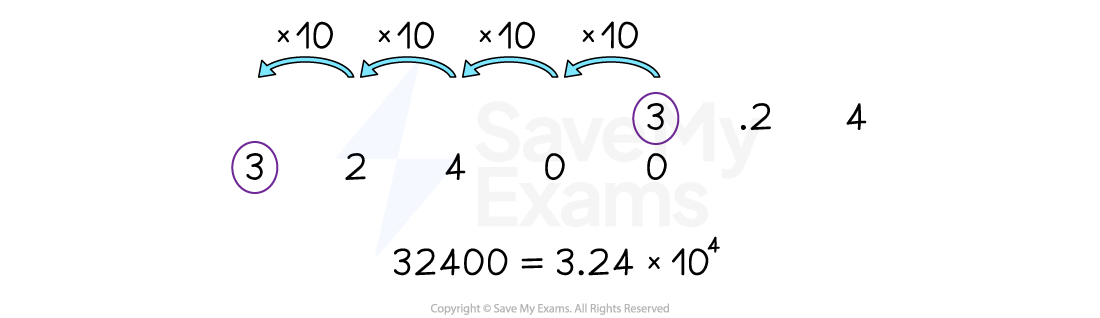
To write a large number such as 32 400 in standard form
Identify the value of
3.24
Find how many times you must multiply 3.24 by 10, to make 32 400
Count how many places you need to move the digits
We need to multiply by 10 four times
32 400 = 3.24 × 10 × 10 × 10 × 10 = 3.24 × 10⁴
How do I write a small number in standard form?
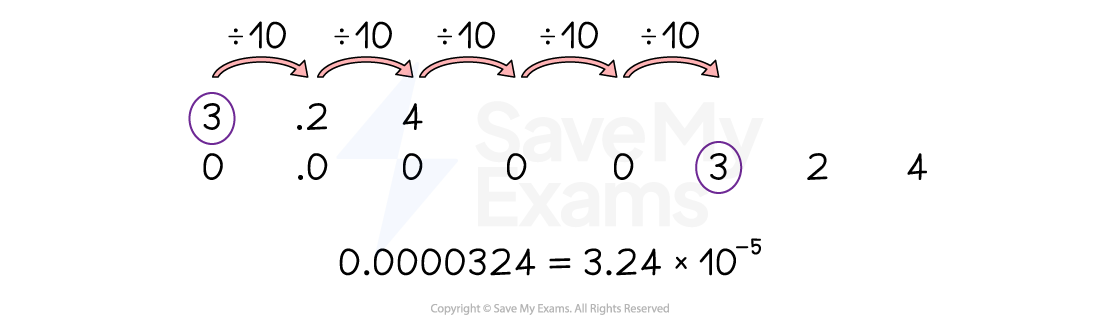
To write a small number such as 0.0000324 in standard form
Identify the value of
3.24
Find how many times you must divide 3.24 by 10, to make 0.0000324
Count how many places you need to move the digits
We need to divide by 10 five times
We are dividing rather than multiplying so the power will be negative
0.0000324 = 3.24 ÷ 10 ÷ 10 ÷ 10 ÷ 10 ÷ 10 = 3.24 × 10⁻⁵
Examiner Tips and Tricks
On some calculators, typing in a very large or very small number and pressing format('truetype')%3Bfont-weight%3Anormal%3Bfont-style%3Anormal%3B%7Dtext%7Bfill%3A%23000000%3B%3C%2Fstyle%3E%3C%2Fdefs%3E%3Cline%20stroke%3D%22%23000000%22%20stroke-linecap%3D%22square%22%20stroke-width%3D%221%22%20x1%3D%220.5%22%20x2%3D%220.5%22%20y1%3D%220.5%22%20y2%3D%2219.5%22%2F%3E%3Cline%20stroke%3D%22%23000000%22%20stroke-linecap%3D%22square%22%20stroke-width%3D%221%22%20x1%3D%2220.5%22%20x2%3D%2220.5%22%20y1%3D%220.5%22%20y2%3D%2219.5%22%2F%3E%3Cline%20stroke%3D%22%23000000%22%20stroke-linecap%3D%22square%22%20stroke-width%3D%221%22%20x1%3D%220.5%22%20x2%3D%2220.5%22%20y1%3D%220.5%22%20y2%3D%220.5%22%2F%3E%3Cline%20stroke%3D%22%23000000%22%20stroke-linecap%3D%22square%22%20stroke-width%3D%221%22%20x1%3D%220.5%22%20x2%3D%2220.5%22%20y1%3D%2219.5%22%20y2%3D%2219.5%22%2F%3E%3Ctext%20fill%3D%22%23000000%22%20font-family%3D%22math17f39f8317fbdb1988ef4c628eb%22%20font-size%3D%2216%22%20text-anchor%3D%22middle%22%20x%3D%2210.5%22%20y%3D%2217%22%3E%3D%3C%2Ftext%3E%3C%2Fsvg%3E) will convert it to standard form.
will convert it to standard form.
Worked Example
(a) Without a calculator, write 0.007052 in standard form.
Answer:
Standard form will be written as a × 10n where a is between 1 and 10
Find the value for a
a = 7.052
The original number is smaller than 1 so n will be negative
Count how many times you need to divide a by 10 to get the original number
0.007052 = 7.052 ÷ 10 ÷ 10 ÷ 10 (3 times)
Therefore n = -3.
0.007052 = 7.052 × 10⁻³
(b) Without a calculator, write 324 500 000 in standard form.
Answer:
Standard form will be written as a × 10n where a is between 1 and 10
Find the value for a
a = 3.245
The original number is larger than 1 so n will be positive
Count how many times you need to multiply a by 10 to get the original number
324 500 000 = 3.245 × 10 × 10 × 10 × 10 × 10 × 10 × 10 × 10 (8 times)
Therefore n = 8
324 500 000 = 3.245 × 10⁸

Unlock more, it's free!
Join the 100,000+ Students that ❤️ Save My Exams
the (exam) results speak for themselves:

Was this revision note helpful?
