Giant Structures (Cambridge (CIE) IGCSE Chemistry): Multiple Choice Questions

Exam code: 0620 & 0971

6 hours69 questions
1
1 mark

The structures of two solids X and Y are shown below.

q1-2-4-mcq-easy-cie-igcse-che

What are the correct uses of these structures?


X

Y

A

industrial lubricating

glass cutters

B

industrial lubricating

industrial lubricating

C

glass cutters

industrial lubricating

D

glass cutters

glass cutters

    2
    1 mark

    Graphite is used extensively as a lubricating material. It is also used in pencils and in the manufacture of electrodes for electrolysis.

    Which row describes how graphite can be used in electrolysis?


    property

    use

    A

    delocalised electrons

    conducts electricity

    B

    delocalised electrons

    acts as an insulator

    C

    low melting point

    acts as an insulator

    D

    low melting point

    conducts electricity

      3
      1 mark

      Graphite is used to produce electrodes due to its ability to conduct electricity.

      What other property does graphite have that makes it useful for this application?

      • Graphite is an unreactive substance and doesn’t react with the electrolyte.

      • Graphite is soft and easy to shape into electrodes.

      • Graphite has a low melting point due to the weak forces in between the layers.

      • Graphite dissolves readily in water.

      4
      1 mark

      Extended Only

      Which statement correctly describes the bonding in metals?

      • A lattice of negative ions in a “sea of electrons”.

      • A lattice of positive ions in a “sea of electrons”.

      • A lattice of neutral atoms with delocalised electrons.

      • A lattice of negative ions with delocalised electrons.

      5
      1 mark

      Extended Only

      Which row provides a correct description of the properties of metals?


      melting point

      boiling point

      conducts electricity

      A

      high

      low

      ×

      B

      low

      high

      ✓

      C

      low

      low

      ×

      D

      high

      high

      ✓

        6
        1 mark

        Which statement about carbon allotropes is correct?

        • Diamond contains carbon atoms bonded to three other carbon atoms.

        • Graphite is a good conductor of electricity because of the presence of mobile ions.

        • Diamond is used as a lubricant because of the weak intermolecular forces between its layers.

        • Graphite is a good conductor of electricity because it contains delocalised electrons.

        7
        1 mark

        Nickel is described as a malleable metal.

        What does malleable mean?

        • It can be drawn out into a thin wire.

        • It allows electricity to pass through it.

        • It can be hammered into a different shape without breaking.

        • It returns to its original shape after being bent.

        8
        1 mark

        Extended Only

        An iron nail is connected into a simple circuit with a battery and a lamp. When the circuit is complete, the lamp lights up.

        Which statement explains why the iron nail conducts electricity?

        • It is the positive ions that move through the metal structure, carrying the electric charge as they go.

        • The delocalised electrons are held in place between the ions and are unable to move through the structure.

        • Electrons transfer from the iron nail to a non-metal, creating a flow of charge.

        • The delocalised electrons can flow through the whole metal structure, allowing them to carry the charge.

        9
        1 mark

        Extended Only

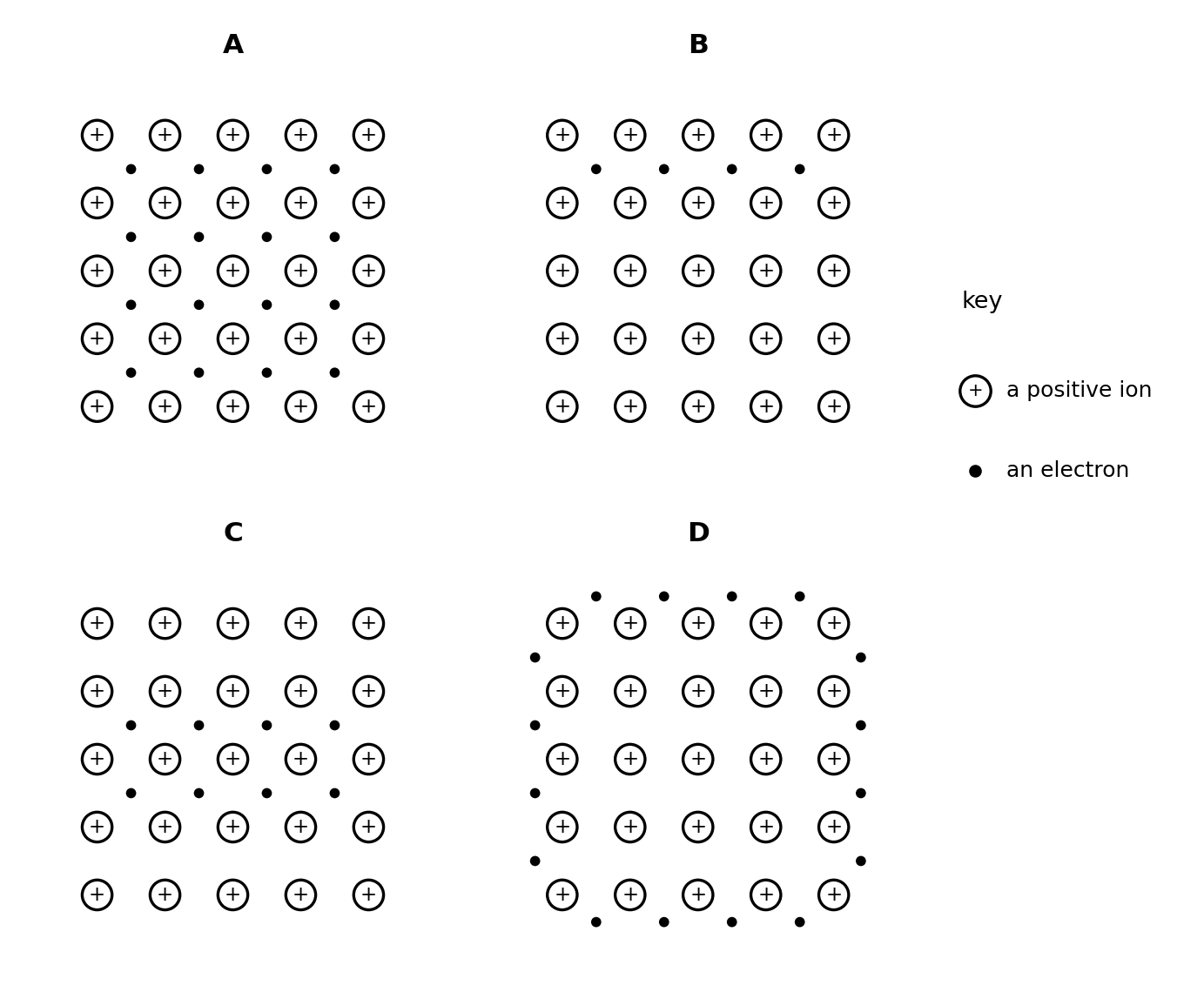
        Which diagram shows the arrangement of particles in a metal?

        Four labelled diagrams in a 2 by 2 grid, each showing a regular 5 by 5 grid of positive ions, with a key giving a circle containing a plus as a positive ion and a small filled circle as an electron. Diagram A has one electron in the centre of every gap between four neighbouring ions, throughout the whole grid. Diagram B has electrons only in the single row of gaps between the top two rows of ions. Diagram C has electrons only in the two rows of gaps between the middle rows of ions. Diagram D has electrons forming a ring around the outside of the whole grid, with none anywhere inside it.
          1
          1 mark

          Which of the following statements about graphite and diamond are incorrect?

          1

          They are allotropes of carbon.

          2

          They both conduct electricity.

          3

          They form different numbers of bonds within their structures.

          4

          They have different uses.

          • 2 and 3

          • 2 only

          • 1, 3 and 4

          • 2 and 4

          2
          1 mark

          Which statement correctly describes the structure of macromolecules?

          • Giant molecular crystal which is held together by weak intermolecular forces.

          • Giant molecular crystal which is held together by strong ionic bonds.

          • Giant molecular crystal which is held together by weak metallic bonds.

          • Giant molecular crystal which is held together by strong covalent bonds.

          3
          1 mark

          Which statement about graphite and diamond is not correct?

          • Graphite is a good lubricant due to the weak forces in between the layers.

          • Diamond is used as a drill tip because it is an extremely hard substance.

          • Graphite has a low melting point due to the weak forces in between the layers.

          • Diamond is an allotrope of carbon.

          4
          1 mark

          Separate: Chemistry and Extended Only

          The following statements describe the structure and properties of silicon(IV) oxide.

          1. Giant covalent structure held together by many strong covalent bonds.

          2. It is a very hard substance.

          Which of the following is correct for statements 1 and 2?

          • Statement 2 is correct but statement 1 is incorrect.

          • Both statements are incorrect.

          • Both are correct and statement 1 explains statement 2.

          • Both are correct and statement 2 explains statement 1.

          5
          1 mark

          Statements 1, 2 and 3 are about diamond and graphite.

          1. They have atoms that form three equally strong bonds 

          2. They are both formed from the same element  

          3. They each conduct electricity

          Which statement(s) is / are correct? 

          • 1 only

          • 2 only

          • 1 and 3 

          • 1 and 2

          6
          1 mark

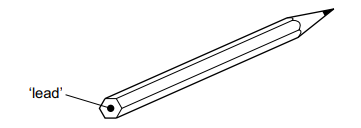
          The ‘lead’ in a pencil is made of a mixture of graphite and clay.

          Diagram of a hexagonal pencil with a pointed tip. An arrow indicates the 'lead' at the opposite end, highlighting the pencil core.

          When the percentage of graphite is increased, the pencil moves across the paper more easily. Which statement explains this observation?

          • Graphite has a high melting point.

          • Graphite is a form of carbon.

          • Graphite is a lubricant.

          • Graphite is a non-metal.

          7
          1 mark

          Extended Only

          Which statement about metals is not correct?

          • They conduct electricity because delocalised electrons can move throughout the metal.

          •   They consist of layers of atoms that can slide over each other.

          • They have a giant lattice of oppositely charged ions in a ‘sea’ of delocalised electrons.

          • They have a giant lattice of positive ions in a ‘sea’ of delocalised electrons.

          8
          1 mark

          Extended Only

          Metals and ionic compounds have similarities and differences in their structure and properties.

          Which row about metals and ionic compounds is correct? 

          similarity

          difference

          A

          both contain positive ions 

          only ionic compounds contain anions 

          B

          both contain positive ions

          ionic compounds conduct using a ‘sea of electrons’

          C

          both are malleable

          only ionic compounds contain anions

          D

          both are malleable 

          ionic compounds conduct using a ‘sea of electrons’ 

            9
            1 mark

             Which statement explains why graphite can be used as a lubricant? 

            • All of the atoms in graphite are carbon.

            • Each carbon atom forms three bonds.

            • Graphite has a macromolecular structure.

            • The layers in graphite can slide over each other.

            10
            1 mark

            Extended Only

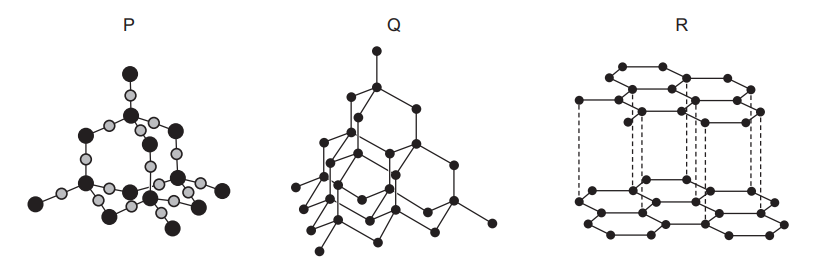
            The diagrams show the structures of three macromolecules P, Q and R

            Three ball-and-stick structures labelled P, Q and R. P: a three-dimensional network of large black atoms joined through small grey atoms. Q: a three-dimensional network of one type of atom, each joined to four others. R: flat hexagonal layers of one type of atom, stacked with dashed lines between layers.

            What are P, Q and R?

            P

            Q

            R

            A

            diamond 

            silicon(IV) oxide

            graphite

            B

            graphite

            diamond 

            silicon(IV) oxide 

            C

            silicon(IV) oxide 

            diamond 

            graphite

            D

            silicon(IV) oxide 

            graphite

            diamond 

              11
              1 mark

              Silicon(IV) oxide and phosphorus(V) oxide are oxides of elements in Period 3 of the Periodic Table.

              Which row describes the correct properties of these two oxides?

              nature of the oxides

              type of bonding

              melting point of silicon(IV) oxide

              melting point of phosphorus(V) oxide

              A

              acidic

              covalent

              high

              low

              B

              acidic

              covalent

              low

              low

              C

              basic

              ionic

              high

              low

              D

              basic

              ionic

              low

              low

                12
                1 mark

                Extended Only

                Platinum can be drawn out into a very thin wire without breaking.

                Which statement explains why platinum is ductile?

                • Layers of ions can take up new positions while the delocalised electrons continue to attract them.

                • The delocalised electrons move into new positions and pull the ions after them.

                • Individual ions break away from the lattice and take up new positions.

                • The layers can slide because there is no attraction between the ions and the delocalised electrons.

                13
                1 mark

                Extended Only

                Three statements about the structure of a metal are shown.

                1 The lattice contains positively charged metal ions.

                2 Each delocalised electron is attracted to one particular metal ion.

                3 The delocalised electrons are attracted to all the positive ions in the lattice.

                Which statements are correct?

                • 1 and 2 only

                • 2 and 3 only

                • 1 and 3 only

                • 1, 2 and 3

                14
                1 mark

                Extended Only

                A small piece of gold is hammered into a thin sheet. It changes shape without breaking.

                Which statement explains why the gold can be hammered into a thin sheet?

                • The delocalised electrons slide over one another.

                • The positive ions and the delocalised electrons are all held in fixed positions.

                • Layers of positive ions slide over one another and the metallic bonding is maintained.

                • Individual positive ions slide over one another and take up new positions.

                15
                1 mark

                Extended Only

                A copper wire conducts electricity when it is connected in a circuit.

                Which statement explains how the copper conducts electricity?

                • The delocalised electrons move through the wire and carry the charge.

                • The copper ions move through the wire and carry the charge.

                • The delocalised electrons are held in fixed positions between the copper ions and pass the charge along the wire.

                • The copper ions vibrate and pass the charge from one ion to the next.

                1
                1 mark

                Separate: Chemistry and Extended Only

                Which statement correctly describes the arrangement of atoms in silicon dioxide?

                • Each silicon atom is bonded to two oxygen atoms and each oxygen atom is bonded to one silicon atom.

                • Each silicon atom is bonded to four oxygen atoms and each oxygen atom is bonded to two silicon atoms.

                • Each silicon atom is bonded to four oxygen atoms and each oxygen atom is bonded to four silicon atoms.

                • Each silicon atom is bonded to two oxygen atoms and each oxygen atom is bonded to four silicon atoms.

                2
                1 mark

                Separate: Chemistry and Extended Only

                Which of the following statements about silicon(IV) dioxide and diamond are correct?

                1

                Silicon(IV) dioxide forms a giant ionic lattice structure.

                2

                They are both compounds.

                3

                They both have very high melting points.

                4

                There are strong covalent bonds in silicon(IV) dioxide.

                • 1 and 3

                • 1 only 2

                • 1, 2 and 4

                • 3 and 4

                3
                1 mark

                Separate: Chemistry and Extended Only

                Which row correctly describes the use of graphite and silicon(IV) dioxide?


                graphite

                silicon(IV) dioxide

                A

                electrodes

                production of plastics

                B

                electrolyte

                production of glass

                C

                electrolyte

                production of plastics

                D

                electrodes

                production of glass

                  4
                  1 mark

                  Separate: Chemistry and Extended Only

                  Which row provides a correct description of the structure and properties of silicon(IV) oxide?


                  forms an acidic oxide

                  has a giant structure

                  conducts electricity

                  A

                  ✓

                  ✓

                  ×

                  B

                  ✓

                  ×

                  ✓

                  C

                  ×

                  ✓

                  ×

                  D

                  ×

                  ×

                  ✓

                    5
                    1 mark

                    Graphite is used as a lubricant.

                    Which statements explain how graphite is able to act as a lubricant?

                    1 The layers of carbon atoms can slide over each other

                    2 The forces of attraction between the layers are weak

                    3 Graphite is unreactive

                    4 Graphite has a high melting point

                    • 1 and 2

                    • 1, 2 and 3

                    • 2 and 4

                    • 1, 2, 3 and 4

                    6
                    1 mark

                    Extended Only

                    Metallic bonds are very strong and give metals their properties. Which of the following definitions is correct for a metallic bond?

                    • A metallic bond is formed by the electrostatic attraction that occurs due to electron transfer between metal atoms.

                    • A metallic bond is formed by the electrostatic attraction between the positive ions and the delocalised electrons.

                    • A metallic bond is formed by the electrostatic attraction that occurs due to the uneven sharing of electrons between metal atoms.

                    • A metallic bond is formed by the intermolecular forces between the positive metal ions and the delocalised electrons.

                    7
                    1 mark

                    Extended Only

                    Tin is a metal. Tin conducts electricity when it is solid and when it is molten.

                    Which statement explains this evidence?

                    • Tin has a lattice of positive ions with delocalised electrons that are able to move in both states.

                    • Tin consists of molecules that are held together by weak intermolecular forces.

                    • Tin is an ionic compound whose ions are able to move only when it is molten.

                    • Tin contains delocalised ions that move through the structure and carry the charge.

                    8
                    1 mark

                    Extended Only

                    Metals are malleable and ductile and can be hammered and pulled into useful shapes.

                    Which statement correctly explains these properties?

                    • Layers of atoms in the metal lattice are rigid and held strongly together so they cannot move.

                    • Layers of atoms in a metal can slide over one another and break the attractive forces that hold them together.

                    • Layers of atoms in a metal can slide over one another and new attractive forces are formed between the metal ions and the delocalised electrons.

                    • Layers of atoms in a metal cannot slide over one another and the attractive forces between the metal ions and the delocalised electrons are unbreakable.

                    9
                    1 mark

                    Extended Only

                    In a metal lattice the delocalised electrons are attracted to certain particles.

                    Which particles are these?

                    • neutral metal atoms

                    • positively charged protons that have been released from the metal nuclei

                    • electrons in the inner shells of the metal atoms

                    • positive metal ions

                    10
                    1 mark

                    Extended Only

                    Metals are good conductors of electricity.

                    Three statements about metals are shown.

                    1 Metals contain delocalised electrons.

                    2 The delocalised electrons can move throughout the structure.

                    3 The positive metal ions are arranged in layers.

                    Which statements are needed to explain why metals conduct electricity?

                    • 1 only

                    • 1 and 2 only

                    • 2 and 3 only

                    • 1, 2 and 3