The Mole & the Avogadro Constant (Cambridge (CIE) IGCSE Chemistry): Multiple Choice Questions

Exam code: 0620 & 0971

6 hours63 questions
1
1 mark

Extended Only

Which row correctly describes the mole and the value of Avogadro’s constant?


one mole of a substance is equal to

one mole of a substance contains

A

the substances relative atomic or molecular mass in grams

 6.02 x 10²³ atoms, molecules or formula units

B

the substances atomic number in grams

 6.02 x 10²³ atoms, molecules or formula units

C

the substances relative atomic or molecular mass in grams

 12.04 x 10²³ atoms, molecules or formula units

D

the substances atomic number in grams

 12.04 x 10²³ atoms, molecules or formula units

    2
    1 mark

    Extended Only

    The complete combustion of methane produces carbon dioxide and steam.

    CH4(g) + 2 O2(g) → 2 H2O(g) + CO2(g)

    Which statements are about the reaction correct?

    1. The empirical formula of methane is CH4

    2. The number of atoms in 1 mole of methane is 4 x Avogadro’s constant

    3. 1 mole of methane produces 72 dm3 of gaseous products at r.t.p

    4. 1 mole of methane occupies a volume of 12 dm3 at r.t.p

    • 1, 2 and 3

    • 1 and 2

    • 1 and 3

    • 2 and 4

    3
    1 mark

    Extended Only

    Magnesium carbonate and hydrochloric acid react to produce salt, water and carbon dioxide.

    MgCO3 (s) + 2HCl (aq) → MgCl2 (aq) + H2O (l) + CO2 (g) 

    What is the volume of CO2 produced when 21 g of magnesium carbonate (Mr = 84) reacts completely with excess hydrochloric acid?

    One mole of gas occupies 24.0 dm3 at room temperature and pressure.

    • 4 dm3

    • 8 dm3

    • 6 dm3

    • 2 dm3

    4
    1 mark

    Extended Only

    Calcium carbonate undergoes thermal decomposition at high temperatures to form calcium oxide and carbon dioxide.

    CaCO3 → CaO + CO2

    What mass of calcium oxide (Mr = 56) is formed when 60 g of calcium carbonate (Mr = 100) is completely decomposed?

    • 28 g

    • 18.5 g

    • 60 g

    • 33.6 g

    5
    1 mark

    Separate: Chemistry and Extended Only

    Substance X was analysed and found to contain 40.00% carbon, 6.67% hydrogen and 53.33% oxygen by mass.

    What is the empirical formula of X?

    • C4H8O4

    • C6H12O8

    • C2H4O2

    • CH2O

    6
    1 mark

    Extended Only

    A sample of a compound contains 0.20 mol of carbon atoms, 0.40 mol of hydrogen atoms and 0.10 mol of oxygen atoms.

    What is the empirical formula of the compound?

    • CHO

    • CH2O

    • C2H4O

    • C4H8O2

    7
    1 mark

    Extended Only

    One mole of any substance contains 6.02 × 10²³ particles.

    How many molecules are there in 2.0 mol of oxygen gas, O2?

    • 3.01 × 10²³

    • 6.02 × 10²³

    • 1.20 × 1024

    • 2.41 × 1024

    8
    1 mark

    Extended Only

    A solution of sodium carbonate, Na2CO3, has a concentration of 0.50 mol / dm3.

    What is this concentration in g / dm3?

    [Mr: Na2CO3, 106]

    • 0.0047 g / dm3

    • 53 g / dm3

    • 106 g / dm3

    • 212 g / dm3

    1
    1 mark

    Separate: Chemistry and Extended Only

    What is the concentration in mol dm-3 of a solution of sodium hydroxide that contains 16 g of NaOH in 200 cm3 of distilled water?

    • 2 mol dm-3

    • 2.5 mol cm-3

    • 0.2 mol dm-3

    • 1 mol cm-3

    2
    1 mark

    Separate: Chemistry and Extended Only

    A student was given a sample of hydrochloric acid and asked to find its concentration in mol dm-3. She titrated 25 cm3 of the acid against a standard solution of sodium hydroxide of 0.1 mol dm-3. The average titre of sodium hydroxide was 30 cm3.

    What is the concentration of the acid?

    • 0.50 mol dm-3

    • 0.12 mol dm-3

    • 1.25 mol dm-3

    • 1.0 mol dm-3

    3
    1 mark

    Separate: Chemistry and Extended Only

    A substance was analysed and found to contain 26.57 % potassium, 35.36 % chromium, and 38.07 % oxygen by mass.

    What is the empirical formula of the substance?

    • KCr2O7

    • K2CrO7

    • K2Cr2O5

    • K2Cr2O7

    4
    1 mark

    Separate: Chemistry and Extended Only

    Substance X was analysed and found to contain 40.00 % carbon, 6.67 % hydrogen and 53.33 % oxygen by mass. The compound has a relative molecular mass of 60.0 g mol-1.

    What is the molecular formula of X?

    • C4H8O4

    • C6H12O8

    • C2H4O2

    • CH2O

    5
    1 mark

    Separate: Chemistry and Extended Only

    A student thermally decomposes 24.8 g of copper carbonate and obtains 11.2 g of copper(II) oxide and carbon dioxide gas which is released.

    CuCO3 → CuO + CO2

    What is the percentage yield of CuO?

    • 55 %

    • 70 %

    • 82 %

    • 90 %

    6
    1 mark

    Separate: Chemistry and Extended Only

    A sample of chalk (limestone) with a mass of 1.70 g was reacted with excess HCl and the amount of carbon dioxide given off was measured using a gas syringe. 0.36 dm3 of CO2 gas was collected at r.t.p.

    CaCO3 + 2 HCl → CaCl2 + CO2 + H2O

    What is the percentage purity of the chalk?

    • 75 %

    • 88 %

    • 90 %

    • 98 %

    7
    1 mark

    Extended Only

    The equation for the reaction between sodium carbonate and excess dilute hydrochloric acid is shown.

    Na2CO3 + 2HCl → 2NaCl + H2O + CO2

    When 26.5 g of sodium carbonate reacts with excess dilute hydrochloric acid, what is the maximum volume of carbon dioxide produced?

    •   6 dm3

    • 12 dm3

    • 18 dm3

    • 24 dm3

    1
    1 mark

    Extended Only

    Calcium carbide and water react to produce ethyne and calcium hydroxide.

    CaC2 (s) + 2H2O (l) → C2H2 (g) + Ca(OH)2 (s)

    What is the volume of C2H2 produced, at standard temperature and pressure, when 45 g of water reacts completely with calcium carbide?

    • 72 dm3

    • 30 dm3

    • 24 dm3

    • 6 dm3

    2
    1 mark

    Extended Only

    Aluminium and oxygen react to produce aluminium oxide.

    4 Al + 3 O2 → 2 Al2O3

    How many kilograms of aluminium oxide are formed when 5.4 kg of aluminium react with excess oxygen?

    • 5.4 kg

    • 88 kg

    • 10.2 kg

    • 33.6 kg

    3
    1 mark

    Extended Only

    Magnesium nitride and water react to produce a precipitate of magnesium hydroxide and ammonia gas.

    Mg3N2 + 6 H2O → 3 Mg(OH)2 + 2 NH3

    How much magnesium nitride is needed to produce 87 g of the precipitate in excess water?

    • 24 g

    • 50 g

    • 30 g

    • 12 g

    4
    1 mark

    Separate: Chemistry and Extended Only

    A student was asked to find the concentration in g / dm3 of a solution of sulfuric acid. She transferred 25 cm3 of the acid to a 250 cm3 volumetric flask and made it up to the mark. She titrated 25 cm3 of the diluted acid against a standard solution of sodium hydroxide of 0.1 mol dm-3. The average titre of sodium hydroxide was 18 cm3.

    What is the concentration of the original acid in grams per decimetre?

    • 9.85 g dm-3

    • 12.25 g dm-3

    • 98 g dm-3

    • 35.28 g dm-3

    5
    1 mark

    Extended Only

    A chemist reacted 0.6 g of magnesium with 0.6 dm3 of oxygen in a sealed container to produce magnesium oxide.

    2Mg + O2 → 2MgO

    Which row correctly describes the limiting reactant?


    limiting reactant

    reason

    A

    Mg

    in excess

    B

    Mg

    is used up first

    C

    O2

    is used up first

    D

    O2

    in excess

      6
      1 mark

      Extended Only

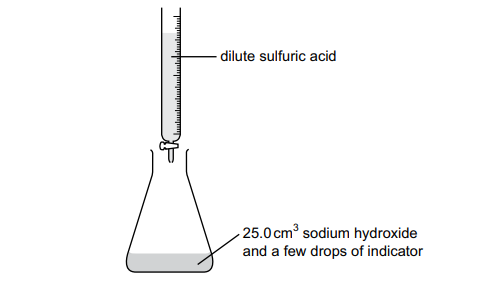
      A volumetric pipette is used to measure 25.0 cm3 of 2.0 mol / dm3 aqueous sodium hydroxide into a conical flask.

       A burette is filled with dilute sulfuric acid.

      Burette releasing dilute sulphuric acid into a conical flask containing 25.0 cm³ sodium hydroxide and indicator, depicting a titration setup.

      The equation for the reaction is shown.

      2NaOH + H2SO4 → Na2SO4 + 2H2O

      The reaction requires 50.0 cm3 of dilute sulfuric acid to reach the end-point.

      What is the concentration of the dilute sulfuric acid in mol / dm3?

      • 0.50 mol / dm3

      • 1.0 mol / dm3

      •   2.0 mol / dm3

      • 4.0 mol / dm3

      7
      1 mark

      Extended Only

      The equation for the reaction between aqueous lead(II) nitrate and aqueous sodium chloride is shown.

      Pb(NO3)2 (aq) + 2NaCl (aq) → PbCl2 (s) + 2NaNO3 (aq) 

      If 100 cm3 of aqueous lead(II) nitrate of concentration 0.1 mol / dm3 is reacted with an excess of aqueous sodium chloride, which mass of lead(II) chloride is obtained? 

      • 1.16 g

      • 2.42 g

      • 2.78 g

      • 3.31 g 

      8
      1 mark

      Extended Only

      Methane and steam react in the presence of a catalyst.

      CH4(g) + H2O(g) → CO(g) + 3H2(g) 

      0.5 mol of methane reacts completely with 0.5 mol of steam. 

      What is the volume of carbon monoxide and hydrogen produced, measured at room temperature and pressure?

      volume of CO/ dm3

      volume of H2 / dm3

      A

      0.5 

      1.5

      B

      1.0

      3.0

      C

      12.0

      12.0

      D

      12.0

      36.0

        9
        1 mark

        How many oxygen atoms are there in 10.0 g of magnesium nitrate, Mg(NO3​)2​?

        (The Avogadro constant, L, is 6.02 × 10²³ mol−1)

        • 4.07 × 10²²

        • 8.14 × 10²²

        • 1.22 × 10²³

        • 2.44 × 10²³

        10
        1 mark

        What is the volume of hydrogen gas produced, measured at room temperature and pressure (r.t.p.), when 5.0 g of magnesium reacts with an excess of dilute hydrochloric acid?

        (The volume of one mole of any gas is 24 dm3 at r.t.p.)

        • 0.21 dm3

        • 2.5 dm3

        • 5.0 dm3

        • 120 dm3