11 mark
The graph below shows a reaction profile for the reaction between methane and oxygen.

What does the label X represent?
Activation energy
Overall energy change
Reactants
Progress of the reaction
Was this exam question helpful?
Exam code: 0620 & 0971
The graph below shows a reaction profile for the reaction between methane and oxygen.
What does the label X represent?
Activation energy
Overall energy change
Reactants
Progress of the reaction
Was this exam question helpful?
What is the reading on the following thermometer?

28.3 oC
28.6 oC
29.2 oC
28.5 oC
Was this exam question helpful?
A student adds a small amount of ammonium chloride to a beaker of water. The temperature of the water decreases from 21 oC to 17 oC.
Which type of reaction has occurred and why?
| type of reaction | reason |
A | exothermic | heat is released |
B | exothermic | heat is absorbed |
C | endothermic | heat is released |
D | endothermic | heat is absorbed |
Was this exam question helpful?
The energy level diagram below shows the relative energies of the reactants and products in a reaction.

Which row correctly describes the type of reaction and corresponding energy change?
| type of reaction | energy change |
A | endothermic | heat is released |
B | endothermic | heat is absorbed |
C | exothermic | heat is released |
D | exothermic | heat is absorbed |
Was this exam question helpful?
Calcium and hydrochloric acid react to produce calcium chloride and hydrogen gas. The energy level diagram for the reaction is shown below.

Which statement about this reaction is not correct?
The temperature of the surroundings increases.
The reaction is endothermic.
The products have less energy than the reactants.
Energy is released during the reaction.
Was this exam question helpful?
The reaction pathway diagram for a reaction, with and without a catalyst, is shown.
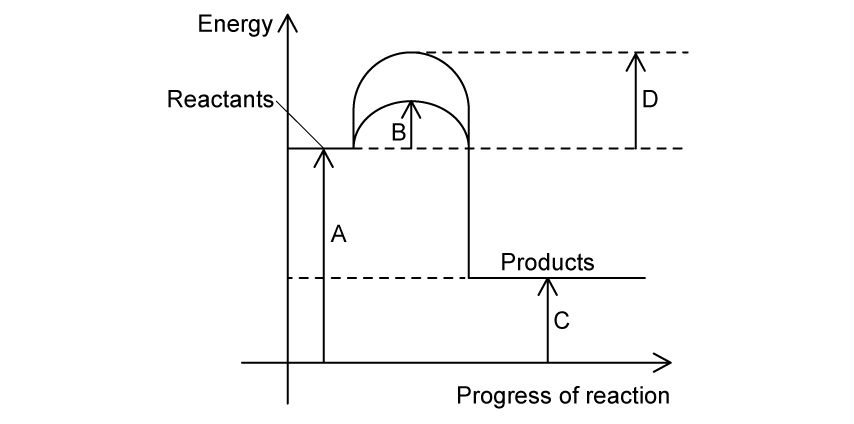
Which letter represents the activation energy of the catalysed reaction?
Was this exam question helpful?
Which of the following processes is endothermic?
Reacting sodium with water.
The use of petrol in an engine.
Distilling crude oil.
Burning fossil fuels.
Was this exam question helpful?
In all chemical reactions, bonds in the reactant species are broken and new bonds are formed in the products. Which statement is correct?
Bond breaking requires energy and is thus an exothermic process.
Bond breaking requires energy and is thus an endothermic process.
Bond breaking releases energy and is thus an exothermic process.
Bond breaking releases energy and is thus an endothermic process.
Was this exam question helpful?
Which is true about chemical energy changes?
| Reaction type | Energy flows | Temperature of surroundings |
A | exothermic | to the surroundings | increases |
B | exothermic | from the surroundings | decreases |
C | endothermic | to the surroundings | decreases |
D | endothermic | from the surroundings | increases |
Was this exam question helpful?
The reaction profile for making nitrogen monoxide, NO, is shown below:

What is the activation energy for this reaction?
+140 kJ
+180 kJ
+320 kJ
-330 kJ
Was this exam question helpful?
Endothermic reactions can be used in emergency sports injury treatment packs.
What is true about these packs?
Absorb energy from the surroundings and transfer it to the injury
Can be re-used
Usually contain ammonium nitrate and water in separate compartments
Cause the temperature of the surroundings to increase
Was this exam question helpful?
A reaction pathway diagram is shown.
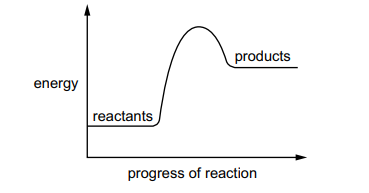
Which statement about the reaction is correct?
Heat is released.
It is a combustion reaction.
It is an endothermic reaction.
The temperature increases.
Was this exam question helpful?
Which diagram is a correctly labelled reaction pathway diagram for an endothermic reaction?
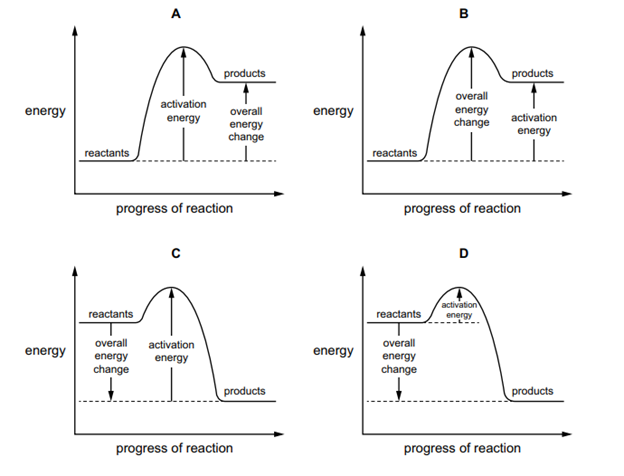
Was this exam question helpful?
The equation for the reaction when hydrogen is used as a fuel is shown.
2H2 + O2 → 2H2O
Which statement about this reaction is correct?
Energy is given out so the temperature of the surroundings decreases.
Energy is taken in so the temperature of the surroundings increases.
The reaction is endothermic so the temperature of the surroundings decreases.
The reaction is exothermic so the temperature of the surroundings increases.
Was this exam question helpful?
The equation for the reaction between gaseous hydrogen and gaseous iodine to form gaseous hydrogen iodide is shown.
H2(g) + I2(g) → 2HI(g)
The reaction is exothermic.
Which statement explains why the reaction is exothermic?
Energy is released when H–H and I–I bonds are broken.
The bond energies of the reactants are larger than the bond energies of the products.
The products are at a higher energy level than the reactants.
More energy is released when two H–I bonds are formed than is used when the H–H and I–I bonds are broken.
Was this exam question helpful?
Which type of reaction occurs when calcium carbonate is heated at a high temperature to produce calcium oxide and carbon dioxide?
combustion
endothermic
oxidation
reduction
Was this exam question helpful?
Which arrow on the energy level diagram shows the overall energy change for an endothermic reaction?
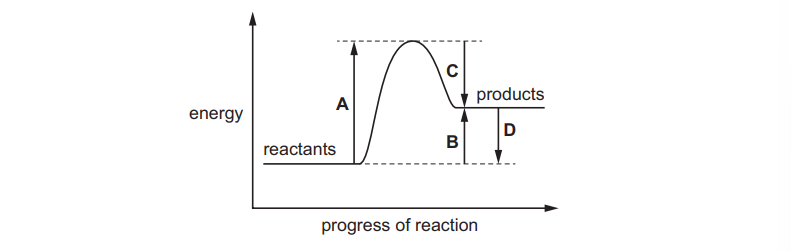
Was this exam question helpful?
The table shows the change in temperature of four different reactions W, X, Y and Z.
initial temperature / °C | final temperature / °C | |
W | 10 | 20 |
X | 23 | 25 |
Y | 15 | 13 |
Z | 22 | 12 |
Which row is correct?
W is the most exothermic reaction.
W and X are endothermic reactions.
Z is the most exothermic reaction.
Y and Z are exothermic reactions.
Was this exam question helpful?
Chlorine and ethane react together in an exothermic reaction to produce chloroethane and hydrogen chloride. The equation for the reaction is shown below.
C2H6 + Cl2 → C2H5Cl + HCl
The table below shows the relevant bond energies.
bond | bond energy / (kJ / mol) |
CーCl | + 340 |
CーC | + 350 |
CーH | + 410 |
ClーCl | + 240 |
HーCl | + 430 |
What is the energy change for the reaction between chlorine and ethane?
-120 kJ / mol
-1020 kJ / mol
+120 kJ / mol
+1020 kJ / mol
Was this exam question helpful?
The production of ammonia involves the exothermic reaction between nitrogen and hydrogen. The equation for the reaction is shown.
N2 + 3 H2 → 2 NH3
The table shows the bond energies.
bond | bond energy / (kJ / mol) |
NーH | +390 |
HーH | +436 |
N☰N | +945 |
What is the energy change during the reaction?
-230 kJ / mol
-1025 kJ / mol
-87 kJ / mol
+87 kJ / mol
Was this exam question helpful?
Chlorine and hydrogen react in an exothermic reaction producing hydrogen chloride. The equation for the reaction is shown.
Cl2 + H2 → 2 HCl
The table shows some of the bond energies involved. The total energy change for this reaction is -184 kJ / mol.
bond | bond energy / (kJ / mol) |
HーCl | +430 |
HーH | +436 |
ClーCl | - |
What is the energy of the Cl─Cl bond?
-170 kJ / mol
+240 kJ / mol
+170 kJ / mol
-240 kJ / mol
Was this exam question helpful?
Methane combusts in oxygen as shown producing an energy change of -890 kJ / mol.
CH4 + 2O2 → CO2 + 2H2O
The table shows some of the bond energies involved.
bond | bond energy / (kJ / mol) |
HーO | +460 |
O=O | +496 |
CーH | +410 |
C=O | - |
What is the energy of the C=O bond?
-155 kJ / mol
+333 kJ / mol
-840 kJ / mol
+841 kJ / mol
Was this exam question helpful?
An energy level diagram is shown below.

Which row is correct for the points labelled 1, 2 and 3?
| 1 | 2 | 3 |
A | activation energy | energy change | reactants |
B | energy change | activation energy | products |
C | energy change | activation energy | reactants |
D | activation energy | energy change | products |
Was this exam question helpful?