Reaction Mechanisms (College Board AP® Chemistry): Exam Questions

1 hour22 questions
1a
1 mark

A reaction mechanism for the decomposition of dinitrogen pentoxide (N2O5) in chloroform is proposed:

  1. Step 1: N2O5 → NO2 + NO3 (slow)

  2. Step 2: N2O5 + NO3 → 3NO2​ + O2 (fast)

Identify the rate-determining step. Justify your answer.

1b
1 mark

Write the rate law for the reaction.

1c
1 mark

Determine the overall balanced equation for the reaction.

1d
1 mark

Explain how an increase in temperature affects the rate of this reaction.

2a
2 marks

A proposed reaction mechanism for the conversion of A to C is shown below:

Step 1: A + B → X (slow)

Step 2: X + D → C (fast)

Identify the intermediate in the mechanism. Explain your answer.

2b
1 mark

Write the overall reaction by combining the elementary steps.

2c
1 mark

State one piece of experimental evidence that could support the presence of the intermediate you identified in part (a).

3a
2 marks

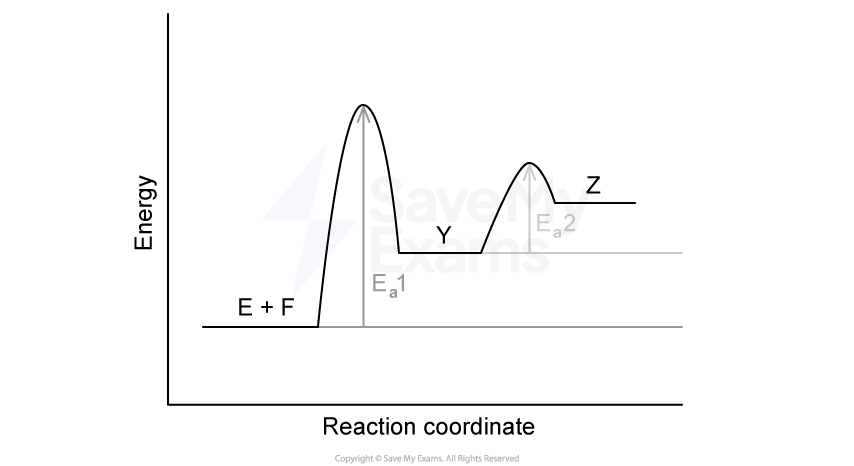
The reaction below occurs in two steps:

Step 1: E + F → Y

Step 2: Y → Z

A reaction energy profile for the mechanism is shown schematically:

Graph showing energy vs. reaction coordinate. Peaks labelled Ea1 and Ea2 indicate activation energies.

Identify which step is the rate-limiting step. Explain your answer.

3b
1 mark

Identify the intermediate in the mechanism. Explain your answer.

3c
1 mark

Based on the energy profile, state whether the overall reaction is exothermic or endothermic.

1a
1 mark

Nitrogen dioxide, NO2(g) , is produced as a by-product of the combustion of fossil fuels in internal combustion engines. At elevated temperatures NO2(g) decomposes according to the equation below.

2 NO2(g)  →  2 NO(g) + O2(g)

The concentration of a sample of NO2(g) is monitored as it decomposes and is recorded on the graph directly below. The two graphs that follow it are derived from the original data.

q6-june-2019---ap-chemistry

Explain how the graphs indicate that the reaction is second order.

1b
1 mark

Write the rate law for the decomposition of NO2 (g) .

1c
2 marks

Consider two possible mechanisms for the decomposition reaction.

 i) Is the rate law described by mechanism I shown below consistent with the rate law you wrote in part (b)? Justify your answer.

Mechanism I

Step 1:

NO2 (g) + NO2 (g) → NO (g) + NO3 (g)

slow

Step 2:

NO3 (g) → NO (g) + O2 (g)

fast

 ii) Is the rate law described by mechanism II shown below consistent with the rate law you wrote in part (b)? Justify your answer.

 Mechanism II

Step 1:

NO2 (g) + NO2 (g)   N2O4 (g)

fast equilibrium

Step 2:

N2O4 (g) → 2 NO (g) + O2 (g)

slow

2a
1 mark

The reaction between nitrogen dioxide and carbon monoxide occurs according to the following equation:

NO2 (g) + CO (g) → NO (g) + CO2 (g) 

Using the following graph, determine the order of reaction with respect to NO2​.

q4a_16-1_ib_hl_medium_sq
2b
2 marks

A student proposes the following single-step mechanism for the reaction:

NO2 + CO → NO + CO2 ​(slow)

The student states that the rate law for the reaction is:

Rate = k [NO2]2 

Justify whether the student’s proposed mechanism is consistent with the given rate law.

2c
1 mark

Another student proposes the following two-step mechanism:

Step 1: NO2 + NO2 → NO + NO3    

Step 2: NO3 + 2CO → NO + 2CO2 

The student states that the rate law for the reaction is:

Rate = k [NO2]2 

Based on the proposed mechanism, identify the rate-determining step and justify your choice.

3a
1 mark

The dimerisation of ethanal (CH3CHO) in dilute alkaline solution to form 3-hydroxybutanal proceeds via the following mechanism:

Step 1: CH3CHO + :OH- → :CH2CHO + H2O (slow)
Step 2: CH3CHO + :CH2CHO → CH3CH(O:-)CH2CHO (fast)
Step 3: CH3CH(O:-)CH2CHO + H2O → CH3CH(OH)CH2CHO + :OH- (fast)

Identify the catalyst in the reaction mechanism. Justify your answer based on its role in the proposed steps.

3b
1 mark

Deduce the rate law based on the proposed mechanism.

3c
1 mark

The following data was collected for the reaction at a constant temperature.

Experiment

Initial [CH3CHO]

(mol dm-3)

Initial [OH-]

(mol dm-3)

Initial rate

(mol dm-3 s-1)

1

0.25

0.20

4.2 x 10⁻²

2

0.25

0.30


Calculate the initial rate for Experiment 2, assuming all conditions remain the same.

3d
1 mark

State the effect, if any, that increasing the concentration of a reactant would have on the value of the rate constant, k.

4a
1 mark

A reaction occurs according to the following experimentally determined rate law:

Rate = k[A]2[B]

A student proposes the following two-step mechanism:

  1. Step 1: A + A ⇌ A2​ (fast equilibrium)

  2. Step 2: A2 + B → C (slow)

Identify the intermediate in the mechanism.

4b
1 mark

Explain whether the mechanism is consistent with the given rate law.

4c
1 mark

If the temperature is increased, describe how the rate constant k changes.

4d
1 mark

Predict the effect of doubling [B] while keeping [A] constant.

1a
1 mark

The decomposition of ozone (O3​) in the presence of chlorine radicals (Cl.) occurs via the following mechanism:

  1. Cl. + O3 rightwards harpoon over leftwards harpoon with k subscript 1 on top ClO. + O2​ (fast)

  2. ClO. + O → Cl. + O2​ (slow)

Identify the intermediate in the reaction mechanism and explain your reasoning.

1b
2 marks

i) Write the rate law for the overall reaction based on the rate-determining step.

ii) Explain why the concentration of Cl. can be considered constant in this reaction.

1c
1 mark

Predict how the rate would be affected if the concentration of O3​ were doubled. Justify your answer.

2a
2 marks

The reaction between hydrogen (H2​) and iodine (I2​) to form hydrogen iodide (HI) was investigated at 298 K, and the following data was obtained:

Experiment

[H2] (mol dm-3)

[I2] (mol dm-3)

Initial rate(mol dm-3 s-1)

1

0.0258

0.0137

6.43 x 10⁻²²

2

0.0258

0.0274

1.29 x 10⁻²¹

3

0.0516

0.0137

1.29 x 10⁻²¹

The following three-step mechanism has been proposed for the reaction:

Step 1: I2 (g) ⇋ 2I (g) (fast equilibrium)

Step 2: H2 (g) + I (g) ⇋ H2I (g) (fast equilibrium)

Step 3: H2I (g) + I (g) → 2HI (g) (slow)

Determine the rate law using the experimental data.

2b
2 marks

Justify how the proposed mechanism supports the experimentally determined rate law.

3a
2 marks

The reaction between iodide ions (I-) and persulfate ions (S2O82-) is often studied using a clock reaction to investigate kinetics. The reaction is given by:

2I- (aq) + S2O82- (aq) → I2 (aq) + 2SO42- (aq)

i) Identify the species being oxidized. Justify your answer using oxidation states.

ii) Identify the species being reduced. Justify your answer in terms of electron transfer.

3b
3 marks

A study of the reaction produced the following experimental data:

Experiment

[S2O82-] (mol dm-3)

[I-] (mol dm-3)

Initial rate(mol dm-3 s-1)

1

0.25

0.10

8.0 x 10⁻³

2

0.10

0.10

3.2 x 10⁻³

3

0.20

0.30

1.92 x 10⁻²

i) Use the experimental data to determine the order of reaction with respect to S2O82-.

ii) Use the experimental data to determine the order of reaction with respect to I.

iii) Write the overall rate law for this reaction based on your answers to (i) and (ii).

3c
2 marks

Determine the rate constant k using data from Experiment 1. Include units in your answer.

3d
3 marks

The following mechanisms have been proposed for the reaction:

Mechanism 1:

  1. I- (aq) + I- (aq) → I22- (aq) (slow)

  2.  I22- (aq) + S2O82- (aq) → I2 (aq) + 2SO42- (aq) (fast)

Mechanism 2:

  1. I- (aq) + S2O82- (aq) → S2O8I3- (aq) (slow)

  2.  S2O8I3- (aq) + I- (aq) → I2 (aq) + 2SO42- (aq) (fast)

Mechanism 3:

  1. I- (aq) + S2O82- (aq)  → S2O8I3- (aq) (fast)

  2.  S2O8I3- (aq) + I- (aq) → I2 (aq) + 2SO42- (aq) (slow)

For each mechanism, evaluate whether it is consistent with the experimentally determined rate law. Justify your answers.

4a
1 mark

A reaction mechanism is proposed:

Step 1: A + B ⇌ C (fast equilibrium)

Step 2: C + D → E (slow)

Identify the intermediate in this reaction mechanism.

4b
1 mark

Write an expression for [C] in terms of [A] and [B] using the pre-equilibrium assumption.

4c
1 mark

Deduce the overall rate law for the reaction using the pre-equilibrium approximation. Assume that D is in excess.

4d
1 mark

Explain why Step 2 is the rate-determining step in this reaction mechanism.