Free Response Questions (College Board AP® Human Geography): Exam Questions

42 mins6 questions
1a
1 mark

The Total Fertility Rate (TFR) helps Geographers assess annual population growth or decline.

Define the concept of the TFR.

1b
1 mark

Identify ONE weakness of using TFR as a measure of development.

1c
1 mark

 Explain how education, particularly for women, impacts fertility rates.

1d
1 mark

 Explain ONE economic factor that contributes to a declining fertility rate in developed countries.

1e
1 mark

Explain ONE social factor that contributes to a high fertility rate in less developed countries.

1f
1 mark

Identify a consequence of a rapidly declining fertility rate on a country’s population or economy.

1g
1 mark

Discuss ONE way that government policies can increase or decrease fertility rates. Use an example.

2a
1 mark
Graph showing birth, death, and population trends from 1820 to 2010 for Germany, Sweden, Chile, Mauritius, and China, illustrating demographic transition.
Demographic transition in 5 countries

The demographic transition model (DTM) illustrates changes in the population of a country over time. It is used to predict future scenarios for a population dependent on which stage they are in.

Using the graph, identify ONE country where the birth rate drops rapidly and give a social reason for this decline.

2b
1 mark

Explain ONE weakness of using the DTM to predict demographic changes in countries.

2c
1 mark

Compare the trends of TWO countries in the graph. Identify ONE similarity and ONE difference.

2d
1 mark

Explain ONE economic factor that contributes to the declining birth rates in stage three of the DTM.

2e
1 mark

Identify a country on the graph that has entered stage 5 of the DTM and explain ONE economic challenge of this.

2f
1 mark

Describe the population growth trend for Chile and give one reason for this pattern.

2g
1 mark

 Explain ONE reason why death rates fall before birth rates in the DTM.

3a
1 mark
Japan 2018 population pyramid shows age distribution by gender. Males in blue on left, females in red on right, with age groups from 0-4 to 100+.
Population pyramid - Japan

An aging population is a social and economic challenge that some developed countries are experiencing. 

 Using the population pyramid, identify ONE characteristic of an aging population

3b
1 mark

 Define the concept of the dependency ratio.

3c
1 mark

Explain ONE cause of an aging population.

3d
1 mark

Explain ONE social consequence of an aging population.

3e
1 mark

Describe ONE government policy countries use to manage the impacts of an aging population

3f
1 mark

Explain how immigration can impact the population structure of an aging population with a shrinking workforce.

3g
1 mark

Explain ONE economic challenge countries face due to an aging population.

4a
1 mark
World map showing population density growth, with darker reds indicating higher growth in regions like Asia and parts of Africa and South America.
Global population density 2023

Global population density varies across the world as a result of human and physical factors.

Describe the spatial pattern shown in the map above.

4b
1 mark

Explain how global population distributions are expected to change by 2100.

4c
1 mark

Identify a country that has a high population density on the map and explain a human factor that has contributed to it.

4d
1 mark

Describe ONE environmental impact of a high population density.

4e
1 mark

Identify a country that has a low population density on the map and explain a physical factor that has contributed to it.

4f
1 mark

Describe ONE economic challenge associated with a low population density.

4g
1 mark

Explain how population distribution can vary within a country.

5a
1 mark
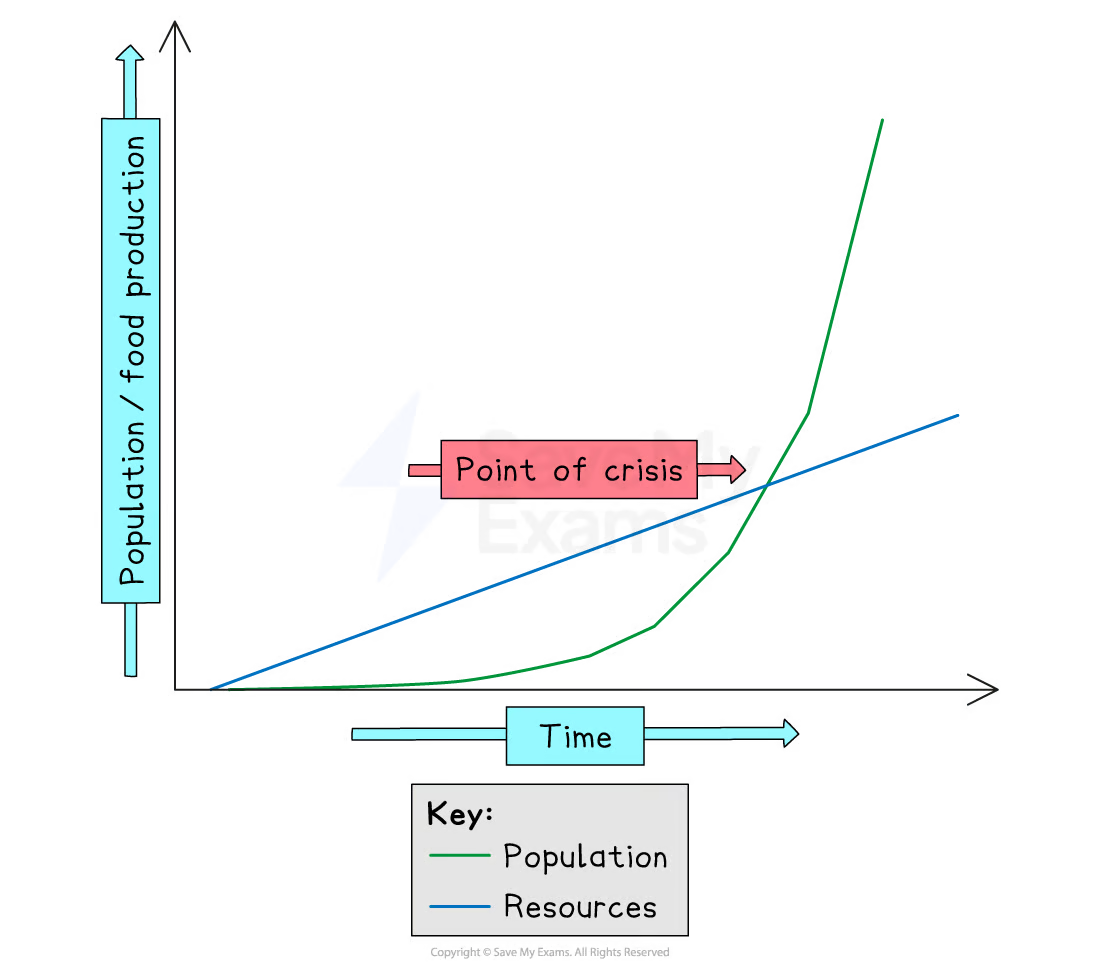
Graph illustrating the "point of crisis" where the green population line exceeds the blue resources line over time; includes labelled axes and key.
Graph showing Malthus Theory

The graph above illustrates the theory developed by Thomas Malthus. In 1798, his “Essay on the Principle of Population” outlined the relationship between population and resources, birthing the well-known Malthusian Theory.

Define the concept of exponential growth.

5b
1 mark

Describe what occurs at the Point of Crisis in Malthusian Theory

5c
1 mark

Describe ONE negative check outlined by Thomas Malthus

5d
1 mark

 Explain ONE criticism of Malthusian Theory

5e
1 mark

 Explain ONE way in which high population rates impact carrying capacity

5f
1 mark

Explain how anti-natalist policies affect population growth

5g
1 mark

 Explain the degree to which agricultural innovation contradicts Malthusian Theory

6a
1 mark
Map illustrating the transatlantic slave trade with arrows between Africa, Europe, and North America, accompanied by captions explaining the trade of goods and enslaved people.
Triangle trade

Referring to the map above, depicting the migration of slaves in the 16th century, describe the triangle trade system

6b
1 mark

Define the concept of forced migration.

6c
1 mark

Explain ONE other cause of forced migration.

6d
1 mark

Outline ONE idea that Ravenstein’s Laws of Migration attempted to explain .

6e
1 mark

Describe ONE of Ravenstein’s Laws of Migration.

6f
1 mark

Explain how the creation of ethnic enclaves leads to the host nation becoming more culturally diverse.

6g
1 mark

Explain the relationship between migration and diffusion.