Development & Human Welfare (Edexcel IGCSE Geography): Exam Questions

Exam code: 4GE1

1 hour20 questions
1a
Sme Calculator
1 mark

Study Figure 13a which gives the population of the continents in 2015 and forecasts for 2100. 

Which one of the following continents had the largest population in 2015? 

q13a-june-2017-edexcel-igcse-geography
  • North America

  • Africa

  • Asia

  • Europe

1b
Sme Calculator
2 marks

Describe the trends in the rate of population growth by 2100. 

2
Sme Calculator
1 mark

Identify the meaning of the term quality of life

  • a person’s well-being in terms of health and happiness 

  • a person’s level of deprivation 

  • a person’s cultural identity 

  • a person’s type of employment and income level 

3a
1 mark

Identify one factor that could be used as a measure of development. 

  • participation in sport 

  • water availability 

  • index of political corruption 

  • bottom-up development 

3b
Sme Calculator
1 mark

Define the term water security

4a
1 mark

Identify the meaning of the term fertility rate

  • the number of live births per thousand of population per year 

  • the number of deaths in a particular population 

  • the number of births in the total population 

  • the number of births per woman in a population 

4b
Sme Calculator
2 marks

Study Figure 9b .

Calculate the range in infant mortality for South Asia between 1960 and 2012. 

You must show all your workings in the space below. 

fig-9b-4ge1-02r-june-2019-edexcel-igcse-geography
5
1 mark

Identify one social indicator of development.

  • carbon emissions per capita

  • gross domestic product

  • gross national product

  • literacy rate

6
1 mark

Identify the definition of gross domestic product (GDP).

  • a measure of development including health and income

  • a measure of improvement in inequality

  • the total value of all imports within a country in a year

  • the total value of goods and services produced by a country in a year

7
1 mark

Identify the best definition of infant mortality rate.

  • number of deaths before age 1, per 1,000 live births in a month

  • number of deaths before age 1, per 1,000 live births in a year

  • number of deaths before age 5, per 1,000 live births in a year

  • number of deaths before age 5, per 1,000 live births in a month

8a
2 marks

Study Figure 9b.

Line graph showing GDP trends from 1990 to 2020 for Australia, Indonesia, Poland, Chile, and Ghana in US$ trillions, with notable growth in Australia and Indonesia.

Calculate the range in gross domestic product (GDP) for Australia from 2000 to 2020.

You must show all your workings in the space below in US$ trillions.

8b
2 marks

Describe a trend shown.

9
1 mark

State two ways of measuring inequality.

10
2 marks

State two quality of life indicators other than GDP per capita.

1
4 marks

Outline the difficulties of measuring development.

2a
2 marks

Study Figure 9a.

World map showing life expectancy in 2022, with countries colour-coded: white for ≤58, yellow 59-65, blue 66-73, red 74-82, black 83+ years.

Identify two labelled countries with the highest life expectancy.

2b
4 marks

Suggest two reasons for the pattern shown in Figure 9a.

3a
2 marks

Study Figure 9a.

Map of southern Africa showing regional Human Development Index scores for 2022, ranging from 0.34 to 0.82, with a colour-coded key.

Identify two labelled regions with the lowest sub-national Human Development Index (HDI).

3b
4 marks

Suggest two reasons for the pattern shown in Figure 9a.

4a
2 marks

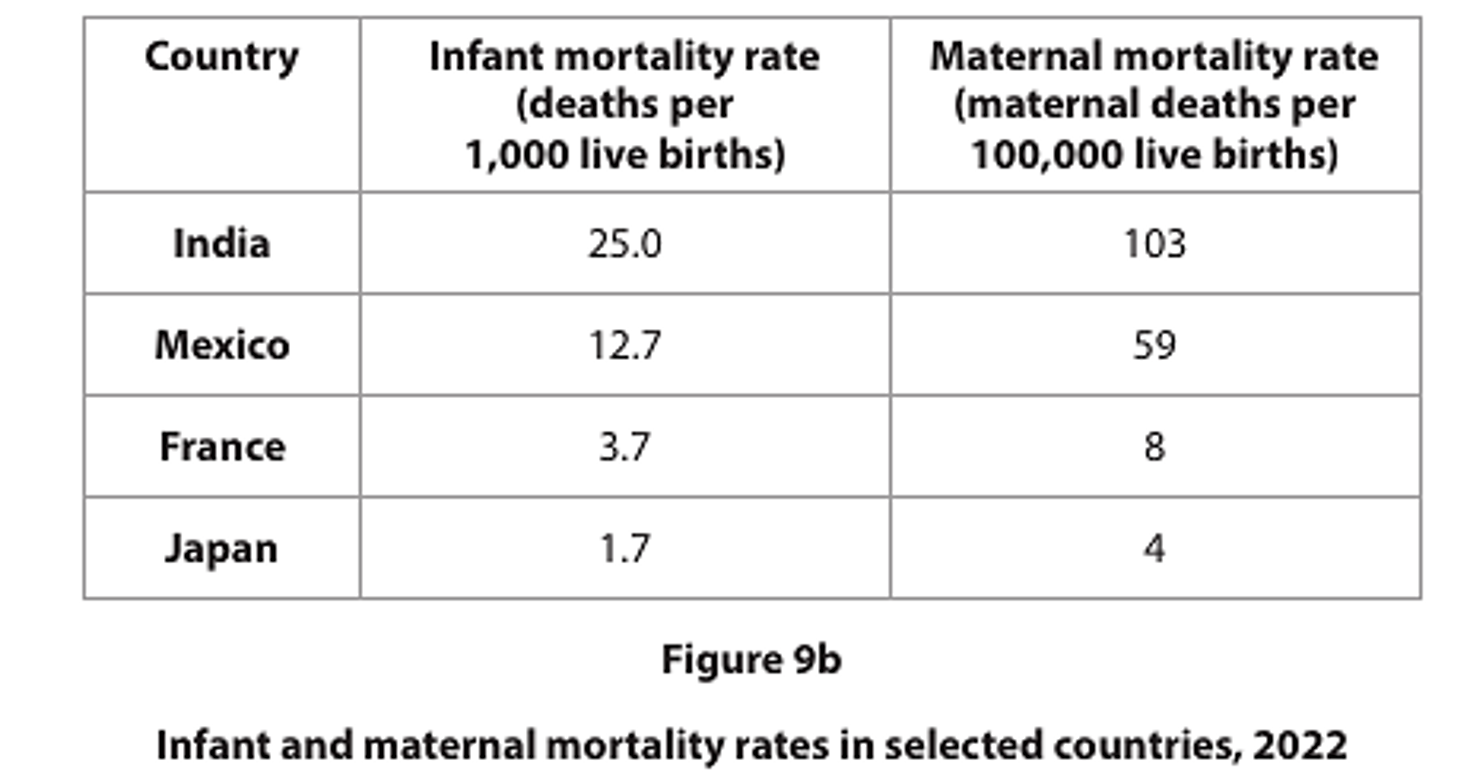
Study Figure 9b.

Table comparing infant and maternal mortality rates in India, Mexico, France, and Japan in 2022. India has the highest infant and maternal rates.

Calculate the mean infant mortality rate.

You must show all your workings in the space below.

4b
2 marks

Describe a pattern shown in Figure 9b.

5
4 marks

Explain two factors that can lead to uneven development within a country.

1
6 marks

Study Figure 9c. 

Assess the different factors that have caused variations in global development.

Table outlining causes of global inequality: climate change, food/water security, resource availability, governments, and demography with brief descriptions.
2
6 marks

Study Figure 9c.

Flowchart depicting the Human Development Index (HDI) with dimensions: health, education, and living standards, linked by respective indicators and indices.

Assess how useful the Human Development Index (HDI) is for understanding patterns of development.

You must refer to the resource in your answer.

3
12 marks

Discuss the view:

Progress in development can be best measured through economic indicators.

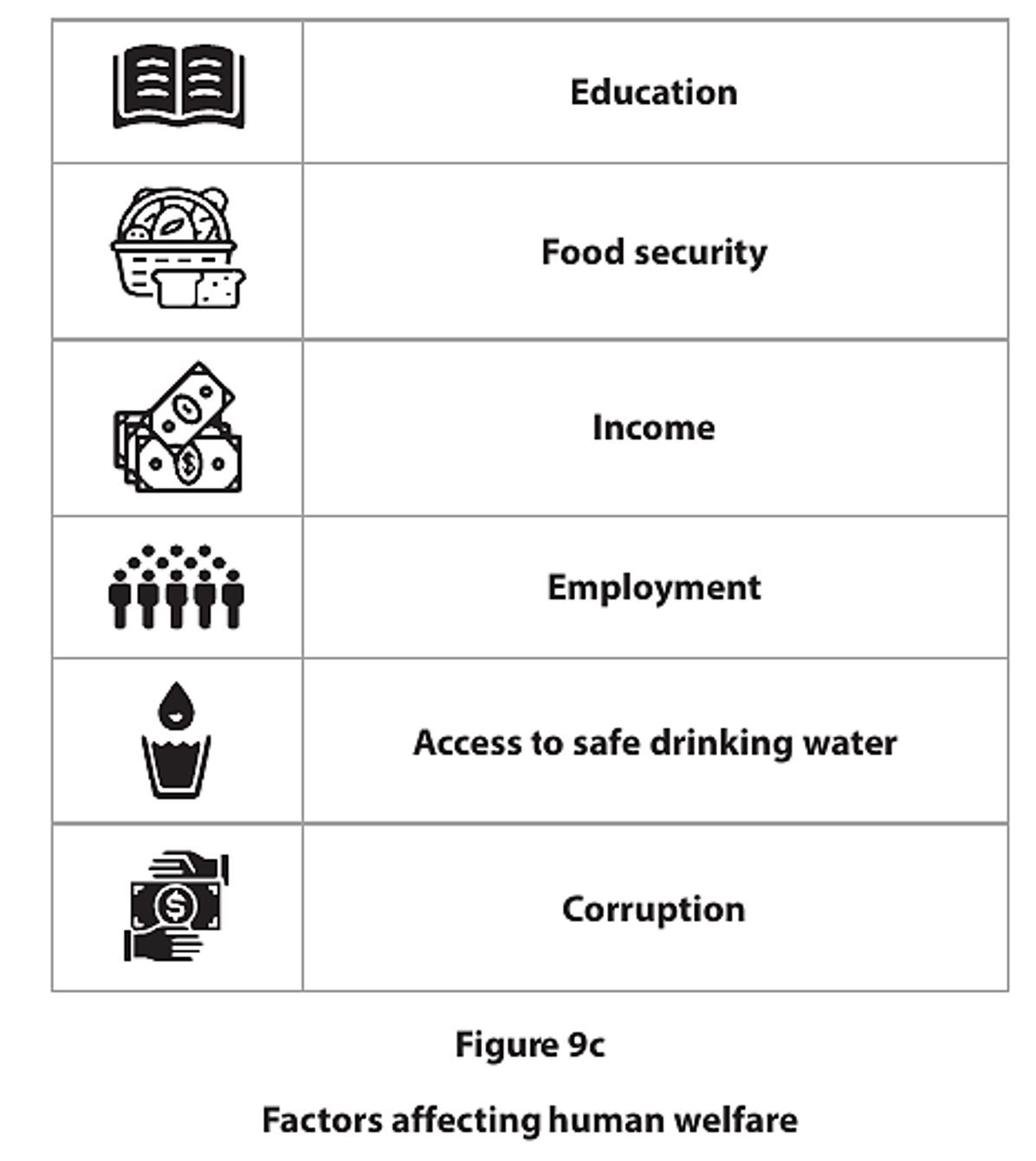
Use Figures 9b and 9c, and your own knowledge and understanding to support your answer.

You must refer to the resources in your answer.

Line graph showing GDP trends from 1990 to 2020 for Australia, Indonesia, Poland, Chile, and Ghana in US$ trillions, with Australia leading.
Table with icons and text listing factors affecting human welfare: education, food security, income, employment, access to safe water, and corruption.
4
6 marks

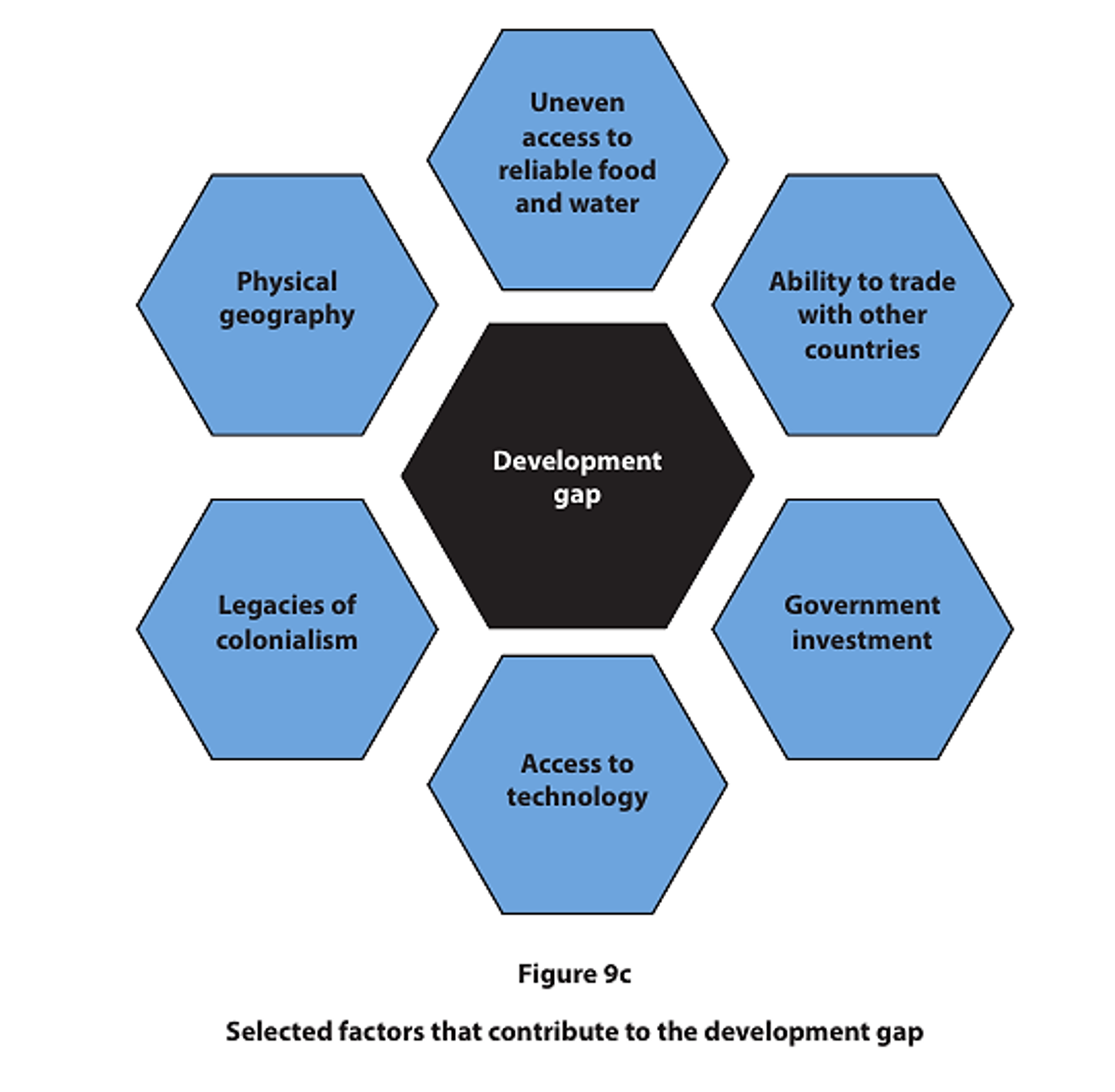
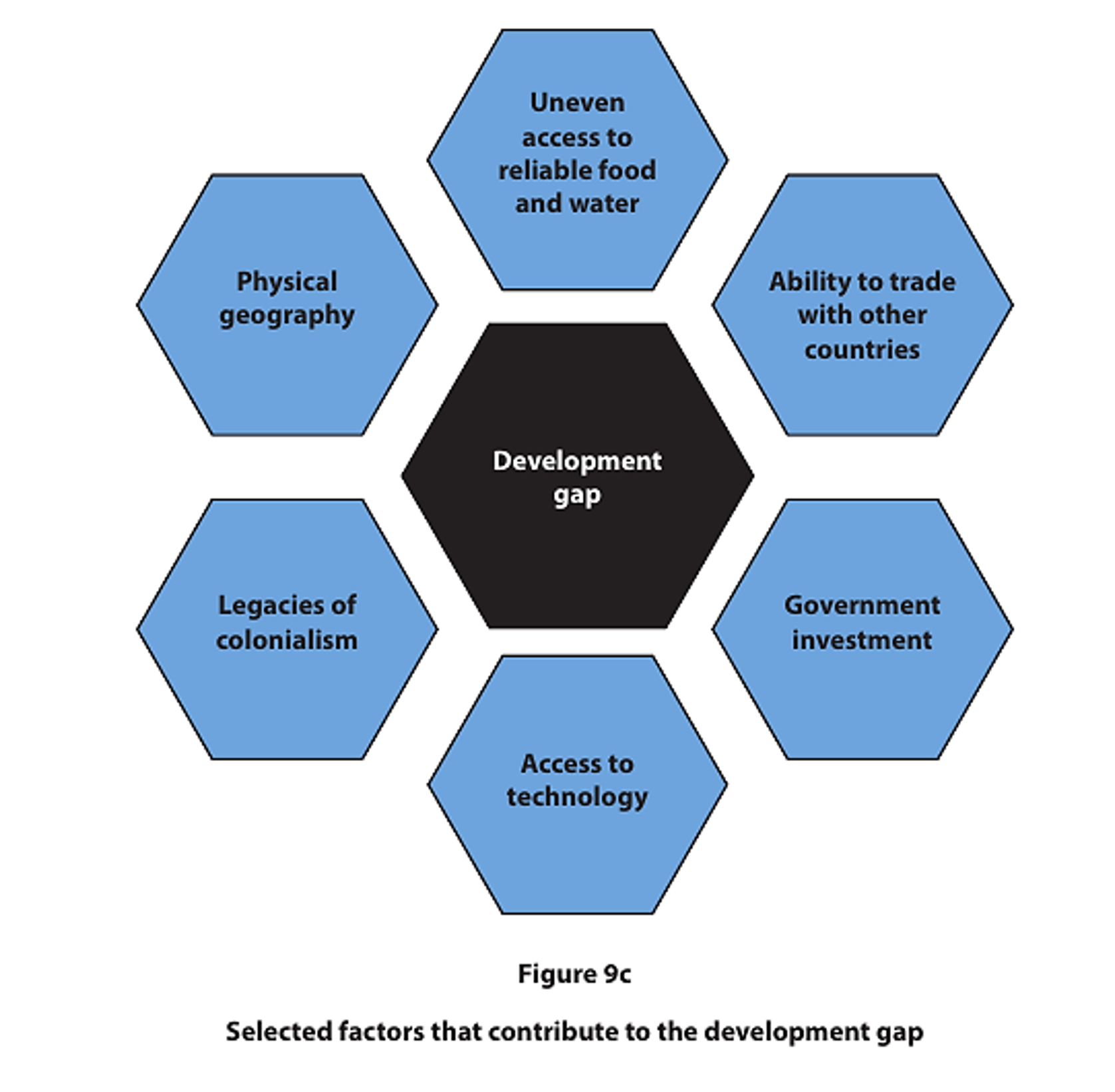
Study Figure 9c.

Hexagonal diagram showing factors in the development gap: geography, colonialism, trade ability, government investment, technology access, and food/water access.

Assess factors that have contributed to the development gap.

You must refer to the resource in your answer.

5
12 marks

Discuss the view:

Food and water security are essential for ensuring greater human welfare.

Use Figures 9b and 9c, and your own knowledge and understanding to support your answer.

You must refer to the resources in your answer.

Table showing 2022 infant and maternal mortality rates per 1,000 and 100,000 live births, respectively, for India, Mexico, France, and Japan.
Diagram of the development gap surrounded by factors: physical geography, legacies of colonialism, food access, technology, trade, and government investment.