Fusion (SQA National 5 Physics): Revision Note
Exam code: X857 75

Fusion
Nuclear fusion is defined as:
The process where two small nuclei combine to form a larger nucleus
Fusion of two nuclei

Massive amounts of energy are released in the process of nuclear fusion
Far more energy than fission or any chemical reaction for a similar mass of reactants
Examiner Tips and Tricks
Take care to spell 'fusion' correctly in the exam.
Examiners will not accept misspellings such as 'fussion' because it is not clear whether the word is 'fusion' or 'fission'.
Conditions of nuclear fusion
Nuclear fusion requires specific conditions:
Extremely high temperatures
Extremely high pressures
Plasma must be contained
Stars, like the Sun, have the required conditions for fusion reactions
Stars use nuclear fusion reactions in their core to release energy
Smaller hydrogen nuclei are combined to form larger helium nuclei, releasing massive amounts of energy in the process
Plasma containment
Plasma is the name given to extremely hot, electrically charged gas
In a fusion reaction, the plasma consists of small nuclei (such as isotopes of hydrogen)
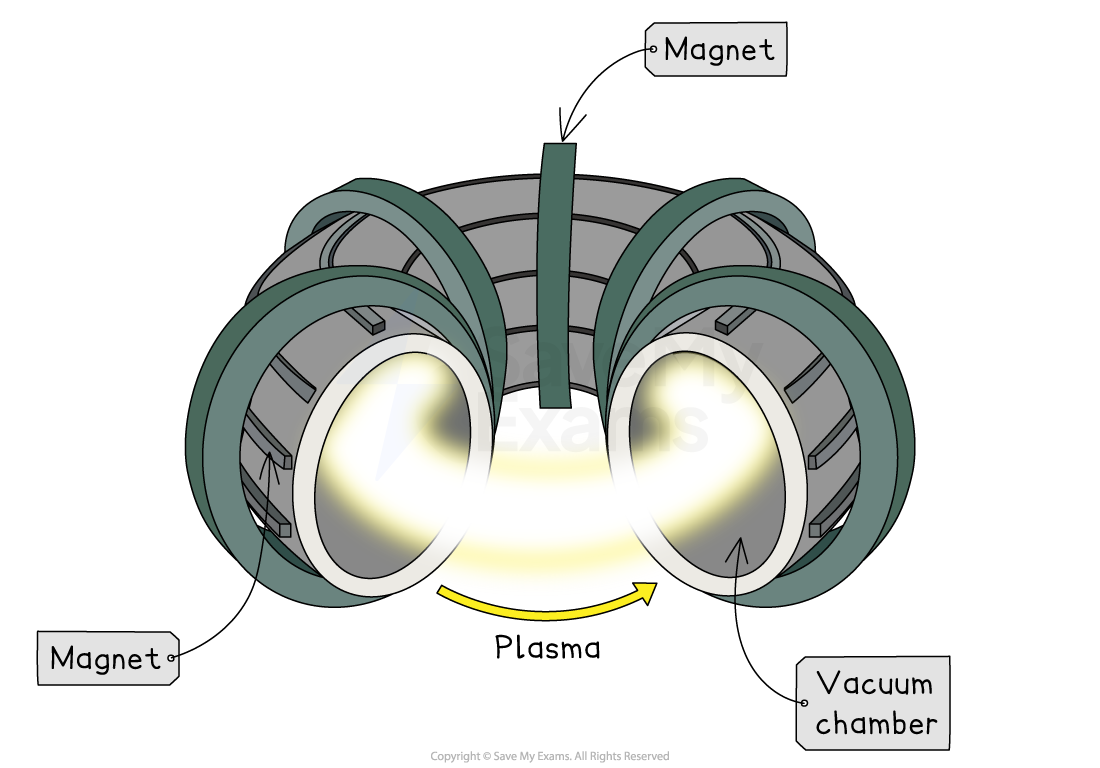
To keep the plasma hot enough for fusion, it cannot touch the sides of the fusion reactor, or it will cool down
Since the plasma is charged, its motion is controlled using magnetic fields
The plasma must be contained in this way long enough for fusion to occur
A plasma containment fusion reactor
Fusion and energy production
It is theoretically possible to produce a fusion reactor that could be used to generate electricity
This technology could potentially solve the world's energy crisis
Currently, the longest sustained fusion reaction was 20 minutes
Scientists are working on fusion, but it is not yet a viable way to produce electricity
Worked Example
Describe two difficulties in sustaining nuclear fusion in a reactor.
Answer:
Any two from:
Nuclear fusion requires extremely high temperatures which are difficult to reach on Earth / require a lot of energy to sustain
The plasma is difficult to control with magnets to keep it away from the walls of the reactor in order to maintain the high temperature
Fusion requires strong magnetic fields to contain the plasma
Fusion requires extremely high pressures, which are difficult to reach / maintain on Earth

Unlock more, it's free!
Join the 100,000+ Students that ❤️ Save My Exams
the (exam) results speak for themselves:

Was this revision note helpful?