Challenges of Space Travel (SQA National 5 Physics): Revision Note
Exam code: X857 75

Challenges of space travel
Space travel poses several challenges, including:
travelling large distances by using as little fuel as possible
manoeuvring a spacecraft in a zero-friction environment
maintaining sufficient energy to operate life support systems
Ion propulsion
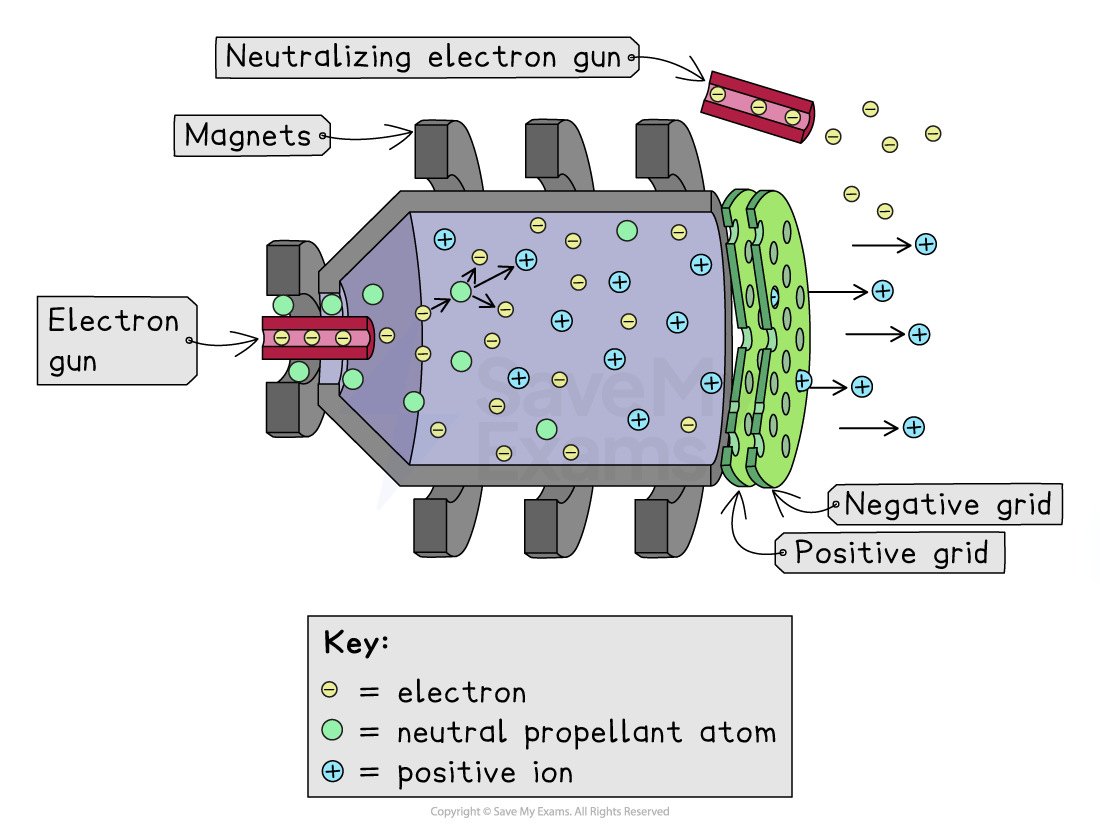
Ion drives are an advanced propulsion method that uses electric fields to accelerate charged particles (ions)
This produces a small, unbalanced force (thrust) that acts over an extended period of time
How it works:
Ions are produced by bombarding a gas or plasma with electrons
The ions are accelerated between positively and negatively charged metal grids
The ions are ejected backwards at very high speed, creating forward thrust (from Newton’s third law)
Electrons are released to neutralise the exhaust, preventing a build-up of charge
Benefits:
Very high fuel efficiency, as only a small mass of propellant is required
Enables spacecraft to travel very long distances
Limitations:
Can only be used in the vacuum of space, as it is not powerful enough for launching from Earth
An ion drive used for space travel
Gravitational slingshot
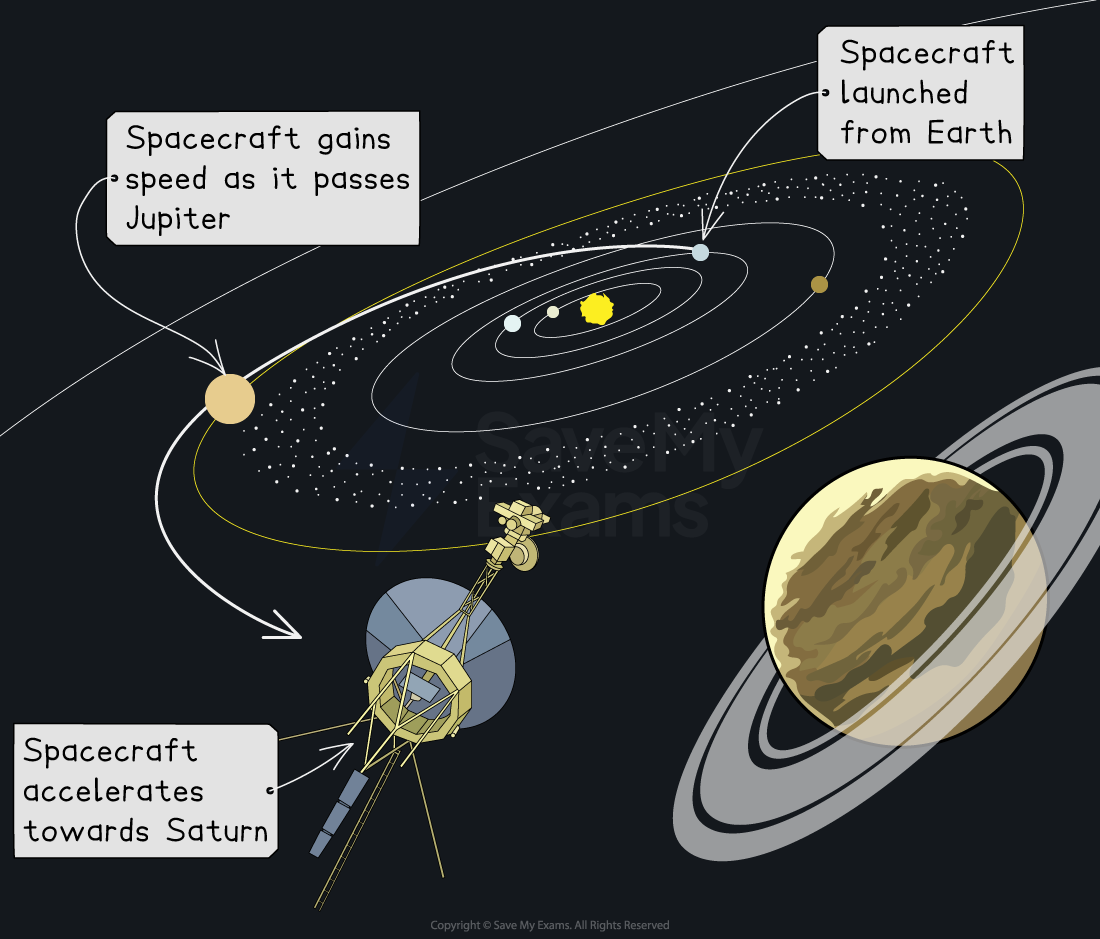
A gravitational slingshot, or gravity assist, is a manoeuvre where a spacecraft uses the gravitational pull of a fast-moving planet, moon, or asteroid to change its speed or direction
How it works:
As the spacecraft approaches the planet’s gravitational field, it accelerates towards it
As it passes the planet (in the direction of its orbit), the spacecraft is flung forward, gaining kinetic energy and changing direction
The planet loses the same amount of kinetic energy, but due to its massive size, this has no noticeable effect on its speed
Benefits:
Saves fuel and time, reducing the need for on-board propulsion
Enables missions to reach the outer planets of the solar system
Using gravity assist to reach the outer solar system
Manoeuvring in space
In space, there is no air resistance or friction, which means:
spacecraft will travel at constant velocity (Newton’s first law), even when the engines are switched off
an unbalanced force must be applied to change the spacecraft's speed or direction
This makes manoeuvring in space very difficult
For example, if a spacecraft wants to dock with the ISS
It must slow down or change direction very carefully
This requires using an ion drive to produce small forces in the opposite direction to its motion
Astronauts are also fitted with propulsion devices for manoeuvring during spacewalks
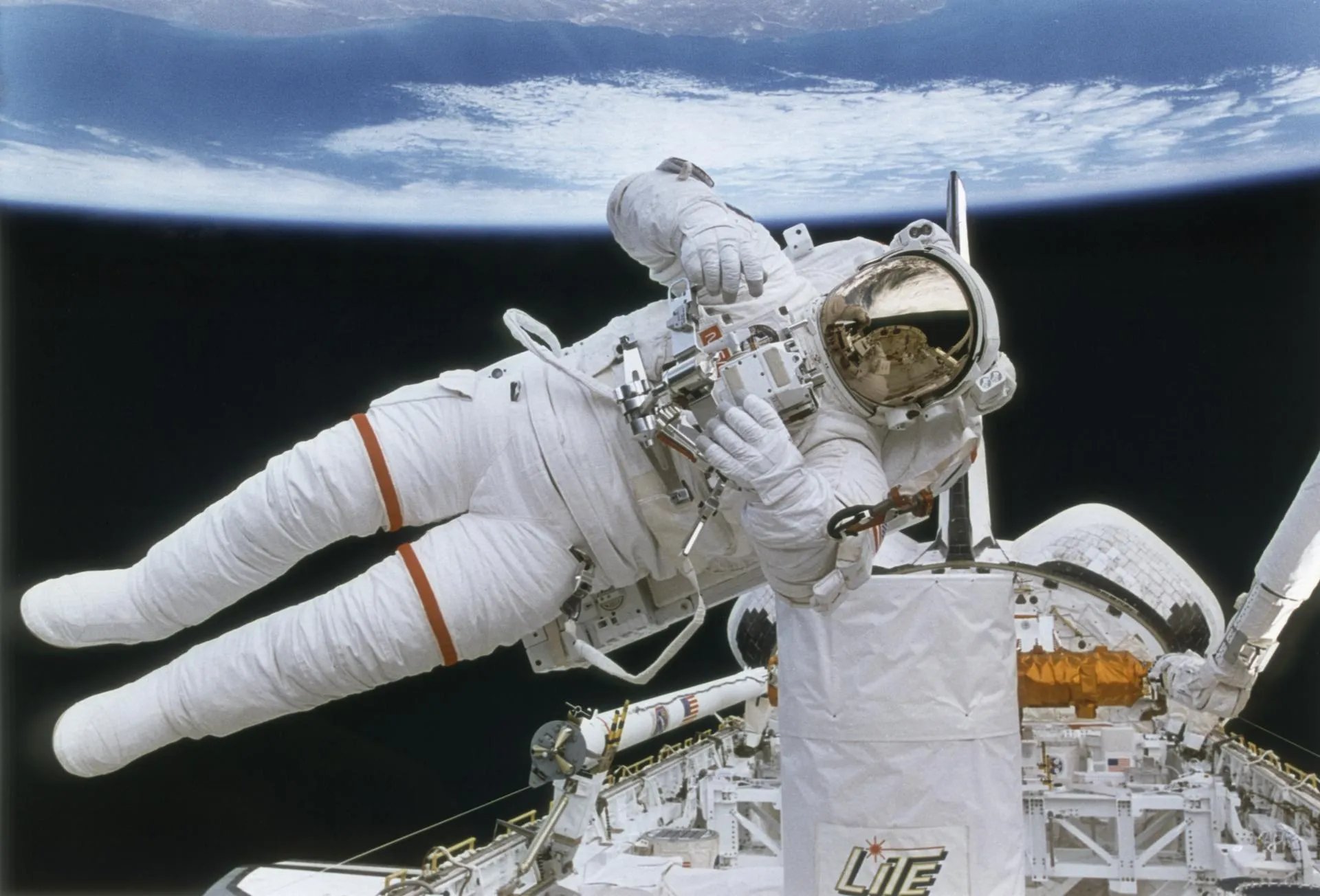
Photo credit: NASA (opens in a new tab)
Supplying energy in space
Spacecraft require a continuous supply of energy to power:
life support systems
instruments that collect information in space
communication systems to send information back to Earth
This energy can be obtained using solar cells, which use energy from the Sun to generate electricity
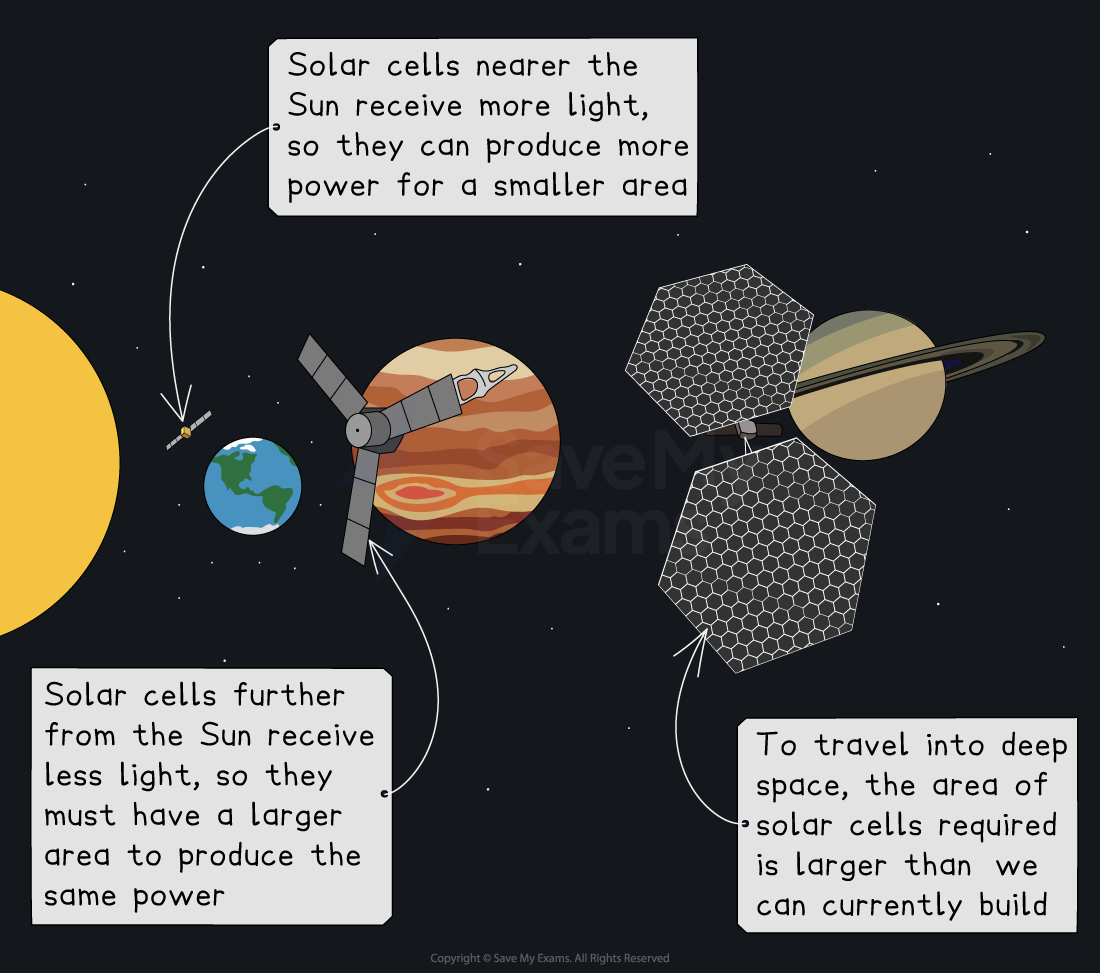
The light available to a solar cell depends on
the distance from the Sun
the area of the solar cell
Individual solar cells can be combined to create solar panels and arrays, increasing the total area which can receive light
The further a spacecraft moves from the Sun, the greater the area of cells required to generate the same power
Benefits:
Solar cells can generate electricity continuously in space
For spacecraft which are close to the Sun (e.g. satellites orbiting the Earth), the power generated by solar cells is sufficient for powering life support systems
Limitations:
Solar arrays with very large areas are required to travel to distant parts of the solar system
The furthest a solar-powered spacecraft has gotten today is the orbit of Jupiter (NASA's Juno spacecraft (opens in a new tab))
It may not be feasible for solar-powered spacecraft to travel beyond Jupiter without further developments in solar technology
Variation of solar cell area with distance from the Sun

Unlock more, it's free!
Join the 100,000+ Students that ❤️ Save My Exams
the (exam) results speak for themselves:

Was this revision note helpful?