Analyse Questions (AQA A Level Business): Revision Note
Syllabus Edition
First teaching 2023
Last exams 2027
Exam code: 7132

How to answer analyse questions
Analyse questions appear in Section B of Paper 1, within each section of Paper 2 and in Questions 1 and 2 of Paper 3
The standard format is 9 marks
A less common 6-mark format ("Analyse one way...") also appears occasionally in Paper 2
A 12-mark format appears in Questions 1 and 2 of Paper 3 only
They are marked using a Level of Response mark scheme
Examiners assess the overall quality of the answer, not individual points
Analyse questions test knowledge, application and analysis
Evaluation is not required and will not earn additional marks
How level of response marking works
Analyse questions are not marked point by point
The examiner reads the whole answer, decides which level it best fits, then awards a mark within that level
This means:
a long answer full of basic points will score lower than a shorter answer with fewer, well-developed points
writing more does not automatically mean scoring more
the quality of reasoning matters more than the quantity of content
The demands of the question
Every analyse question has specific demands
These are what an answer must do to reach Level 3
Demonstrating understanding of the key concept or theory in the question
Analysing the cause and effect relationship in the context of the specific business
Before writing, identify what the question is actually asking
E.g. An answer to "Analyse one reason why AJS plc has decided to become more capital intensive" must explain both what capital intensity means and why the specific situation at AJS plc — using evidence from the data — would lead to that decision
An answer that explains capital intensity without connecting it to the AJS data cannot reach Level 3
How to build a chain of analysis
The key skill in an analyse question is building a chain of reasoning that moves from a cause through to a consequence:
Point → Explanation → Link to context → Effect → Further consequence
Worked Example
For a 6-mark "Analyse one way" question, you should resist the temptation to make multiple points
One single point, fully developed and applied to context, will reach Level 3
A second undeveloped point adds nothing and wastes time
Analyse one reason why AJS plc has decided to become more capital intensive.
[6 marks]
AJS plc's labour turnover rate of 15% [LINK TO CONTEXT] is significantly higher than the industry average [POINT] of 4% [LINK TO CONTEXT], suggesting the business is struggling to retain workers [EXPLANATION]. High turnover increases recruitment and training costs and may disrupt production continuity [EFFECT]. Replacing labour with capital-intensive machinery would reduce the business's dependence on a workforce that is proving costly [LINK TO CONTEXT] and unreliable to maintain [FURTHER CONSEQUENCE].
This chain earns marks as follows:
Clear understanding of what labour turnover means (knowledge)
Use of the specific data from the stimulus (application)
A logical chain of reasoning from the problem to the decision (analysis)
Although brief, this answer is likely to achieve 6 marks
Worked Example
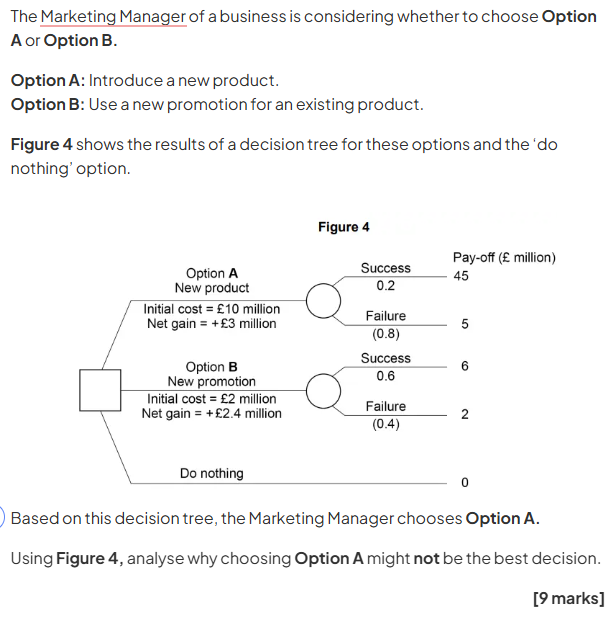
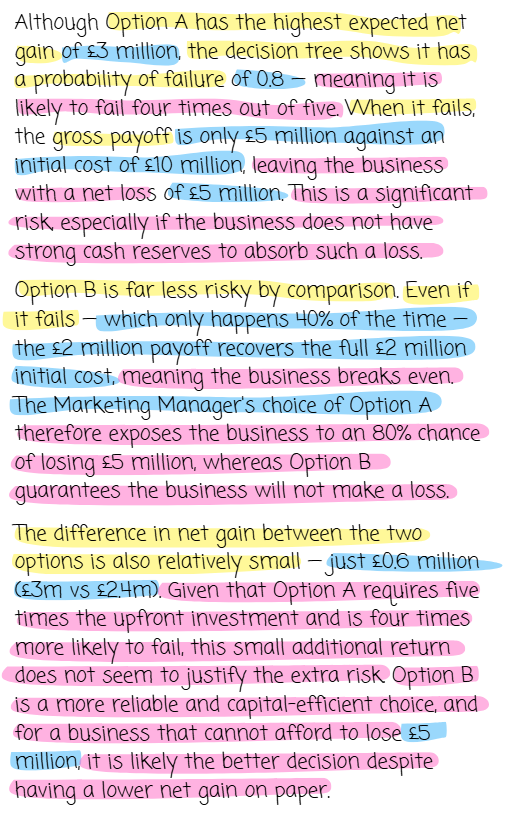
An example 9-mark response

Examiner Tips and Tricks
Common mistakes
Listing points without developing them
Three bullet points with no chains of reasoning will not progress beyond Level 1
Describing rather than analysing
Explaining what something is without explaining what effect it has on the business
Ignoring the context
Writing a general textbook answer without referring to the business scenario will not exceed Level 2
Adding evaluation
Judgemental words such as "however" or "on the other hand" are not penalised, but evaluation is not rewarded in analyse questions - time is better spent developing the analysis
Misreading "Analyse one way" - in 6-mark questions, writing about multiple impacts when only one is required dilutes the depth of the answer
Tips for success in analyse questions
Read the question carefully and identify its specific demands before writing
What concept must you demonstrate, and what must you explain about the business?
For a 12-mark question, aim for two or more well-developed analytical chains
The mark scheme expects both depth and range for Level 3
For a 9-mark question, aim for two well-developed analytical chains rather than three or four undeveloped points
Depth scores higher than breadth at Level 3
For a 6-mark "Analyse one way" question, choose your strongest point and develop it fully - and stop there
Always use evidence from the stimulus
A specific figure, a named detail from the case, or data from an appendix - this is what separates Level 2 from Level 3
There are no marks for evaluation in an analyse question
A justified conclusion is not needed and should not be written
Level descriptors
9-Mark analyse questions
Two well-developed points should be made
Both depth and range are needed for Level 3
Level | Marks | What the examiner is looking for |
|---|---|---|
Level 3 | 7–9 |
|
Level 2 | 4–6 |
|
Level 1 | 1–3 |
|
6-Mark analyse questions
One well-developed point needs to be made
The depth of one point is sufficient for Level 3
Level | Marks | What the examiner is looking for |
|---|---|---|
Level 3 | 5–6 |
|
Level 2 | 3–4 |
|
Level 1 | 1–2 |
|
12-Mark analyse questions
Two or more well-developed points are needed
Both depth AND range are required for Level 3
Level | Marks | What the examiner is looking for |
|---|---|---|
Level 3 | 9–12 |
|
Level 2 | 5–8 |
|
Level 1 | 1–4 |
|

Unlock more, it's free!
Join the 100,000+ Students that ❤️ Save My Exams
the (exam) results speak for themselves:

Was this revision note helpful?