Evaluate Questions (AQA A Level Business): Revision Note
Syllabus Edition
First teaching 2023
Last exams 2027
Exam code: 7132

How to answer evaluation questions
What is an evaluate question?
Evaluate questions carry the most marks on the AQA A-Level Business paper and require a balanced argument with a justified judgement. They appear in three versions:
16 marks — Paper 2 (every section) and Paper 3 (Q3, Q4)
20 marks — Paper 3 Q5 only; always includes a data appendix requiring quantitative analysis
24 marks — Paper 3 Q6 only; synoptic, requiring wider business knowledge beyond the case study
Common command phrases
"To what extent..." (most common)
"Would you advise...? Justify your view"
"Evaluate whether..."
How marks are allocated
Assessment Objective | What it means | 16 | 20 | 24 |
|---|---|---|---|---|
Knowledge |
| 2 | 4 | 5 |
Application |
| 3 | 3 | 4 |
Analysis |
| 4 | 5 | 6 |
Evaluation |
| 7 | 8 | 9 |
Evaluation carries the most marks in every version. Most students lose marks here by describing facts, asserting a view without reasoning, or saving all judgement for the final sentence.
Levels of response
Examiners don't mark point-by-point - they read the whole answer and decide which level it best fits
The 16-mark question uses 4 levels; the 20- and 24-mark questions use 5
Top band (L4 on 16-mark, L5 on 20/24) — Precise, well-selected knowledge; well-developed analysis applied throughout; balanced arguments; judgements built on analysis with clear focus throughout
Level 4 (20/24 only) — Same qualities as top band, achieved less consistently
Level 3 — Either limited range with good depth or wide range with limited depth; judgements linked to analysis but lack balance
Level 2 — Limited range and depth; mainly descriptive; judgements with weak links to analysis
Level 1 — Isolated or imprecise knowledge; little analysis; judgements based on assertion
The key difference between Level 3 and the top bands is balance and sustained evaluation
Top answers build judgement throughout, not just in the final paragraph.
How to structure an evaluate answer
There is no single formula, but a strong evaluate answer will:

Open with a clear position — identify the key issue and signal the approach
Develop 2–3 arguments in favour — each as a chain of analysis applied to the business
Develop 2–3 counter-arguments — with equal rigour; don't dismiss the other side
Evaluate throughout — weigh arguments as they are made, not only at the end
Conclude with a supported judgement — a direct, reasoned answer to the question based on the strongest evidence
Format-specific notes
16-mark
4–5 well-developed paragraphs with a clear conclusion; build evaluation into every paragraph
20-mark
5–6 paragraphs; explicitly calculate or interpret the appendix data, don't just mention it
24-mark
5–6 paragraphs with a defended position; reference the case study business but also draw on wider business examples (small vs large, public vs private, profit vs social enterprise) and link across different areas of the specification
Worked Example
Nari
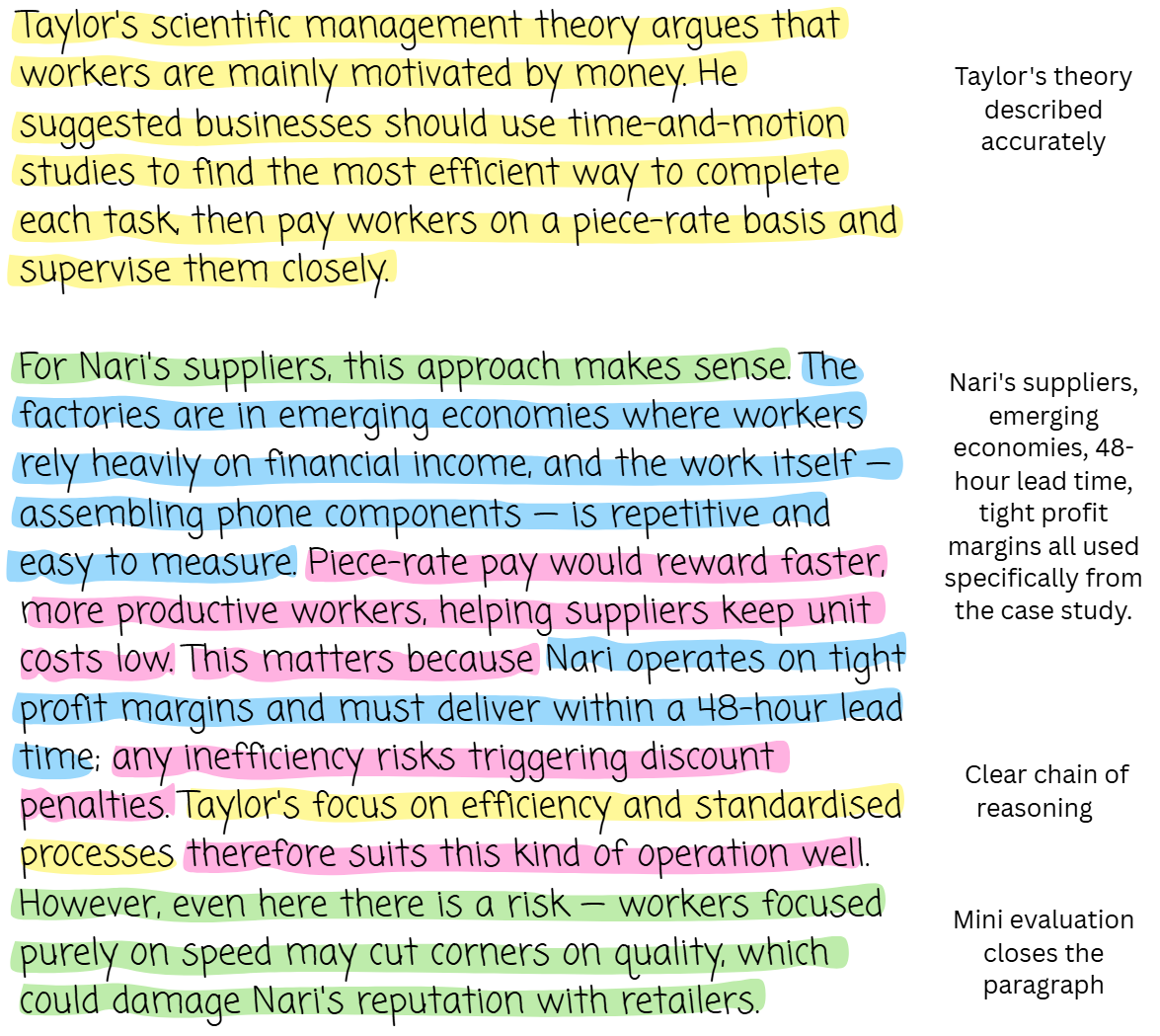
Nari is a mobile phone manufacturer based in Asia. Although its brand name is not as strong as the Apple iPhone, Nari’s phones sell at much lower prices, which make them competitive. Nari adds new features to its phones and develops new models every few months. The company has an objective of 95% of sales from products launched in the last year. It has relatively low profit margins but high sales volumes.
To win business, Nari promises the retailers that sell its phones a lead time of 48 hours; any delay results in a major discount for the retailers on the products they have ordered.
To achieve low prices and still be profitable, the company focuses on being more efficient than its rivals. The company has a ‘just-in-time' approach to manufacturing. It has a global supply chain with hundreds of different component suppliers based in more than 50 countries. These components are delivered using a variety of transportation methods every few hours from all over the world to its assembly factories in China.
Some of Nari’s suppliers have factories based in emerging economies. The managers of a number of these suppliers use Taylor’s motivation theory to motivate their employees.
The company invests heavily in projects to help local communities where it is based. It contributes some of its profits every year to charities and provides significant finance for initiatives to protect the environment.
Nari has recently experienced protectionism in its European markets as governments have limited the number of phones it can sell in their countries.
Regional breakdown of Nari’s global sales in 2019
% | |
USA | 5 |
Asia | 55 |
Europe | 30 |
Rest of the world | 10 |
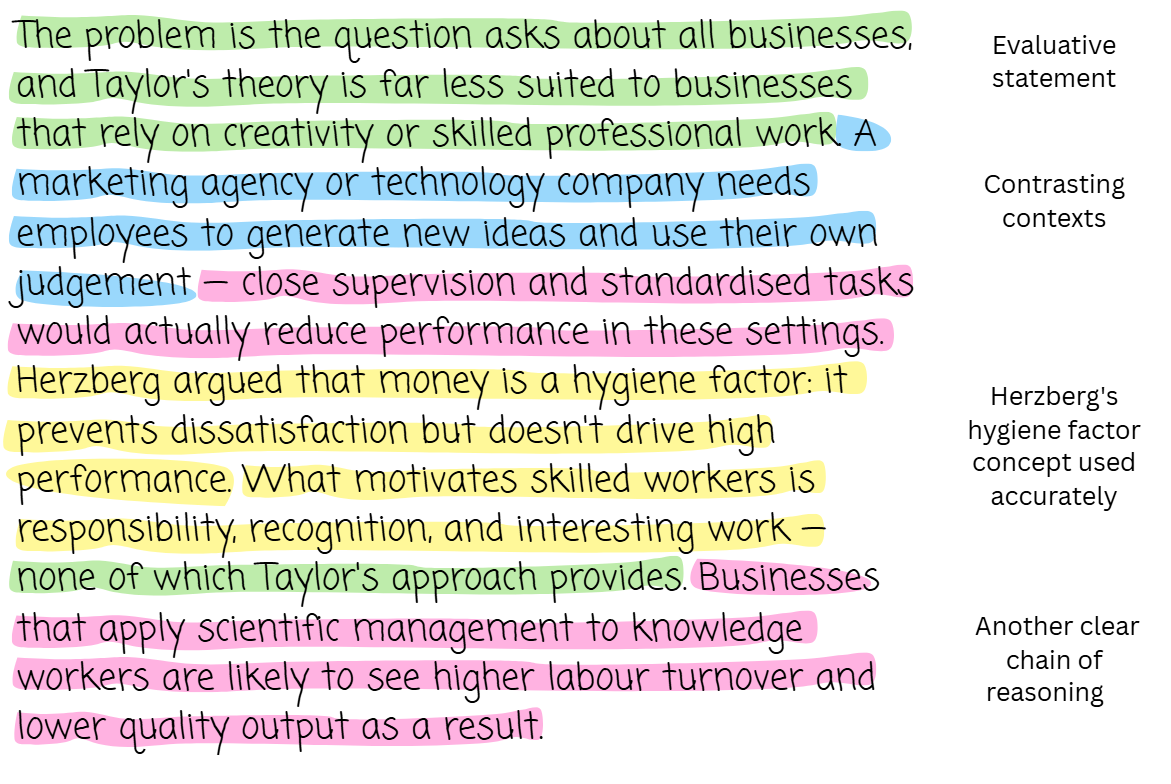
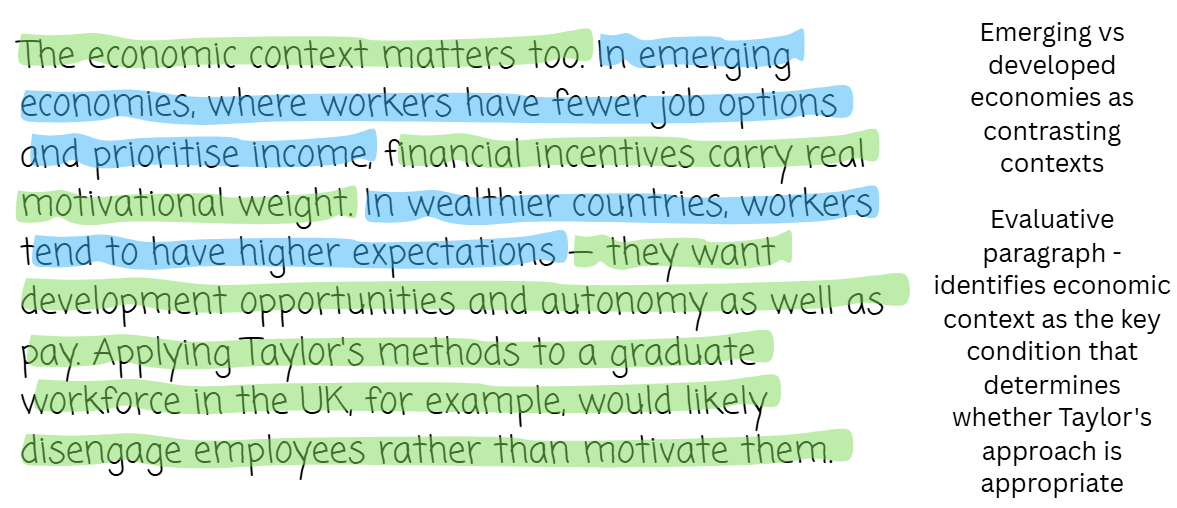
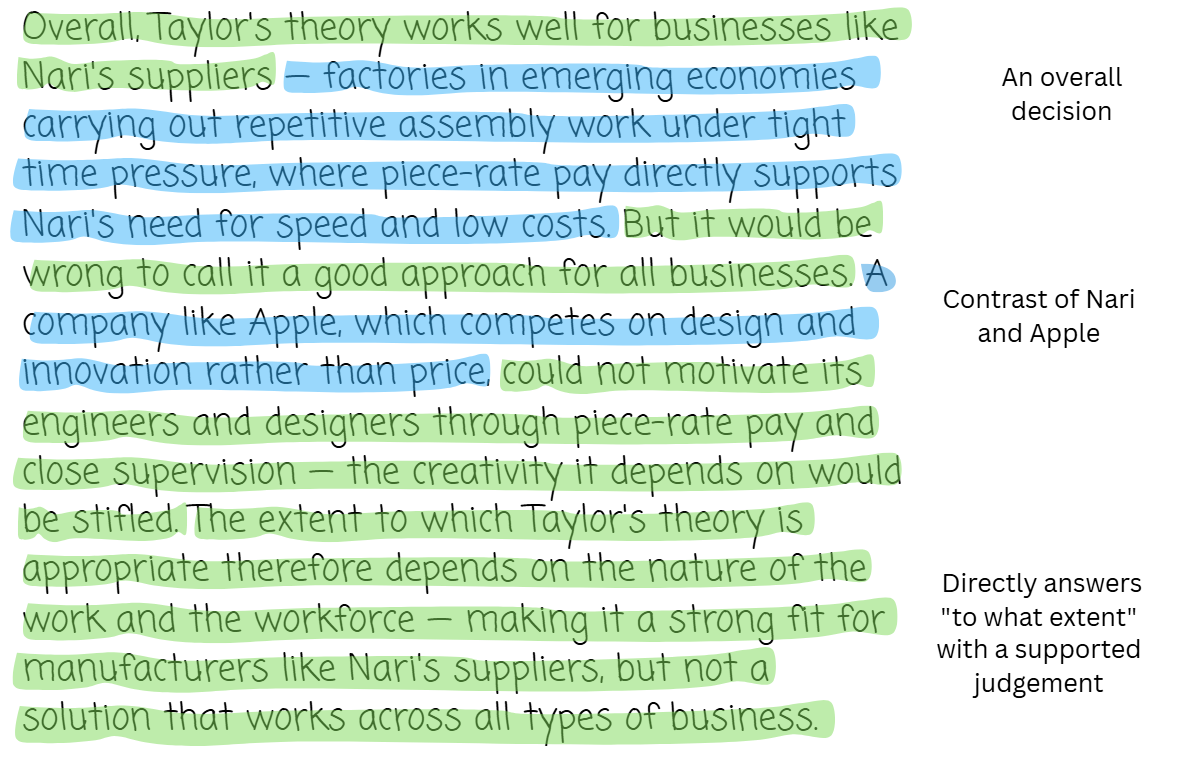
The managers of a number of Nari’s suppliers use Taylor’s motivation theory when motivating their employees.
To what extent do you think using Taylor’s theory would be a good way for all businesses to motivate their employees?
[16 marks]

Examiner Tips and Tricks
Common reasons students lose marks
Describing instead of analysing - saying "Wildroots could expand capacity" is description; showing why it would matter for profit, risk or the workforce is analysis
Asserting a view - "Wildroots should accept the contract" is not evaluation; giving a reason based on the strongest evidence is
Ignoring the data - especially in 20-mark questions; failing to engage with the appendix costs application marks
One-sided answers - even if a conclusion is clear, top marks require genuine engagement with the other side
Generic responses - particularly in Paper 3; every point must connect to the case study business
Tips for success in evaluate questions
Plan before you write
Decide two or three points on each side, note the data you will use, and settle on your conclusion before you begin
Use signpost phrases to signal evaluation clearly
"However...", "On the other hand...", "The extent to which this matters depends on...", "A more significant factor is..."
In 24-mark questions, use phrases such as "For a small business like Wildroots..., whereas for a large multinational..." to show synoptic thinking
Write your conclusion last
Make sure it directly answers the question with a clear, supported view
Sitting on the fence rarely reaches Level 4 or 5
Reread the question before you start your conclusion
Check your answer is focused on what was actually asked, not just the topic in general

Unlock more, it's free!
Join the 100,000+ Students that ❤️ Save My Exams
the (exam) results speak for themselves:

Was this revision note helpful?