Calculation Questions (AQA A Level Business): Revision Note
Syllabus Edition
First teaching 2023
Last exams 2027
Exam code: 7132

How to answer calculate questions
Calculate questions appear in Section B of Paper 1 and within Question 1 of Paper 2
They are worth 2–4 marks depending on the complexity of the calculation
All calculate questions require you to show your working
You can collect marks for a partially correct working, even if the final answer is incorrect
Types of calculations
Financial ratios and performance | Operations and HR data |
|---|---|
|
|
Investment appraisal | Financial analysis |
|
|
How marks are awarded
Calculate questions use a structured mark scheme
Marks are typically split between:
Method marks — awarded for correctly stating or applying the formula, even if the final answer is wrong
Answer marks — awarded for the correct final figure
This means if you use the right formula but make an arithmetic error, you can still score most of the available marks
The own figure rule (OFR) applies
If you carry an incorrect figure forward from one step and use it correctly in the next, you can still earn subsequent method marks
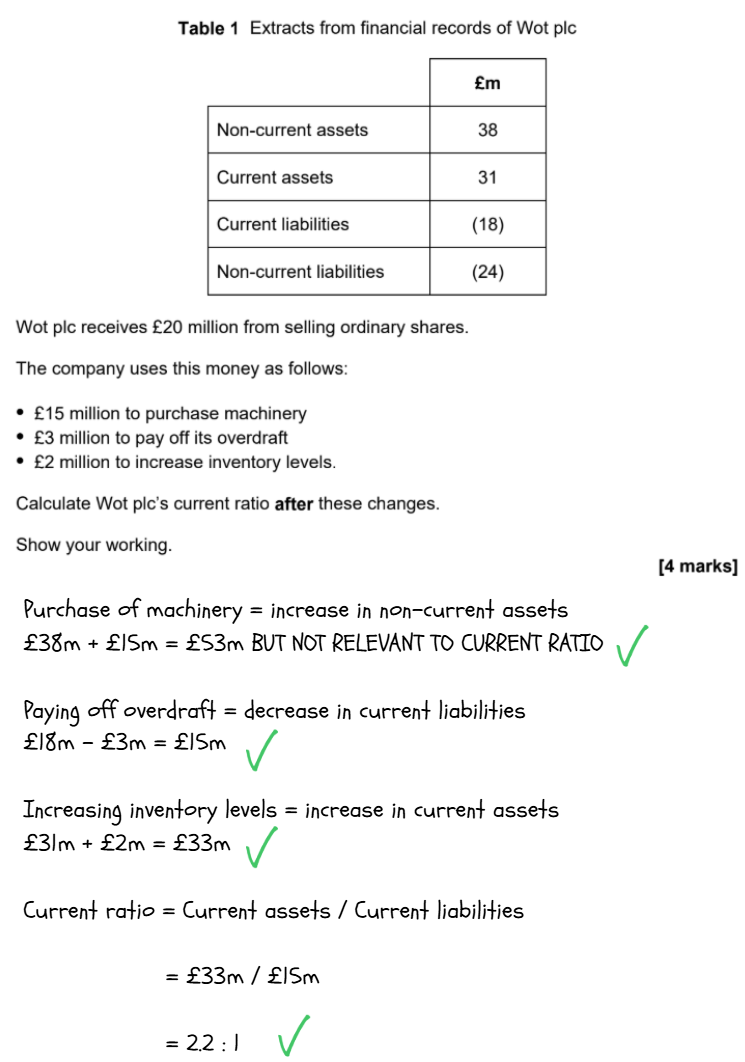
Worked Example
How to approach calculation questions
Step 1: Identify the formula
Write down the formula before substituting any numbers
This earns the method mark even if the calculation goes wrong
Step 2: Identify the correct figures from the data
Calculate questions always provide the data needed — either in a table, appendix or the question itself
Take care to use the right figures
Common errors include using revenue instead of cost of sales, or using the wrong year's data
Step 3: Substitute and calculate
Show each stage of the working clearly
Do not skip steps
A single line with only the answer gives the examiner nothing to award method marks for if it is wrong
Step 4: State the answer with units
Give the final answer clearly, including the appropriate unit — %, £, days, times or :1 for ratios
An answer without units may be penalised depending on the question
Step 5: Check the answer is plausible
A current ratio of 47:1 or a gearing ratio of 340% should prompt a recheck
A sense of whether the answer is in the right range catches arithmetic errors before they cost marks
Examiner Tips and Tricks
Common mistakes
Not showing working — a wrong answer with no working scores zero
Using the wrong figure from the data — for example, using gross profit instead of profit from operations for ROCE
Forgetting to multiply or divide by 100 when a percentage is required
Giving a ratio answer as a percentage, or vice versa
Rounding too early in a multi-step calculation, causing the final answer to be slightly off
Omitting or using the wrong units in the final answer
Tips for success in calculate questions
Always write the formula first
Even if you then make an arithmetic error, you will still earn the method mark
Use the data provided carefully
Read column headings and check which year or figure the question is asking about before you start
Show every step
Two lines of clear working are better than one line that jumps straight to an answer
Include units in your final answer
A current ratio should be expressed as, for example, 1.8:1 — not just 1.8
If you get an answer that looks unreasonable, recheck your figures rather than leaving it
A gearing ratio above 50% or a current ratio below 1:1 is not impossible, but should prompt a second look
Do not spend too long on a 2 or 3-mark calculate question
If you are stuck after a minute, write down the formula, substitute what you can, and move on

Unlock more, it's free!
Join the 100,000+ Students that ❤️ Save My Exams
the (exam) results speak for themselves:

Was this revision note helpful?